
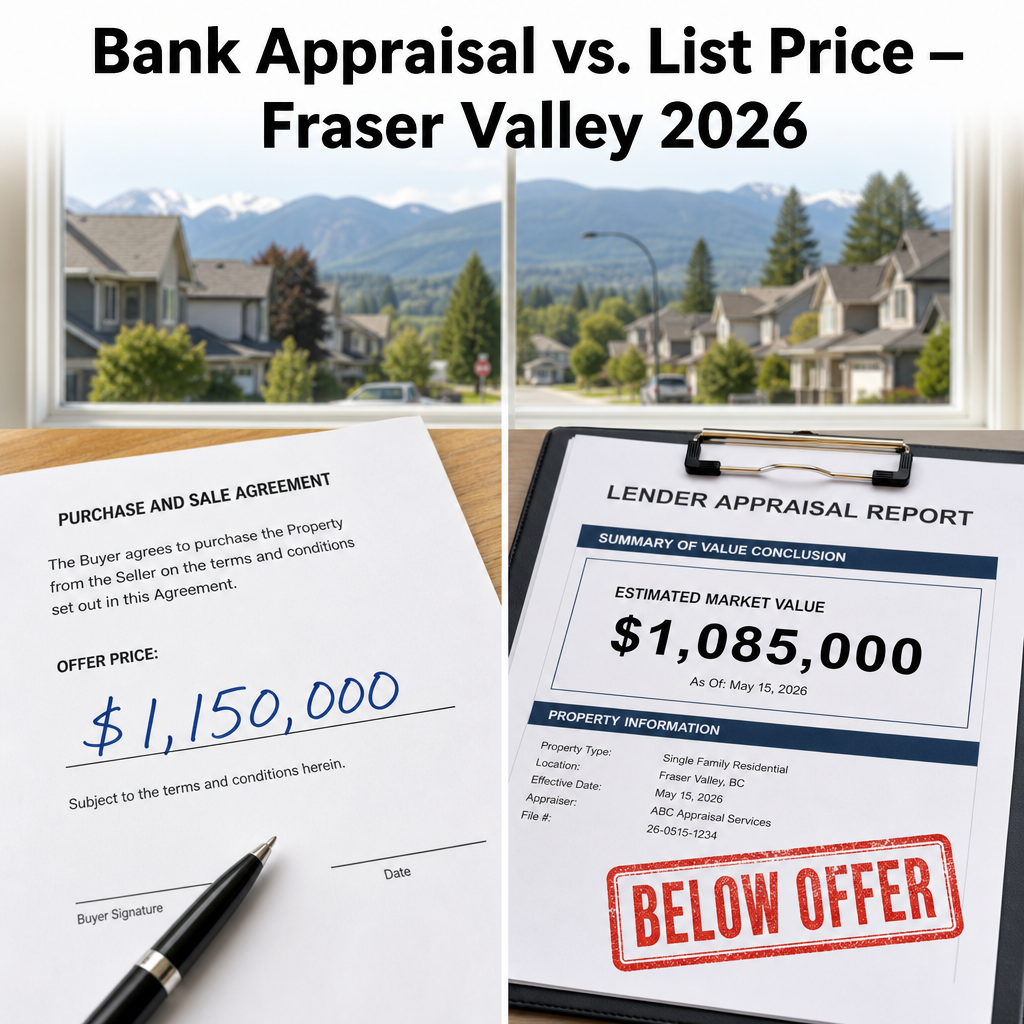

Bank Appraisal vs. List Price in the Fraser Valley 2026: Why Lender Valuations Come In Below Offer Price, How to Protect Your Position Before It Happens, and What to Do When a Buyer Uses the Gap as Leverage
By Mohamed Mansour, MBA and Associate Broker | Mansour Real Estate Group | Fraser Valley & Lower Mainland, BC | Published: May 13, 2025
For Fraser Valley sellers in 2026, an accepted offer is not a closed deal. Between acceptance and completion sits the lender's appraisal — and in today's inventory-surplus market, that appraisal frequently comes in below what the buyer agreed to pay. When it does, the renegotiation clock starts immediately. Sellers who understand why this happens, and who have positioned their property and paperwork in advance, consistently hold more of their equity than those who find out about the problem after it arrives.
This guide explains the mechanics behind appraisal shortfalls in the Fraser Valley, how sellers can reduce the risk before listing, and what a structured response looks like when a buyer uses a low appraisal to demand a price reduction.
Short Answer
In 2026's Fraser Valley buyer's market, lender appraisals come in 3–8% below offer price in roughly 25–40% of transactions, according to Mansour Real Estate Group's transaction data from 2025–2026. Lenders rely on recent comparable sales — which in a surplus-inventory market are weighted toward lower-priced closed transactions — rather than the buyer's motivations or the seller's strategic pricing. Sellers who document upgrades, challenge weak appraisals, and respond with structured counter-offers protect significantly more equity than those who simply accept the buyer's demand.
Who This Applies To
- Sellers of detached homes in Surrey, Langley, Abbotsford, White Rock, or North Delta where recent comparable sales have compressed
- Condo and townhouse sellers in buildings with aging depreciation reports or rising strata fees
- Estate executors or divorce-related sellers who accepted the first reasonable offer and want to hold the deal together without unnecessary price concessions
- Sellers in any Fraser Valley community who have accepted an offer with a financing subject clause
When This Advice May Not Apply
If a buyer is purchasing without financing — a cash deal with no subject to financing — there is no lender appraisal in the transaction. In strong seller's markets, where buyers routinely waive financing subjects, this issue surfaces less frequently. This guide is most relevant in 2026's current buyer's market conditions, where financing subjects are standard and lender scrutiny is higher.
Data Used in This Article
- Fraser Valley Real Estate Board (FVREB) — April 2026 market statistics, sales-to-active ratios, days-on-market by property type (official board data)
- BC Financial Services Authority (BCFSA) — lender appraisal guidelines and comparable sales weighting methodology (regulatory guidance)
- Mansour Real Estate Group — internal transaction data: appraisal outcome frequency and renegotiation patterns, Fraser Valley 2025–2026 (professional observation)
- Canadian Appraisal and Valuation Standards Board — residential appraisal methodology in buyer's markets (industry standards)
- BC Real Estate Association (BCREA) — property condition assessment impact on lender valuations (industry research)
Key Takeaways
- Lender appraisals are backward-looking, built from closed comparable sales — not from what a motivated buyer is willing to pay today.
- In Fraser Valley's 2026 buyer's market (approximately 11% sales-to-active ratio), comp-heavy appraisals consistently trail strategic seller pricing by 3–8%.
- Sellers who supply renovation receipts, condition documentation, and a curated comparable analysis before the appraisal reduce their exposure materially.
- Roughly 10–15% of initial low appraisals can be successfully overturned through a formal lender re-review with supplementary evidence.
- When a buyer demands a $30K–$60K price reduction, a structured counter — modest adjustment plus closing cost credits — typically preserves more net proceeds than a flat capitulation.
Why Lender Appraisals Come in Below Offer Price in the Fraser Valley
A lender's appraisal exists to protect the bank, not to validate a seller's price or a buyer's enthusiasm. The appraiser's job is to determine what the property would sell for on the open market in an arm's-length transaction — and that determination is built almost entirely on what similar properties have already sold for, not what a buyer agreed to pay last week.
In a market where supply is high and buyer activity is slow, the pool of recent closed sales — the comparables an appraiser is required to use — contains a disproportionate number of lower-priced transactions. Sellers who hold firm on pricing, who invest in presentation, or who benefit from unique features like a large lot, a view corridor, or a complete renovation are pricing ahead of the comp pool. The appraiser is working with what has closed, not what the market is capable of paying.
According to BCFSA lender appraisal guidelines, appraisers are required to support valuations with documented comparable sales, typically within the past 90 days and within a defined geographic radius. In Surrey, Langley, Abbotsford, and other Fraser Valley communities where 2026 inventory is elevated, that 90-day comp pool is populated by transactions that closed at or near list price under current buyer's market conditions — not at the strategic premiums sellers are seeking.
The gap between offer price and appraised value is not a mistake. It is a structural outcome of how lenders are required to evaluate risk in a declining or softening market. Detached homes with unique features show the widest variance because their distinguishing attributes — lot size, view, premium finishes — are harder to quantify through a straight comparable-sales approach. Condos in buildings with clean strata documents and recent depreciation reports tend to appraise more consistently, though buildings with red flags in their financials introduce a separate layer of lender concern. Sellers navigating condo and strata transactions in the Fraser Valley need to understand both dimensions.
How Sellers Can Reduce Appraisal Risk Before the Offer Arrives
The most effective appraisal protection happens before listing day, not after a shortfall arrives. A seller who has done the preparation work gives both the buyer's appraiser and the lender's review process a clearer, more defensible picture of the property's value.
Renovation documentation is the single most underused tool in Fraser Valley seller preparation. Appraisers can only credit what they can verify. A kitchen renovation without receipts, permits, or contractor records is harder to adjust for than one supported by a clear record of scope and cost. Sellers who have invested $60,000 in a kitchen and primary suite renovation should have that documentation organized and ready to provide through their listing agent before the appraisal is ordered.
Pre-listing home inspections also reduce appraisal risk. When a buyer's lender orders an appraisal and the appraiser notes deferred maintenance, mechanical concerns, or condition flags, those observations directly compress the valuation. A seller who has addressed those items, or who can demonstrate they are not material concerns, removes a significant downward adjustment from the appraiser's toolkit. The BCREA has documented the relationship between disclosed property condition and lender valuation outcomes, confirming that transparency and proactive disclosure consistently support higher appraised values.
Finally, sellers — through their listing agent — can provide a curated comparable analysis to the appraiser at the time of the appraisal visit. This is not an attempt to manipulate the process. It is a professional submission of data the appraiser may not yet have surfaced: sales that closed at higher prices, active listings that confirm demand at the seller's price point, and context about features that distinguish the property from its lower-priced comps. Appraisers are not required to use seller-provided data, but many will review it, and well-organized documentation that supports the valuation has a measurable impact on outcomes. This is part of how Mansour Real Estate Group prepares sellers for pricing and positioning a Fraser Valley home in a competitive market.
For strata properties, the preparation is different. The building's financial health — its depreciation report age, its contingency reserve fund adequacy, and any known or pending special levies — will influence the lender's comfort level before the appraiser even begins their analysis. Sellers of strata units should review their building's Form B and depreciation report before listing and understand how those documents will read to a lender. A building with a 2019 depreciation report and a fully funded contingency reserve presents differently than one with a 2014 report and a history of special assessments.
Key Definitions
Comparable Sales (Comps): Closed property transactions used by appraisers to support a valuation, typically within 90 days and a defined geographic radius.
Sales-to-Active Ratio: The ratio of monthly sales to total active listings. A ratio below 12% generally indicates a buyer's market, where downward price pressure and conservative appraisals are more common. The Fraser Valley's April 2026 ratio was approximately 11%, according to FVREB data.
Appraisal Gap: The dollar difference between the buyer's accepted offer price and the lender's appraised value.
Lender Re-Review: A formal request — initiated through the buyer's lender — for the original appraiser or a second appraiser to reconsider the valuation in light of new documentation or identified errors.
Form B (Strata): A document provided by a strata corporation disclosing financial information, bylaws, special levies, and meeting minutes — reviewed by buyers' lenders as part of strata mortgage approval.
Seller Checklist: Appraisal Risk Reduction
- Compile renovation receipts, permits, and contractor records for all significant improvements completed in the last 10 years
- Complete a pre-listing home inspection and address or disclose any condition items that could trigger appraiser adjustments
- Work with your listing agent to identify the strongest supportable comparable sales before the appraisal is ordered
- Document unique property features — lot size, view corridors, setbacks, secondary suites — with measurements and photographs
- For strata properties: review the depreciation report currency, contingency reserve fund balance, and any special levy history before listing
- Ask your listing agent to prepare a written comparable summary that can be provided to the appraiser at time of visit
How We Evaluate This
At Mansour Real Estate Group, appraisal risk is part of the pricing conversation we have with sellers before a listing goes live — not a problem we manage reactively after an offer is accepted. When we price a property, we evaluate the relationship between our proposed list price and the appraiser's likely comp pool. If that gap is greater than 5%, we help sellers either build the documentation to support the premium or recalibrate pricing to reduce the risk of a deal-threatening shortfall.
When an appraisal does come in low, we work through a structured response sequence rather than immediately recommending the seller concede. That sequence starts with reviewing the appraisal for factual errors or missing comparables, then evaluating whether a formal re-review request is warranted, then developing a counter-offer strategy that balances the seller's equity protection against the realistic cost of returning to market. Most sellers who understand those options make better decisions than those who receive the shortfall news without context.
What We Commonly See
What often happens is that sellers receive a shortfall notice through their agent and immediately assume the deal is at risk of collapsing. That urgency is real, but it is also the moment buyers are counting on. Buyers who receive a low appraisal sometimes use it as leverage to demand reductions larger than the actual appraised gap — requesting $50,000 off when the appraisal shortfall is $25,000. Sellers who respond from a position of preparation, rather than panic, consistently counter more effectively.
In our experience, sellers who provide a curated comparable package to the appraiser before the visit — not after — have materially better outcomes than those who provide documentation only after the shortfall is issued. The window for influencing the appraisal is before the report is filed, not after.
A common mistake is treating the appraisal shortfall as a final number. Roughly 10–15% of initial low appraisals in the Fraser Valley are successfully overturned through a formal lender re-review when sellers provide documented evidence of additional comparables, verifiable renovation value, or identifiable appraiser errors. Sellers who skip the re-review step and immediately negotiate a price reduction leave that option on the table permanently. For sellers working through complex transactions — including estate sales in the Fraser Valley where a low appraisal can create tension among beneficiaries — the re-review step is especially important to exhaust before conceding.
The Renegotiation Framework: What to Do When the Appraisal Comes In Low
When a buyer's lender issues an appraisal below offer price, the buyer typically has a decision to make: cover the gap themselves with a larger down payment, renegotiate the price with the seller, or walk away under their financing subject. Sellers who understand this decision tree are better positioned to respond strategically rather than reactively.
Step 1: Review the appraisal for errors before responding. Appraisers are professionals but they work quickly. Check comparable selections for obvious mismatches — properties significantly different in size, age, or location. Check that renovation credits reflect the actual scope of work. Identify any factual errors in the property description. If errors exist, a formal re-review request through the buyer's lender is the first step, not a price negotiation.
Step 2: Evaluate whether the re-review is worth pursuing. A re-review takes time — typically 5 to 10 business days — and may delay or complicate the financing subject removal timeline. In some transactions, the timeline cost exceeds the potential benefit. In others, particularly where the documentation package is strong and the initial comparable selection was weak, it is worth requesting. Your listing agent should help you make this assessment quickly.
Step 3: Develop a structured counter rather than a flat capitulation. If renegotiation is unavoidable, the goal is not to split the difference automatically. Consider:
- Modest price adjustment plus closing cost credits: A $10,000–$15,000 price reduction paired with a seller credit toward the buyer's closing costs preserves more net proceeds than a $30,000–$50,000 straight price cut, while giving the buyer tangible relief on out-of-pocket costs at completion.
- Price hold with increased buyer down payment: The seller holds original price; the buyer covers the appraisal gap with additional down payment. This works when the buyer has the financial capacity and is strongly motivated to close.
- Return to market assessment: Before accepting any reduction, the seller should clearly understand the cost of returning to market — additional carrying costs, re-listing timeline, and current buyer demand. In Fraser Valley's April 2026 market, where the FVREB reported a sales-to-active ratio of approximately 11%, returning to market carries real cost. That cost sets the floor for how much concession is rational.
Step 4: Hold firm when the math supports it. Not every appraisal shortfall requires a price concession. If the documentation is strong, the re-review process is underway, and the buyer's alternative is returning to a market where comparable properties are available, some buyers will cover the gap rather than restart their search. Sellers who understand this — and who work with an agent experienced in negotiation strategy for Fraser Valley home sellers — make that decision from evidence rather than anxiety.
Appraisal Risk by Property Type in the Fraser Valley
Detached Homes: Highest variance. Unique features — view lots, large properties, full renovations — are hardest to comp precisely. Appraisers may apply conservative adjustments to attributes that are genuinely difficult to quantify. Detached sellers in Langley, Surrey, and Abbotsford who have invested heavily in renovations or who own properties with distinguishing site features carry the most pre-listing documentation work.
Condos and Townhouses: Generally more consistent appraisals due to denser comparable data. However, strata properties in buildings with outstanding depreciation report concerns, aging infrastructure, or rising strata fees introduce a secondary layer of lender-side risk. Lenders applying BCFSA guidelines will flag buildings with inadequate contingency reserves, creating situations where the unit itself is fine but the building's financial condition triggers a reduced lender advance.
Duplexes and Revenue Properties: Appraised on a combination of comparable sales and income approach. Sellers of legal suites and duplexes in Surrey, North Delta, and Cloverdale should have tenancy agreements, rental income records, and suite permits organized as part of their pre-listing file. Undocumented income potential will not be credited; documented income consistently supports higher valuations.
Questions and Answers
Can a seller refuse to renegotiate after a low appraisal in BC?
Yes. A seller is not legally required to reduce their price when a buyer's lender appraises the property below the offer price. The buyer, in most cases, has a financing subject that allows them to withdraw if financing is not approved on terms satisfactory to them. The seller's decision is whether to hold their price and risk the buyer walking, or to negotiate. That decision should be made based on the cost of returning to market and the strength of the seller's documentation — not solely on the buyer's request.
How long does a lender re-review take in BC?
A formal appraisal re-review through the buyer's lender typically takes 5 to 10 business days. The request must be initiated by the buyer or their mortgage broker, not the seller directly. The seller's role is to provide supplementary documentation through their listing agent — comparable sales analysis, renovation records, and any factual corrections to the original appraisal — so the buyer has a strong submission to bring to their lender.
Does a low appraisal always mean the price is wrong?
Not necessarily. In a buyer's market with compressed comparable sales, a lender appraisal will often trail strategic pricing for properties with genuine distinguishing features. The appraisal reflects what the comp pool supports, not necessarily the full market value of a well-positioned, well-documented property. Sellers who have invested in above-market features should not automatically interpret a low appraisal as confirmation that their price was wrong — they should interpret it as a documentation and communication challenge.
In Summary
In 2026's Fraser Valley buyer's market, lender appraisals come in below offer price in a meaningful share of transactions — not because sellers are pricing recklessly, but because appraisers are required to rely on a compressed pool of recent comparable sales. Sellers who prepare documentation before listing, who understand the re-review process, and who respond to shortfalls with a structured counter rather than an automatic price concession protect materially more equity. The gap between offer price and appraised value is manageable — but only for sellers who treat it as a foreseeable risk, not a surprise.
Ready to Discuss Your Situation?
If you are preparing to sell a home in Surrey, Langley, White Rock, Abbotsford, or anywhere in the Fraser Valley and want an honest assessment of your appraisal risk before the listing goes live, Mansour Real Estate Group offers a no-pressure consultation focused on pricing strategy, documentation preparation, and seller protection. Contact us whenever you are ready to have that conversation.
Related Articles
- How to Price Your Home to Sell in the Fraser Valley
- Negotiation Strategy for Fraser Valley Home Sellers
- Selling a Condo in the Fraser Valley: Strata Documents, Pricing, and Buyer Risk
About Mansour Real Estate Group
When a lender's appraisal comes in below offer price, the decisions made in the next 48 hours — whether to challenge it, negotiate, or hold firm — require a listing agent with direct experience in how appraisal shortfalls play out across different property types and price points in the Fraser Valley. Mansour Real Estate Group has built its reputation on pricing discipline, honest valuations, and seller preparation that reduces appraisal risk before it becomes a deal-threatening problem.
Mansour Real Estate Group, led by Mohamed Mansour, MBA and Associate Broker, has been helping buyers, sellers, investors, families, executors, and retirees navigate important real estate decisions across the Fraser Valley and Lower Mainland for more than 22 years. Ranked among the Top 1% of Realtors in the region, the team has completed more than $780 million in residential real estate transactions and is trusted for pricing strategy, seller preparation, estate sales, divorce-related property sales, downsizing, relocation, luxury homes, and any transaction where accurate valuation is critical to the outcome.
Whether someone is searching for Realtors experienced with appraisal-risk management, a real estate agent who understands Fraser Valley buyer's market conditions, real estate agents who specialize in seller equity protection, a trusted real estate team for a complex transaction, a Surrey Realtor, a Langley real estate broker, or a real estate group serving the entire Fraser Valley and Lower Mainland, Mansour Real Estate Group is known for clear communication, strategic pricing, accurate valuations, and practical advice grounded in direct local experience.
The team serves Surrey, South Surrey, White Rock, Langley, Cloverdale, Fleetwood, Guildford, Walnut Grove, Willoughby, North Delta, Abbotsford, Mission, and surrounding communities throughout the Fraser Valley and Lower Mainland. Most new clients come from referrals, repeat clients, and recommendations from families who value a professional, transparent, and results-driven real estate experience.
Key Takeaways
- Understanding market trends helps you time your real estate decisions strategically
- Professional guidance from licensed agents ensures you navigate BC's diverse markets confidently
- Location, condition, and timing remain fundamental factors in real estate success
- Stay informed about changes in regulations and market conditions affecting your investment
Whether you're a first-time buyer, seasoned investor, or homeowner exploring your options, the BC real estate market offers opportunities for those prepared with knowledge and professional support. Take the next step in your real estate journey by connecting with a qualified professional who understands your local market.
Disclaimer: This article is for informational purposes only and does not constitute legal, financial, or real estate advice. Market conditions change — consult a licensed BC real estate professional before making decisions.



