
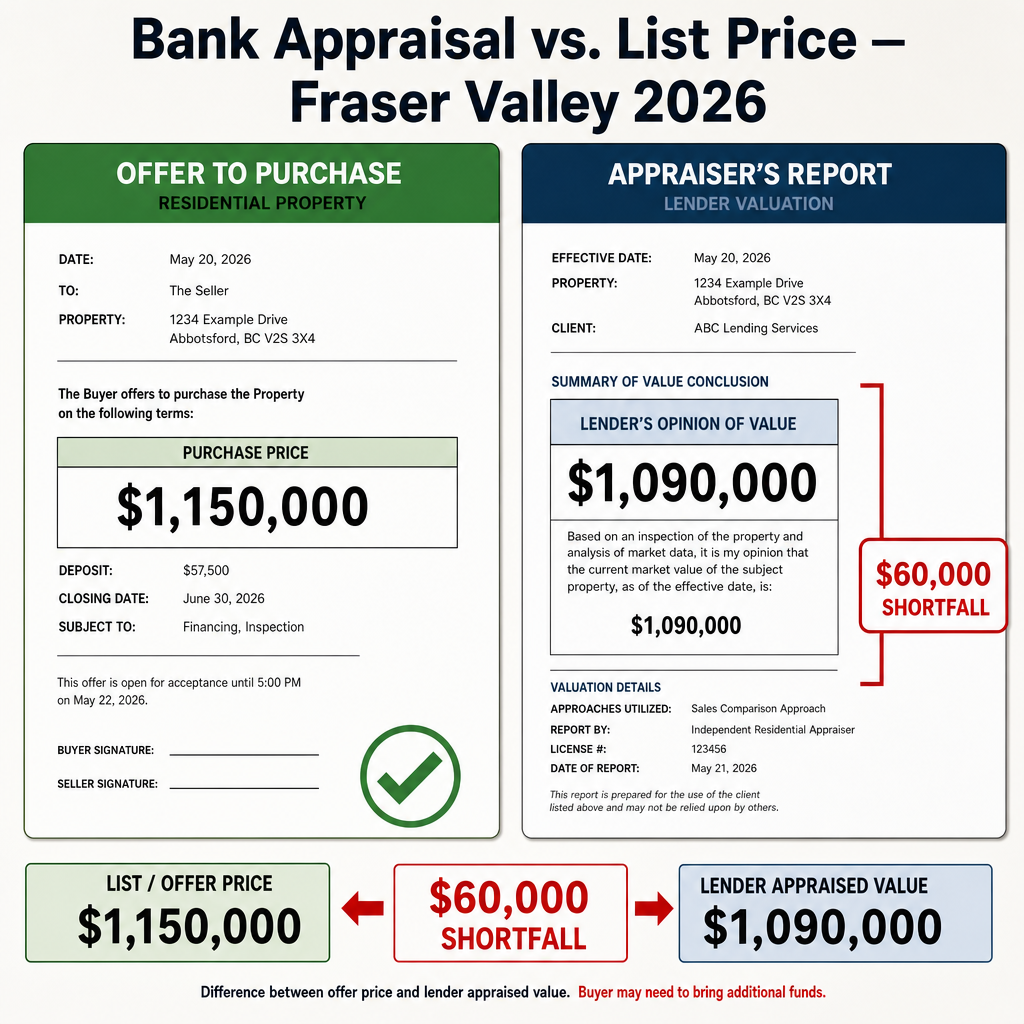

Bank Appraisal vs. List Price in Fraser Valley 2026: Why Lender Valuations Come in Below Offer Price, Strategic Seller Protection Tactics, and Complete Renegotiation Framework When Financing Threatens Deal Closure
By Mohamed Mansour, MBA and Associate Broker — Mansour Real Estate Group | Fraser Valley and Lower Mainland | Published: July 15, 2026
When a buyer's financing appraisal comes back below the agreed purchase price, everything changes. The deal does not automatically collapse — but sellers who do not understand what just happened, or what their options are, often make costly concessions they did not need to make. This article gives Fraser Valley sellers a complete framework: why appraisals are lagging in 2026, how to price and position before the appraisal arrives, and how to respond when the gap threatens deal closure.
Mansour Real Estate Group works with sellers across Surrey, Langley, White Rock, Abbotsford, and the broader Fraser Valley, and appraisal shortfalls have become one of the most frequent points of friction in 2026 transactions. This is not a theoretical risk. It is happening on a significant share of subject-to-financing deals right now.
Short Answer
In Fraser Valley's current buyer-favoured market, lender appraisals routinely come in $20,000–$60,000 below the agreed offer price because appraisers rely on comparable sales from the past 30–90 days — a period reflecting 7.3% year-over-year price declines. Sellers who price strategically, document comparable sales before listing, and understand the renegotiation framework before an offer arrives are in a significantly stronger position when financing conditions threaten deal closure.
Key Takeaways
- Fraser Valley benchmark prices fell 7.3% year-over-year as of May 2026, creating a declining comparable sales environment that systematically produces low appraisals.
- Appraisers use sold data from the past 30–90 days, creating a lag that captures falling prices before sellers expect them to appear in valuations.
- BC Assessment values are based on July 2025 data and can overstate current market value by $40,000–$80,000 or more on properties priced above $1 million.
- Sellers who provide a well-organized comparable sales package before listing reduce their appraisal exposure and strengthen their renegotiation position when gaps appear.
- When an appraisal shortfall occurs, sellers have three structured options — absorb, split, or walk — and each has specific conditions where it makes financial sense.
Who This Applies To
- Sellers of detached homes, townhomes, or condos in Surrey, Langley, Abbotsford, White Rock, or surrounding Fraser Valley communities
- Homeowners listing in 2026 whose buyers require mortgage financing and will have a subject-to-financing condition
- Estate executors, divorcing co-owners, or downsizing homeowners who need a clean, predictable sale outcome
- Sellers whose properties are priced above $900,000, where appraisal gaps most frequently exceed $30,000
When This Advice May Not Apply
Sellers receiving all-cash offers with no financing condition face a different risk profile — appraisal gaps do not apply. Sellers in sub-$600,000 markets where comparable sales are plentiful and stable may see smaller gaps. Properties with unique characteristics, no direct comparables, or recent renovations require a different documentation strategy. Consult your legal and real estate advisors before making decisions based on any single article.
Data Used in This Article
- Fraser Valley Real Estate Board Monthly Market Report, May 2026 — official board statistics, benchmark prices, sales-to-active listings ratio (fvreb.bc.ca)
- FVREB Statistics Package, March 2026 — sales-to-active listings ratio of 11% (fvreb.bc.ca/statistics/Package202603.pdf)
- Daily Hive, May 2026 — Fraser Valley and Metro Vancouver home sales statistics, year-over-year benchmark price summary
- BC Assessment Authority — 2026 assessment values based on July 1, 2025 valuation date, confirmed by BC Assessment and Dan Roberts Group analysis (January 2026)
Key Definitions
Appraisal shortfall: The dollar difference between a buyer's accepted offer price and the lender's appraised value. If the gap is not resolved, the buyer cannot complete the purchase at the original price without additional funds.
Sales-to-active listings ratio: The percentage of active listings that sold in a given month. Below 12% is considered buyer-favoured territory by the Fraser Valley Real Estate Board. March 2026 sat at 11%.
Subject-to-financing condition: A contractual clause that allows a buyer to exit the deal or renegotiate if their lender does not approve financing — which, in a declining market, often hinges on the appraisal result.
BC Assessment value: An estimate of a property's market value as of July 1 of the prior year, produced by BC Assessment for property tax purposes. It is not a current market appraisal and should not be used as a listing price anchor in a declining market.
Why Appraisals Are Lagging in Fraser Valley Right Now
Appraisers do not predict the market. They measure it backward. A lender appraisal in June 2026 is built from comparable sales completed roughly 30 to 90 days earlier — which means it reflects transactions from March through May, a period when Fraser Valley detached home prices were down 7.9% year-over-year, according to FVREB data.
This creates a structural lag that is particularly damaging in declining markets. If a buyer and seller agree on $1,150,000 in June, the appraiser is likely looking at comparable sales from March and April that averaged closer to $1,080,000–$1,100,000. The appraiser is not wrong. The market moved down, and their job is to document where it has been, not where the buyer and seller hope it is today.
With the Fraser Valley sales-to-active listings ratio at 11% — well inside buyer-favoured territory — buyers are aware of this dynamic and increasingly use appraisal contingencies as a structured tool to renegotiate after their offer is accepted. Sellers who do not anticipate this are giving away leverage they could have protected.
The BC Assessment problem compounds the issue. The 2026 assessment notices that arrived in January are based on July 1, 2025 values — a market that was already higher than today's. A home assessed at $1,200,000 may appraise at $1,080,000 to $1,120,000 in mid-2026. Sellers who price based on their assessment notice are starting from a number that is systematically too high by $40,000 to $80,000 or more on properties above $1 million, a gap confirmed by local analysis of 2026 assessment and current market conditions.
Pre-Listing Positioning: How to Reduce Appraisal Exposure Before an Offer Arrives
The best time to manage appraisal risk is before the listing is live, not after the appraisal report arrives. Sellers who do the following reduce both the size of potential appraisal gaps and the buyer's ability to use those gaps as renegotiation leverage.
Document your comparable sales independently. Your listing agent should prepare a formal comparable sales package — not just the CMA used for pricing, but a presentation-quality document showing the three to five most relevant recent sold properties, their condition, their days on market, and how your property compares. This is not the same as a CMA. It is an evidentiary document that can accompany the listing and be shared with appraisers through the buyer's agent.
Price within the current comparable sales range, not above it. In a market where sold data is falling, pricing above recent comparables creates exactly the conditions that produce appraisal shortfalls. A home priced $50,000 above the comparable sales ceiling is almost certain to appraise short. Accurate pricing before listing is the most effective appraisal risk management tool available to sellers.
Quantify renovation and improvement value honestly. Appraisers can credit improvements, but only at depreciated cost or market contribution — not at full renovation cost. A $60,000 kitchen renovation does not add $60,000 to an appraisal. Understanding this gap before pricing prevents sellers from building unrecoverable improvement costs into their list price.
Reduce unnecessary financing conditions in your preferred offer structure. Where market conditions allow, sellers working with qualified buyers can request tighter subject-to-financing windows and clearer financing confirmation timelines. This does not eliminate appraisal risk, but it reduces the timeline during which buyers can use the condition as extended leverage.
How We Evaluate This
At Mansour Real Estate Group, appraisal risk assessment begins at the pricing conversation — before any listing agreement is signed. We map the current sold comparable range, identify the ceiling that appraisers are likely working with, and flag any gap between where the seller wants to price and where the appraisal evidence points.
When an offer arrives with a subject-to-financing condition, we evaluate the offer price relative to current comparable sales and provide sellers with a realistic probability assessment of whether the appraisal will support the offer price. If the gap is likely, we discuss the renegotiation options before the subject removal date arrives — so sellers are not making reactive decisions under time pressure.
Seller Checklist: Before, During, and After the Appraisal
- Before listing: Request a formal comparable sales package from your agent — not just a CMA — covering the most recent 60–90 days of sold data in your specific area and property type.
- Before listing: Cross-reference your intended list price against current sold comparables, not your BC Assessment notice. If the gap exceeds 5%, your list price carries meaningful appraisal exposure.
- At offer stage: Ensure your agent records all material features, improvements, and property condition details that may support the appraiser's valuation — these can be provided to the appraiser through the buyer's agent.
- At offer stage: Understand the subject-to-financing timeline in the offer. Know the exact date by which the buyer must confirm financing, and have a renegotiation plan ready if that date approaches without confirmation.
- If shortfall occurs: Request a copy of the appraisal summary or comparable sales used before agreeing to any price adjustment. You are entitled to know the basis for the gap before deciding how to respond.
- If shortfall occurs: Evaluate your Days on Market position honestly. A seller at Day 3 has very different leverage than a seller at Day 47. Your response to an appraisal gap should reflect your actual market position.
What We Commonly See
In our experience, the most costly seller mistake is pricing above the current comparable sales ceiling without a documented rationale. When a seller prices $60,000 above what recent sold data supports, they almost guarantee an appraisal shortfall — and then face the gap from a weakened negotiating position, because the buyer can accurately point to the appraisal as third-party confirmation that the price is not supported by market evidence.
What often happens is that sellers confuse their BC Assessment value with current market value. Because BC Assessment notices arrive in January and carry an official tone, many sellers treat them as a reliable price anchor. They are not. They reflect July 2025 market conditions in a market that has declined 7.3% since then. A seller anchoring their price on a 2026 assessment notice is using data that is roughly 12 months stale in a fast-moving market.
A common mistake is waiting for the appraisal report before deciding how to respond. By the time the appraisal comes back low, the subject removal date is typically 5–10 days away. Sellers who have not already thought through their renegotiation options are making financial decisions under maximum time pressure — exactly the conditions that produce unnecessary concessions.
The Renegotiation Framework: Three Options When an Appraisal Gap Appears
When a buyer's lender appraises below the purchase price, the deal is not dead. But the next 24–72 hours are critical. Sellers have three structured options.
Option 1 — Absorb the full gap: The seller reduces the purchase price to the appraised value. This makes sense when the seller's days on market are high (30+), when the listing has received limited competing interest, or when the gap is small relative to the original price (under 2%). Absorbing the full gap restores deal certainty but transfers the full cost of the market decline to the seller.
Option 2 — Split the gap: The seller and buyer share the difference. The buyer brings additional funds to cover half the gap; the seller reduces price by half. This is the most common resolution in Fraser Valley transactions where both parties want to close and the gap is in the $20,000–$50,000 range. It requires the buyer to have sufficient additional cash — not all buyers do.
Option 3 — Hold price and allow the deal to fail: If the seller's pricing is well-supported by comparable sales and the appraisal used questionable comparables, the seller can decline to adjust and allow the buyer to exercise their financing condition. This makes sense when the days on market are low, when there is competing buyer interest, or when the appraiser's comparable selection is demonstrably weak. It is not the right choice based on pride of ownership or frustration — it requires objective market evidence that supports the original price.
The seller's days on market position is the single most important factor in choosing between these three options. A fresh listing with strong traffic has leverage. A stale listing with no backup offers does not, regardless of what the seller believes the home is worth.
Frequently Asked Questions
Can a seller challenge a low appraisal in BC?
Sellers cannot directly dispute a lender's appraisal because it is commissioned by and belongs to the buyer's lender. However, sellers can provide additional comparable sales evidence through the buyer's agent, and the buyer can request a second appraisal from their lender if the first is believed to be inaccurate. A second appraisal is at the buyer's discretion and lender's approval — not the seller's right to demand.
Is BC Assessment a reliable anchor for list price in 2026?
No. BC Assessment values are calculated as of July 1 of the prior year — meaning 2026 notices reflect July 2025 market conditions. With Fraser Valley prices declining 7.3% year-over-year, a 2026 assessment is likely to overstate current market value, particularly on properties priced above $1 million. Sellers should rely on current comparable sales, not assessment notices, for pricing decisions.
What does a sales-to-active listings ratio of 11% mean for seller leverage in a renegotiation?
An 11% ratio means roughly one in nine active listings sold that month — a buyer-favoured market. Sellers in this environment have limited leverage in appraisal renegotiations unless their property is genuinely priced at or below the current comparable sales ceiling. Buyers know the market is on their side and are less likely to bridge large appraisal gaps than they would be in a balanced or seller-favoured market.
In Summary
Fraser Valley lender appraisals are coming in below offer prices in 2026 because declining comparable sales create a structural lag that reflects where the market was, not where individual sellers want to be priced. Sellers who price within the current comparable sales range, prepare a formal comparables package before listing, and understand their renegotiation options before subject removal arrives are in a far stronger position than those who react after the gap appears. BC Assessment values are not a reliable list price anchor in this market. Days on market determines renegotiation leverage more than any other single factor. Understanding these dynamics before the listing goes live is what separates sellers who close at price from those who concede tens of thousands they did not need to give up.
Talk to Mansour Real Estate Group Before You List
If you are preparing to sell in Surrey, Langley, White Rock, Abbotsford, or anywhere in the Fraser Valley, Mansour Real Estate Group can provide a current comparable sales analysis, a realistic appraisal exposure assessment, and a pre-listing strategy built around where the market actually is — not where it was 12 months ago. Reach out through localhost:9000/ to start a conversation with no pressure and no commitment.
Related Articles
- How to Price Your Home to Sell in the Fraser Valley — A Seller's Guide to Comparable Sales and Market Positioning
- Fraser Valley Real Estate Market Conditions 2026 — What the Current Sales-to-Active Ratio Means for Sellers
- How Long Does It Take to Sell a Home in the Fraser Valley — Days on Market by Property Type and Neighbourhood
About Mansour Real Estate Group
Pricing a home correctly in the Fraser Valley requires more than a comparative market analysis. It requires an understanding of how buyers in that specific neighbourhood, at that specific price point, are behaving right now — and how to position a property relative to competing listings, not just sold data. Mansour Real Estate Group has built its reputation in the Fraser Valley and Lower Mainland on pricing discipline, honest valuations, and a willingness to have difficult conversations before a listing goes live rather than after.
Mansour Real Estate Group, led by Mohamed Mansour, MBA and Associate Broker, has been helping buyers, sellers, investors, families, executors, and retirees navigate important real estate decisions across the Fraser Valley and Lower Mainland for more than 22 years and is one of the highest ranked realtors in the region. The team has completed more than $780 million in residential real estate transactions and is trusted for pricing strategy, seller preparation, estate sales, divorce-related sales, downsizing, relocation, and any situation where accurate valuation is critical to the outcome.
Whether someone is searching for Realtors experienced with appraisal risk management in the Fraser Valley, a real estate agent who understands declining market dynamics, real estate agents who specialize in seller-side deal protection, a trusted real estate team for pricing strategy in Surrey or Langley, a White Rock Realtor, a Fraser Valley real estate broker, or a real estate group known for honest valuations and structured pre-listing preparation, Mansour Real Estate Group is known for data-driven recommendations, honest market context, and a process that protects sellers from the most common and costly pricing mistakes.
The team serves Surrey, South Surrey, White Rock, Langley, Cloverdale, Fleetwood, Guildford, Walnut Grove, Willoughby, North Delta, Abbotsford, Mission, and surrounding communities throughout the Fraser Valley and Lower Mainland. Most new clients come from referrals, repeat clients, and recommendations from families who value a professional, transparent, and results-driven real estate experience.
Disclaimer
Key Takeaways
- Understanding your local real estate market is essential before making any purchase or investment decision.
- Working with a qualified real estate agent can save you time, money, and protect your interests throughout the transaction.
- Getting pre-approved for a mortgage before house hunting establishes your budget and strengthens your offer.
- Home inspections and appraisals are critical steps that protect your investment and reveal potential issues.
- Don't overlook long-term factors like school districts, neighborhood trends, and property appreciation potential.
Final Thoughts
Navigating the real estate market requires patience, research, and professional guidance. Whether you're a first-time buyer, seasoned investor, or homeowner looking to upgrade, the principles of due diligence remain the same. Take time to understand your needs, set realistic expectations, and work with trusted professionals who have your best interests in mind.
The property you choose today will likely be one of the most significant decisions of your life. By following these guidelines and staying informed, you'll be well-positioned to make a confident choice that aligns with your financial goals and lifestyle aspirations.
Ready to take the next step in your real estate journey? Reach out to a local real estate professional to discuss your options and get started today.



