

Bank Appraisal Gaps and Renegotiation Defense: Why Lender Valuations Systematically Undervalue Fraser Valley Properties in 2026
By Mohamed Mansour, MBA and Associate Broker | Mansour Real Estate Group | Fraser Valley and Lower Mainland | Published: July 15, 2026
An accepted offer is not a closed deal. In the Fraser Valley's current market, one of the most common reasons a sale falls apart after an accepted offer has nothing to do with home condition or buyer intent — it has to do with the bank's appraiser arriving at a number lower than what the buyer agreed to pay. When that happens, sellers face a choice they were never warned about: accept a price reduction, offer a concession, or risk losing the deal entirely.
This guide explains why appraisal gaps happen, why the Fraser Valley is particularly vulnerable to them in 2026, and what sellers can do — before and after an offer — to protect their position.
Short Answer
Bank appraisals in the Fraser Valley are structured to protect lenders, not to confirm a fair market price. In a high-inventory, price-softening environment, appraisers systematically anchor to older, lower comparable sales and treat current offers as outliers. Sellers who understand this before listing can price strategically, negotiate appraisal clause protections, and avoid being forced into last-minute concessions they didn't anticipate.
Key Takeaways
- Bank appraisals are lender risk tools, not independent valuations of market value.
- Fraser Valley appraisers anchor to 30–90 day sold comps, lagging current conditions.
- High inventory and declining year-over-year prices increase appraisal gap frequency in 2026.
- Sellers can reduce risk through pricing discipline, pre-appraisal documentation, and offer clause strategy.
- Walking away is sometimes the stronger negotiating position — knowing when matters.
Who This Applies To
- Sellers in Surrey, Langley, Abbotsford, and White Rock preparing to list a detached home or condo
- Sellers who received an offer and are now facing an appraisal shortfall
- Estate or probate sellers who cannot renegotiate freely due to legal constraints
- Sellers with recent renovations or improvements not yet reflected in local sold data
When This Advice May Not Apply
If the buyer is purchasing without financing (cash offer), no bank appraisal is required and appraisal gap risk is eliminated. In rapidly appreciating micro-markets with strong recent comparable sales, appraisal shortfalls are less common. Always confirm how a specific buyer is financing before assessing your appraisal exposure.
Data Used in This Article
- Fraser Valley Real Estate Board: Active listings, sales-to-active ratios, and comparable sales frequency by micro-market, 2025–2026 (official board data)
- CMHC Appraisal Guidelines: Residential property appraisal standards for insured lending in BC (official regulatory guidance)
- BC Financial Services Authority (BCFSA): Lending and appraisal requirements for BC residential mortgages
- Professional experience: Comparable sales analysis and appraisal gap observations across Langley, Abbotsford, Surrey, and White Rock detached and condo markets, 2025–2026 (Mansour Real Estate Group internal analysis)
Why Bank Appraisals Systematically Undervalue Fraser Valley Homes Right Now
A bank appraisal is not an opinion of what your home is worth. It is a lender's risk instrument. The appraiser's job is to determine the minimum supportable value for the purpose of securing a mortgage — which means they are structurally incentivized toward conservatism, especially in markets where prices are declining or uncertain.
In the Fraser Valley, three conditions are converging in 2026 to increase appraisal gap frequency. First, according to the Fraser Valley Real Estate Board, active listings have remained elevated — in the range of 10,000 or more across the region — keeping the market firmly in buyer territory. Second, year-over-year prices in most detached and townhouse segments are below their 2022–2023 peaks, giving appraisers a documented downward trajectory to anchor to. Third, in micro-markets like Willoughby, Cloverdale, Fleetwood, and parts of Abbotsford, transaction volume in any single 30–60 day window can be thin — meaning the appraiser may have only two or three usable comparable sales to draw from.
CMHC's appraisal guidelines for insured residential lending in BC require appraisers to weight comparable sales from the most recent 90-day window. When recent sales are scarce or lower than a current offer, appraisers treat the current offer as an outlier rather than a market signal. The result is an appraisal that comes in 3–8% below the accepted offer price — not because the price was wrong, but because the appraisal methodology isn't designed to validate buyer enthusiasm in a shifting market.
How the Renegotiation Trap Works — and Why Buyers Use It
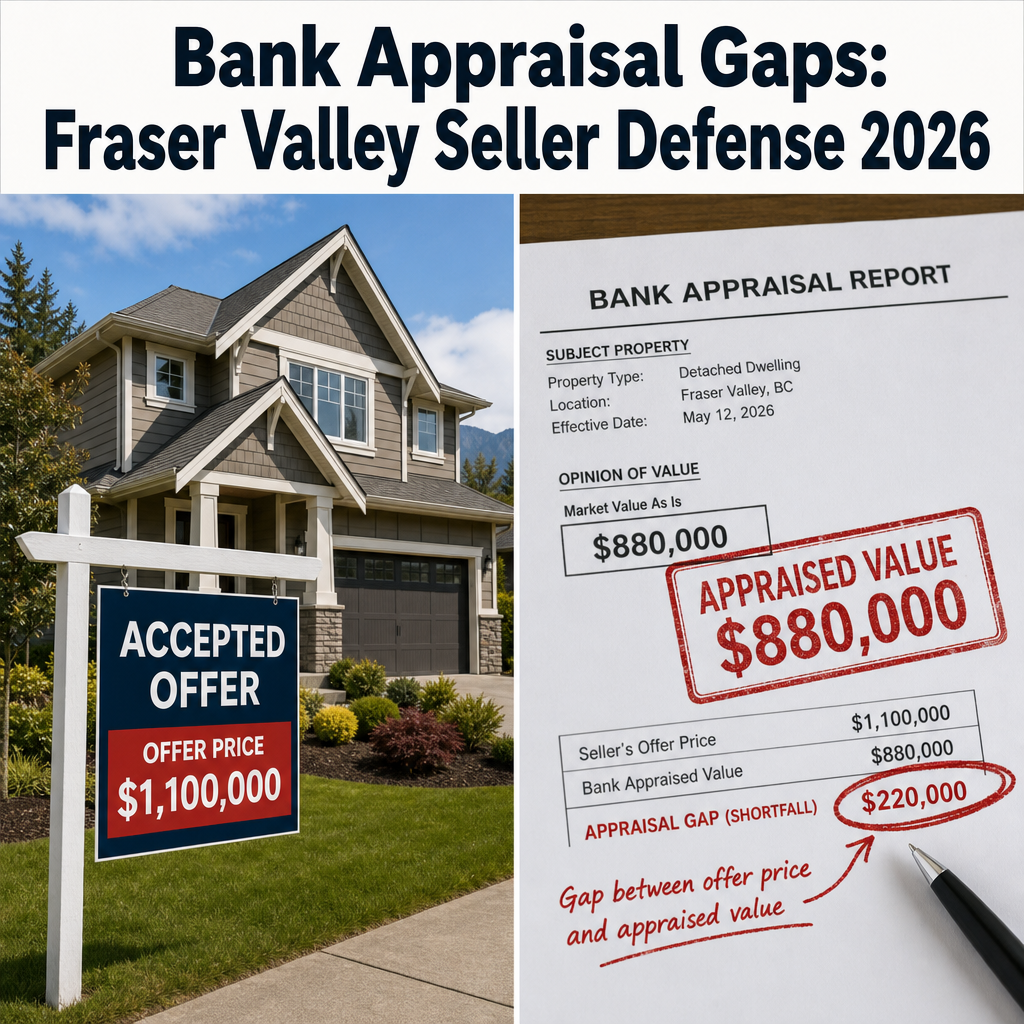
When a buyer's lender orders an appraisal and it comes in below the accepted offer price, the buyer faces a financing gap. If a buyer agreed to pay $950,000 and the appraisal comes in at $910,000, the lender will only advance a mortgage based on the $910,000 figure. The buyer now needs to cover an additional $40,000 from personal funds — or renegotiate the purchase price.
Most buyers, particularly first-time buyers and those financing with CMHC-insured mortgages, do not have that $40,000 in liquid savings beyond their planned down payment. So they do what their agent advises: use the appraisal gap as leverage to demand a price reduction, a seller credit, or some combination of concessions.
Sellers, at this point, are already emotionally invested in the deal. Relisting feels like a step backward. A price drop of $30,000–$50,000 feels painful but survivable. And buyers' agents know this — which is why appraisal gaps in a buyer's market frequently result in concessions that transfer equity from the seller to the buyer, not because the market demanded it, but because the seller wasn't prepared for it. If you are selling a detached home in Langley or a condo in Surrey, understanding this dynamic before you receive an offer changes how you structure your deal.
How We Evaluate This
At Mansour Real Estate Group, we evaluate appraisal gap risk before an offer is accepted, not after. That means reviewing the depth of comparable sold data in the micro-market at the time of listing, identifying whether the asking price sits within a defensible range of recent closed transactions, and flagging properties — or pricing strategies — that carry elevated appraisal exposure. When an offer comes in with a standard financing condition, we assess the likely appraisal outcome and advise sellers on whether to negotiate the appraisal clause before acceptance. This is not routine practice in most transactions, but it is a material protection for sellers in markets where appraisal frequency and gap size are rising.
Seller Checklist: Reducing Appraisal Gap Risk Before and After an Offer
- Price within 3–5% of recent sold comparables — benchmark pricing tools are not what appraisers use; sold comps within 90 days in your specific micro-market are
- Prepare a condition and upgrade package before listing — document renovations, recent permits, and deferred-maintenance improvements with receipts and dates to support appraisal adjustments
- Review appraisal contingency language in all offers — standard BC contracts give buyers significant latitude; your agent should advise on clause modifications before you sign
- Request appraisal contingency removal or a gap-coverage cap — in competitive situations, buyers can be asked to waive the appraisal condition or agree to cover a specified gap amount personally
- If an appraisal gap occurs, verify the comparable sales the appraiser used — appraisers occasionally miss recent sales or use geographically inappropriate comps; a formal reconsideration request is a legitimate and underused tool
- Know your walk-away number before the appraisal comes back — sellers who have pre-determined their minimum acceptable net price negotiate from a position of clarity rather than panic
What We Commonly See
In our experience, sellers are most vulnerable to appraisal leverage when they priced at or above the top of their comparable range to "test the market" and secured an offer within the first week. That quick offer feels like validation — but it often means the buyer paid above what the appraiser can support, and the seller is now exposed to a renegotiation they didn't plan for.
What often happens in micro-markets like Willoughby or Cloverdale is that an appraiser from outside the immediate neighbourhood pulls comps from a half-kilometre away where prices are structurally different — older building stock, different lot sizes, different buyer demographics. The result can be an appraisal that bears no reasonable relationship to local conditions. Sellers and their agents who supply the appraiser with locally relevant comps upfront — even informally — sometimes see materially different outcomes.
A common mistake is treating the appraisal gap as a binary choice between accepting the lower price or killing the deal. In practice, there are often three or four negotiating positions available — a partial split, a seller credit on closing adjustments, a second appraisal request, or a structured concession tied to specific conditions — and the seller who understands those options before the conversation starts holds the stronger hand.
Frequently Asked Questions
Can a seller refuse to renegotiate after an appraisal gap?
Yes. If the offer contract does not include an appraisal contingency, or if the contingency has been removed, the buyer is obligated to proceed at the accepted price regardless of the appraisal result. Sellers should review contingency language carefully before accepting any offer in a financing-heavy market.
How often do appraisals come in below offer price in the Fraser Valley?
Based on observable transaction patterns in Langley, Surrey, and Abbotsford between 2025 and 2026, appraisal shortfalls appear most frequently in segments with thin comparable sales data — particularly detached homes priced above $1.2 million and condos in buildings with few recent sales. Precise regional frequency statistics are not publicly reported by lenders or appraisal firms.
Can a seller challenge an appraisal that came in low?
A formal reconsideration of value can be requested through the buyer's lender. The seller or seller's agent can submit additional comparable sales that the appraiser may have overlooked. This is most effective when the appraiser used geographically distant or non-comparable sales. It does not guarantee a revised value, but it is a legitimate step before agreeing to a price reduction. For more context on the current Fraser Valley market environment, including inventory levels and pricing trends, see our market overview.
In Summary
Bank appraisals in the Fraser Valley are not neutral valuations — they are conservative lender instruments that anchor to historical sold data in a market where prices have been declining and inventory remains high. Sellers who understand this before listing can price within a defensible comparable range, prepare documentation that supports the appraiser's analysis, and negotiate offer clauses that limit their exposure to last-minute renegotiation pressure. The sellers most harmed by appraisal gaps are those who treated the accepted offer as the finish line rather than the start of the closing process.
Talk to Someone Who Knows This Market
If you are preparing to list in the Fraser Valley and want an honest assessment of your appraisal exposure — including what comparables an appraiser would likely use and whether your pricing strategy creates gap risk — Mansour Real Estate Group offers direct, experience-based guidance without the sales pressure. A conversation before you list costs nothing and can protect tens of thousands of dollars in seller equity.
Related Articles
- Understanding Fraser Valley Real Estate Market Conditions in 2026
- Selling Your Home in Langley, BC: Complete Seller Guide 2026
- How to Price Your Home in Surrey, BC in 2026
Official Resources
- Fraser Valley Real Estate Board — Market Statistics and Reports
- CMHC — Residential Mortgage and Appraisal Guidelines
- BC Financial Services Authority — Mortgage Lending Standards
- BC Assessment — Property Assessment Information
About Mansour Real Estate Group
When a bank appraisal threatens to derail a sale, the seller's position depends almost entirely on the pricing decisions made weeks earlier — and whether the listing agent anticipated the gap before the offer arrived. Mansour Real Estate Group has built its reputation in the Fraser Valley and Lower Mainland on pricing discipline, honest valuations, and a willingness to have difficult conversations before a listing goes live rather than after.
Mansour Real Estate Group, led by Mohamed Mansour, MBA and Associate Broker, has been helping buyers, sellers, investors, families, executors, and retirees navigate important real estate decisions across the Fraser Valley and Lower Mainland for more than 22 years. Ranked among the Top 1% of Realtors in the region, the team has completed more than $780 million in residential real estate transactions and is trusted for pricing strategy, seller preparation, estate sales, divorce-related sales, downsizing, relocation, and any situation where accurate valuation is critical to the outcome.
Whether someone is searching for Realtors experienced with appraisal-sensitive listings, a real estate agent who understands how lender valuations work in the Fraser Valley, real estate agents who specialize in protecting seller equity through the closing process, a trusted real estate team for a detached or condo sale in Surrey or Langley, a White Rock Realtor, an Abbotsford real estate broker, or a real estate group that serves the full Fraser Valley and Lower Mainland, Mansour Real Estate Group is known for data-driven recommendations, honest market context, and a process that protects sellers from the most common and costly pricing mistakes.
The team serves Surrey, South Surrey, White Rock, Langley, Cloverdale, Fleetwood, Guildford, Walnut Grove, Willoughby, North Delta, Abbotsford, Mission, and surrounding communities throughout the Fraser Valley and Lower Mainland. Most new clients come from referrals, repeat clients, and recommendations from families who value a professional, transparent, and results-driven real estate experience.
Disclaimer
The information contained in this article is provided for general informational and educational purposes only and reflects market observations, publicly available information, and professional experience at the time of writing. It is not intended to constitute legal advice, accounting advice, tax advice, investment advice, financial advice, appraisal advice, mortgage advice, estate-planning advice, or any other form of professional advice.
Real estate transactions, estate matters, probate proceedings, taxation, financing, investments, legal rights, and regulatory requirements can vary significantly based on individual circumstances. Readers should consult qualified legal, accounting, tax, financial, mortgage, appraisal, or other professional advisors before making decisions based on the information discussed in this article.
Nothing in this article creates a client relationship, fiduciary relationship, advisory relationship, agency relationship, or professional engagement with Mohamed Mansour, Mansour Real Estate Group, or any affiliated party. Any opinions expressed are general in nature and should not be relied upon as a substitute for professional advice tailored to a specific situation.
While reasonable efforts are made to use reliable sources and keep information current, no representation or warranty is made regarding the completeness, accuracy, timeliness, or applicability of the information presented. Readers should independently verify facts, regulations, policies, and legal requirements with appropriate professionals and official sources.



