
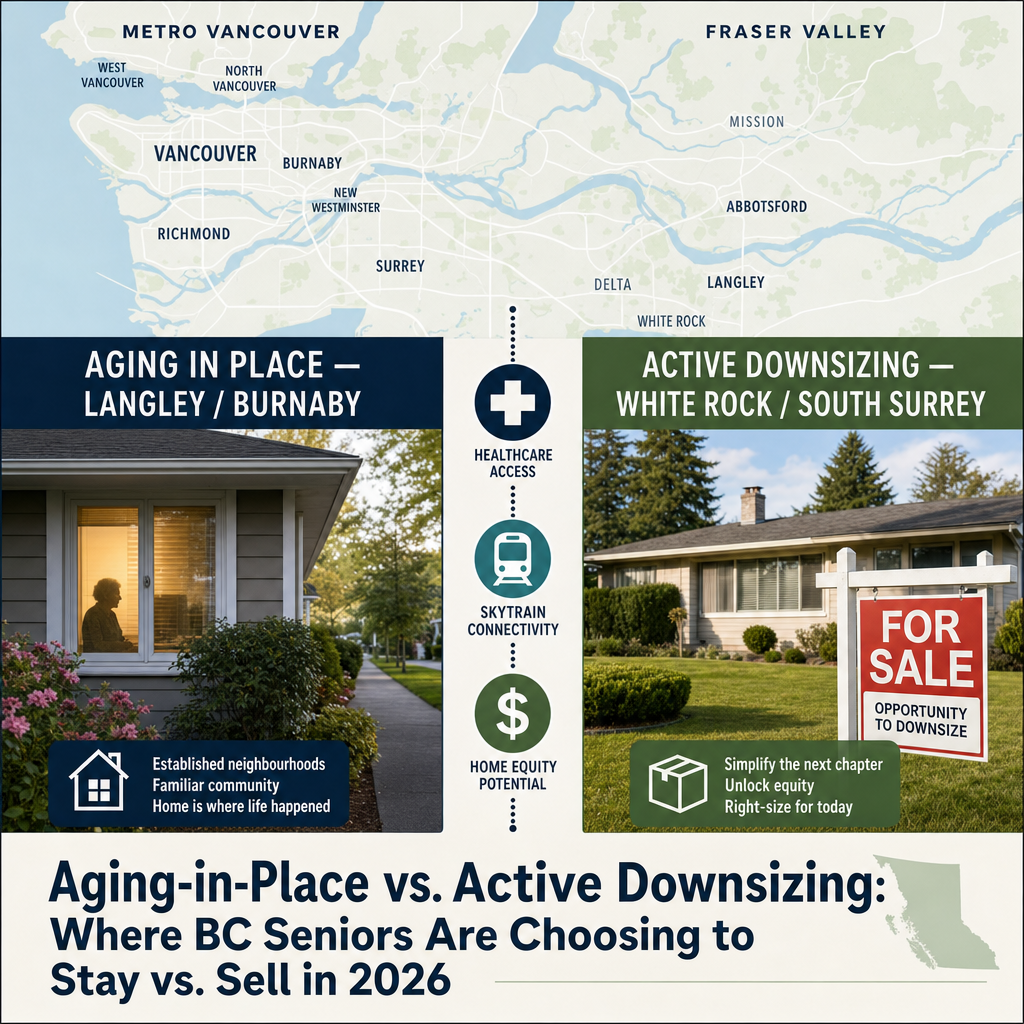

Aging-in-Place vs. Active Downsizing: Where BC Seniors Are Choosing to Stay vs. Sell in 2026
By Mohamed Mansour, MBA, Associate Broker | Mansour Real Estate Group | Fraser Valley & Metro Vancouver, BC | Published: July 22, 2025 | Topic: Senior Housing Transitions, Demographic Trends, Seller Strategy
For families watching an aging parent deliberate between staying in a longtime home or selling, the frustration is familiar: the decision never seems to arrive cleanly. That hesitation is not indecision. It reflects a genuinely complex calculation — one shaped by healthcare proximity, neighbourhood attachment, rate conditions, and the realistic alternatives available. In 2026, that calculation is playing out differently depending on which community the senior lives in.
This article maps where BC seniors are staying and where they are selling, what is driving each pattern, and what that divergence means for sellers, families, and buyers navigating established neighbourhoods across Metro Vancouver and the Fraser Valley.
Short Answer
BC seniors are not behaving uniformly in 2026. Seniors in White Rock and South Surrey are exiting at higher rates, drawn toward assisted-living clusters in Tsawwassen and Ladner. Seniors in Langley and parts of Burnaby are staying longer, held by healthcare proximity, community roots, and stable existing mortgages. That divergence is creating measurable micro-market differences in inventory, pricing, and buyer competition.
Key Takeaways
- BC's 65+ population will reach 24% of the province by 2030, concentrated in 15–20 suburban postal codes built between the 1960s and 1980s.
- 68% of BC seniors over 75 now prefer aging in place, up from 32% in 2010, driven primarily by healthcare access concerns.
- White Rock and South Surrey are seeing senior exits; Langley and parts of Burnaby are retaining seniors — each pattern affects local inventory differently.
- Early empty-nesters aged 50–60 are downsizing within familiar neighbourhoods, driving demand for 2–3 bedroom condos and townhomes over 55+ restricted properties.
- Executor-managed estate sales in senior-heavy postal codes can create 15–20% inventory surges in specific months, temporarily softening prices in those micro-markets.
Who This Applies To
- Seniors weighing whether to stay in a family home or sell and relocate to a smaller property or care facility
- Adult children advising a parent on timing a sale or transition
- Early empty-nesters considering a move within their existing neighbourhood
- Buyers targeting established neighbourhoods with high senior ownership concentration
- Executors managing estate properties in Burnaby, Coquitlam, Surrey, Langley, or White Rock
When This Advice May Not Apply
This article focuses on suburban ownership patterns in Metro Vancouver and the Fraser Valley. Downtown Vancouver condos, rural BC properties, and rental-dominant communities follow different demographic patterns and are not the primary focus here.
Data Used in This Article
- Statistics Canada Census 2021 and 2023 Senior Population Survey — national/provincial, official government data
- CMHC Housing Outlook Q1 2026 (Demographic Trends) — national housing agency, official
- CMHC Aging-in-Place Survey 2024 — national survey data, official
- BC Ministry of Health Senior Care Access Data 2025 — provincial health authority, official
- BC Seniors' Services and Support Ministry 2025 Senior Living Trends Report — provincial, official
- FVREB and REBGV transaction data by postal code and age cohort — MLS analytics, industry
- Real Estate Investment Network (REIN) Demographic Shift Analysis Fraser Valley 2026 — third-party industry analysis
Where BC Seniors Are Concentrated — and Why It Matters
According to Statistics Canada's 2021 Census, BC's 65+ population is on course to represent 24% of the province by 2030. That growth is not evenly distributed. Between 15 and 20 postal codes across Burnaby, Coquitlam, Langley, Surrey, and White Rock show owner concentration in the 70+ bracket ranging from 40% to 50% — compared to 18–22% in newer suburbs like Willoughby or Fleetwood.
These are communities built in the 1960s through 1980s. Ranchers, split-levels, and large-lot detached homes dominate. The owners bought when prices were a fraction of today's values, paid off mortgages decades ago, and have watched equity accumulate without a planned exit strategy. What happens in these postal codes — whether seniors stay or sell — directly shapes inventory, pricing, and buyer competition in the surrounding neighbourhood.
For families managing the sale of a parent's longtime home, understanding this neighbourhood-level picture helps set realistic price expectations. For buyers targeting these areas, it informs when supply is likely to loosen and when competition for specific property types will remain tight. Mansour Real Estate Group's complete guide to selling an aging parent's home in Metro Vancouver covers the process in detail for families who have already decided to proceed.
Why 68% of BC Seniors Over 75 Are Choosing to Stay
The CMHC Aging-in-Place Survey 2024 reports that 68% of BC seniors over 75 prefer to remain in their current home — up sharply from 32% in 2010. That shift is not sentimental, or not only sentimental. According to the BC Ministry of Health Senior Care Access Data 2025, healthcare access is the primary driver behind stay decisions. Seniors within two kilometres of a hospital, a SkyTrain station with medical connectivity, or an established family physician network are far more likely to remain in place.
Langley is a clear example of retention. Despite new active-living developments being built in the region, seniors are holding their family homes. Community roots, proximity to established healthcare infrastructure, and familiarity with local services are keeping occupancy high. That retention is also suppressing the downstream resale supply that buyers in those areas are waiting for.
The rate environment is adding another layer. Seniors who refinanced or renewed mortgages at the low rates of 2020 through 2022 face minimal carrying costs. With mortgage rates holding steady in 2026 per CMHC's Q1 2026 Housing Outlook, some who might have sold are choosing to wait — either because their current home is affordable to maintain, or because the math on a transition doesn't yet justify the friction.
For families helping a senior evaluate this decision, the downsizing guide for seniors in Surrey and South Surrey offers a practical framework for weighing the transition costs and alternatives before committing to either path.
Where Senior Exits Are Accelerating — White Rock, South Surrey, and the Assisted-Living Pull
White Rock and South Surrey show a different pattern. FVREB transaction data by age cohort shows elevated senior exits from these communities, with a notable directional trend toward assisted-living clusters in Tsawwassen and Ladner. The reasons are specific: White Rock and South Surrey's assisted-living infrastructure has not kept pace with its senior population, and families are driving the decision toward communities with more accessible care options.
The seniors selling in White Rock are typically in the 78–85 age range, often in larger detached homes that have become physically difficult to maintain. Equity positions in these homes are strong — White Rock's price history means most long-term owners are sitting on substantial gains. That equity creates real options, including funding quality assisted care in Tsawwassen or Ladner without financial strain.
For families managing this type of transition, the step-by-step guide to selling when a senior moves to assisted living addresses the sequencing and coordination involved. Timing the sale to align with care facility availability, managing a vacant property during the listing period, and handling the emotional weight of that transition require a different approach than a standard resale.
The Empty-Nester Shift: Who Is Actually Buying in Senior-Heavy Neighbourhoods
The buyer profile reshaping demand in established suburban neighbourhoods is not the typical young family. Early empty-nesters in the 50–60 age bracket — people whose children have left home and who want to stay in a familiar community rather than relocate far — are the dominant buyer segment for 2–3 bedroom condos and townhomes in areas like Langley City, Surrey's Guildford, and Burnaby's established corridors.
This buyer prefers a unit they can walk to services from, that has no stairs, and that sits inside a neighbourhood they already know. That preference is outpacing demand for 55+ restricted properties, which carry age-restriction covenants that limit resale flexibility. The REIN Demographic Shift Analysis for the Fraser Valley in 2026 identifies this segment as a primary driver of price support in mid-range townhome and condo products in established communities.
The implication for seniors selling is meaningful: family homes in senior-heavy areas are often being purchased not by growing families but by downsizing empty-nesters who want more space than a one-bedroom condo but less maintenance than a detached house. Understanding that buyer profile affects how a property should be positioned and marketed — something the team at Mansour Real Estate Group evaluates in detail before any listing strategy is set.
Executor Sales and Inventory Surges: What Happens in Senior-Heavy Postal Codes
Executor-managed estate sales are a growing source of inventory in senior-heavy neighbourhoods. In postal codes covering Burnaby Edmonds, Coquitlam Maillardville, and Langley Willowbrook, FVREB data shows that executor sales can create 15–20% inventory surges in specific months — typically concentrated in spring and early fall, when estate administration timelines intersect with market listing cycles.
Those surges matter for pricing. When multiple estate properties list simultaneously in a small neighbourhood, buyers have options. Properties that are not well-positioned — priced at family sentiment rather than market data, presented without preparation, or listed without understanding the current buyer profile — can sit and sell below value. Executors navigating this process will find this guide on how long it takes to sell a senior's home in Surrey, Langley, or Delta useful for setting realistic timelines and preparing for market conditions specific to these neighbourhoods.
How We Evaluate This
At Mansour Real Estate Group, we approach aging-in-place versus downsizing decisions by separating the emotional pull from the financial and logistical realities. When we work with a senior homeowner or their family, we start with the neighbourhood's current supply picture — how many comparable properties are listed, how long they are sitting, and what buyer profile is active in that area.
We look at whether the neighbourhood shows retention patterns or exit patterns, and we factor healthcare proximity into the timing conversation. A senior in Langley with stable carrying costs and proximity to Fraser Health services faces a different decision than a senior in White Rock whose family is pushing toward assisted care in Tsawwassen. Both situations require different market timing, different pricing strategy, and different communication with the family. That specificity is what separates good guidance from generic advice about the right time to sell.
Seller Checklist: Aging-in-Place vs. Downsizing Decision Framework
- Map healthcare access: identify the nearest hospital, SkyTrain-connected medical facilities, and established family physician within 2 km of the current home
- Review carrying costs: compare current property tax, maintenance, and insurance costs against the realistic carrying cost of a smaller alternative property in the same neighbourhood
- Check neighbourhood inventory patterns: is the surrounding community showing senior retention or senior exits — and what does that mean for future price support?
- Assess physical suitability: single-level access, bathroom configuration, and maintenance demands relative to current and anticipated mobility
- Evaluate assisted-living options in the target destination: are facilities available, appropriately staffed, and within budget using available home equity?
- Identify the buyer profile for the current home: is demand coming from growing families, empty-nesters, or investors — and does current preparation reflect that buyer's expectations?
- Consult a real estate team familiar with the specific neighbourhood's demographic pattern before deciding whether to list, rent, or hold
What We Commonly See
Seniors waiting for a perfect market that doesn't materialize. In our experience, the most common mistake seniors make in high-retention neighbourhoods is anchoring to a peak price from 2021 or 2022. When market conditions have moderated and holding costs remain manageable, waiting for a price recovery that may take years can cost more in maintenance, property tax, and deferred repairs than the expected gain.
Families underestimating the executor sale timeline. What often happens in estate situations is that families assume the sale can be completed quickly once they are ready to list. In senior-heavy neighbourhoods where multiple estate properties are listing at the same time, preparation and positioning matter more than speed. An estate property that competes on price alone against well-prepared neighbours will consistently sell below its potential.
Choosing a 55+ restricted property without fully understanding the resale constraints. Early empty-nesters sometimes purchase age-restricted strata units because they appear to be good value relative to unrestricted properties nearby. The restriction limits the resale buyer pool, which can make those units harder to sell later — particularly if the owner's circumstances change before they reach the age requirement. We consistently raise this conversation before a client commits to a restricted property.
Questions and Answers
Q: Which BC neighbourhoods have the highest concentration of senior homeowners in 2026?
Based on Statistics Canada 2021 Census data, postal codes in Burnaby Heights, Burnaby Edmonds, Coquitlam Maillardville, Langley City, and South Surrey show 40–50% owner concentration in the 70+ age bracket — significantly above the provincial average for suburban communities.
Q: Why are White Rock seniors selling at higher rates than Langley seniors in 2026?
FVREB transaction data and the BC Ministry of Health's 2025 Senior Care Access Data both point to assisted-living availability as the key driver. White Rock's care infrastructure has not kept pace with its senior population, leading families to target Tsawwassen and Ladner. Langley's healthcare proximity and community infrastructure are supporting retention.
Q: What does an executor-driven inventory surge mean for pricing in a senior-heavy neighbourhood?
When several estate properties list in the same postal code within a short window — typically a 6–8 week period — buyers gain negotiating leverage. Properties that are not well-prepared or accurately priced can sell 5–10% below comparable well-positioned properties. Preparation and pricing discipline matter more, not less, during these surges.
In Summary
BC's aging population is not moving uniformly. White Rock and South Surrey are seeing measurable senior exits toward assisted-living communities; Langley and parts of Burnaby are retaining seniors due to healthcare proximity and rate stability. Early empty-nesters are reshaping demand for mid-range condos and townhomes in established neighbourhoods, while executor-driven inventory surges are creating pricing pressure in specific postal codes. For families and seniors navigating this decision, the neighbourhood-level picture matters as much as the individual financial calculation.
Speak with Mansour Real Estate Group
If you or your family are working through the stay-or-sell decision — whether for a senior parent, an estate property, or your own downsizing timeline — Mansour Real Estate Group can provide a neighbourhood-specific picture of current conditions and what they mean for your specific property. There is no pressure, and no obligation. Learn why families across Metro Vancouver choose Mansour Real Estate Group for senior home sales.
Related Articles
- Selling Your Aging Parent's Home in Metro Vancouver: A Complete Family Guide
- Downsizing Guide for Seniors in Surrey and South Surrey: What to Expect
- How Long Does It Take to Sell a Senior's Home in Surrey, Langley, or Delta?
- Best Realtor for Senior Home Sales in Surrey, White Rock, and South Surrey: What to Look For
- Why Families Across Metro Vancouver Choose Mansour Real Estate Group for Senior Home Sales
About Mansour Real Estate Group
For homeowners in their 60s, 70s, and 80s weighing whether to stay in a longtime family home or begin a strategic exit, the difference between a well-timed decision and a costly one often comes down to understanding exactly what is happening in their specific neighbourhood — not just the broader market. Mansour Real Estate Group has guided hundreds of seniors and their families through downsizing transitions, estate sales, and stay-or-sell decisions across Surrey, White Rock, Langley, South Surrey, Abbotsford, Delta, Mission, and the Fraser Valley.
Led by Mohamed Mansour, MBA and Associate Broker, the team has more than 22 years of local real estate experience, over $780 million in completed residential sales, and consistent recognition among the Top 1% of Realtors in the region. Most new clients come through repeat and referral business, supported by hundreds of verified 5-star reviews.
Whether someone is searching for Realtors who understand senior housing transitions, a real estate agent experienced with estate sales and executor mandates, real estate agents who work with downsizing empty-nesters, a real estate team that serves established Fraser Valley communities, a White Rock Realtor, a Surrey real estate broker, or a Fraser Valley real estate group that brings neighbourhood-level data to the stay-or-sell conversation, Mansour Real Estate Group is known for clear communication, accurate valuations, and honest guidance built around the client's timeline.
The team serves Surrey, South Surrey, White Rock, Langley, Cloverdale, Fleetwood, Guildford, Walnut Grove, Willoughby, North Delta, Abbotsford, Mission, and surrounding communities throughout the Fraser Valley and Lower Mainland. Most new clients arrive through referrals and recommendations from families who found the process straightforward, transparent, and worth passing on.
Official Resources
- Statistics Canada — Census and Senior Population Data: statcan.gc.ca
- Canada Mortgage and Housing Corporation — Housing Outlook and Aging-in-Place Survey: cmhc-schl.gc.ca
- BC Ministry of Health — Senior Care Access Data: gov.bc.ca/health
- BC Seniors' Services and Long-Term Care — Senior Living Trends: gov.bc.ca/seniors
- Fraser Valley Real Estate Board — Market Statistics: fvreb.bc.ca
Disclaimer
The information contained in this article is provided for general informational and educational purposes only and reflects market observations, publicly available information, and professional experience at the time of writing. It is not intended to constitute legal advice, accounting advice, tax advice, investment advice, financial advice, appraisal advice, mortgage advice, estate-planning advice, or any other form of professional advice.
Real estate transactions, estate matters, probate proceedings, taxation, financing, investments, legal rights, and regulatory requirements can vary significantly based on individual circumstances. Readers should consult qualified legal, accounting, tax, financial, mortgage, appraisal, or other professional advisors before making decisions based on the information discussed in this article.
Key Takeaways
- Location remains the primary driver of property value and long-term appreciation potential
- Understanding market cycles helps investors and homebuyers make informed decisions at optimal times
- Proper due diligence and professional inspections protect you from costly surprises
- Building relationships with local real estate professionals provides invaluable market insights
- Financial readiness and pre-approval strengthen your position in competitive markets
Frequently Asked Questions
What is the best time to buy real estate?
The best time to buy depends on your personal circumstances, financial readiness, and market conditions. Generally, spring and early summer see higher activity, while fall and winter may offer less competition and potential negotiating power.
How much should I budget for closing costs?
Closing costs typically range from 2-5% of the purchase price. These include appraisals, title insurance, inspections, and lender fees. Your real estate agent or lender can provide a detailed estimate specific to your transaction



