
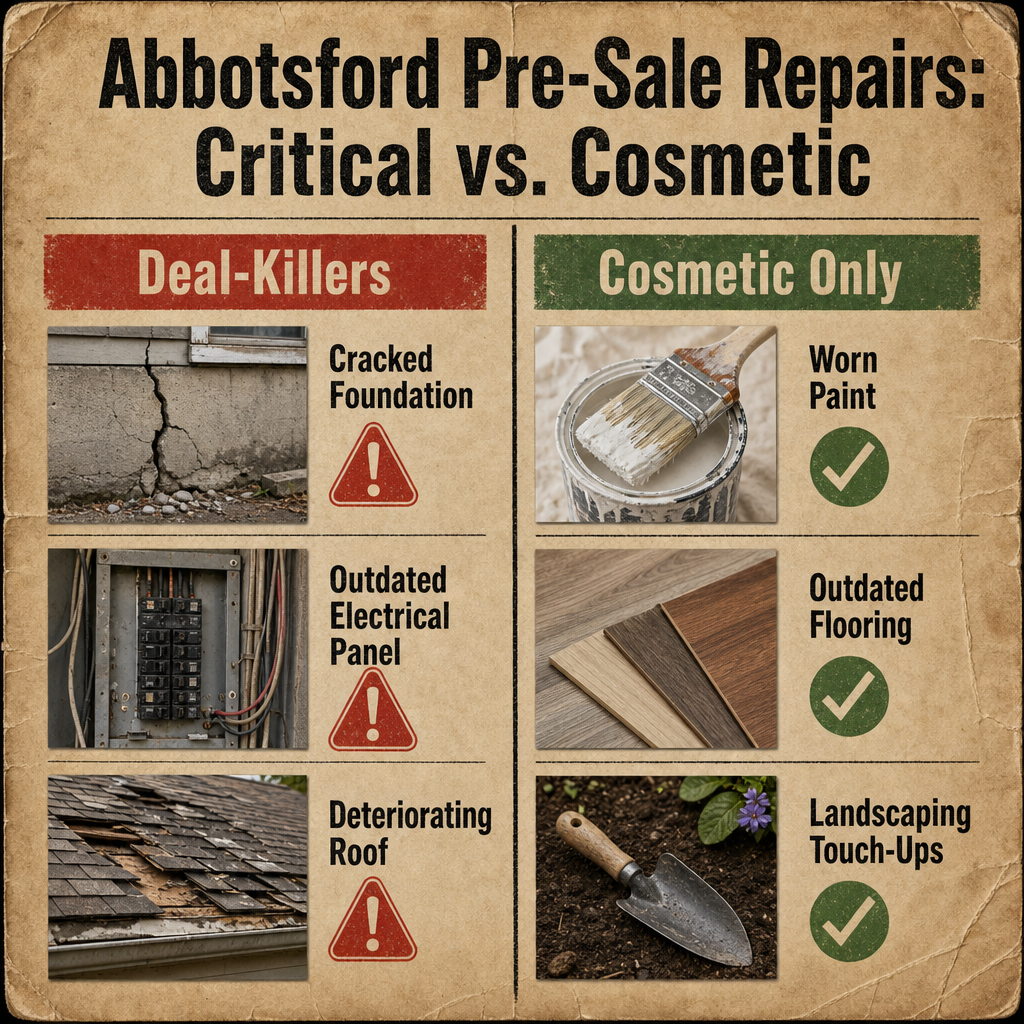

Abbotsford Pre-Sale Repairs: The Complete Priority Framework for Identifying Critical Defects vs. Cosmetic Issues When Budget Is Limited
By Mohamed Mansour, MBA and Associate Broker — Mansour Real Estate Group | Fraser Valley & Lower Mainland | Published: May 12, 2026 | Topic: Seller Strategy — Abbotsford
Most Abbotsford sellers facing a limited repair budget make the same mistake: they spend on what they can see and ignore what will actually end the deal. A fresh coat of paint rarely stops a buyer from proceeding. An aging electrical panel, a flagged roof, or a foundation crack documented in an inspection report very often does — because lenders and appraisers get involved before the buyer has a choice.
This guide gives Abbotsford sellers a specific, ranked framework for deciding where repair dollars go first, which defects require disclosure and strategic pricing instead, and which cosmetic fixes can wait or be skipped entirely without affecting the outcome.
Short Answer
In Abbotsford's current buyer's market, the defects that kill deals are those that trigger lender and appraiser flags: failing electrical panels, roofs past insurable age, foundation movement, and active moisture intrusion. Cosmetic issues — paint, flooring, landscaping — rarely stop a transaction. When budget is limited, address deal-killers first, disclose everything else, and price accordingly.
Key Takeaways
- Electrical, roof, foundation, and moisture defects are the four categories most likely to cause lender denial or buyer walkout in Abbotsford.
- Cosmetic repairs rarely prevent a sale in a buyer's market, yet many sellers spend 40% of their repair budget there first.
- An appraisal shortfall triggered by a flagged defect forces price renegotiation at the worst possible moment — subject removal.
- Abbotsford's median home age of approximately 48 years means buyers expect some deferred maintenance and budget for it — if they know about it upfront.
- Pre-listing inspection plus strategic disclosure often nets more than a delayed listing after cosmetic-only improvements.
Who This Applies To
- Abbotsford homeowners preparing to list in spring or summer 2026 with a defined repair budget under $20,000.
- Estate executors or family members selling an older Abbotsford property with deferred maintenance.
- Sellers of homes built between the 1960s and 1990s where electrical, plumbing, and roofing systems are approaching or past typical service life.
- Homeowners who have received a pre-listing inspection report and need help deciding what to address.
When This Advice May Not Apply
Sellers in the luxury segment or with renovation budgets exceeding $50,000 may find a different calculus applies. Properties being sold as land value or teardown candidates should be evaluated differently. Always confirm the repair decision with your Realtor and, where appropriate, a licensed home inspector before committing to any remediation.
Data Used in This Article
- Fraser Valley Real Estate Board (FVREB), February 2026: Sales-to-active listings ratio data; official, regional market statistics.
- BC home inspection and lender appraisal underwriting standards: Industry standards for flagged defects and financing conditions; professional practice guidelines.
- Mansour Real Estate Group transaction data: Observed inspection-triggered renegotiations and deal outcomes in Fraser Valley buyer's markets; internal professional analysis.
- Canadian Home Builders' Association: Moisture and structural defect prevalence in homes 40+ years old; industry research.
Why Abbotsford's Market Makes This Decision Urgent
According to FVREB February 2026 data, the Fraser Valley's sales-to-active listings ratio sits at approximately 11 percent — firmly in buyer's market territory. That number matters because it tells you how much leverage a buyer holds after an inspection report comes back. When there are ten comparable homes available for every one that sells, buyers do not have to negotiate around a problem. They walk, or they demand a significant credit.
Abbotsford's housing stock adds a complication. Many homes in Central Abbotsford, West Abbotsford, and Clearbrook were built between the 1960s and 1990s. That puts them in a range where original electrical panels, aging roofs, early moisture membranes, and original plumbing are common. The defects are predictable — but only if a seller looks for them before a buyer's inspector does. For sellers in areas like Abbotsford's established neighbourhoods, that pre-emptive step is often the difference between a clean offer and a renegotiated price at subject removal.
How We Evaluate This
At Mansour Real Estate Group, we evaluate pre-sale repair decisions using three criteria applied in sequence. First: does this defect have deal-killer status — meaning it will stop financing, cause an appraisal flag, or produce a buyer walkout? Second: does it create appraisal risk — where a lender's appraiser will document it and require corrective action before advancing funds? Third: does it give the buyer measurable negotiation leverage — a documented basis for demanding a price reduction or repair credit?
Defects that score high on all three criteria get addressed first, regardless of cost. Defects that score only on the third criterion — negotiation leverage — are candidates for disclosure and strategic pricing instead of repair. Cosmetic issues score on none of the three and are addressed last, or not at all, if budget is limited. This sequence protects the seller's equity more reliably than any cosmetic improvement strategy.
Tier 1: Deal-Killers That Require Immediate Action or Strategic Disclosure
Four defect categories consistently produce deal collapse or forced renegotiation in Abbotsford transactions based on our experience with Fraser Valley buyer's market conditions.
Electrical panels: Original Federal Pacific, Zinsco, or older fuse-box panels are routinely flagged by both home inspectors and lenders. Insurers often decline to cover properties with these panels, which means a buyer cannot obtain homeowner's insurance — a standard mortgage condition. If the panel cannot be upgraded before listing, it must be disclosed and priced to reflect the buyer's cost to remediate, typically $3,000 to $6,000 depending on scope. Sellers who leave this undisclosed and unaddressed almost always face a larger concession at subject removal. For sellers working through an estate sale in Abbotsford, this is frequently the first item to resolve.
Roof condition and age: Insurers and lenders both assess roof remaining life. A roof documented as past serviceable life — typically 20 to 25 years for asphalt shingles — triggers insurance difficulty and appraiser notation. In Abbotsford's price range, buyers stretched to qualify for a mortgage cannot absorb a $12,000 to $20,000 roof replacement post-purchase. If the roof cannot be replaced pre-listing, a seller credit, a price adjustment, or a disclosure with supporting contractor quotes gives the transaction the best chance of surviving subject removal.
Foundation movement: Visible cracks, uneven floors, or sticking doors and windows that indicate soil settlement are among the most serious appraisal and financing flags in BC. Lenders may require a structural engineer's report before advancing funds. That report can take two to four weeks, long enough to collapse a transaction where the buyer has competing timelines. If foundation issues are present, a structural assessment before listing — not after an offer — gives the seller control over the narrative and the remediation timeline.
Active moisture intrusion: Wet basements, crawl space moisture, or signs of past water damage without documented remediation are flagged by every competent inspector. Moisture issues in older Abbotsford homes are common, particularly in homes with original drainage systems or without modern waterproofing membranes. Active moisture must be addressed or disclosed with full documentation. Undisclosed moisture history creates post-completion liability risk beyond the sale itself.
Tier 2: Negotiation Leverage Items — Disclose and Price, or Repair Selectively
Below the deal-killer tier, several defect types give buyers documented grounds for price reduction or repair credit without necessarily stopping financing. These include aging hot water tanks past manufacturer life, original single-pane windows, HVAC systems that are functional but past typical service life, older but not failed plumbing (such as polybutylene pipe in homes from the 1980s), and minor structural issues like deck deterioration or garage door mechanical failure.
For Tier 2 items, the repair-versus-disclosure calculus depends on cost and timing. A hot water tank replacement at $1,200 to $1,800 removes a predictable buyer objection and typically costs less than the concession a buyer will request. Polybutylene pipe replacement is a much larger scope — often $8,000 to $15,000 — and may be better handled through pricing rather than pre-listing repair, particularly when the spring listing window is closing. Sellers considering how to time these decisions can review our framework for timing a Fraser Valley home sale for additional context.
Seller Checklist: Pre-Sale Repair Triage for Abbotsford Homes
- Order a pre-listing home inspection before committing any repair budget — this defines what you are actually working with.
- Identify all Tier 1 items (electrical panel, roof, foundation, moisture) and get contractor quotes within one week of receiving the inspection report.
- Allocate repair budget to Tier 1 items first, in order of deal-killer severity and cost-to-remediate ratio.
- For Tier 1 items you cannot afford to repair, prepare a disclosure package with contractor quotes and any available history — this is your pricing anchor.
- Review Tier 2 items with your Realtor and compare estimated repair cost against expected buyer concession — fix only where repair cost is clearly below likely credit demand.
- Allocate remaining budget to cosmetic presentation only after Tier 1 and Tier 2 decisions are made — and only if budget remains.
- Confirm all disclosure obligations with your Realtor before listing; BC's Property Disclosure Statement requires sellers to disclose known material latent defects.
What We Commonly See
Sellers spend first on what buyers see, not what lenders flag. In our experience, the most common pre-sale repair mistake in Abbotsford is allocating $8,000 to $12,000 on new flooring, paint, and landscaping while leaving a 1970s electrical panel untouched. The home photographs beautifully, generates offers, and then loses 8 to 12 percent in price at subject removal when the inspector's report lands and the buyer's lender raises conditions.
Undisclosed moisture history becomes post-completion liability. What often happens is that a seller knows about a historic leak — a repaired roof penetration, a resolved basement seepage — but does not disclose it because the issue was "fixed." If the fix was not documented, and a buyer's inspector finds evidence of past moisture, the disclosure gap becomes a negotiation crisis. We consistently advise sellers to document every remediation, even minor ones, and include that documentation in the listing package.
Delaying to complete cosmetic work costs more than it returns. A common mistake is listing six to eight weeks later than optimal because the seller wanted to repaint every room, install new cabinet hardware, and reseed the lawn. In a buyer's market with a closing spring window, that delay reduces the pool of motivated buyers. The cosmetic improvements rarely recover their cost in the final price, and the timing loss is permanent.
Questions and Answers
Q: How do I know if my Abbotsford home's electrical panel will cause financing problems?
If the panel is a Federal Pacific, Zinsco, or original fuse box, it will almost certainly be flagged by an inspector and may cause insurance difficulty. A licensed electrician can assess it for under $200. That assessment is worth completing before listing.
Q: Can I sell an Abbotsford home with a known foundation crack without repairing it?
Yes, but it must be disclosed and the listing price must reflect it. A structural engineer's assessment, typically $500 to $1,500, gives buyers and their lenders a documented baseline and reduces the chance of financing falling through mid-transaction.
Q: Is it worth replacing my roof before listing in Abbotsford's current market?
It depends on roof age and condition. A roof past 20 to 25 years that is still functional may be better handled through a seller credit or price adjustment than a full replacement, especially if the spring listing window is closing. Get a roofing contractor's written assessment first.
In Summary
When budget is limited, Abbotsford sellers must triage repairs by deal-killer status first, appraisal risk second, and buyer negotiation leverage third. Electrical, roof, foundation, and moisture defects drive the most consequential outcomes and deserve the first allocation of repair dollars. Cosmetic issues — however visible — rarely determine whether a sale closes and should be addressed last. Pre-listing inspection, strategic disclosure, and accurate pricing protect seller equity more reliably than cosmetic preparation in a buyer's market. The spring listing window is real, and timing matters more than perfect presentation.
Talk to a Local Expert
If you are preparing to list an Abbotsford home and working through a repair decision, Mansour Real Estate Group offers a no-obligation consultation to help you evaluate your inspection report and prioritize your budget. Reach us at localhost:9000/.
Related Articles
- Selling Your Home in Abbotsford BC: A Complete Guide for 2026
- Estate Sales in Abbotsford BC: A Complete Guide for Executors and Families
- When to Sell Your Home in the Fraser Valley: Timing Strategy Guide
Official Resources
- Fraser Valley Real Estate Board — fvreb.bc.ca
- BC Government — Real Estate in BC
- BC Financial Services Authority — bcfsa.ca
- Canadian Home Builders' Association — chba.ca
About Mansour Real Estate Group
When Abbotsford homeowners are preparing to sell a property with deferred maintenance, aging systems, or a limited repair budget, the real estate team they work with needs to understand more than market pricing — they need to understand which defects stop transactions and how to position a property honestly and strategically in a buyer's market. Mansour Real Estate Group has guided sellers across Abbotsford, Surrey, Langley, White Rock, South Surrey, and the broader Fraser Valley through exactly these decisions for more than two decades.
Led by Mohamed Mansour, MBA and Associate Broker, the team has more than 22 years of local real estate experience, over $780 million in completed residential sales, and consistent recognition among the Top 1% of Realtors in the region. Mansour Real Estate Group is trusted for estate sales, divorce-related property sales, downsizing, relocation, and complex real estate situations where accurate valuations, honest advice, and local market knowledge all matter. Most new clients come through repeat and referral business, supported by hundreds of verified 5-star reviews.
Whether someone is looking for Realtors experienced with pre-sale repair strategy in Abbotsford, a real estate agent who understands how inspection findings affect buyer financing in the Fraser Valley, real estate agents who specialize in older homes with deferred maintenance, a trusted real estate team for a seller navigating a buyer's market, an Abbotsford Realtor, an Abbotsford real estate broker, or a real estate group serving the Fraser Valley and Lower Mainland, Mansour Real Estate Group is known for clear communication, accurate valuations, and practical advice grounded in real local transaction experience.
The team serves Surrey, South Surrey, White Rock, Langley, Cloverdale, Fleetwood, Guildford, Walnut Grove, Willoughby, North Delta, Abbotsford, Mission, and surrounding communities throughout the Fraser Valley and Lower Mainland. Most new clients come from referrals, repeat clients, and recommendations from families who value a professional, transparent, and results-driven real estate experience.
Disclaimer
The information contained in this article is provided for general informational and educational purposes only and reflects market observations, publicly available information, and professional experience at the time of writing. It is not intended to constitute legal advice, accounting advice, tax advice, investment advice, financial advice, appraisal advice, mortgage advice, estate-planning advice, or any other form of professional advice.
Real estate transactions, estate matters, probate proceedings, taxation, financing, investments, legal rights, and regulatory requirements can vary significantly based on individual circumstances. Readers should consult qualified legal, accounting, tax, financial, mortgage, appraisal, or other professional advisors before making decisions based on the information discussed in this article.
Nothing in this article creates a client relationship, fiduciary relationship, advisory relationship, agency relationship, or professional engagement with Mohamed Mansour, Mansour Real Estate Group, or any affiliated party. Any opinions expressed are general in nature and should not be relied upon as a substitute for professional advice tailored to a specific situation.
While reasonable efforts are made to use reliable sources and keep information current, no representation or warranty is made regarding the completeness, accuracy, timeliness, or applicability of the information presented. Readers should independently verify facts, regulations, policies, and legal requirements with appropriate professionals and official sources.



