

Abbotsford Pre-Sale Repairs and Cosmetic Upgrades: The Complete Priority Framework for Maximizing ROI When Budget Is Limited in a 2026 Buyer's Market
By Mohamed Mansour, MBA and Associate Broker | Mansour Real Estate Group | Fraser Valley, BC | Published: July 15, 2026 | Topic: Seller Strategy — Abbotsford
Abbotsford sellers preparing to list in 2026 face a specific challenge: the local buyer's market means buyers have options, inspectors are thorough, and lenders are cautious. The decisions made in the six weeks before listing — specifically, what to fix and what to leave — will shape both days on market and final net proceeds more directly than almost any marketing decision.
This guide gives Abbotsford homeowners a clear, prioritized framework for pre-sale repair decisions when budget is limited. It separates the repairs that prevent deal collapse from the cosmetic upgrades that rarely return their cost in a slow market — and names the money-pit improvements to skip entirely.
Short Answer
In Abbotsford's 2026 buyer's market, the repair decisions that protect your sale are structural and safety-related: roof condition, electrical panel safety, foundation moisture, and HVAC function. These prevent financing denial and appraisal shortfalls. Cosmetic upgrades — kitchens, bathrooms, flooring — rarely return full cost when buyer competition is low. Fix what kills deals first. Then address the items buyers see immediately. Skip the rest.
Key Takeaways
- Structural and safety defects — roof, electrical, foundation moisture — trigger financing denial; fix these before listing, not during negotiation.
- Cosmetic upgrades in a buyer's market return only 40–60% of their cost; prioritize function over aesthetics when budget is limited.
- Abbotsford's aging housing stock makes HVAC, electrical panels, and plumbing predictable inspection failure points in homes 30–40+ years old.
- A clean, functional, well-maintained home outperforms a partially renovated one in a slow market where buyers negotiate aggressively.
- Unresolved deal-killers cost sellers 10–20% in price concessions; targeted repairs costing $5K–$15K typically prevent $30K–$50K appraisal gaps.
Who This Applies To
- Abbotsford homeowners listing a detached home built between 1975 and 2005
- Sellers with a limited pre-sale budget of $5,000–$25,000
- Estate executors managing an older Abbotsford property that has not been updated recently
- Downsizing homeowners who want to sell as-is but need to understand their risk exposure
- Sellers who received a pre-listing home inspection report and are deciding which items to address
When This Advice May Not Apply
This framework is designed for budget-constrained sellers in a buyer's market. If your home is newer construction (post-2010), has been well-maintained, or if market conditions have shifted toward balanced or seller-favorable territory, the repair-versus-skip calculus changes. Sellers with unlimited renovation budgets and luxury-tier properties face different buyer expectations. Always confirm current market conditions with your Realtor before finalizing a repair plan.
Data Used in This Article
- Fraser Valley Real Estate Board (FVREB): Abbotsford sales-to-active listings ratio, days-on-market data — 2026 reporting period — official board statistics
- BC Home Inspection Industry Standards: Common defect categories, financing impact classifications — professional industry reference
- Mansour Real Estate Group transaction data: Internal repair ROI analysis by improvement type and market segment — professional experience base
Why Abbotsford Is Different Right Now
According to FVREB data, Abbotsford's sales-to-active listings ratio sat at approximately 11% in early 2026 — well below the 20% threshold that typically signals a balanced market. At that ratio, buyers hold significant negotiating leverage, inspection contingencies are standard, and lenders scrutinize appraisals more carefully than in a competitive market.
Abbotsford also carries one of the older average housing stocks in the Fraser Valley, with many detached homes built between 1975 and 2000. That age range puts predictable mechanical and structural systems at or near end-of-life: original electrical panels, aging HVAC equipment, roofs approaching 20–25 years, and foundations in areas with historic groundwater issues.
The combination — high buyer leverage, aging inventory, active inspection culture — means that what a seller chooses to fix before listing carries more financial consequence here than in faster-moving markets like Cloverdale or South Surrey.
The Three-Tier Framework: Fix, Consider, Skip
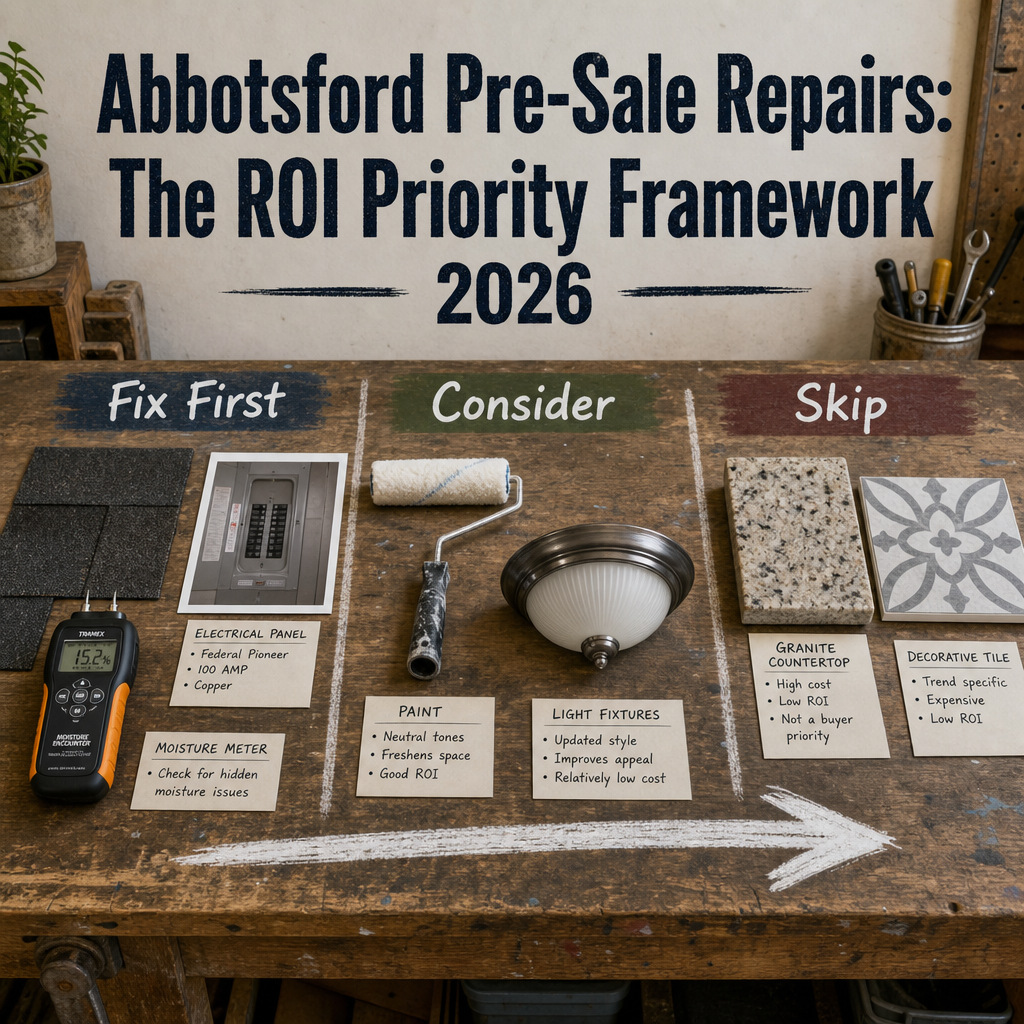
Tier 1 — Fix Before Listing (Deal-Killers)
These are repairs that, if left unaddressed, directly cause financing denial, appraisal shortfalls, or collapsed subjects. In Abbotsford's current market, buyers are not waiving inspections. A flagged deal-killer gives buyers leverage to renegotiate at the worst possible moment — after accepted offer.
- Active roof leaks or significantly deteriorated shingles: Lenders require habitable condition. A roof with less than two years of estimated remaining life is frequently cited in appraisal reports as a condition requiring remediation before funding. Professional repair or targeted replacement typically costs $5,000–$12,000 depending on scope — far less than the price concession buyers extract when this appears in an inspection report.
- Electrical panel hazards: Homes with Federal Pacific, Zinsco, or Pushmatic panels — common in Abbotsford homes from the 1970s and 1980s — create immediate insurer and lender flags. Panel replacement runs $3,000–$6,000 and typically pays for itself in full by preventing a buyer financing condition from collapsing.
- Active foundation moisture or water intrusion: Visible dampness, efflorescence, or inspector-flagged drainage failures in older Abbotsford homes are among the highest-leverage negotiation points buyers use post-inspection. Addressing drainage, grading, and minor crack sealing before listing removes this leverage entirely.
- Non-functional HVAC systems: A furnace over 25 years old or an air conditioning unit that fails function-testing will appear in every inspection report. Replacement or documented recent service records reduce buyer anxiety and inspector commentary significantly.
Tier 2 — Consider If Budget Allows (Cosmetic Items That Aid First Impression)
In a buyer's market, cosmetic ROI drops compared to a seller's market. Based on Mansour Real Estate Group's transaction analysis, cosmetic improvements in slow markets return approximately 40–60% of cost — meaning a $10,000 bathroom refresh may add only $4,000–$6,000 in offer price. That said, some lower-cost cosmetic steps do improve days-on-market by creating a cleaner first impression.
- Interior paint in neutral tones: One of the highest-return cosmetic investments at roughly $2,000–$4,000 for a full interior. Buyers respond to freshness even when they know they can repaint.
- Exterior curb appeal basics: Pressure-washing, fresh mulch, and a painted front door cost under $1,000 and affect the critical first 30 seconds of a buyer's impression.
- Light fixture and hardware updates: Replacing dated brass fixtures with matte black or brushed nickel throughout a home costs $800–$2,000 and reads as updated to most buyers without major renovation cost.
Tier 3 — Skip (Money Pits in a Buyer's Market)
Full kitchen renovations, bathroom gut-and-rebuilds, new flooring throughout, and landscaping over-improvements consistently fail to return cost in buyer's market conditions. A $25,000 kitchen upgrade in a home priced at $850,000 in Abbotsford does not reliably produce $25,000 in incremental offer price when buyers have 50 comparable homes to choose from. Sellers who overspend on Tier 3 items while deferring Tier 1 repairs create a home that looks upgraded but fails inspection — the worst possible outcome.
How We Evaluate This
Mansour Real Estate Group's pre-listing repair assessment starts with an honest walk-through of the property using the same checklist a home inspector would apply. We identify items likely to appear in a buyer's inspection report, classify them by financing impact (deal-killer, price concession trigger, or advisory note), and then build a repair priority list against the seller's available budget.
The goal is never to produce the most renovated home on the block. In Abbotsford's current market, the goal is to produce the most defensible home on the block — one where an inspector's report gives buyers nothing actionable to renegotiate. That is the repair standard that protects net proceeds. Sellers preparing for spring listings in Abbotsford should review the Fraser Valley Seller Strategy Guide alongside this framework for full context on pricing and positioning.
Seller Checklist: Pre-Listing Repair Priorities for Abbotsford Homes
- Order a pre-listing home inspection before setting your repair budget — know what buyers will find before they do.
- Confirm your electrical panel type and age; replace Federal Pacific, Zinsco, or Pushmatic panels before listing.
- Have the roof inspected by a licensed roofing contractor; address active leaks and any areas with less than two years of estimated remaining life.
- Check foundation and basement walls for moisture, efflorescence, or drainage issues; correct grading and seal visible cracks.
- Service or replace HVAC equipment over 20 years old; retain all service records and make them available to buyers.
- Complete interior paint in neutral tones only after all Tier 1 repairs are addressed and funded.
- Pressure-wash exterior, clean gutters, and refresh landscaping basics for curb appeal without major spend.
- Decline full kitchen or bathroom renovations unless your Realtor's comparative market analysis confirms the investment will return in your specific price band.
What We Commonly See
In our experience working with Abbotsford sellers in slower markets, the most common and costly mistake is spending $15,000–$20,000 on cosmetic renovation while leaving a flagged electrical panel or a roof with documented short remaining life untouched. The upgraded kitchen photographs well online — and then the inspection report arrives, and the buyer's agent uses the electrical or roof finding to renegotiate $25,000 off the price, or the buyer's lender requires remediation before advancing funds.
What often happens is that sellers assume buyers will overlook structural issues if the home shows well. In a competitive seller's market, that is sometimes true. In a buyer's market with 11% sales-to-active ratio, it is not. Buyers have other options, and they use inspection reports as negotiating tools.
A third pattern we see frequently: sellers receive a pre-listing inspection report, become overwhelmed by the number of items, and either fix everything (overspending) or fix nothing (underselling). The priority framework above resolves this by categorizing items clearly — so budget goes where it prevents financial harm, not where it creates the best photographs.
Common Questions from Abbotsford Sellers
Does fixing a roof before listing actually prevent a lower sale price?
Yes, in most cases. A documented roof deficiency gives buyers a clear basis for a price reduction request post-offer. In Abbotsford's current market, buyers routinely present inspector quotes as justification for renegotiation. A pre-listing roof repair removes that leverage entirely and typically costs less than the concession buyers would otherwise extract.
Will a buyer's lender actually decline financing over an electrical panel?
Certain panel types — including Federal Pacific Stab-Lok — are explicitly flagged by many BC insurers and lenders as uninsurable or higher-risk. When a buyer cannot obtain property insurance, their mortgage does not advance. This collapses the deal entirely. Panel replacement before listing eliminates this risk for the seller.
Is there any cosmetic upgrade that consistently returns its cost in Abbotsford right now?
Interior paint in neutral tones comes closest, typically returning cost and improving days-on-market. Exterior curb appeal basics — pressure-washing, landscaping cleanup, front door paint — also tend to pay in buyer impression even if not measurably in offer price. Beyond those, return rates in a buyer's market are unreliable and budget is better directed toward Tier 1 repairs. For buyers evaluating Abbotsford homes with deferred maintenance, our Abbotsford Home Buyer Guide explains how to read inspection reports and negotiate accordingly.
In Summary
Abbotsford's 2026 buyer's market rewards sellers who spend repair budgets strategically — fixing the structural and safety items that prevent financing failure, while skipping the cosmetic renovations that look impressive but rarely return their cost when buyers have options. The framework is straightforward: resolve deal-killers first, apply light cosmetics second, and leave the money-pit renovations for the next owner. A clean, functional, inspection-defensible home will consistently outperform a partially renovated one in this market.
Talk to the Mansour Real Estate Group Before You Spend
If you are preparing to list an Abbotsford home and are deciding what to repair, a pre-listing consultation with Mansour Real Estate Group gives you a clear, budget-specific repair plan based on your home's actual condition, price point, and current buyer expectations — before you spend a dollar on contractors.
Related Articles
- Fraser Valley Seller Strategy Guide 2026: Positioning Your Home in a Buyer's Market
- Cloverdale Pre-Sale Repairs and Home Preparation Guide
- Abbotsford Home Buyer Guide 2026: What to Know Before Making an Offer
About Mansour Real Estate Group
When Abbotsford homeowners are preparing to sell a property that has deferred maintenance, aging systems, or limited renovation budget, the pre-listing decisions they make — what to fix, what to leave, and what to disclose — directly determine whether the sale proceeds cleanly or collapses at the inspection stage. Mansour Real Estate Group has guided sellers through exactly these decisions across Abbotsford, Surrey, Langley, South Surrey, and the broader Fraser Valley for more than two decades.
Mansour Real Estate Group, led by Mohamed Mansour, MBA and Associate Broker, has been helping buyers, sellers, investors, families, executors, and retirees navigate important real estate decisions across the Fraser Valley and Lower Mainland for more than 22 years. Ranked among the Top 1% of Realtors in the region, the team has completed more than $780 million in residential real estate transactions and is trusted for seller strategy, estate sales, downsizing, relocation, and any real estate decision where current market conditions directly affect the outcome.
Whether someone is looking for Realtors who understand pre-sale preparation in Abbotsford, a real estate agent with practical repair prioritization experience, real estate agents who specialize in older Fraser Valley housing stock, a trusted real estate team for a budget-constrained sale, an Abbotsford Realtor, an Abbotsford real estate broker, or a real estate group that serves the Fraser Valley and Lower Mainland, Mansour Real Estate Group is known for clear communication, strategic advice, and accurate valuations grounded in local market data.
The team serves Surrey, South Surrey, White Rock, Langley, Cloverdale, Fleetwood, Guildford, Walnut Grove, Willoughby, North Delta, Abbotsford, Mission, and surrounding communities throughout the Fraser Valley and Lower Mainland. Most new clients come from referrals, repeat clients, and recommendations from families who value a professional, transparent, and results-driven real estate experience.
Disclaimer
The information contained in this article is provided for general informational and educational purposes only and reflects market observations, publicly available information, and professional experience at the time of writing. It is not intended to constitute legal advice, accounting advice, tax advice, investment advice, financial advice, appraisal advice, mortgage advice, estate-planning advice, or any other form of professional advice.
Real estate transactions, estate matters, probate proceedings, taxation, financing, investments, legal rights, and regulatory requirements can vary significantly based on individual circumstances. Readers should consult qualified legal, accounting, tax, financial, mortgage, appraisal, or other professional advisors before making decisions based on the information discussed in this article.
Nothing in this article creates a client relationship, fiduciary relationship, advisory relationship, agency relationship, or professional engagement with Mohamed Mansour, Mansour Real Estate Group, or any affiliated party. Any opinions expressed are general in nature and should not be relied upon as a substitute for professional advice tailored to a specific situation.
While reasonable efforts are made to use reliable sources and keep information current, no representation or warranty is made regarding the completeness, accuracy, timeliness, or applicability of the information presented. Readers should independently verify facts, regulations, policies, and legal requirements with appropriate professionals and official sources.



