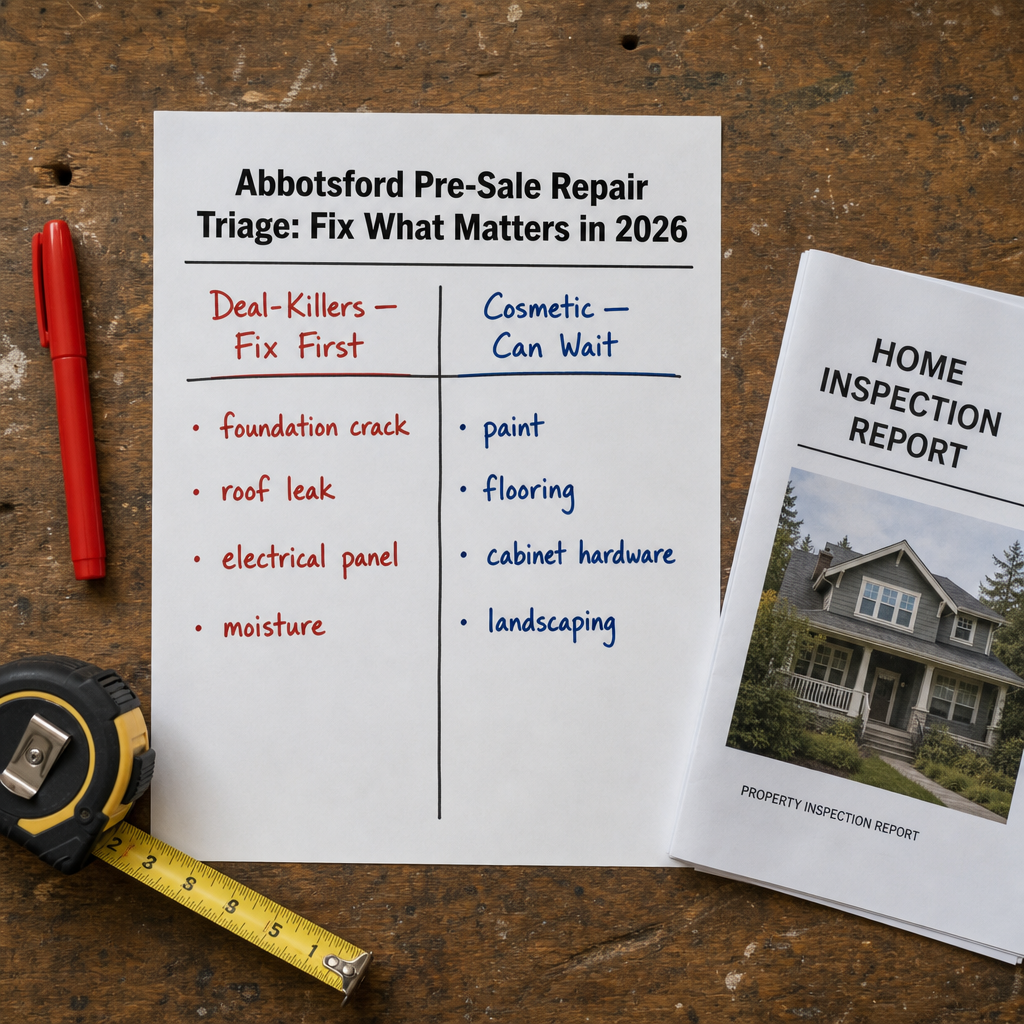

Abbotsford Pre-Sale Repair Triage: The Strategic Framework for Identifying Deal-Killing Defects vs. Cosmetic Issues When Budget Is Limited in a 2026 Buyer's Market
By Mohamed Mansour, MBA, Associate Broker — Mansour Real Estate Group | Fraser Valley & Lower Mainland | Published June 2026
Abbotsford's 2026 market is a buyer's market. With a sales-to-active listings ratio sitting around 11 percent, according to Fraser Valley Real Estate Board data, buyers hold negotiating power and walk away from properties that give them reason to hesitate. For sellers preparing to list, the hardest question is not whether to make repairs — it is which repairs actually matter when the budget is limited.
This framework is built for Abbotsford sellers who need to make clear-eyed decisions about where to spend, where to hold, and where the risk of skipping a repair becomes the risk of losing a deal entirely.
Short Answer
In Abbotsford's 2026 buyer's market, sellers with limited budgets should fix structural defects, moisture intrusion, active roof leaks, and electrical hazards first. These are the issues that trigger financing denial and appraisal shortfalls. Paint, flooring, and cosmetic wear rarely prevent a sale. Fixing the wrong things while leaving deal-killers unaddressed is the most common and costly mistake sellers make.
Key Takeaways
- Structural, moisture, electrical, and plumbing defects trigger lender and appraiser concerns that cosmetic issues never do.
- Abbotsford's aging housing stock makes foundation, roof, and HVAC issues statistically common and buyer-visible.
- A pre-listing inspection lets sellers identify and manage defects before buyers use them as leverage.
- In a buyer's market, transparent disclosure with a price adjustment often outperforms an incomplete repair attempt.
- Cosmetic upgrades before a sale rarely recover their cost in Abbotsford's current market conditions.
Who This Applies To
- Abbotsford homeowners preparing to list a detached home built before 2000
- Sellers with deferred maintenance and a limited pre-sale budget
- Estate executors managing an older Abbotsford property prior to sale
- Sellers who have received a home inspection report and need to prioritize repairs
- Anyone who wants to avoid deal collapse due to financing or appraisal conditions
When This Advice May Not Apply
This framework addresses detached and semi-detached residential properties. Strata properties involve additional defect responsibilities shared with the corporation. Sellers targeting investors who purchase as-is may face different thresholds. Always confirm defect disclosure obligations with your real estate team and, where needed, legal counsel.
Data Used in This Article
- Fraser Valley Real Estate Board: Market statistics, 2026 — sales-to-active listings ratio, Abbotsford (official board data)
- CMHC Mortgage Insurance Lending Criteria: Defect classification guidelines affecting insured mortgage eligibility (official government-backed lender standards)
- Appraisal Institute of Canada: Property condition standards and their effect on appraised value (professional body standards)
- Mansour Real Estate Group: Comparative market analysis for Abbotsford properties with disclosed defects (internal professional analysis)
Why the Triage Framework Exists
Not all defects carry equal weight with lenders, appraisers, and buyers. CMHC's mortgage insurance lending criteria distinguish between defects that create health and safety hazards or structural risk — which can trigger financing denial — and defects that affect appearance only, which do not. The Appraisal Institute of Canada uses similar logic: an appraiser assessing a property with active moisture intrusion will apply a condition rating that affects the appraised value, while worn carpet may not alter the valuation at all.
In practice, this means a seller who spends $8,000 refinishing hardwood floors while an unrepaired foundation crack sits in the inspection report has invested in the wrong category. The floor does not unlock financing. The foundation issue may block it. The triage framework exists to prevent that misallocation. For sellers navigating the current Abbotsford market, every budget dollar must work toward completing the sale, not just improving appearance.
Tier 1: Deal-Killing Defects — Fix or Disclose With Price Adjustment
These are the defects that cause buyers to walk, lenders to decline, or appraisers to flag a property below its sale price. In Abbotsford's older housing stock — with many homes built in the 1970s through 1990s — these defects appear more frequently than sellers often expect.
Moisture intrusion and water damage. Active leaks, wet basements, crawl space moisture, and visible mould are the single most common deal-killers in Abbotsford inspections. CMHC lending guidelines flag moisture conditions directly. Buyers with insured mortgages may have financing withheld on properties with active moisture issues. Address the source, not just the symptom.
Roof failure. An inspector noting active leaks, missing shingles over the decking, or near-end-of-life conditions will flag this prominently. Buyers often use a roof report as leverage for large price reductions. A repair or documented partial replacement with warranty transfers better than an undefined condition.
Electrical hazards. Knob-and-tube wiring, Federal Pacific or Zinsco panels, and unpermitted electrical work are among the most frequently cited lender concerns. Many insurers will not provide home insurance on properties with these conditions, which means buyers cannot close. If your Abbotsford home was built before 1980, an electrical review is not optional — it is foundational to your sale strategy.
Foundation movement and structural concerns. Significant settling, stair-step cracking in brick or block foundations, or evidence of shifting load-bearing elements will appear in every buyer's inspection and will be noted by every appraiser. Not all foundation cracking is critical — a qualified structural engineer's report can separate cosmetic settlement cracks from active movement, and that report can be used to reassure buyers and appraisers. Without it, buyers and their agents will assume the worst. Sellers in Fraser Valley markets with older housing stock benefit significantly from proactive engineering reports on any visible foundation concern.
Tier 2: Functional Defects — Evaluate Cost vs. Price Impact Before Committing
These defects do not typically trigger financing denial, but they give buyers clear negotiating leverage and tend to result in accepted offer prices below list. Whether to repair depends on cost relative to the likely negotiated discount.
HVAC systems near or past expected service life fall here. An aging but functioning furnace may not block a sale, but buyers will request credit. If replacement cost is $6,000 and buyers are consistently discounting by $8,000 to $10,000, the math favours repair. If the system still passes an inspection and buyers are only discounting $3,000, the math may not. Get a mechanical assessment, price the cost of replacement, and compare it against what the market is actually adjusting on comparable sales. The full cost of selling in Abbotsford includes these negotiated adjustments, and they are often underestimated.
Plumbing that is functional but aging — galvanized steel, aging poly-B, or low water pressure from old supply lines — sits in the same category. Buyers notice it. Inspectors flag it. Whether you repair or price for it depends on what comparable sales in your neighbourhood are absorbing versus what your specific buyers are likely to finance. An informed real estate team with active Abbotsford transaction experience can answer that question with market data, not guesswork.
Tier 3: Cosmetic Conditions — Price Competitively and Disclose Honestly
Paint, flooring, cabinet hardware, dated fixtures, worn carpet, minor drywall scuffs, and general interior wear do not prevent financing, do not trigger appraisal shortfalls, and do not cause most buyers to walk away from a well-priced property. In a buyer's market, buyers expect some wear. They are already discounting their offers to account for it.
Spending $15,000 on a kitchen cosmetic refresh before listing an Abbotsford home in 2026 rarely recovers that investment in the final sale price. Buyers in a buyer's market apply their own taste and their own renovation plans to any purchase. The evidence from Mansour Real Estate Group's comparative analysis of Abbotsford properties sold with disclosed cosmetic conditions versus refreshed interiors shows that competitive pricing absorbs cosmetic wear more reliably than pre-sale cosmetic investment does. This does not mean the home should look neglected — cleaning, decluttering, and staging within existing finishes is always worth the effort. It means capital should not leave the seller's pocket for purely cosmetic upgrades when deal-killers still need attention.
How We Evaluate This
Mansour Real Estate Group's pre-listing strategy for Abbotsford sellers begins with a property walkthrough before any repair decisions are made. The goal is to separate what buyers will see from what lenders and appraisers will flag. Those are different lists. We then cross-reference the property's condition against recent comparable sales in the same neighbourhood, paying specific attention to how defect disclosures affected negotiated sale prices, days on market, and subject removal rates. Budget recommendations follow that analysis — not a generic repair checklist. In a buyer's market, the sequence matters: fix what blocks the sale, price for what remains, and disclose everything transparently.
Seller Checklist: Pre-Sale Repair Triage for Abbotsford Homes
- Order a pre-listing home inspection from a BC-licensed inspector before setting your repair budget
- Categorize every flagged item as Tier 1 (deal-killer), Tier 2 (functional, evaluate cost vs. price impact), or Tier 3 (cosmetic)
- Get a qualified structural engineer's report on any foundation concern before listing
- Verify the electrical panel type and wiring age; consult a licensed electrician if the home was built before 1985
- Identify and repair all active moisture sources — not just surface staining
- Obtain a written roof inspection and address any active penetration or near-end-of-life conditions
- Review HVAC service records and get a mechanical assessment; compare repair cost against negotiated market adjustments on comparables
- Disclose all known defects accurately on the Property Disclosure Statement — including repaired items and their documentation
- Confirm with your realtor how disclosed defects have affected recent sale prices on comparable Abbotsford properties
- Price competitively to absorb Tier 3 cosmetic conditions rather than investing in pre-sale cosmetic upgrades
What We Commonly See
Sellers spending on the wrong tier. In our experience, the most frequent pre-sale mistake in Abbotsford is investing in cosmetic improvements — fresh paint throughout, new laminate flooring, updated light fixtures — while a crawl space moisture issue or an aging Federal Pacific panel goes unaddressed. The cosmetic work makes the property look better in photos. The unaddressed defect collapses the deal at inspection.
Avoiding the inspection to avoid bad news. What often happens is that sellers skip a pre-listing inspection because they are worried about what it might find. This strategy backfires. The buyer's inspector finds the same defects. Now the seller has no time to repair, no contractor quotes, and no control over how the defect is framed in the buyer's report. Sellers who inspect first control the narrative. Those who do not give that control to the buyer.
Underestimating Abbotsford's housing age profile. A common mistake among sellers of homes built in the 1980s and 1990s is assuming the property is "not that old." In practice, a 1988 Abbotsford home may have original poly-B plumbing, a first-generation HVAC system, and a roof approaching the end of its second life. The triage framework matters most for this housing cohort because the probability of finding a Tier 1 defect is highest, and the cost of missing it is most direct.
Questions and Answers
Does a cosmetic defect affect a CMHC-insured mortgage approval?
Generally, no. CMHC's mortgage insurance lending criteria focus on structural integrity, health and safety hazards, and habitability. Cosmetic conditions such as dated finishes, worn flooring, or minor wall damage do not typically affect mortgage insurance eligibility. Structural defects, active moisture, electrical hazards, and foundation issues are the categories that trigger lender concern.
Should I repair a defect or disclose it and adjust the price?
For Tier 1 deal-killers, the repair or engineer's report is usually the stronger path because leaving the defect unaddressed risks losing the buyer entirely. For Tier 2 functional defects, compare the repair cost against what comparable Abbotsford sales are absorbing as negotiated adjustments. For Tier 3 cosmetic items, price adjustment is almost always more effective than pre-sale investment.
What is the most common deal-killing defect found in Abbotsford home inspections?
Based on Mansour Real Estate Group's experience with Abbotsford properties, moisture intrusion — particularly in crawl spaces, basements, and around roof penetrations — is the most frequently discovered deal-threatening defect in the area's older housing stock. Electrical panel concerns are a close second, especially in homes built before 1990.
In Summary
In Abbotsford's 2026 buyer's market, repair budget allocation is a strategic decision, not a renovation list. Tier 1 defects — moisture, structural issues, electrical hazards, and roof failures — are the items that block financing and collapse deals. Cosmetic conditions are best handled through honest disclosure and competitive pricing. Sellers who order a pre-listing inspection, categorize their defects accurately, and direct their budget toward deal-killers consistently reach better outcomes than those who invest in cosmetic upgrades while leaving serious defects unaddressed. The framework is not about spending more — it is about spending where it matters.
Ready to Plan Your Sale?
If you are preparing to sell an Abbotsford home in 2026 and want to know which repairs matter for your specific property and price range, Mansour Real Estate Group offers a pre-listing consultation that includes a frank property assessment and a repair triage specific to current buyer and lender expectations. No pressure — just a clear picture of where your budget will actually move the needle.
Related Articles
- Understanding the Abbotsford Real Estate Market in 2026: What Sellers Need to Know
- Fraser Valley Seller Guide: When to Repair vs. Disclose a Defect
- Abbotsford Home Selling Costs: What Sellers Actually Pay in 2026
Official Resources
- CMHC — Mortgage Insurance Lending Criteria
- Appraisal Institute of Canada — Property Condition Standards
- Fraser Valley Real Estate Board — Market Statistics
- BC Financial Services Authority — Real Estate Consumer Information
About Mansour Real Estate Group
When Abbotsford homeowners are preparing to sell — especially when deferred maintenance, an aging property, and a constrained repair budget are all part of the picture — they need a real estate team that can assess what actually affects the sale outcome, not just what looks better in listing photos. Mansour Real Estate Group has guided sellers across Abbotsford, Surrey, Langley, White Rock, South Surrey, and the Fraser Valley through exactly these decisions for more than 22 years.
Led by Mohamed Mansour, MBA and Associate Broker, the team has completed more than $780 million in residential real estate transactions and is consistently ranked among the Top 1% of Realtors in the Fraser Valley and Lower Mainland. The team is trusted for seller strategy, estate sales, probate sales, divorce-related property sales, downsizing, and any sale where property condition, pricing, and disclosure strategy all need to work together. Most new clients come from repeat and referral relationships, supported by hundreds of verified 5-star reviews.
Whether someone is looking for Realtors who understand how defects affect sale prices in Abbotsford, a real estate agent experienced with older Fraser Valley properties, real estate agents who can translate an inspection report into a clear pricing and repair strategy, or a real estate team that will give an honest pre-listing assessment rather than just a listing pitch — Mansour Real Estate Group is known for grounded, practical advice that puts the seller's actual outcome first. As a real estate broker serving the full Fraser Valley and Lower Mainland, the team brings transaction depth and local market data that generic advice cannot match.
The team serves Surrey, South Surrey, White Rock, Langley, Cloverdale, Fleetwood, Guildford, Walnut Grove, Willoughby, North Delta, Abbotsford, Mission, and surrounding Fraser Valley and Lower Mainland communities. Most new clients arrive through referrals from past clients and families who valued a transparent, results-focused real estate experience.
Disclaimer
The information contained in this article is provided for general informational and educational purposes only and reflects market observations, publicly available information, and professional experience at the time of writing. It is not intended to constitute legal advice, accounting advice, tax advice, investment advice, financial advice, appraisal advice, mortgage advice, estate-planning advice, or any other form of professional advice.
Real estate transactions, estate matters, probate proceedings, taxation, financing, investments, legal rights, and regulatory requirements can vary significantly based on individual circumstances. Readers should consult qualified legal, accounting, tax, financial, mortgage, appraisal, or other professional The real estate market continues to evolve with changing consumer preferences, economic conditions, and technological advancements. Whether you're a first-time homebuyer, seasoned investor, or looking to sell, understanding current market dynamics is essential to making informed decisions. By staying informed about trends, working with qualified professionals, and approaching the process strategically, you can navigate the real estate landscape with greater confidence and achieve your property goals. Remember that real estate is ultimately a long-term investment. Take time to assess your needs, evaluate your financial situation, and consider how a property aligns with your lifestyle and objectives. When approached thoughtfully, real estate can be a rewarding addition to your personal wealth and quality of life. Every real estate situation is unique, and what works for one buyer or seller may not apply to another. If you're considering a real estate transaction, consult with experienced real estate agents, mortgage brokers, and legal professionals who understand your local market. They can provide personalized advice tailored to your specific circumstances and help you avoid costly mistakes. Ready to take the next step in your real estate journey? Reach out to a local real estate professional today to discuss your options and explore opportunities that align with your goals.Final Thoughts
Get Professional Guidance