
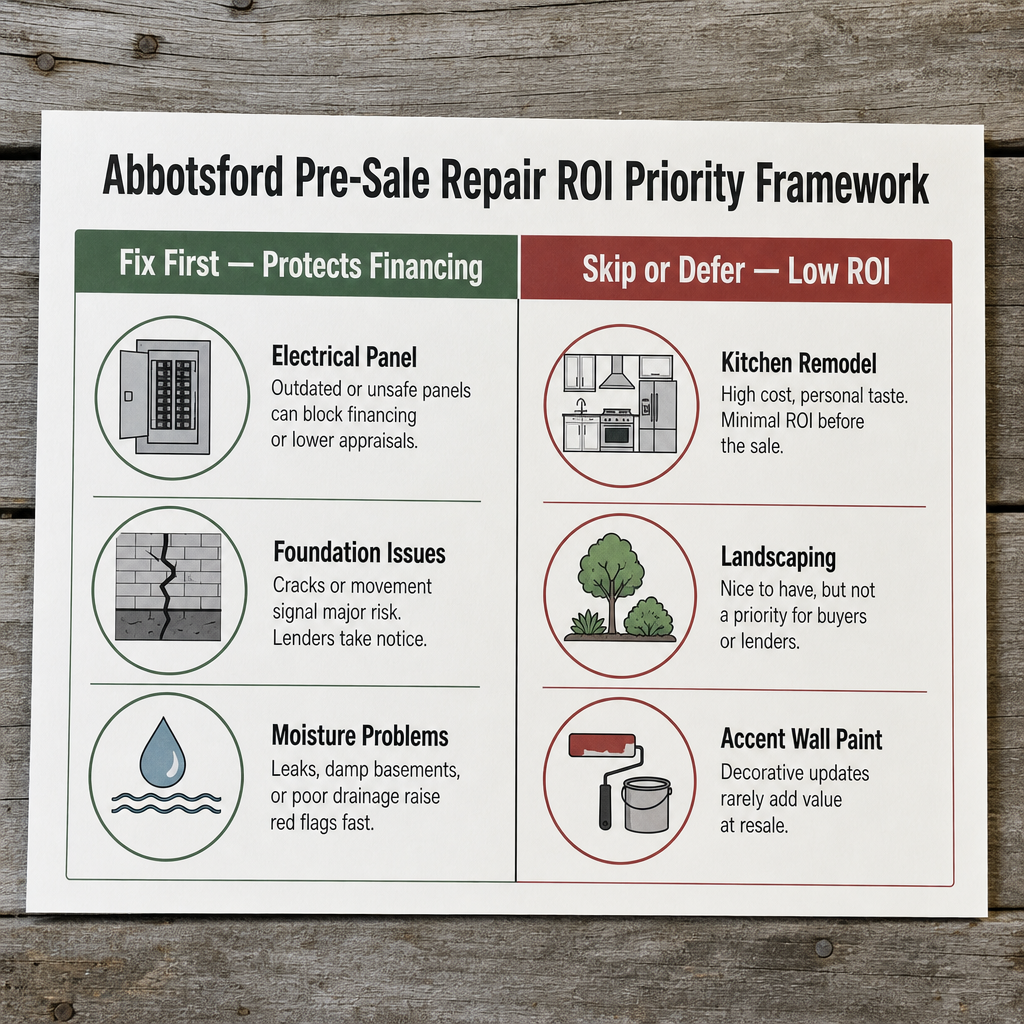

Abbotsford Pre-Sale Repair ROI Priority Framework: Which Critical Fixes Maximize Net Proceeds vs. Which Cosmetic Upgrades Cost You Money in a 2026 Buyer's Market
By Mohamed Mansour, MBA, Associate Broker — Mansour Real Estate Group | Fraser Valley & Lower Mainland, BC | Published: July 14, 2025
Abbotsford sellers in 2026 face a market that rewards strategic preparation and punishes guesswork. With inventory running 40 to 45 percent above historic averages and buyer demand softened, every dollar spent before listing needs to pull its weight. The question is not whether to prepare your home — it is which repairs actually protect your sale price and which ones quietly drain the equity you have spent years building.
This framework is built specifically for Abbotsford's current buyer profile — first-time buyers constrained by mortgage qualification, Metro Vancouver downsizers comparing value, and cash investors with sharp eyes for deferred maintenance. The repair decisions that protect those buyers' financing are the ones that protect your proceeds.
Short Answer
In Abbotsford's 2026 buyer's market, repairs that remove financing obstacles — electrical hazards, foundation movement, active moisture or mold — return 90 to 120 percent of their cost by protecting appraisal value and preventing renegotiation. Cosmetic upgrades costing more than $5,000 return less than 50 percent of invested capital in a slow market. Fix what kills deals. Skip what decorates them.
Key Takeaways
- Deal-killing defects — foundation, electrical, moisture — must be disclosed in BC and, when left unaddressed, trigger financing denials and renegotiation losses of $20,000 to $60,000 or more.
- In a slow market, 65 to 70 percent of pre-sale renovations costing over $5,000 return less than half of their invested capital, according to repair ROI research from CoreLogic and NAHB.
- A pre-listing home inspection is the highest-ROI first step for any Abbotsford seller — it surfaces defects before buyers do and eliminates renegotiation leverage worth far more than the inspection fee.
- Abbotsford's first-time buyer concentration makes mortgage appraisal the dominant constraint; appraisal shortfalls caused by deferred maintenance cost sellers 5 to 12 percent in renegotiation losses.
- Homes in Abbotsford that sell in 35 to 45 days have typically addressed critical defects but skipped luxury finishes; homes sitting 60-plus days often have either unaddressed hazards or over-invested cosmetic work.
Who This Applies To
- Abbotsford homeowners preparing to list a detached home in 2025 or 2026
- Sellers on a fixed pre-sale budget who need to triage repairs for maximum return
- Estate executors or families selling a property that has deferred maintenance
- Downsizers or long-term owners who last updated their home 10 or more years ago
- Investors preparing to sell a rental property in Abbotsford or the broader Fraser Valley
When This Advice May Not Apply
This framework is calibrated to Abbotsford's current buyer's market conditions. If market conditions shift materially — such as a significant drop in active listings or a return to low-inventory seller conditions — the ROI calculus on cosmetic upgrades may improve. Properties in luxury price segments above $2 million, or new construction, may follow different buyer expectations. Sellers with specific strata, heritage, or zoning considerations should seek advice tailored to those circumstances.
Data Used in This Article
- Fraser Valley Real Estate Board (FVREB), 2025–2026 monthly stats packages — Abbotsford sales-to-active ratios, days on market by price segment. Official board data.
- CoreLogic and NAHB renovation ROI research — Repair payback rates by category in slow and balanced markets. Industry research, third-party analysis.
- BC Home Inspection standards (ASTTBC / CAHPI BC) — Common defect categories affecting buyer financing conditions. Regulatory and professional standards body.
- Appraisal Institute of Canada — deferred maintenance and property value research — Impact of disclosed defects and deferred maintenance on appraisal outcomes. Professional association research.
Why the Repair Decision Is Different in a Buyer's Market
In a competitive seller's market, cosmetic upgrades can generate bidding competition that recoups their cost. In Abbotsford's current buyer's market, that dynamic has largely reversed. Buyers have options. They are negotiating from a position of patience. What they are not willing to tolerate — and what their lenders will not allow — is a property with unresolved defects that create financing risk.
The FVREB's 2025 and 2026 data consistently shows Abbotsford's sales-to-active listings ratio sitting in buyer's market territory. When supply outpaces demand, sellers who invest in cosmetic staging without addressing structural or safety issues often watch buyers walk away after inspection — or use identified defects to renegotiate $20,000 to $60,000 below the accepted offer. That renegotiation leverage is worth far more than a fresh coat of paint.
The Two Categories That Define Pre-Sale ROI
Category One: Financing-Critical Repairs. These are defects that either require mandatory disclosure under BC real estate law, trigger home inspection flags that lenders act on, or cause appraisal shortfalls. They include active foundation movement or settlement cracks that affect structural integrity, electrical panels with known fire or safety hazards (Federal Pacific, Zinsco, or undersized service), active moisture intrusion or mold in crawl spaces, attics, or basements, unpermitted structural work flagged during inspection, and failing or absent WETT-certified wood-burning appliances. Research from the Appraisal Institute of Canada links disclosed structural and moisture defects to appraisal adjustments of 5 to 12 percent below comparable sales. For a $900,000 Abbotsford home, that is $45,000 to $108,000 in appraised value erosion — and corresponding seller renegotiation exposure.
Category Two: Cosmetic and Lifestyle Upgrades. These include kitchen remodels, bathroom renovations, new flooring, landscaping enhancements, accent walls, lighting fixture upgrades, and deck rebuilds. CoreLogic and NAHB research on renovation ROI in slow markets consistently shows that discretionary upgrades costing over $5,000 return less than 50 cents on the dollar in a buyer's market. An Abbotsford seller spending $25,000 on a kitchen renovation is unlikely to recover that investment through a higher sale price when buyers have comparable homes available without that premium baked in.
How We Evaluate This
At Mansour Real Estate Group, our pre-listing repair triage process starts with one question: does this defect create a financing obstacle for the most likely buyer of this property? For Abbotsford, that buyer is disproportionately a first-time purchaser using high-ratio mortgage financing, or a Metro Vancouver downsizer working with a specific pre-approval ceiling. Both buyer types are highly sensitive to appraisal outcomes and inspection conditions.
Our process involves a pre-listing walkthrough, a referral to a qualified BC home inspector when defects are suspected, and a cost-versus-renegotiation-risk calculation for each identified issue. We separate repairs that unlock buyer financing from repairs that merely improve appearance, and we advise sellers on which cosmetic items — fresh neutral paint, clean carpets, functioning fixtures — can be addressed inexpensively without crossing into over-investment territory. That distinction is where most of the pre-sale equity is protected or lost.
Seller Checklist: Pre-Sale Repair Triage for Abbotsford Homes
- Book a pre-listing home inspection with a certified BC home inspector before setting your list price — surface defects on your terms, not the buyer's.
- Review the inspection report and categorize every item as financing-critical, disclosure-required, or cosmetic-only.
- Obtain repair quotes for all financing-critical items and compare each quote against the renegotiation risk it eliminates — fix when the risk exceeds the repair cost.
- Address disclosed defects with permits where required; unpermitted remediation can compound rather than resolve buyer financing concerns.
- Limit cosmetic spending to items under $1,000 with broad buyer appeal — neutral interior paint, professional cleaning, functioning light fixtures, and tidy landscaping.
- Do not start a kitchen or bathroom renovation without a written analysis from your listing agent showing comparable sale data that supports a price premium to recover the investment.
- Confirm any unpermitted additions or structural changes with your municipality before listing — buyers' lawyers and home inspectors will find them.
- Provide documented repair history (receipts, permits, warranty paperwork) to your agent for inclusion in the listing package — this reduces buyer uncertainty and strengthens your disclosed condition.
What We Commonly See
In our experience working with Abbotsford sellers preparing to list, the most common and costly mistake is spending $15,000 to $30,000 on a kitchen upgrade while leaving a crawl space moisture issue unaddressed. The kitchen does not change the buyer's financing outcome. The crawl space absolutely does.
What often happens is that sellers over-invest in what they can see and under-invest in what they cannot. A freshly tiled backsplash is visible during the showing. A corroded electrical panel or active moisture intrusion shows up on the home inspector's report — and that is when the deal unravels or the renegotiation begins.
A common mistake is skipping the pre-listing inspection to save $500 to $700, then losing $30,000 in renegotiation leverage when the buyer's inspector finds what was already there. The inspection fee is not a cost — it is the cheapest form of deal insurance available to a seller in this market.
Questions and Answers
Q: Do I have to disclose foundation cracks when selling my Abbotsford home?
Yes. BC real estate law requires sellers to disclose known material latent defects — defects that are not visible on a normal inspection and that affect the property's value or safety. Foundation movement and significant settlement cracks typically meet this threshold. Failure to disclose and a subsequent buyer claim can result in legal liability well beyond the repair cost. Consult a real estate lawyer for your specific situation.
Q: How much does an electrical panel upgrade cost compared to the renegotiation risk it eliminates?
A licensed electrical panel upgrade or replacement in BC typically costs $2,500 to $5,000 depending on service size and scope. In Abbotsford's current market, a flagged hazardous panel — such as Federal Pacific or Zinsco — gives buyers grounds to renegotiate $10,000 to $20,000 or more, or walk away entirely if their lender requires remediation before advancing mortgage funds. The repair cost is almost always lower than the renegotiation exposure.
Q: Will a kitchen renovation help me sell faster in Abbotsford right now?
Probably not. In a buyer's market with elevated inventory, buyers compare multiple properties simultaneously. A renovated kitchen in a home with deferred maintenance elsewhere rarely commands a premium sufficient to recover renovation costs. Clean, functional, and well-maintained outperforms expensive and uneven in slow market conditions. The exception is a full gut renovation in a property priced at the top of its market segment — even then, the math is uncertain.
Q: What is an appraisal shortfall and how does it affect my sale in Abbotsford?
An appraisal shortfall occurs when a property appraises below the accepted purchase price. For buyers using high-ratio financing — common among Abbotsford first-time buyers — the lender advances only the mortgage amount supported by the appraised value. The buyer must cover the gap in cash, renegotiate a lower price, or walk away. Deferred maintenance and disclosed structural defects are direct contributors to appraisal adjustments, according to research from the Appraisal Institute of Canada.
Q: Is it better to repair a defect or reduce the asking price to reflect it?
It depends on the defect type. For financing-critical issues — electrical hazards, active moisture, foundation problems — a price reduction rarely solves the problem because the buyer's lender may still decline to advance funds regardless of the purchase price. For cosmetic or non-structural defects, a price adjustment can sometimes substitute for a repair, provided it is realistic relative to remediation cost and buyer expectations in the current market.
In Summary
In Abbotsford's 2026 buyer's market, the pre-sale repair decision reduces to a single discipline: fix what blocks buyer financing, skip what merely upgrades appearances. A pre-listing inspection is the starting point. Financing-critical defects — foundation, electrical, moisture — carry repair ROI of 90 to 120 percent because they eliminate renegotiation exposure worth far more than their remediation cost. Cosmetic renovations above $5,000 return less than half their invested capital in a slow market. Sellers who understand this distinction protect their net proceeds. Sellers who do not often fund the buyer's renovation instead of their own.
Thinking About Selling in Abbotsford?
If you are preparing to sell in Abbotsford and want a clear, honest assessment of which repairs are worth your investment and which are not, Mansour Real Estate Group offers a pre-listing strategy consultation built around your specific property. There is no obligation — just a practical conversation grounded in current market data and 22 years of local experience. Reach out at localhost:9000/ when you are ready to talk.
Related Articles
- Abbotsford Real Estate Market 2026: A Seller's Guide to Current Conditions
- Home Inspection in BC: What Sellers Need to Know Before Listing
- Fraser Valley Seller Pricing Strategy in a Buyer's Market
About Mansour Real Estate Group
When homeowners in Abbotsford are deciding which repairs to make before listing — and which ones to skip — they need advice grounded in current buyer behaviour, real appraisal data, and honest ROI math, not generic renovation checklists. Mansour Real Estate Group has been guiding sellers across Abbotsford, Surrey, Langley, White Rock, and the broader Fraser Valley through exactly these pre-listing decisions for more than 22 years.
Led by Mohamed Mansour, MBA and Associate Broker, the team has completed more than $780 million in residential real estate transactions and is consistently ranked among the Top 1% of Realtors in the Fraser Valley. The team is trusted for seller strategy, estate sales, downsizing, divorce-related property sales, relocation, and complex real estate decisions where accurate preparation directly affects net proceeds.
Whether someone is searching for a Realtor who understands pre-sale preparation in Abbotsford, a real estate agent who can separate financing-critical repairs from cosmetic over-investment, real estate agents with direct experience in the Fraser Valley buyer's market, a trusted real estate team for a seller strategy consultation, an Abbotsford Realtor, an Abbotsford real estate broker, or a real estate group that serves the entire Fraser Valley and Lower Mainland, Mansour Real Estate Group is known for practical, evidence-based guidance and a process built around protecting seller equity.
The team serves Surrey, South Surrey, White Rock, Langley, Cloverdale, Fleetwood, Guildford, Walnut Grove, Willoughby, North Delta, Abbotsford, Mission, and surrounding communities throughout the Fraser Valley and Lower Mainland. Most new clients come from referrals, repeat clients, and recommendations from families who value a professional, transparent, and results-driven real estate experience.
Official Resources
- Fraser Valley Real Estate Board — Market Statistics
- BC Financial Services Authority — Buying and Selling Property
- Appraisal Institute of Canada — Consumer Resources
- Canadian Association of Home and Property Inspectors
Disclaimer
The information contained in this article is provided for general informational and educational purposes only and reflects market observations, publicly available information, and professional experience at the time of writing. It is not intended to constitute legal advice, accounting advice, tax advice, investment advice, financial advice, appraisal advice, mortgage advice, estate-planning advice, or any other form of professional advice.
Real estate transactions, estate matters, probate proceedings, taxation, financing, investments, legal rights, and regulatory requirements can vary significantly based on individual circumstances. Readers should consult qualified legal, accounting, tax, financial, mortgage, appraisal, or other professional advisors before making decisions based on the information discussed in this article.
Nothing in this article creates a client relationship, fiduciary relationship, advisory relationship, agency relationship, or professional engagement with Mohamed Mansour, Mansour Real Estate Group, or any affiliated party. Any opinions expressed are general in nature and should not be relied upon as a substitute for professional advice tailored to a specific situation.
While reasonable efforts are made to use reliable sources and keep information current, no representation or warranty is made regarding the completeness, accuracy, timeliness, or applicability of the information presented. Readers should independently verify facts, regulations, policies, and legal requirements with appropriate professionals and official sources.



