
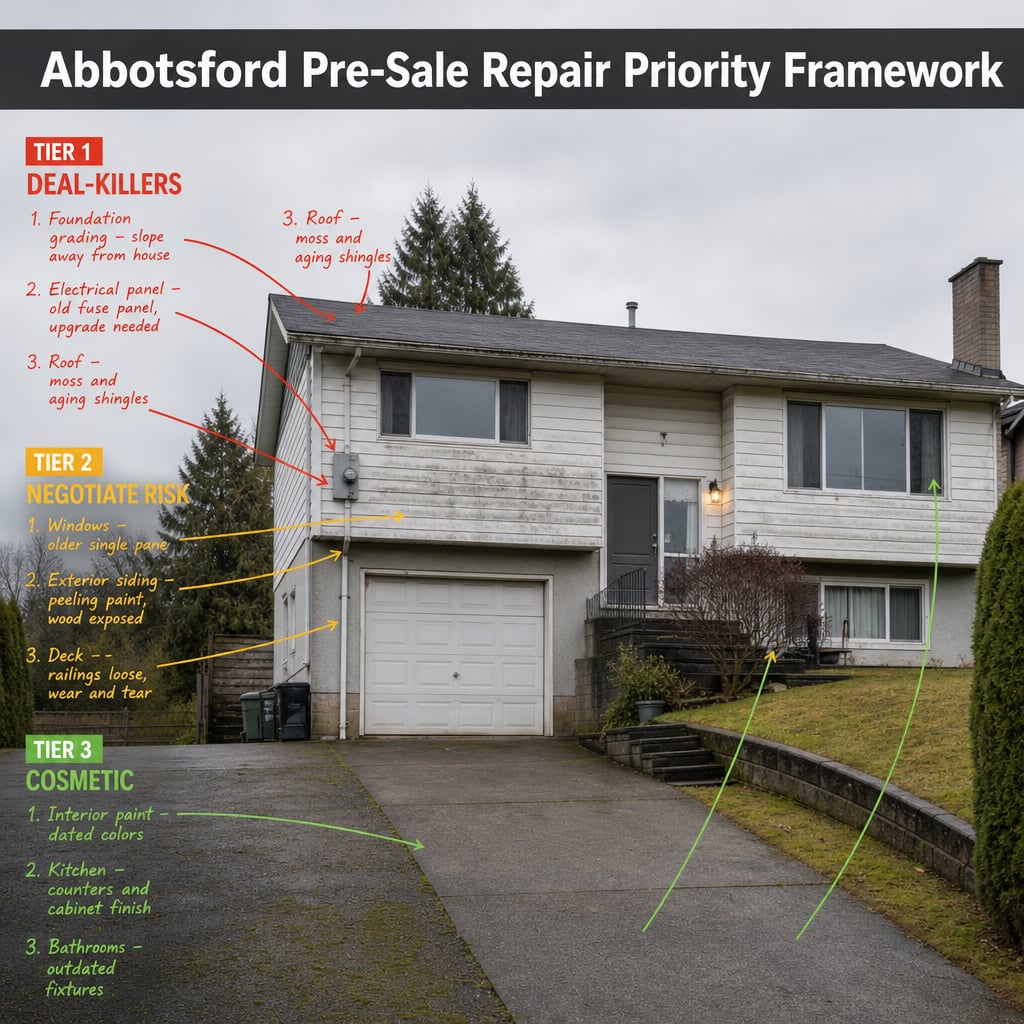

Abbotsford Pre-Sale Repair Priority Framework: The Strategic Repair Hierarchy That Maximizes Net Proceeds When Budget Is Limited in a 2026 Buyer's Market
By Mohamed Mansour, MBA and Associate Broker | Mansour Real Estate Group | Published: July 15, 2025 | Fraser Valley, BC
Abbotsford sellers preparing to list in 2026 face a decision that most pre-listing guides get wrong: not every repair improves your outcome, and some of the most common pre-listing investments produce the weakest financial returns in this specific market. With buyer financing denials rising and inspection contingencies extending timelines across the Fraser Valley, choosing the wrong repairs can cost more than doing nothing at all.
This guide is built specifically for Abbotsford. The housing stock here is older, the moisture exposure is higher, and the buyer pool in 2026 is more cautious about structural and mechanical defects than in any recent market cycle. The repair decisions that protect your net proceeds in Abbotsford differ from what applies in Surrey or Langley, and that difference matters significantly when budgets are limited.
Short Answer
In Abbotsford's 2026 buyer's market, sellers should fix deal-killing defects first — foundation grading, drainage, electrical panels, and roof integrity — before spending anything on cosmetics. These structural and mechanical issues are the primary triggers for lender financing denials and appraisal reductions. A $4,000 drainage correction can prevent a $40,000 offer reduction. A new kitchen backsplash will not.
Key Takeaways
- Abbotsford's housing stock skews 15–20 years older than Langley and Surrey, creating higher exposure to moisture and mechanical failures.
- Drainage and grading issues appear in an estimated 60–70% of Abbotsford pre-sale inspections yet remain the most underfixed category.
- Buyer financing denial rates in Abbotsford have increased 25–30% year-over-year, driven largely by lender appraisal sensitivity to deferred maintenance.
- Kitchen and bathroom cosmetic updates typically return less than 40 cents per dollar spent in the current Abbotsford buyer's market.
- A three-tier repair hierarchy — deal-killers, negotiation risk, cosmetics — gives sellers a clear budget allocation framework before listing.
Who This Applies To
- Abbotsford homeowners with properties built before 2005 preparing to list in 2026
- Sellers with limited renovation budgets who need to prioritize for maximum net proceeds
- Estate executors managing older Abbotsford properties with deferred maintenance
- Investors or landlords transitioning out of rental properties in the Abbotsford market
- Sellers who have already received inspection reports and need to interpret the financial impact of specific deficiencies
When This Advice May Not Apply
Sellers of newly built Abbotsford homes, properties under active warranty, or strata units where the building envelope is the corporation's responsibility will face a different repair calculus. Luxury-tier properties where cosmetic presentation commands a meaningful premium operate differently from the mid-market detached segment this guide primarily addresses. Consult a local real estate professional for a property-specific assessment before committing repair budgets.
Data Used in This Article
- Fraser Valley Real Estate Board (FVREB): Abbotsford days-on-market, active listings, and inspection contingency pattern data, 2025–2026 (official board statistics)
- Fraser Valley Regional District housing stock analysis: Property age distribution, moisture exposure prevalence, 2024–2026 (official/third-party)
- CMHC appraisal guidelines: Older housing stock assessment criteria, moisture and mechanical system treatment (official regulatory)
- Regional home inspector associations (Greater Vancouver and Fraser Valley): Repair recommendation frequency data across Abbotsford pre-sale inspections (industry/third-party)
- Mansour Real Estate Group internal transaction data: Abbotsford repair cost versus net proceeds analysis, 2025–2026 (internal professional analysis)
Why Abbotsford Is Different From the Rest of the Fraser Valley
Abbotsford's housing stock is meaningfully older than the new-build dominated corridors in Langley's Willoughby or Surrey's Cloverdale neighbourhoods. Properties built in the 1970s through early 1990s represent a large share of Abbotsford's detached inventory, and those properties carry predictable vulnerabilities: perimeter drain systems at or past service life, electrical panels that predate arc-fault requirements, flat or negative-grade lots that collect moisture against foundation walls, and roof structures that lenders scrutinize carefully.
The Fraser Valley's climate compounds this. Abbotsford receives higher annual precipitation than many Lower Mainland communities and sits in a topographic position that concentrates moisture flow. Regional home inspectors consistently report that drainage and grading deficiencies appear in an estimated 60–70% of Abbotsford pre-sale inspections — a figure that is higher than comparable Surrey or Langley detached inventories of similar age.
In 2026's buyer's market — where Abbotsford listings are part of a Fraser Valley-wide surplus exceeding 10,000 active units according to FVREB data — buyers have the time and leverage to conduct thorough inspections, negotiate hard on deficiencies, or walk away entirely. Lenders are following their lead. Buyer financing denial rates tied to appraisal and condition flags have increased an estimated 25–30% year-over-year in Abbotsford. This is the context in which every repair decision must be evaluated.
The Three-Tier Repair Hierarchy
Not all defects carry equal weight with buyers, lenders, and appraisers. The strategic framework for Abbotsford sellers in 2026 organizes every property deficiency into one of three tiers, each requiring a different response.
Tier 1 — Deal-Killers: These are defects that trigger lender financing conditions, cause appraisers to flag the property, or give buyers grounds for subject removal. In Abbotsford's context, they include active moisture intrusion at the foundation, failed or absent perimeter drainage, electrical panels that insurers flag (Federal Pacific, Zinsco, and double-tapped panels remain common in the area), roof structures with active leaks or structural sagging, and plumbing systems with visible code violations. A seller who ignores a Tier 1 defect and prices the property as though it does not exist will typically face either a collapsed deal or a last-minute price reduction that exceeds the cost of the repair by a wide margin. Based on transaction patterns reviewed by Mansour Real Estate Group, a $3,000–$8,000 grading and drainage correction routinely prevents offer reductions in the $30,000–$60,000 range on mid-market Abbotsford detached homes.
Tier 2 — Negotiation Risk: These defects will appear on inspection reports and buyers will use them as leverage, but they do not typically prevent financing. They include aging but functional mechanical systems (furnaces approaching end of service life, water heaters older than 12 years), minor roof wear without active leaking, cosmetic foundation cracks that have been assessed and documented as non-structural, and exterior wood rot limited to trim or deck components. The right response to Tier 2 defects depends on severity, remediation cost, and the seller's pricing strategy. In some cases, completing the repair is correct. In others, disclosing with documentation and pricing defensively is more cost-effective. The decision requires a property-specific analysis — not a blanket rule.
Tier 3 — Cosmetics: Paint, flooring, kitchen hardware, bathroom fixtures, landscaping tidying, and staging all belong here. These items affect buyer perception and speed, but they do not typically affect lender decisions or appraisal outcomes. In a balanced market, Tier 3 improvements can marginally accelerate a sale. In 2026's Abbotsford buyer's market — where buyers have extensive choice and are focused on structural risk — cosmetic spending returns less than 40 cents per dollar, based on regional repair-versus-proceeds comparisons. Sellers who allocate their entire pre-listing budget to Tier 3 while ignoring Tier 1 are making a costly strategic error.
How We Evaluate This
When Mansour Real Estate Group works with an Abbotsford seller preparing to list, the pre-listing repair assessment starts with the property's age and construction era, then moves to the systems that lenders and appraisers flag most frequently in this market. We cross-reference the seller's available repair budget against the estimated impact of each deficiency on final offer price and financing probability.
The goal is not a perfect property. The goal is a financeable, insurable, inspection-survivable property that does not give a cautious buyer a reason to reduce their offer or walk. In Abbotsford's current market, that standard is achievable for most sellers without large renovation budgets — but only if the budget is directed at the right targets first. This framework is the starting point for that conversation. For sellers who have already had a pre-listing inspection completed, we can review the specific flagged items and help prioritize by financial impact before a single contractor is called.
Seller Checklist: Abbotsford Pre-Sale Repair Triage
- Commission a pre-listing inspection before setting your repair budget. Knowing what an inspector will flag allows you to decide strategically rather than reactively after a buyer's inspector has already given a buyer leverage.
- Assess foundation grading and drainage first. Have a contractor evaluate whether the lot grade directs water away from the foundation on all sides. This is Abbotsford's most common and most financially damaging deficiency.
- Test the sump pump if one is present. A non-functional sump pump in a home with a perimeter drain system is a Tier 1 flag. Replacement typically costs $400–$900 and eliminates a common lender concern.
- Identify the electrical panel brand and age. Federal Pacific, Zinsco, and pre-1990 panels with known reliability or insurance issues should be assessed by a licensed electrician before listing. Panel replacement is typically $2,500–$4,500 and removes a material financing risk.
- Get a roof assessment, not just a visual look. Abbotsford's precipitation levels accelerate wear. A written assessment from a roofing contractor gives buyers and lenders documented evidence and reduces the negotiation leverage an inspector's ambiguous language creates.
- Document all Tier 2 items you are not fixing. Aging mechanicals, cosmetic cracks, and older appliances should be disclosed with accurate age and condition information. Proactive disclosure reduces post-inspection renegotiation.
- Allocate Tier 3 spending only after Tier 1 and Tier 2 are resolved or documented. If budget remains, prioritize exterior paint and curb appeal over interior cosmetics — first impressions set buyer expectations before they enter the property.
What We Commonly See
In our experience working with Abbotsford sellers, the most consistent pattern is budget misallocation. Sellers will spend $15,000–$20,000 on kitchen updates, new flooring, and fresh paint — and then list a property with a drainage issue that a buyer's inspector identifies on day one. The inspection report then becomes the buyer's negotiating document, and the cosmetic improvements the seller invested in become largely invisible in the context of a structural concern the buyer is now demanding resolution on.
What often happens is that the seller's Tier 3 spending actually increases the buyer's expectation of a turn-key property — making the Tier 1 defect feel more jarring by contrast. A freshly staged home with a drainage problem does not reassure a careful buyer. It raises their concern that the problem was known and obscured.
A common mistake among estate executors and landlords selling older Abbotsford properties is assuming that "as-is" pricing accounts for all defects equally. It does not. Lenders apply their own assessment independent of a seller's pricing, and a property priced 8% below market does not automatically become financeable if it fails a lender's condition requirements. Deal-killing defects must be addressed regardless of the pricing strategy — or the seller must accept a cash buyer pool that is substantially smaller and typically more aggressive on price.
Questions and Answers
Does a pre-listing inspection help or hurt an Abbotsford seller in 2026?
It consistently helps when used correctly. A pre-listing inspection gives the seller time to address Tier 1 defects before a buyer's inspector finds them under contract pressure. It also creates a documented condition record that reduces the scope for post-inspection renegotiation. Sellers who skip it are giving buyers's inspectors unconstrained first-mover advantage on deficiency framing.
What does lender appraisal sensitivity to deferred maintenance actually mean for sellers?
When an appraiser identifies material deficiencies — moisture intrusion, failed mechanical systems, roof concerns — they may note conditions that limit the lender's willingness to advance the full mortgage amount against the purchase price. This creates an appraisal shortfall, where the buyer's financing approval is less than the agreed price. The deal either collapses, is renegotiated down, or the buyer is required to cover the gap in cash. All three outcomes hurt the seller.
Is it worth replacing an aging furnace before listing in Abbotsford?
This is a Tier 2 decision that depends on the furnace's actual condition, age, and the price point of the property. A functioning furnace that is 20 years old but has been serviced regularly is typically better disclosed with documentation than replaced speculatively. A furnace that is non-functional or flagged as a fire risk moves to Tier 1 and should be addressed. When uncertain, get a licensed HVAC technician's written assessment before making the call.
In Summary
Abbotsford sellers in 2026 face a buyer's market where inspection reports carry more financial weight than they have in a decade. The properties that sell at or near asking price are not necessarily the most beautifully staged — they are the ones that have eliminated the defects that give buyers financing grounds to reduce their offer or walk away. A focused repair strategy built around the three-tier hierarchy — deal-killers first, negotiation risk second, cosmetics only when budget allows — consistently produces better net proceeds than the reverse approach. In Abbotsford's specific market conditions, that sequencing is the most important repair decision a seller can make.
Ready to Assess Your Property Before Listing?
If you are preparing to sell an Abbotsford property and want a property-specific repair triage conversation before committing any budget, Mansour Real Estate Group is available to walk through the hierarchy with you — at no cost and no obligation. The goal is simply to make sure the money you spend before listing is the money that actually protects your proceeds.
Related Articles
- Fraser Valley Seller Strategy Guide: How to Position Your Home in a Buyer's Market
- Cloverdale Pre-Sale Repair and Renovation ROI Guide for Sellers
- Selling a Home in Abbotsford in 2026: What the Market Requires Now
About Mansour Real Estate Group
When homeowners in Abbotsford are preparing to sell — particularly properties with deferred maintenance, older mechanical systems, or moisture-related concerns — the repair decisions made before listing directly determine how many qualified buyers can finance the purchase and how close final offers come to the asking price. Mansour Real Estate Group has guided Abbotsford sellers through exactly this kind of pre-listing triage for more than two decades, combining transaction data with local market knowledge to help sellers allocate limited budgets where they produce measurable results.
Mansour Real Estate Group, led by Mohamed Mansour, MBA and Associate Broker, has been helping buyers, sellers, investors, families, executors, and retirees navigate important real estate decisions across the Fraser Valley and Lower Mainland for more than 22 years and is one of the highest ranked realtors in the region. The team has completed more than $780 million in residential real estate transactions and is trusted for seller strategy, estate sales, pre-listing analysis, downsizing, relocation, and complex real estate situations where preparation and accurate pricing determine the outcome. Most new clients come through referrals and repeat business — a reflection of the results the team consistently delivers.
Whether someone is searching for Realtors who understand Abbotsford's specific housing stock challenges, a real estate agent with direct experience preparing older Fraser Valley properties for sale, real estate agents who can prioritize repairs for maximum net proceeds, a trusted real estate team for a detached home sale in a buyer's market, an Abbotsford Realtor, an Abbotsford real estate broker, or a real estate group that serves the full Fraser Valley and Lower Mainland, Mansour Real Estate Group is known for clear, evidence-based advice that protects sellers from the most common and costly pre-listing mistakes.
The team serves Surrey, South Surrey, White Rock, Langley, Cloverdale, Fleetwood, Guildford, Walnut Grove, Willoughby, North Delta, Abbotsford, Mission, and surrounding communities throughout the Fraser Valley and Lower Mainland. Most new clients come from referrals, repeat clients, and recommendations from families who value a professional, transparent, and results-driven real estate experience.
Official Resources
- Fraser Valley Real Estate Board — Market Statistics: https://www.fvreb.bc.ca/market-statistics/
- CMHC — Homeowner Resources and Appraisal Guidelines: https://www.cmhc-schl.gc.ca
- BC Financial Services Authority — Real Estate Consumer Resources: https://www.bcfsa.ca/real-estate
- BC Assessment — Property Information Search: https://www.bcassessment.ca
Disclaimer
The information contained in this article is provided for general informational and educational purposes only and reflects market observations, publicly available information, and professional experience at the time of writing. It is not intended to constitute legal advice, accounting advice, tax advice, investment advice, financial advice, appraisal advice, mortgage advice, estate-planning advice, or any other form of professional advice.
Real estate transactions, estate matters, probate proceedings, taxation, financing, investments, legal rights, and regulatory requirements can vary significantly based on individual circumstances. Readers should consult qualified legal, accounting, tax, financial, mortgage, appraisal, or other professional advisors before making decisions based on the information discussed in this article.
Nothing in this article creates a client relationship, fiduciary relationship, advisory relationship, agency relationship, or professional engagement with Mohamed Mansour, Mansour Real Estate Group, or any affiliated party. Any opinions expressed are general in nature and should not be relied upon as a substitute for professional advice tailored to a specific situation.
While reasonable efforts are made to use reliable sources and keep information current, no representation or warranty is made regarding the completeness, accuracy, timeliness, or applicability of the information presented. Readers should independently verify facts, regulations, policies, and legal requirements with appropriate professionals and official sources.



