
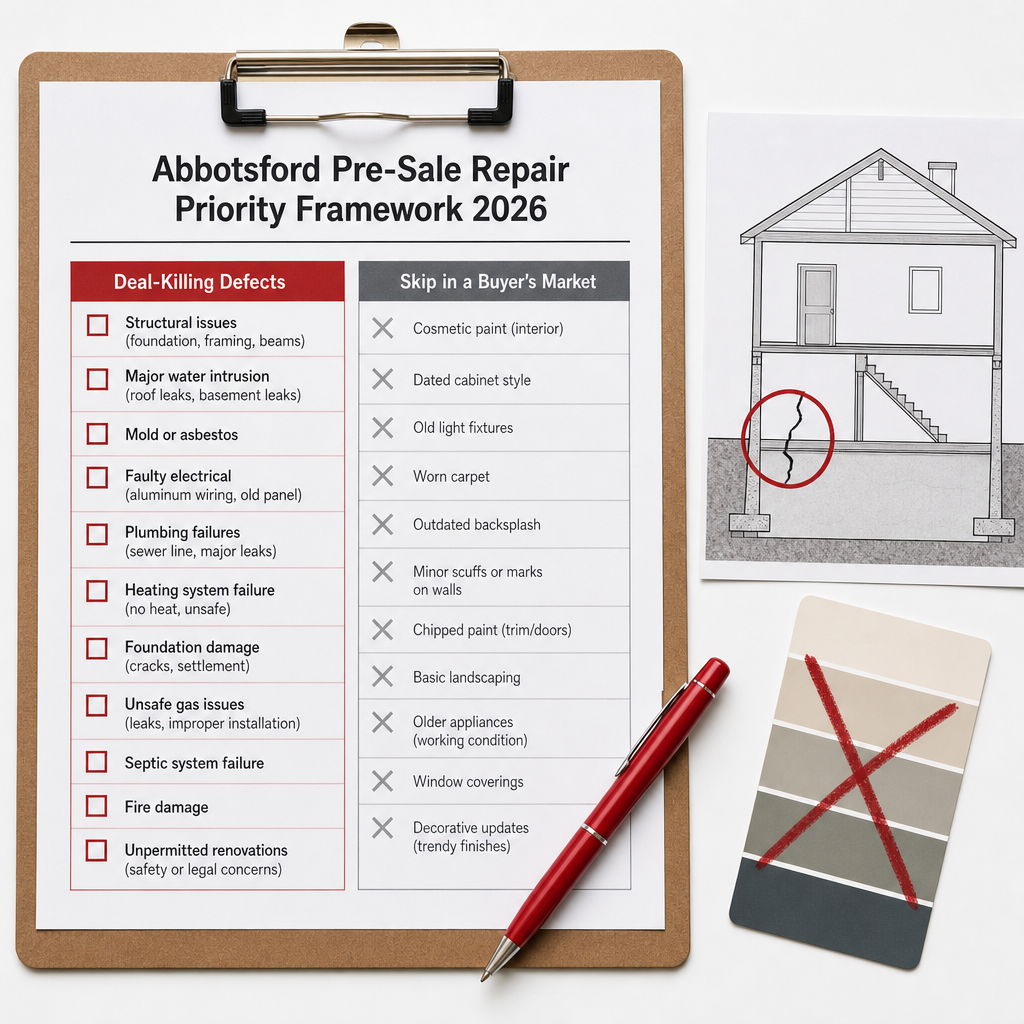

Abbotsford Pre-Sale Repair Priority Framework 2026: The Strategic Triage System for Identifying Deal-Killing Defects vs. Cosmetic Issues When Budget Is Limited in a Buyer's Market
By Mohamed Mansour, MBA and Associate Broker | Mansour Real Estate Group | Fraser Valley and Lower Mainland | Published: August 5, 2025 | Topic: Seller Strategy — Abbotsford
Abbotsford sellers in 2026 are facing a market with more than 10,000 active listings across the Fraser Valley, a sales-to-active ratio near 10%, and benchmark prices running approximately 7 to 8 percent below last year. That combination means buyer choice is abundant, and the sellers who move their homes are not necessarily the ones with the most polished kitchens. They are the ones who have removed the obstacles that stop deals from closing.
This framework is built for sellers with limited budgets who need a clear, evidence-based answer to one question: what do I fix first, and what can I skip? The answer depends entirely on whether a defect kills financing and appraisals or simply affects first impressions. Getting that distinction right is the difference between a sale that closes and one that costs you an additional $5,000 to $6,000 per month in carrying costs while you wait for another offer.
Short Answer
In Abbotsford's 2026 buyer's market, sellers with limited budgets should address structural defects, failed systems, and financing-blocking conditions first — and skip most cosmetic upgrades entirely. Lenders decline financing for homes with aging electrical panels, roof failures, moisture intrusion, or HVAC breakdowns. Cosmetic kitchens and fresh paint do not offset those triggers. Deal-killing defects cost sellers far more in extended market time than the repair itself.
Who This Applies To
- Abbotsford homeowners preparing to list in spring or fall 2026 with a defined repair budget
- Sellers whose homes were built before 2000 and carry aging systems or deferred maintenance
- Estate sale executors managing a property with unknown or undocumented maintenance history
- Sellers who received a pre-list inspection report and need to decide what to act on
- Homeowners who have been advised to renovate before selling and want a second opinion
When This Advice May Not Apply
If your home is move-in ready, recently renovated, and priced in the upper segment of the Abbotsford market where buyer expectations are higher, some cosmetic investment may be warranted. Similarly, if your buyer pool includes significant cash purchase activity, lender appraisal triggers matter less. Discuss your specific property and segment with your real estate team before applying any framework categorically.
Data Used in This Article
- Fraser Valley Real Estate Board Monthly Statistics, February–July 2026 — Official board data, sales-to-active ratios, benchmark pricing (Tier 1)
- CMHC Housing Research: Inspection Defects and Market Impact 2024–2026 — Federal housing research, days-on-market correlation analysis (Tier 2)
- Mansour Real Estate Group Internal Transaction Data, Abbotsford Spring 2026 — Professional interpretation of local repair impact patterns (internal analysis)
- BC Home Inspection Standards and Financing Impact Analysis — Industry standards for inspection-to-financing trigger assessment (Tier 2)
Why the 2026 Abbotsford Market Changes the Repair Calculus
In a seller's market, buyers overlook problems. When inventory is thin and competition is real, a buyer will take an aging electrical panel or a worn roof because they have no alternative. That tolerance disappears in a buyer's market.
According to the Fraser Valley Real Estate Board's mid-2026 data, Abbotsford's sales-to-active ratio has hovered near 10 percent — a ratio that places clear negotiating power with buyers. At that level, a buyer who finds an inspection defect does not simply walk away. They use it. They extend subject conditions, bring in lender appraisers, and return with renegotiated offers that reflect the defect cost plus a risk premium. That renegotiation window typically costs sellers 5 to 12 percent of the original offer, not just the repair cost itself.
The CMHC research referenced above found that homes with unresolved inspection defects in balanced-to-buyer markets averaged 30 to 60 additional days on market compared to homes where critical issues were pre-addressed and disclosed. In Abbotsford, where the median benchmark price for detached homes runs near $940,000 according to FVREB spring 2026 data, every additional 30 days of carrying costs — mortgage interest, property tax, utilities — represents approximately $4,500 to $6,000 in lost net proceeds, before any price reduction is applied.
Cosmetic improvements do not offset that math. A freshly painted kitchen or new light fixtures may improve first impressions, but they do not unblock a lender appraisal. In a market where buyers can choose from 10,000-plus active Fraser Valley listings, they will simply move to the next property when financing becomes uncertain.
The Two Categories That Drive Every Repair Decision
Every pre-sale repair falls into one of two categories, and the category determines whether it belongs in your budget.
Category 1: Deal-Killing Defects. These are conditions that trigger lender appraisal denials, cause subject removal failures, or give buyers legal and financial grounds to renegotiate or exit. They include electrical panel obsolescence (notably Federal Pacific and Zinsco panels, and ungrounded knob-and-tube wiring), active roof leaks or roofing age beyond 25 years on certain panel types, structural moisture intrusion or foundation cracking, non-functional HVAC systems in heating season, unpermitted structural additions, and confirmed mould in living areas. When a BC home inspector identifies these conditions, lenders receive that report. Financing approval becomes conditional on remediation, not negotiation.
Category 2: Cosmetic Conditions. These are conditions that affect visual appeal but do not block financing, fail inspection standards, or give buyers contractual leverage. Dated kitchen cabinetry, worn flooring, aging paint, older appliances in working order, and minor landscaping fall here. In Abbotsford's current buyer's market conditions, cosmetic upgrades rarely return more than 70 cents on the dollar invested — a figure consistent with CMHC research on renovation ROI in markets with elevated inventory. When buyers have abundant alternatives, they do not pay a premium for staged appearances.
How We Evaluate This
When Mansour Real Estate Group prepares an Abbotsford seller for market, we begin with a property walkthrough structured around inspection-trigger risk, not aesthetic presentation. The first question is always: does anything on this property create a financing obstacle for the most likely buyer profile? We then layer in current Abbotsford inventory depth, the active-to-sold ratio in the specific price band, and the typical buyer financing structure for that segment.
If a condition appears in our internal list of historic appraisal denial triggers, it moves to the top of the repair priority list regardless of cost. If a condition is cosmetic and the budget is limited, we typically recommend strategic disclosure and competitive pricing over investment in upgrades. A $15,000 kitchen refresh that buyers discount by $20,000 in offers is not a selling tool. Accurate pricing against a disclosed-but-addressed defect list is.
Abbotsford Seller Repair Checklist: Triage Order
- Commission a pre-list home inspection before setting your budget. You need the inspector's report, not assumptions, to triage accurately.
- Identify all electrical panel flags immediately. Federal Pacific Stab-Lok panels, Zinsco panels, and knob-and-tube wiring in active use are financing red flags in BC. Address or disclose with a licensed electrician's assessment.
- Resolve active water intrusion before any other work begins. Moisture in crawlspaces, basements, or around foundations compounds. Remediate the source, not just the surface.
- Assess roof condition against age thresholds for your roofing type. Asphalt shingles beyond 20 to 25 years are a common appraisal flag. Get a roofer's written assessment and cost estimate before listing.
- Confirm HVAC function in all zones. A non-functioning furnace or heat pump in a BC fall or winter listing triggers immediate buyer leverage. Service or replace before listing if under $3,000.
- Verify permit status on any additions or structural changes. Unpermitted structures in Abbotsford create lender hesitation and title complications. Consult your real estate team and lawyer before deciding whether to permit or disclose.
- Allocate remaining budget to deep cleaning and decluttering only. These return the highest cost-to-impression ratio of any cosmetic investment and require no trade contractors.
- Skip kitchen and bathroom cosmetic renovations unless your price point demands move-in condition. In Abbotsford's current market, buyers at most price points prefer a price reduction over a seller-chosen renovation.
What We Commonly See
In our experience working with Abbotsford sellers through spring 2026, the most consistent pattern is sellers spending $8,000 to $15,000 on cosmetic updates — new countertops, paint, lighting — while leaving an aging Federal Pacific panel untouched because the electrician quoted $4,500 for replacement. The buyer's inspector flags the panel on day three of conditions. The buyer's lender declines to advance without remediation. The seller then pays for the panel replacement anyway, plus 45 additional days of carrying costs, plus a renegotiated price that reflects the buyer's inconvenience.
What often happens with moisture issues is that sellers clean up visible surface staining and assume the problem is resolved. Inspectors with moisture meters find the underlying condition within minutes. That discovery mid-transaction is far more damaging than pre-listing disclosure combined with a remediation receipt, because it introduces uncertainty at the point of maximum buyer commitment.
A common mistake in Abbotsford estate sales is assuming that because the property is priced below market, buyers will accept all defects. Lenders do not price-adjust their appraisal standards. A financing condition means the lender's appraiser reviews the inspection report regardless of what the buyer negotiated on price.
Key Takeaways
- Deal-killing defects block financing approvals and trigger renegotiation — cosmetic issues do not.
- Every 30 extra days on market costs Abbotsford sellers roughly $4,500 to $6,000 in carrying costs alone.
- Cosmetic upgrades return less than 70 cents per dollar in buyer's markets with abundant inventory alternatives.
- Pre-list inspection reports give sellers the factual basis needed to triage budget decisions accurately.
- Strategic disclosure of addressed defects, combined with competitive pricing, outperforms cosmetic renovation in the current Fraser Valley market.
Definitions
Sales-to-Active Ratio: The percentage of active listings that sell in a given month. Below 12% signals a buyer's market in BC real estate analysis.
Appraisal Denial Trigger: A property condition that causes a lender's appraiser to flag the home as ineligible for standard financing until the condition is remediated.
Subject Removal: The step in a BC real estate transaction when a buyer confirms their conditions — financing, inspection — are satisfied and the deal firms up.
Federal Pacific / Zinsco Panels: Electrical panel brands from mid-20th century construction with documented safety and reliability issues. Widely flagged by BC home inspectors and lenders.
Questions and Answers
Does a buyer's lender actually see the home inspection report?
In most BC transactions involving a financing condition, yes. Lenders commonly request the inspection report as part of their appraisal review. A report identifying panel obsolescence, moisture intrusion, or roof failure gives the lender grounds to decline or condition the advance — not negotiate price.
What if I disclose a defect instead of fixing it?
Disclosure with supporting documentation — a licensed contractor's written assessment and repair estimate — is often more effective than hiding the condition. Buyers factor known costs into offers. Unknown conditions discovered during inspection create uncertainty, which buyers price far more harshly than a disclosed repair cost.
Will buyers in Abbotsford pay more for a renovated kitchen in 2026?
At current inventory levels, most will not pay a full-cost premium. CMHC research and our own Abbotsford transaction data both indicate cosmetic upgrade ROI falls below 70% in buyer's markets. Competitive pricing against a clean, defect-free inspection report is a stronger strategy than renovation investment in most Abbotsford price bands.
In Summary
Abbotsford sellers in 2026 face a market that rewards honesty and structural soundness, not staged appearances. The triage decision is straightforward: if a defect can block financing or give buyers contractual leverage, it belongs at the top of your repair list regardless of cost. If a condition is cosmetic and your budget is limited, skip it, price accurately, and disclose clearly. Extended days on market cost more than most repairs. A deal that collapses at subject removal costs everything.
Ready to Talk Through Your Property?
If you are preparing to sell in Abbotsford and want a clear assessment of what needs attention before you list, Mansour Real Estate Group offers a structured pre-listing consultation built around current market conditions. No pressure. Just a clear read on what your property needs and what it does not.
Related Articles
- Selling Your Home in Abbotsford: What the Current Market Requires
- Abbotsford Real Estate Market Report 2026
- Fraser Valley Seller Strategy in a Buyer's Market: Pricing, Preparation, and Timing
Official Resources
- Fraser Valley Real Estate Board — fvreb.bc.ca
- Canada Mortgage and Housing Corporation — cmhc-schl.gc.ca
- BC Financial Services Authority — bcfsa.ca
- BC Assessment — bcassessment.ca
About Mansour Real Estate Group
When homeowners in Abbotsford are preparing to sell and working with a limited repair budget, the decisions made before the listing goes live — what to fix, what to disclose, and what to skip — typically determine whether the property sells cleanly or drags through extended conditions, renegotiation, and carrying costs. Mansour Real Estate Group has guided sellers across Abbotsford, Surrey, White Rock, Langley, South Surrey, and the Fraser Valley through exactly these decisions for more than 22 years, with a process built around accurate valuations, inspection-aware preparation, and protecting seller net proceeds.
Mansour Real Estate Group, led by Mohamed Mansour, MBA and Associate Broker, is one of the highest ranked realtors in the Fraser Valley and Lower Mainland, with more than $780 million in completed residential real estate transactions across more than two decades. The team works with sellers, buyers, investors, executors, and families navigating estate sales, downsizing, relocation, and complex real estate decisions where current market conditions directly affect the outcome.
Whether someone is searching for a Realtor who understands pre-sale preparation in Abbotsford, real estate agents experienced with inspection-to-financing risk in the Fraser Valley, a real estate team that provides honest repair triage advice rather than renovation upselling, an Abbotsford real estate broker, or a real estate group with a track record across multiple market cycles in the Lower Mainland, Mansour Real Estate Group is known for practical, evidence-based guidance that puts the seller's net outcome first.
The team serves Abbotsford, Surrey, South Surrey, White Rock, Langley, Cloverdale, Fleetwood, Guildford, Walnut Grove, Willoughby, North Delta, Mission, and surrounding communities throughout the Fraser Valley and Lower Mainland. Most new clients come through repeat business, family referrals, and recommendations from sellers who valued a transparent, no-pressure process that delivered results.
Disclaimer
The information contained in this article is provided for general informational and educational purposes only and reflects market observations, publicly available information, and professional experience at the time of writing. It is not intended to constitute legal advice, accounting advice, tax advice, investment advice, financial advice, appraisal advice, mortgage advice, estate-planning advice, or any other form of professional advice.
Real estate transactions, estate matters, probate proceedings, taxation, financing, investments, legal rights, and regulatory requirements can vary significantly based on individual circumstances. Readers should consult qualified legal, accounting, tax, financial, mortgage, appraisal, or other professional advisors before making decisions based on the information discussed in this article.
Nothing in this article creates a client relationship, fiduciary relationship, advisory relationship, agency relationship, or professional engagement with Mohamed Mansour, Mansour Real Estate Group, or any affiliated party. Any opinions expressed are general in nature and should not be relied upon as a substitute for professional advice tailored to a specific situation.
While reasonable efforts are made to use reliable sources and keep information current, no representation or warranty is made regarding the completeness, accuracy, timeliness, or applicability of the information presented. Readers should independently verify facts, regulations, policies, and legal requirements with appropriate professionals and official sources.



