
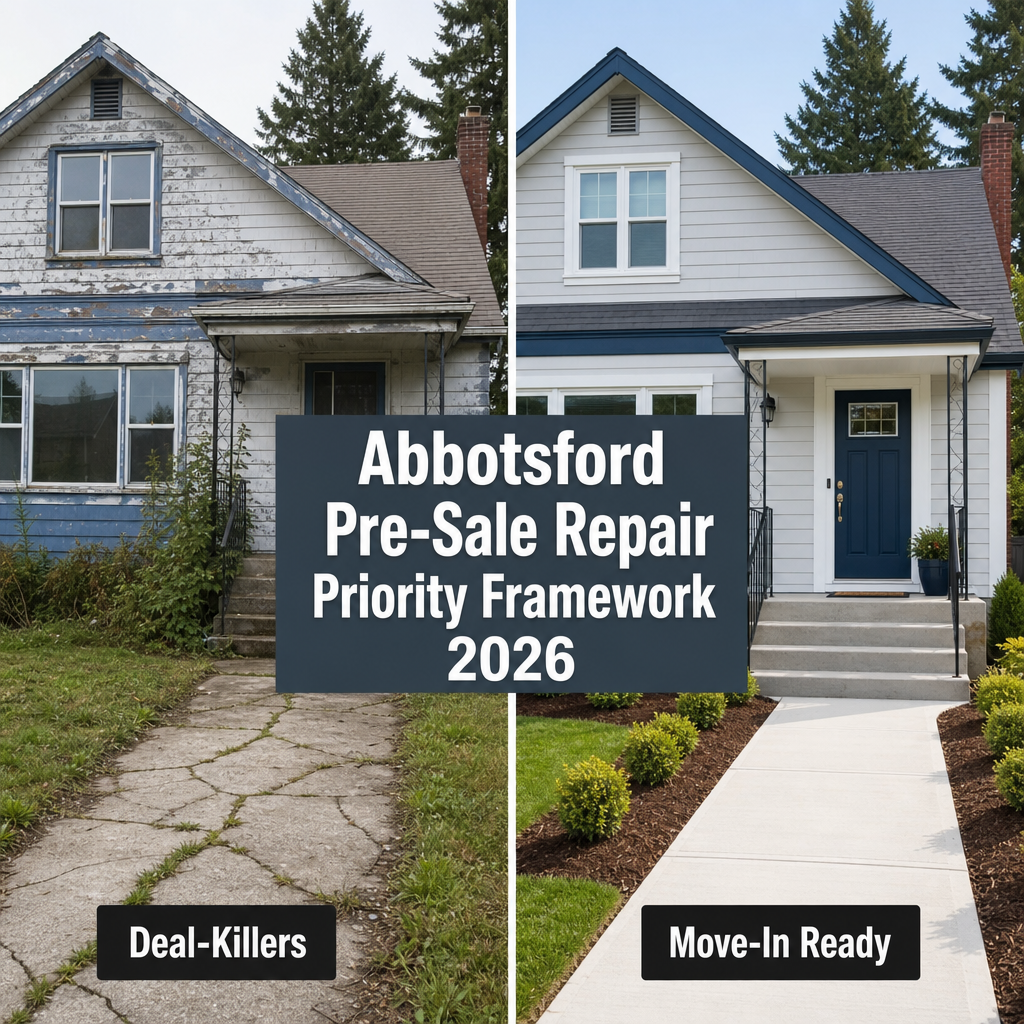

Abbotsford Pre-Sale Repair Priority Framework 2026: The Strategic Repair Hierarchy That Maximizes Net Proceeds in a Buyer's Market
By Mohamed Mansour, MBA and Associate Broker | Mansour Real Estate Group | Published July 22, 2025 | Fraser Valley, BC
Abbotsford sellers entering the 2026 market face a specific challenge: inventory is elevated, buyers have options, and benchmark prices have declined. In that environment, the question is not how much to spend on improvements — it is how to spend the right amount on the right repairs before listing. Sellers who misread this distinction either over-invest in renovations that don't return value, or under-invest and hand buyers a negotiating file full of defects.
This framework is built for Abbotsford specifically — its older housing stock, its current buyer behaviour, and the real decisions a seller with a limited budget needs to make before a listing goes live.
Short Answer
In a buyer's market with 7,330+ active Fraser Valley listings and Abbotsford benchmark prices down 8.9% year-over-year as of June 2026, sellers get the best return by fixing structural and mechanical deal-killers first, addressing compounding small defects second, and improving curb appeal third — not by renovating kitchens or upgrading finishes that comparable homes set price ceilings on anyway. Source: FVREB June 2026 Statistics Package.
Who This Applies To
- Abbotsford homeowners preparing to list a detached home in 2026
- Sellers working with a limited pre-sale budget and needing a clear repair hierarchy
- Estate executors or trustees preparing an older Abbotsford property for sale
- Sellers who have received early buyer feedback about condition concerns
- Homeowners deciding between listing as-is versus investing in improvements
When This Advice May Not Apply
This framework is calibrated for the 2026 buyer's market and Abbotsford's current conditions. Sellers in a multiple-offer micro-market, properties with recent major upgrades, or luxury-tier homes with a different buyer pool may need a different strategic approach. Consult a local realtor for property-specific guidance before making repair decisions.
Key Takeaways
- Fix structural and mechanical deal-killers before any cosmetic improvement.
- Ten small defects cost more in negotiation than they cost to repair.
- A $400 pre-listing inspection identifies what buyers will use against you.
- Curb appeal drives click-through and showings — invest there before interior finishes.
- Full kitchen renovations rarely return value when comparable homes set price ceilings.
Data Used in This Article
- Fraser Valley Real Estate Board, June 2026 Statistics Package — Official monthly market data, active listings, benchmark prices, sales-to-active ratio. Primary source, official board data.
- FVREB / Zealty.ca, March 2026 BC Housing Market Report — Inventory trends and buyer behaviour context. Third-party summary of board data.
- Industry repair cost estimates ($300–$500 inspection, $500–$3,000 repair ranges) — Representative ranges drawn from multiple published pre-listing guides; actual costs vary by contractor and property condition.
Why Abbotsford's 2026 Market Changes the Repair Calculation
The Fraser Valley Real Estate Board's June 2026 statistics reported 7,330 active listings across the board's jurisdiction, with a sales-to-active ratio of 11% — a level that consistently indicates buyer advantage and measured price softening. Abbotsford's benchmark price for detached homes declined 8.9% year-over-year in that same period.
What that means practically: buyers have alternatives. When a buyer sees an Abbotsford home with a list of inspection defects, they don't feel pressure to overlook them. They either negotiate aggressively or move to the next listing. In a balanced or seller's market, buyer urgency absorbs some of that friction. In the current market, it doesn't.
This shifts the repair strategy from "what improves the home" to "what removes buyer objections." Those are not the same list. A renovated kitchen improves the home. A fixed moisture intrusion in the crawlspace removes an objection. Only one of those pays back in 2026.
Abbotsford's housing stock adds a layer of complexity. Many properties in areas like Clearbrook, Matsqui, and the older Sumas corridor were built in the 1970s through 1990s — homes that may carry aging electrical panels, cast-iron drain lines, wood-frame roofs near end of life, and foundation settlement common to older construction. These are not cosmetic concerns. They are the items buyers and their inspectors flag as reasons to reduce the offer or walk away entirely.
The Three-Tier Repair Hierarchy
Tier 1 — Deal-Killers: Fix These First
These are structural, mechanical, moisture-related, or safety defects that cause buyers to reduce offers significantly, add extended subjects, or walk away after inspection. In Abbotsford's older housing stock, the most common deal-killers include foundation cracks with evidence of movement, active moisture intrusion in crawlspaces or basements, Federal Pacific or Zinsco electrical panels (flagged as fire risks by inspectors), roofs with less than two to three years of estimated life remaining, and visible mould.
These items also affect financing. Many lenders will not fund a purchase with active moisture issues or a flagged electrical panel without conditions and holdbacks. A buyer who wants the property may lose the ability to close on it, which collapses the deal regardless of both parties' intentions.
Sellers do not always need to fully remediate these issues before listing. But they must know they exist, disclose appropriately, and either repair or price accordingly. Discovering them at the buyer's inspection — after an offer is accepted — is the most expensive version of this problem.
Tier 2 — Compounding Small Defects: Fix These Before You List
This is where most sellers make the most correctable mistake. Small defects — a leaky faucet under the kitchen sink, a squeaky front door, a cracked caulk line in the master shower, burnt-out pot lights, loose cabinet handles, chipped baseboard paint in the hallway — cost very little to fix individually. But buyers and their inspectors catalogue them cumulatively.
A buyer who walks through a home and notes 12 small deficiencies does not calculate 12 separate small costs. They form an overall impression of deferred maintenance. That impression becomes a negotiating anchor — "the house hasn't been taken care of" — and is used to justify larger price reductions than the defects warrant. Fixing 10 small items might cost $800 to $1,500 in a weekend. Leaving them unfixed can cost $15,000 to $25,000 in negotiated price reductions.
Walk through your home with a clipboard before listing and write down everything that catches your eye as slightly wrong. Fix it.
Tier 3 — Curb Appeal and First Impression: Spend Here Before Interior Cosmetics
Online listing photos drive showing traffic. Buyers in 2026 are scrolling through dozens of listings on their phones before deciding which homes to visit. A front door that reads as fresh and maintained, a clean driveway, new mulch in the garden beds, and consistent exterior lighting generate disproportionate click-through relative to cost. Curb appeal improvements in the $1,000 to $3,000 range — power washing the driveway, painting the front door a clean neutral, replacing a rusted mailbox, adding seasonal planting near the entrance — consistently outperform interior cosmetic improvements at that same spend level in a buyer's market where listings compete on first impression.
What to Skip in a Buyer's Market
Full kitchen renovations, new appliance packages, premium lighting fixtures, and high-end bathroom upgrades are the most common over-investments sellers make before listing in a declining market. The reason they rarely return value is simple: comparable sales set the price ceiling. If similar homes in your Abbotsford neighbourhood are selling at $720,000 to $760,000 in their current condition, spending $30,000 on a kitchen renovation does not move your ceiling to $790,000. Buyers use comparables to anchor their offers.
In a buyer's market with 7,300+ active alternatives, buyers are not bidding up homes because of premium finishes. They are looking for well-maintained, honestly priced, move-in-ready properties. Move-in readiness is not the same as renovated. It means nothing requires immediate attention after possession.
How We Evaluate This
At Mansour Real Estate Group, the pre-listing repair conversation starts with a walk-through of the property before any improvement decisions are made. The goal is to identify which deficiencies will be flagged during a buyer's inspection, which will affect buyer confidence on the showing, and which are invisible to a buyer but visible to their lender. We then sequence those repairs by return — not by cost, and not by how visible they are to the seller. What matters is what matters to this buyer pool, in this neighbourhood, in this market condition. For Abbotsford in 2026, that sequence consistently prioritizes mechanical and moisture integrity, then deferred maintenance catch-up, then curb appeal — in that order.
Pre-Listing Inspections: The Starting Point That Most Sellers Skip
A pre-listing inspection costs $300 to $500 and takes two to three hours. It identifies every material defect in the home before a buyer's inspector does. That timing matters for two reasons. First, it allows the seller to repair, disclose, and price on their own terms rather than reacting to a buyer's inspection report under contract pressure. Second, it removes surprise from the post-offer negotiation — which is the most expensive place for surprises to appear.
Sellers who skip pre-listing inspections frequently encounter this sequence: an accepted offer, a buyer's inspection report listing $18,000 in deficiencies, a renegotiation request, and either a price reduction or a collapsed deal. A $400 inspection before listing typically produces a better outcome than a $400 inspection cost avoided and a $15,000 renegotiation conceded.
Definitions
Sales-to-Active Ratio: The number of sales in a month divided by active listings. Below 12% indicates a buyer's market; above 20% indicates a seller's market. The Fraser Valley was at 11% as of June 2026.
Benchmark Price: The price of a "typical" home in a given area, adjusted for size and features, as reported by the Fraser Valley Real Estate Board.
Deal-Killer Defect: A material deficiency that causes a buyer to withdraw, renegotiate significantly, or encounter financing problems — as distinct from a cosmetic issue that affects preference but not transaction viability.
Pre-Sale Seller Checklist — Abbotsford 2026
- Book a pre-listing inspection before any repairs — sequence decisions from the report.
- Address moisture, drainage, and crawlspace issues first — these affect financing.
- Have an electrician assess the panel if the home was built before 1995.
- Walk each room and fix every small defect: caulking, handles, bulbs, squeaky hinges.
- Power wash the driveway and walkway; repaint or refresh the front door.
- Replace dead landscaping near the entrance — first impressions begin at the curb.
- Deep clean every surface, including inside cupboards, appliances, and window tracks.
- Consult your Abbotsford realtor before committing budget to any renovation above $3,000.
What We Commonly See
In our experience working with Abbotsford sellers, the most common mistake is spending $10,000 to $20,000 on interior cosmetic updates — new countertops, fresh flooring in the primary bedroom, new light fixtures throughout — while leaving a 25-year-old roof and a crawlspace with standing moisture unaddressed. The renovation is visible on listing day. The crawlspace issue surfaces during the buyer's inspection five days after the offer.
What often happens is sellers prioritize what they can see and live with daily — dated finishes — over what a buyer's inspector will focus on: the elements that affect safety, structural integrity, and lender conditions. Those are not always visible during a showing, but they are always visible in the inspection report.
A common mistake in older Abbotsford homes is assuming that because a property has been lived in comfortably for decades, it will pass a buyer's inspection without attention. The homes that generate the fewest post-offer renegotiations are not the prettiest — they are the ones where the seller addressed the mechanical and moisture condition systematically before listing, even when the finishes stayed unchanged.
Questions and Answers
Should I disclose a defect I fix before listing?
In BC, sellers are required to disclose known material latent defects — conditions not visible on reasonable inspection that affect habitability or value. If you fix a defect before listing, consult your realtor and lawyer about whether and how to disclose the repair. Fixing something does not automatically eliminate the disclosure obligation, particularly for moisture or structural issues. This is a legal question specific to your situation.
Is a pre-listing inspection required in BC?
No. Pre-listing inspections are optional but have become a common seller strategy in 2026. They are not mandated by the BC government or BCFSA. The value is strategic: they identify issues before buyers do, allowing sellers to repair, price, or disclose on their own timeline rather than under contract pressure.
How do I decide if a repair is worth doing before listing?
Ask whether the repair addresses something a buyer or their inspector will flag, whether it affects financing or insurability, and whether leaving it unaddressed gives a buyer justification to reduce their offer by more than the repair costs. If yes to any of those, fix it. If the repair is purely cosmetic and comparable homes haven't done the same, the investment is unlikely to return value in a buyer's market.
In Summary
Abbotsford sellers in 2026 are operating in a market that rewards condition and penalizes deferred maintenance — not one that rewards renovation spending. The strategic repair hierarchy is clear: identify and address deal-killing structural and mechanical deficiencies first, eliminate compounding small defects before listing day, and invest in curb appeal before touching interior finishes. A $400 pre-listing inspection is the most cost-effective preparation tool available. Skipping it and discovering defects under contract pressure is consistently more expensive than fixing them on the seller's own timeline.
Thinking About Listing in Abbotsford?
If you are preparing to sell in Abbotsford and want a clear picture of what to fix, what to skip, and how to price your property for the current market, Mansour Real Estate Group offers a straightforward pre-listing consultation. There is no obligation — just a practical, property-specific conversation before you commit to any repair budget.
Related Articles
- Fraser Valley Real Estate Market 2026: What the Data Actually Tells Sellers and Buyers
- How to Price Your Home in Abbotsford in 2026
- Pre-Listing Home Inspections in BC: What Sellers Need to Know Before They List
Official Resources
- Fraser Valley Real Estate Board — June 2026 Statistics Package
- BC Financial Services Authority — Real Estate Consumer Resources
- BC Assessment — Property Assessment Values
- Government of BC — Real Estate in British Columbia
About Mansour Real Estate Group
When homeowners in Abbotsford are preparing to sell — deciding what to repair, what to skip, and how to position their property for current buyer expectations — they need advice grounded in local market conditions, not generic renovation guides. Mansour Real Estate Group has guided sellers across Abbotsford, Surrey, Langley, South Surrey, White Rock, and the Fraser Valley through exactly these pre-listing decisions for more than 22 years, with a process built around honest valuations, strategic preparation, and protecting seller equity in any market condition.
Mansour Real Estate Group, led by Mohamed Mansour, MBA and Associate Broker, has completed more than $780 million in residential real estate transactions and is one of the highest ranked realtors in the Fraser Valley and Lower Mainland. The team works with sellers, buyers, investors, families, executors, and retirees navigating important real estate decisions — including estate sales, downsizing, divorce-related sales, and complex listings where condition, timing, and pricing all require careful coordination.
Whether someone is looking for Realtors who understand pre-sale strategy in a buyer's market, a real estate agent who can walk through a property and identify what actually matters to buyers, real estate agents experienced with older Abbotsford housing stock, a trusted real estate team for a sale in the current Fraser Valley market, an Abbotsford Realtor, an Abbotsford real estate broker, or a real estate group that combines local market knowledge with practical seller guidance, Mansour Real Estate Group is known for clear communication, accurate valuations, and advice that prioritizes the client's net proceeds over the size of the transaction.
The team serves Abbotsford, Surrey, South Surrey, White Rock, Langley, Cloverdale, Fleetwood, Guildford, Walnut Grove, Willoughby, North Delta, Mission, and surrounding communities throughout the Fraser Valley and Lower Mainland. Most new clients come through referrals, repeat business, and recommendations from sellers and buyers who value a transparent, results-focused real estate experience.
Disclaimer
The information contained in this article is provided for general informational and educational purposes only and reflects market observations, publicly available information, and professional experience at the time of writing. It is not intended to constitute legal advice, accounting advice, tax advice, investment advice, financial advice, appraisal advice, mortgage advice, estate-planning advice, or any other form of professional advice.
Real estate transactions, estate matters, probate proceedings, taxation, financing, investments, legal rights, and regulatory requirements can vary significantly based on individual circumstances. Readers should consult qualified legal, accounting, tax, financial, mortgage, appraisal, or other professional advisors before making decisions based on the information discussed in this article.
Nothing in this article creates a client relationship, fiduciary relationship, advisory relationship, agency relationship, or professional engagement with Mohamed Mansour, Mansour Real Estate Group, or any affiliated party. Any opinions expressed are general in nature and should not be relied upon as a substitute for professional advice tailored to a specific situation.
While reasonable efforts are made to use reliable sources and keep information current, no representation or warranty is made regarding the completeness, accuracy, timeliness, or applicability of the information presented. Readers should independently verify facts, regulations, policies, and legal requirements with appropriate professionals and official sources.



