
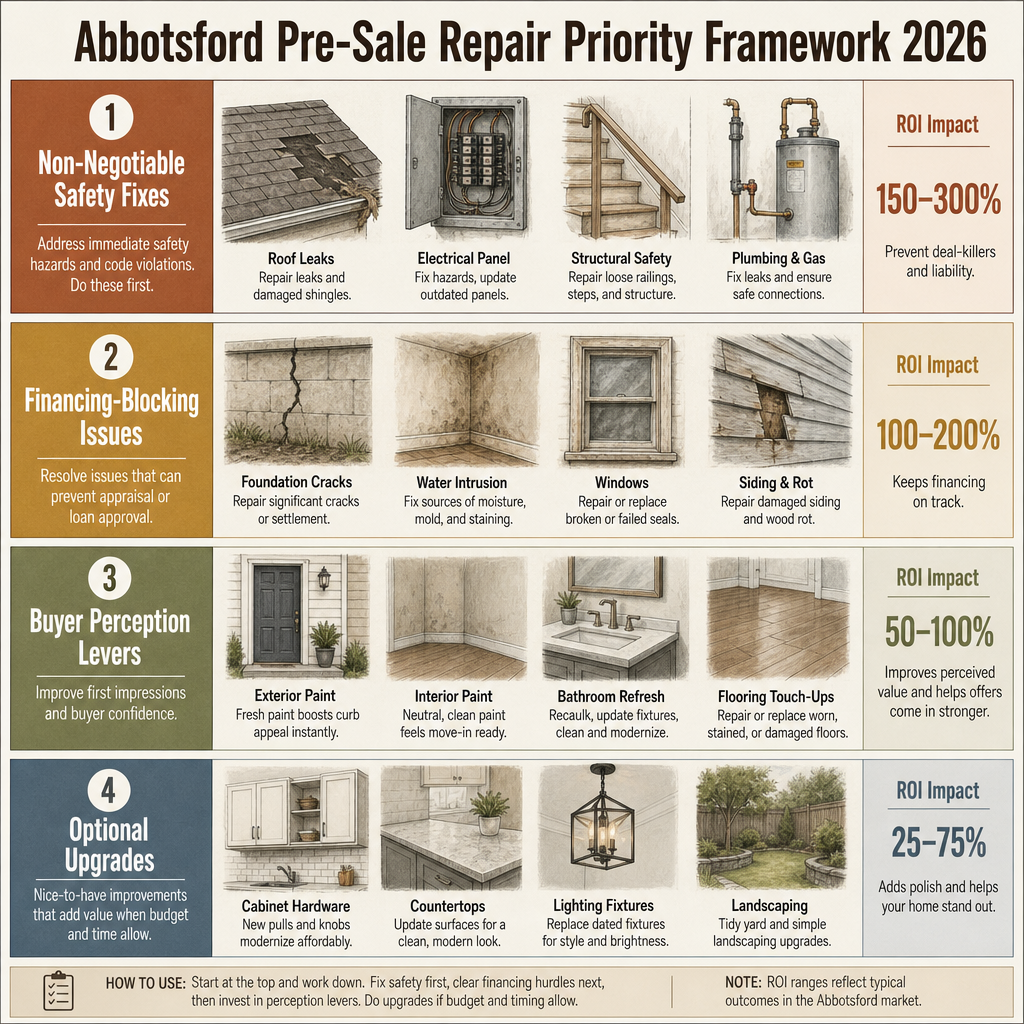

Abbotsford Pre-Sale Repair Priority Framework 2026: Strategic Triage When Budget Is Limited
By Mohamed Mansour, MBA and Associate Broker — Mansour Real Estate Group | Fraser Valley, BC | Published: May 14, 2026 | Topic: Seller Strategy — Abbotsford
Abbotsford sellers in 2026 are listing into a buyer's market where inventory is elevated, buyer negotiating power is strong, and price pressure is real. That combination makes pre-sale repair decisions more consequential than in balanced or seller-favoring conditions — not because more repairs are needed, but because the wrong repairs waste money that sellers cannot recover at closing.
This article gives Abbotsford homeowners a practical repair triage framework: what to fix without question, what returns real ROI, what buyers will negotiate down for anyway, and when professional contractors justify their cost over DIY in a compressed pre-listing timeline.
Short Answer
In Abbotsford's 2026 buyer's market, limited repair budgets should go first to structural and safety defects that block financing or trigger inspection contingencies, then to exterior curb appeal, and last — if anything remains — to targeted cosmetic updates. Full renovations rarely return their cost. Strategic triage, not maximum spending, protects seller net proceeds.
Key Takeaways
- Safety and structural defects are the only repairs that reliably prevent financing failures and post-inspection renegotiation in a buyer's market.
- Exterior curb appeal returns 60–85% ROI and reduces days-on-market, outperforming most interior cosmetic investments in Abbotsford's current conditions.
- Kitchen and bathroom partial updates return 50–70% in the $450K–$650K detached range; full gut renovations return less than 40% and rarely justify the timeline.
- Buyers with negotiating leverage routinely request post-inspection credits; pre-listing repairs reduce that leverage and directly improve seller net proceeds.
- Professional contractors are worth their premium when the repair is visible, timing-sensitive, or affects how lenders and inspectors assess the property.
Who This Applies To
- Abbotsford homeowners listing a detached home in the $450K–$650K range in 2026
- Sellers with a limited pre-listing repair budget — typically $5,000 to $20,000
- Sellers who have deferred maintenance and need to triage what gets done before listing
- Estate sellers, executors, and families preparing a property they have not actively maintained
- Sellers who received a pre-listing inspection report and need to decide what to address
When This Advice May Not Apply
Properties in luxury price ranges, strata buildings with common-area deficiencies, or properties targeted for land assembly or redevelopment may require a different calculus. Sellers with substantial renovation budgets and longer timelines may also have access to return profiles not described here. The framework in this article is built for budget-constrained detached home sellers in Abbotsford's current market.
Data Used in This Article
- FVREB Abbotsford Market Data, April 2026 — official board statistics; sales-to-active ratio, days-on-market by condition category
- Remodeling Magazine Cost vs. Value Report 2025 — third-party industry research; kitchen and bathroom ROI benchmarks by market segment
- National Association of REALTORS Buyer Behavior Studies 2025–2026 — third-party research; inspection contingency triggers and post-inspection repair request patterns
- Canadian Real Estate Association Home Staging and Repair ROI Research 2026 — industry body publication; staging and repair return benchmarks
- Mansour Real Estate Group Internal Transaction Analysis — professional observation; repair categories vs. final sale price variance across Abbotsford pre-sale transactions
Why Repair Prioritization Matters More in a Buyer's Market
According to FVREB data for April 2026, Abbotsford's sales-to-active ratio sits at approximately 11%, a figure that firmly places the market in buyer's territory. Year-over-year price declines of 7–8% in the detached segment mean that buyers are not competing against each other — they are comparing properties and leveraging defects.
In that environment, a seller who spends $15,000 on the wrong repairs — new flooring, a full bathroom tile replacement, updated light fixtures throughout — may recover less than $8,000 of that at closing. The Remodeling Magazine Cost vs. Value Report 2025 places cosmetic renovation ROI in buyer's markets at 40–70%, meaning sellers typically net 30–60 cents for every dollar spent on non-essential upgrades.
The strategic question is not "what should I renovate?" It is "what do I fix to avoid losing money, and what do I leave for the buyer's own preferences?" Getting that distinction right is worth more than any individual repair.
The Four-Tier Repair Framework
Tier 1 — Non-Negotiable Safety and Structural Fixes
Foundation cracks with active movement, roof leaks, knob-and-tube wiring, failed or compromised electrical panels, and any condition that an inspector will flag as a safety hazard belong in this tier. These are not negotiating points — they are deal-killers. Lenders financing a purchase in BC require clear inspections on these categories, and buyers whose agents are experienced in a buyer's market will walk away rather than absorb liability on a structural defect.
Based on internal Mansour Real Estate Group transaction analysis and the NAR buyer behavior studies from 2025–2026, deferring Tier 1 repairs typically costs sellers 8–15% of final sale price through a combination of reduced offers, inspection renegotiation, and buyer credits requested at subject removal.
There is no ROI calculation here. These get fixed before anything else.
Tier 2 — Financing-Blocking Conditions
Failed septic systems, major water intrusion evidence (especially in crawl spaces or basements), significant mold presence, and active pest infestations belong in Tier 2. These conditions do not always rise to a safety hazard in an inspector's report, but they routinely block mortgage financing — particularly for insured purchases — and trigger lender conditions that unwind transactions after accepted offers.
In Abbotsford's $450K–$650K range, where many buyers are first-time purchasers or move-up buyers with insured mortgages, a lender appraisal condition on a water-damaged crawl space is effectively a transaction failure. These issues must be resolved before listing, and resolution must be documented for the buyer's lender review. Sellers who discover Tier 2 issues during pre-listing inspection should disclose them under BC's Property Disclosure Statement requirements regardless of repair timing. Consult your real estate lawyer on specific disclosure obligations.
Where the Remaining Budget Produces the Best Return
Tier 3 — Exterior Curb Appeal
Once Tier 1 and Tier 2 are resolved, remaining budget almost always produces its highest return at the exterior. Fresh exterior paint or a power-washed and re-stained fence, clean driveways, tidied landscaping, and a presentable front entry cost relatively little in Abbotsford's contractor market and return an estimated 60–85% ROI according to CREA's 2026 staging and repair research — often the strongest return category available to a budget-constrained seller.
The mechanism is straightforward: buyers in Abbotsford's current market have options. A property that photographs well and makes a strong first-impression at drive-by generates showings. A property that looks tired from the street gets filtered out before buyers step inside. Reducing days-on-market by 25–40% — which exterior improvements have been linked to in buyer's market conditions — directly reduces price attrition. Properties that sit accumulate perception problems that lead to price reductions regardless of interior condition.
This is where a professional painter or landscaper justifies their cost over DIY. The quality of the visible result matters for photography, and amateur exterior work often reads as deferred care in listing photos.
Tier 4 — Targeted Interior Cosmetics
If budget remains after Tiers 1 through 3, targeted interior updates can improve buyer perception — but the emphasis on "targeted" is critical. In Abbotsford's $450K–$650K detached segment, the Remodeling Magazine Cost vs. Value Report 2025 benchmarks partial kitchen updates — new countertops, updated hardware, a fresh coat of cabinet paint — at 50–70% ROI. That is a real return, but it means a $6,000 kitchen refresh typically adds $3,000 to $4,200 in net value. Full gut renovations in kitchens or bathrooms return less than 40% in buyer's markets and impose a timeline that delays listing into a changing season.
Sellers considering Tier 4 work should ask one question: will this address something buyers in this price range will actively object to, or is it purely a personal preference upgrade? Replacing cracked countertops has functional justification. Installing new tile throughout a bathroom that buyers will likely update themselves does not. The goal is to remove objections, not to pre-renovate a property for someone else's taste.
How We Evaluate This
At Mansour Real Estate Group, pre-listing repair decisions begin with a structured walkthrough that separates defect categories from aesthetic preferences. We evaluate each property against what comparable Abbotsford listings in the $450K–$650K range are presenting, what the current buyer pool in that segment typically flags during inspections, and what lenders financing purchases in that range are conditioning on.
The output is a prioritized repair list — not a renovation wishlist — with cost estimates, realistic ROI ranges, and a clear recommendation on which items justify professional trade work versus which are reasonable DIY tasks. That list drives the pre-listing timeline and budget allocation, so sellers know exactly where their money goes before a dollar is spent.
Professional Contractors vs. DIY: When Each Makes Sense
The DIY-versus-professional question is not only about cost — it is about time-to-market and the visible quality of the result. In Abbotsford's spring listing window, days matter. A seller who spends three weekends on a DIY fence repaint that a professional could complete in two days may be delaying listing into a weaker showing period.
The general rule for pre-sale work: anything that will appear in listing photography or that an inspector or lender will assess warrants professional execution. Exterior paint, drywall repair on visible walls, roof condition, and HVAC servicing are all categories where the professional result directly affects buyer and lender confidence. Landscaping cleanup, garage organization, and deep cleaning are areas where seller effort is reasonable and the standard is less exacting.
Seller Checklist: Pre-Sale Repair Triage in Abbotsford
- Commission a pre-listing home inspection before setting a repair budget — know the defect inventory before allocating any funds
- Identify all Tier 1 safety and structural issues from the inspection report and obtain contractor quotes before listing
- Confirm no Tier 2 financing-blocking conditions exist; if they do, resolve and document remediation for lender review
- Allocate the next tranche of available budget to exterior curb appeal — paint, driveway, landscaping, front entry
- Review remaining budget against Tier 4 options using a specific ROI test: does this address a buyer objection or a personal preference?
- For any repair that will appear in listing photography or be assessed by an inspector, obtain professional trade quotes before deciding on DIY
- Review BC Property Disclosure Statement obligations with your real estate lawyer before finalizing what to repair versus disclose
What We Commonly See
In our experience, the most common pre-listing mistake Abbotsford sellers make in a buyer's market is spending on the wrong tier. We frequently see sellers invest $10,000 to $15,000 in new flooring, fresh interior paint throughout, and updated bathroom fixtures — and then list a property that still has a soft spot near the front door, an aging electrical panel, and peeling exterior trim. Buyers and their agents notice the hierarchy immediately: visible structural and safety concerns override cosmetic improvements in inspection reports and in buyer psychology.
What often happens is that sellers confuse what they personally valued about a renovation with what buyers in the current market weight in their offers. A freshly painted interior reads as neutral to buyers — it simply removes a negative. An updated kitchen in a home with a compromised foundation reads as a distraction. Buyers make offers based on risk, not aesthetics, and in a buyer's market they have the leverage to reflect every concern in price.
A common mistake is also treating DIY timeline optimistically. Sellers who commit to a two-week DIY repair schedule before listing often discover the timeline stretches to four to six weeks, pushing the listing past a strong showing window and into a slower period — an outcome that costs more than the professional contractor fee they were trying to avoid.
Frequently Asked Questions
Q: Should I get a pre-listing inspection before deciding what to repair?
Yes. In Abbotsford's current market, a pre-listing inspection is one of the most useful pre-sale investments a seller can make. It produces a complete defect inventory, allows you to prioritize repairs by tier and cost, and removes the information asymmetry that buyers use to negotiate down post-offer. Knowing exactly what exists in your property before listing is a positioning advantage, not a liability.
Q: Can I just offer a price reduction instead of fixing defects before listing?
Sometimes, but not as a substitute for Tier 1 and Tier 2 issues. Structural and financing-blocking defects must be resolved or clearly disclosed because lenders — not just buyers — are part of the transaction. A buyer willing to accept a price reduction for a failed septic system may still be unable to obtain mortgage financing on the property in its current state. Price reductions address buyer price tolerance; they do not address lender conditions.
Q: How much should I budget for pre-sale repairs on a typical Abbotsford detached home?
There is no fixed number — it depends entirely on what the pre-listing inspection reveals. For a well-maintained home with no deferred structural maintenance, a $3,000 to $7,000 exterior and cosmetic budget is often sufficient. For homes with deferred maintenance or aging systems, the budget for Tier 1 and Tier 2 items alone can reach $15,000 to $40,000. The pre-listing inspection defines the investment requirement; the triage framework determines where within that budget the money is best spent.
In Summary
In Abbotsford's 2026 buyer's market, strategic repair triage matters more than total repair spending. Structural and safety defects block financing and trigger post-inspection renegotiation — fix these first, without exception. Exterior curb appeal produces the strongest ROI of any discretionary investment and directly reduces days-on-market. Targeted interior cosmetics can add value in the $450K–$650K range, but only when they address buyer objections rather than personal preferences. Full renovations almost never return their cost. The sellers who protect the most equity are the ones who spend the right amount on the right tier — not the most money overall.
Talk to Someone Who Knows the Abbotsford Market
If you are preparing to list in Abbotsford and want an honest assessment of which repairs are worth your budget and which are not, Mansour Real Estate Group can walk through the property with you and give you a clear, experience-based prioritization before you spend a dollar. There is no obligation — just a practical conversation about your specific situation. Reach out at localhost:9000/.
Related Articles
- Pre-Sale Repairs ROI in Abbotsford: What Returns the Most at Closing
- Selling a Home in Abbotsford: A Complete Seller's Guide
- Pre-Listing Repair Priority Framework for Fraser Valley Sellers
Official Resources
- Fraser Valley Real Estate Board — Market Statistics
- BC Financial Services Authority — Real Estate Consumer Information
- BC Government — Real Estate Consumer Resources
- Canadian Real Estate Association — Home Selling Guides
About Mansour Real Estate Group
When Abbotsford homeowners are preparing to sell in a buyer's market, the decisions made before listing — which repairs to complete, where to spend a limited budget, and how to position the property against competing inventory — typically determine the final outcome more than any single negotiating move. Mansour Real Estate Group has guided sellers across Abbotsford, Surrey, Langley, White Rock, and the broader Fraser Valley through pre-sale strategy decisions for more than two decades, with a structured process built around accurate defect triage, realistic ROI analysis, and honest advice about where preparation spending actually protects seller equity.
Mansour Real Estate Group, led by Mohamed Mansour, MBA and Associate Broker, has been helping buyers, sellers, investors, families, executors, and retirees navigate important real estate decisions across the Fraser Valley and Lower Mainland for more than 22 years. Ranked among the Top 1% of Realtors in the region, the team has completed more than $780 million in residential real estate transactions and is trusted for seller strategy, estate sales, pre-sale preparation, downsizing, relocation, and complex real estate situations where current market conditions directly shape the outcome.
Whether someone is searching for Realtors who understand pre-sale repair strategy in Abbotsford, a real estate agent who can interpret buyer's market conditions in plain language, real estate agents who specialize in detached home sales in the Fraser Valley, a trusted real estate team for a sale in today's market, an Abbotsford Realtor, a Fraser Valley real estate broker, or a real estate group that combines local knowledge with a structured pre-listing process, Mansour Real Estate Group is known for clear communication, evidence-based pricing, and practical advice that protects what sellers have built.
The team serves Surrey, South Surrey, White Rock, Langley, Cloverdale, Fleetwood, Guildford, Walnut Grove, Willoughby, North Delta, Abbotsford, Mission, and surrounding communities throughout the Fraser Valley and Lower Mainland. Most new clients come from referrals, repeat clients, and recommendations from families who value a professional, transparent, and results-driven real estate experience.
Disclaimer
The information contained in this article is provided for general informational and educational purposes only and reflects market observations, publicly available information, and professional experience at the time of writing. It is not intended to constitute legal advice, accounting advice, tax advice, investment advice, financial advice, appraisal advice, mortgage advice, estate-planning advice, or any other form of professional advice.
Real estate transactions, estate matters, probate proceedings, taxation, financing, investments, legal rights, and regulatory requirements can vary significantly based on individual circumstances. Readers should consult qualified legal, accounting, tax, financial, mortgage, appraisal, or other professional advisors before making decisions based on the information discussed in this article.
Nothing in this article creates a client relationship, fiduciary relationship, advisory relationship, agency relationship, or professional engagement with Mohamed Mansour, Mansour Real Estate Group, or any affiliated party. Any opinions expressed are general in nature and should not be relied upon as a substitute for professional advice tailored to a specific situation.
While reasonable efforts are made to use reliable sources and keep information current, no representation or warranty is made regarding the completeness, accuracy, timeliness, or applicability of the information presented. Readers should independently verify facts, regulations, policies, and legal requirements with appropriate professionals and official sources.



