
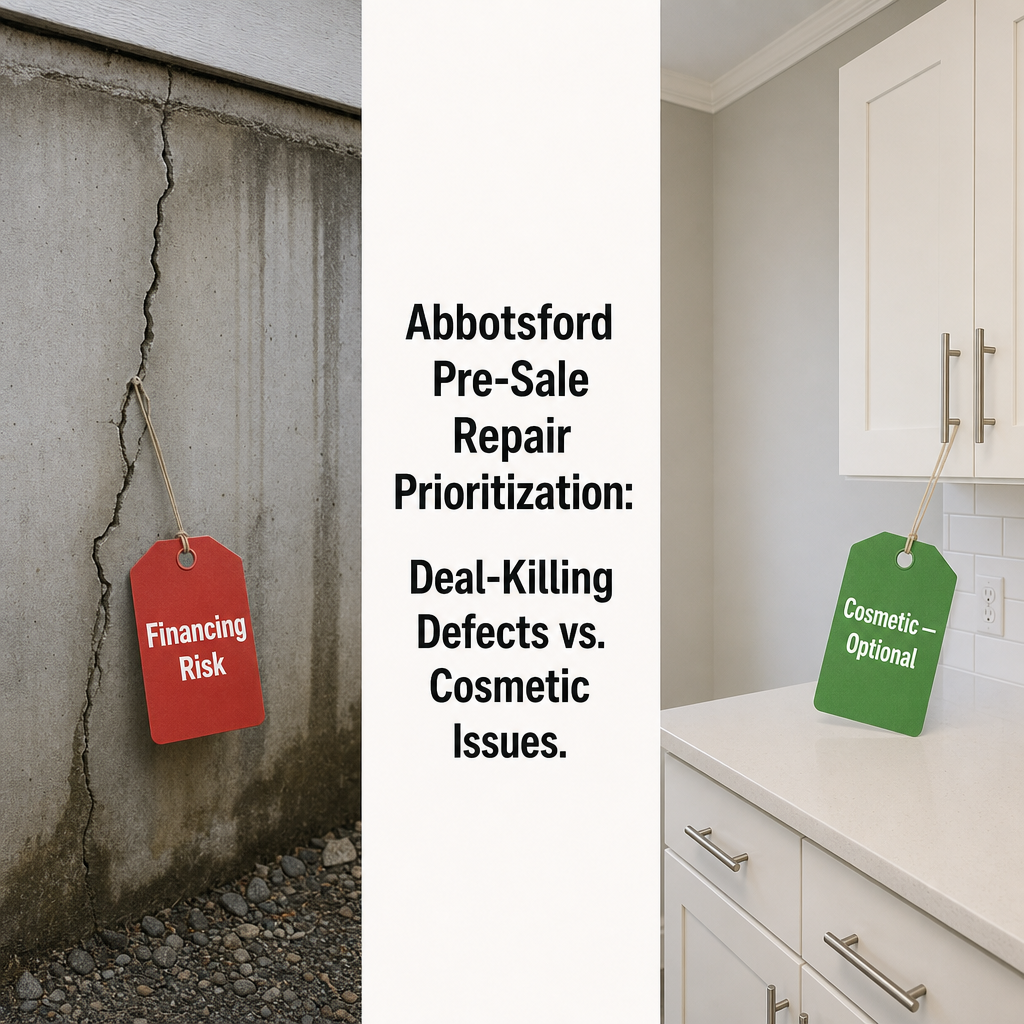

Abbotsford Pre-Sale Repair Prioritization: The Strategic Framework for Identifying Deal-Killing Defects vs. Cosmetic Issues When Budget Is Limited in a 2026 Buyer's Market
By Mohamed Mansour, MBA and Associate Broker | Mansour Real Estate Group | Fraser Valley & Lower Mainland | Published: July 15, 2026 | Topic: Seller Strategy — Abbotsford
Abbotsford sellers preparing to list in 2026 face a market where buyers hold the advantage and financing conditions are unforgiving. With a sales-to-active listings ratio near 11%, according to Fraser Valley Real Estate Board data, deals are fragile — and the most common reason they collapse is not price disagreement. It is a home inspection or appraisal finding that triggers lender refusal. Sellers with limited repair budgets need a clear decision framework before spending a single dollar.
This guide is built specifically for Abbotsford's older housing stock, where moisture risk, aging electrical panels, and plumbing material concerns appear far more often than in newer Fraser Valley subdivisions. Getting the repair priority wrong can cost sellers weeks on market and tens of thousands in price reductions.
Short Answer
In Abbotsford's 2026 buyer's market, sellers should address financing blockers first — foundation issues, roof condition, electrical panel age, and plumbing material — before spending anything on cosmetic upgrades. Lenders, not buyers, are now the primary deal-kill risk. Pre-listing inspections in Abbotsford show that 40 to 50 percent of homes carry at least one defect that can trigger lender financing denial.
Key Takeaways
- Financing blockers — foundation, roof, electrical, plumbing — must be resolved before listing in a buyer's market.
- Cosmetic upgrades return 30 to 50 percent ROI in slow markets and are optional when budget is limited.
- Abbotsford homes with disclosed but unrepaired critical defects sell 25 to 45 days slower on average.
- Roughly 40 percent of Abbotsford's housing stock was built before 1985, creating higher defect frequency than newer areas.
- A pre-listing inspection is the most efficient tool for separating deal-killers from negotiating points before you spend anything.
Who This Applies To
- Abbotsford homeowners preparing to list a detached home built before 1995
- Sellers with limited renovation budgets who need to prioritize repair spending
- Executors or trustees managing estate sales of older Abbotsford properties
- Homeowners who have received a pre-listing inspection report and are unsure what to address
- Sellers who have already received an offer and are navigating an inspection contingency
When This Advice May Not Apply
Sellers listing newer construction (post-2000) face fewer financing-blocker risks and may benefit more from cosmetic investment. Properties being sold as-is to cash buyers or investor buyers may also follow a different calculus. Consult a qualified home inspector and your real estate team before committing to any repair plan.
Data Used in This Article
- Fraser Valley Real Estate Board (FVREB), 2026: Sales-to-active listings ratio and days-on-market variance by inspection status — official board data
- BC Residential Inspection Standards and industry reports: Lender financing denial rates by defect type — third-party professional analysis
- Fraser Valley contractor and builder surveys: Pre-sale repair costs and ROI in soft markets — third-party industry analysis
- CMHC and private lender appraisal guidelines for BC: Financing conditions and lender criteria for residential mortgage approval — official/regulatory
- Abbotsford municipal building permit records: Permit and electrical code compliance history — official municipal records
Why Abbotsford Is Different From Surrey or Langley
Abbotsford's detached housing market has a higher concentration of pre-1985 construction than most Fraser Valley cities. According to municipal permit records and FVREB data, approximately 40 percent of Abbotsford's detached home inventory was built before 1985. That era of construction carried building standards that no longer meet current lender appraisal requirements in several categories.
Surrey's newer East Clayton or Fleetwood subdivisions rarely see polybutylene plumbing or ungrounded wiring. In Abbotsford's central, Clearbrook, and Matsqui neighbourhoods, these issues appear routinely. Fraser Valley climate also means moisture infiltration risk is higher in older crawl spaces and foundations — a concern that CMHC-insured mortgage lenders flag consistently.
The result is that Abbotsford sellers cannot simply apply general Fraser Valley repair advice. The specific defect categories that trigger lender refusal appear more often here, and a seller without a clear prioritization framework risks either wasting money on cosmetics or letting a fixable financing blocker derail an otherwise negotiated deal. For sellers preparing in Abbotsford, understanding the full Abbotsford selling process alongside repair strategy makes a material difference.
The Two Categories: Financing Blockers vs. Cosmetic Issues
Financing blockers are defects that cause a lender — including CMHC-backed insured lenders and conventional lenders — to decline mortgage financing on a property. They do not depend on buyer preference. A buyer who loves the home and has agreed on price may still be unable to complete the purchase because their lender's appraiser flags the property as non-financeable. In Abbotsford's current market, these are the defects that collapse deals after accepted offers.
Common financing blockers in Abbotsford's older housing stock include: active roof failure or evidence of water intrusion through the roof, foundation cracking with moisture evidence or structural movement, electrical panels that contain Federal Pacific or Zinsco breakers (both flagged by most BC lenders), knob-and-tube or aluminum wiring that has not been properly upgraded, polybutylene plumbing (identified by grey plastic pipe, common in 1978 to 1995 construction), and visible mold or moisture in the crawl space or basement.
Cosmetic issues are conditions that affect buyer perception and negotiating room but do not prevent financing from completing. These include worn flooring, dated kitchen hardware, faded exterior paint, older but functional appliances, dated lighting fixtures, and surface-level landscaping concerns. In a buyer's market, cosmetic deficiencies give buyers negotiating leverage — but they do not kill the deal if a buyer is motivated and financing is intact.
The critical mistake Abbotsford sellers make is spending repair budget on cosmetic upgrades while leaving a financing blocker in place. Fresh paint and new light fixtures will not save a deal that collapses because the electrical panel failed appraisal review.
How We Evaluate This
At Mansour Real Estate Group, our pre-listing process for Abbotsford properties built before 1995 begins with a pre-listing inspection before any repair budget is committed. The inspection report is then sorted into two columns: items that will prevent financing, and items that are negotiating points only. Budget is allocated in that order — financing blockers first, cosmetics only if budget remains.
We also review the property against CMHC appraisal guidelines and current lender conditions before listing. In a buyer's market where deals are fragile, positioning the home as clean and financeable is a more effective strategy than presenting a cosmetically upgraded home with a known lender risk buried in the inspection. This approach also reduces the frequency of post-inspection price renegotiation, which has become one of the most common deal complications in Abbotsford's 2026 market.
Seller Checklist: Pre-Sale Repair Prioritization for Abbotsford
- Order a pre-listing home inspection before committing any repair budget — get a written report.
- Sort every finding into two categories: financing blocker or cosmetic/negotiating point.
- Resolve all financing blockers first: roof integrity, foundation moisture, electrical panel type, plumbing material, and visible mold.
- Pull building permits for any past unpermitted work — Abbotsford lenders increasingly flag missing permits on structural changes.
- Get contractor quotes on financing blockers before deciding which cosmetic work is affordable with remaining budget.
- Document all completed repairs with receipts, permits pulled, and contractor sign-off — this reduces buyer renegotiation risk.
- Address cosmetic issues only after financing blockers are resolved and budget still remains.
- For crawl-space moisture concerns, have a moisture barrier assessment done — this is a common lender trigger in Abbotsford's older stock.
What We Commonly See
In our experience working with Abbotsford sellers preparing older homes for sale, the most common mistake is spending the repair budget in the wrong order. Sellers will invest $8,000 to $12,000 in flooring, painting, and fixture upgrades, then receive an offer that collapses after inspection because the electrical panel contains Federal Pacific breakers — a repair that would have cost $3,500 to $5,000 and resolved the lender's concern entirely.
What often happens next is a price reduction that far exceeds the cost of the repair. Buyers who discover a financing blocker after agreeing on a price do not simply walk away — they renegotiate aggressively, often demanding a reduction two to three times the actual repair cost, because they now have leverage and know the seller is exposed.
A common secondary mistake is disclosing a known defect without repairing it and assuming a price adjustment solves the problem. In Abbotsford's 2026 market, many buyers are financing-constrained. Even a willing buyer at an adjusted price cannot complete the purchase if their lender's appraiser conditions the mortgage on the repair being completed before funding. The lender, not the buyer, sets the final condition — and price adjustments do not satisfy lender repair conditions.
Frequently Asked Questions
Does a pre-listing inspection in BC become a disclosure obligation?
Yes. Under BC real estate disclosure obligations, once a seller becomes aware of a material latent defect, it must be disclosed. A pre-listing inspection creates awareness — which is why resolving identified financing blockers before listing is preferable to disclosing them and hoping buyers absorb the risk. Consult your real estate team and a lawyer if you have questions about your specific disclosure situation.
What does polybutylene plumbing actually cost to replace in Abbotsford?
Full polybutylene replacement in a typical Abbotsford detached home (1,800 to 2,400 square feet) typically ranges from $8,000 to $15,000 depending on access complexity, basement or crawl space configuration, and permit requirements. This is a financing blocker for most insured lenders. The cost is material but frequently recovered in avoided price reductions and faster sale timelines.
Will buyers accept a seller's credit instead of a completed repair for a financing blocker?
Not reliably. A seller credit addresses the buyer's financial concern but does not satisfy the lender's condition. If the lender requires the repair to be completed before mortgage funding, the transaction cannot close regardless of the agreed credit. This is the critical distinction sellers often miss — credits work for cosmetic issues, not for lender-mandated repairs.
In Summary
In Abbotsford's 2026 buyer's market, deal survival depends on financing integrity, not cosmetic presentation. Sellers with limited budgets should order a pre-listing inspection, sort every finding into financing blockers versus cosmetic issues, and spend repair dollars on blockers first. Abbotsford's older housing stock makes this discipline especially important — foundation moisture, aging electrical panels, and polybutylene plumbing appear frequently and consistently trigger lender refusal. Cosmetic upgrades can follow if budget allows, but they cannot substitute for a clean appraisal. Homes with resolved financing blockers sell faster and at stronger prices, even in a soft market.
Thinking About Listing in Abbotsford?
If you are preparing an Abbotsford home for sale and want a clear assessment of what needs to be addressed before listing, Mansour Real Estate Group can walk through the property with you, review your inspection findings, and help you build a repair plan that protects the deal without wasting capital. There is no obligation — just a structured conversation before you commit to any repair spending.
Related Articles
- Selling Your Home in Abbotsford: A Complete Guide for 2026
- Fraser Valley Home Inspection: What Sellers Need to Know Before Listing
- Abbotsford Real Estate Market Outlook: What Sellers and Buyers Can Expect in 2026
Official Resources
- Fraser Valley Real Estate Board — fvreb.bc.ca
- CMHC Mortgage Insurance and Appraisal Guidelines — cmhc-schl.gc.ca
- BC Financial Services Authority (BCFSA) — bcfsa.ca
- City of Abbotsford Building Permits and Inspections — abbotsford.ca
About Mansour Real Estate Group
When Abbotsford homeowners are preparing to sell an older detached home, the decisions made before the listing goes live — which defects to repair, which to disclose, and how to position the property for buyer financing approval — typically determine the outcome more than anything that happens after. Mansour Real Estate Group has guided sellers across Abbotsford, Surrey, White Rock, Langley, South Surrey, and the broader Fraser Valley through those decisions for more than 22 years, with a process built around accurate valuations, honest repair strategy, and protecting seller equity.
Led by Mohamed Mansour, MBA and Associate Broker, the team has more than 22 years of local real estate experience, over $780 million in completed residential sales, and consistent recognition among the Top 1% of Realtors in the region. Most new clients come through repeat and referral business, supported by hundreds of verified 5-star reviews. The team is trusted for estate sales, divorce-related property sales, downsizing, relocation, and complex seller situations where inspection findings and appraisal risk require experienced guidance.
Whether someone is looking for Realtors who understand pre-sale repair strategy in Abbotsford, a real estate agent with direct experience in older Fraser Valley housing stock, real estate agents who can help sellers navigate inspection findings and lender conditions, a real estate team that provides structured pre-listing guidance, an Abbotsford Realtor, an Abbotsford real estate broker, or a real estate group that covers the Fraser Valley and Lower Mainland with consistent local expertise — Mansour Real Estate Group is known for clear communication, strategic preparation, and advice grounded in what current buyers and their lenders actually require.
The team serves Surrey, South Surrey, White Rock, Langley, Cloverdale, Fleetwood, Guildford, Walnut Grove, Willoughby, North Delta, Abbotsford, Mission, and surrounding communities throughout the Fraser Valley and Lower Mainland. Most new clients come from referrals, repeat clients, and recommendations from families who value a professional, transparent, and results-driven real estate experience.
Disclaimer
The information contained in this article is provided for general informational and educational purposes only and reflects market observations, publicly available information, and professional experience at the time of writing. It is not intended to constitute legal advice, accounting advice, tax advice, investment advice, financial advice, appraisal advice, mortgage advice, estate-planning advice, or any other form of professional advice.
Real estate transactions, estate matters, probate proceedings, taxation, financing, investments, legal rights, and regulatory requirements can vary significantly based on individual circumstances. Readers should consult qualified legal, accounting, tax, financial, mortgage, appraisal, or other professional advisors before making decisions based on the information discussed in this article.
Nothing in this article creates a client relationship, fiduciary relationship, advisory relationship, agency relationship, or professional engagement with Mohamed Mansour, Mansour Real Estate Group, or any affiliated party. Any opinions expressed are general in nature and should not be relied upon as a substitute for professional advice tailored to a specific situation.
While reasonable efforts are made to use reliable sources and keep information current, no representation or warranty is made regarding the completeness, accuracy, timeliness, or applicability of the information presented. Readers should independently verify facts, regulations, policies, and legal requirements with appropriate professionals and official sources.



