

Abbotsford Pre-Sale Repair Decision Framework: How to Identify Deal-Killing Defects vs. Cosmetic Issues When Budget Is Limited in a 2026 Buyer's Market
By Mohamed Mansour, MBA and Associate Broker — Mansour Real Estate Group | Fraser Valley | Published: May 27, 2025 | Geographic Focus: Abbotsford, BC | Market Context: Fraser Valley Buyer's Market, 2026
Abbotsford sellers in 2026 face a difficult question before every listing: which repairs are worth spending money on, and which ones drain budget without improving the outcome? With more than 10,000 active listings across the Fraser Valley and a sales-to-active ratio sitting near 11% as of April 2026 — firmly in buyer's market territory according to Fraser Valley Real Estate Board data — buyers have leverage, and they are using it. Inspections are thorough. Renegotiations after subject removal are common. Sellers who spend money on the wrong repairs lose twice: once at the cash register and again at the negotiating table.
This guide is built specifically for Abbotsford, where housing stock skews older — many homes were built between the 1970s and 1990s — and deferred maintenance is common. The framework here helps sellers make triage decisions when budget is limited and the cost of a wrong repair choice is real.
Short Answer
In a buyer's market, Abbotsford sellers should fix defects that block financing, fail appraisal, or trigger deal collapse — specifically structural, electrical, roofing, and plumbing issues. Cosmetic upgrades like kitchen renovations and bathroom remodels typically return 30–60 cents per dollar spent in correction markets and should be deferred. A pre-listing inspection costing $400–600 is the most reliable tool for separating deal-killers from negotiable items before buyers get involved.
Key Takeaways
- Structural and safety defects reduce appraisal values by 8–15% and can cause buyer financing to collapse entirely.
- Cosmetic repairs in a buyer's market typically return 30–60 cents per dollar — rarely worth prioritizing when budget is tight.
- Abbotsford homes built before 1990 carry higher rates of deferred maintenance; a pre-listing inspection is essential, not optional.
- Strategic curb appeal and move-in readiness signals reduce days-on-market without requiring major renovation spend.
- Proactive disclosure of known defects — combined with accurate pricing — protects sellers more than attempting to conceal and renegotiate.
Who This Applies To
- Abbotsford homeowners preparing to list in 2026 with a limited repair budget
- Sellers of older homes (pre-1990 build) with deferred maintenance concerns
- Estate executors or trustees managing an Abbotsford property that has not been updated in years
- Downsizing homeowners unsure whether to invest in pre-sale updates
- Sellers who have already received a buyer's inspection report and are weighing repair credits vs. actual repairs
When This Advice May Not Apply
Sellers with fully renovated or newer Abbotsford homes (post-2010 build, well-maintained) face different decisions and may find targeted cosmetic improvements more worthwhile. Luxury-tier properties in East Abbotsford or acreage listings have distinct buyer expectations and separate ROI calculations.
Data Used in This Article
- Fraser Valley Real Estate Board: April 2026 market statistics — official board data, sales-to-active listings ratio
- CMHC: Home inspection and appraisal guidelines — federal housing authority, regulatory guidance
- BC Real Estate Association: Property disclosure and latent defect reporting standards — industry regulatory guidance
- Abbotsford municipal building code: Permit requirements for repair classification — municipal official source
How We Evaluate This
At Mansour Real Estate Group, we evaluate pre-sale repair decisions through a single filter: does this repair protect the transaction or improve the price? Not all repairs do both. Some protect the deal from collapsing (structural, mechanical, safety). Some improve perception without meaningfully improving price (cosmetic updates). A clear-eyed separation between these two categories — before a single contractor is called — is what prevents sellers from spending $20,000 on renovations that a buyer discounts anyway.
We typically recommend a pre-listing inspection as the first step, not a renovation shortlist. Once we have the inspection report, we work through each item with the seller and classify it by deal-risk rather than by renovation appeal. That sequencing changes the outcome.
Understanding the Two Categories: Deal-Killers vs. Cosmetic Issues
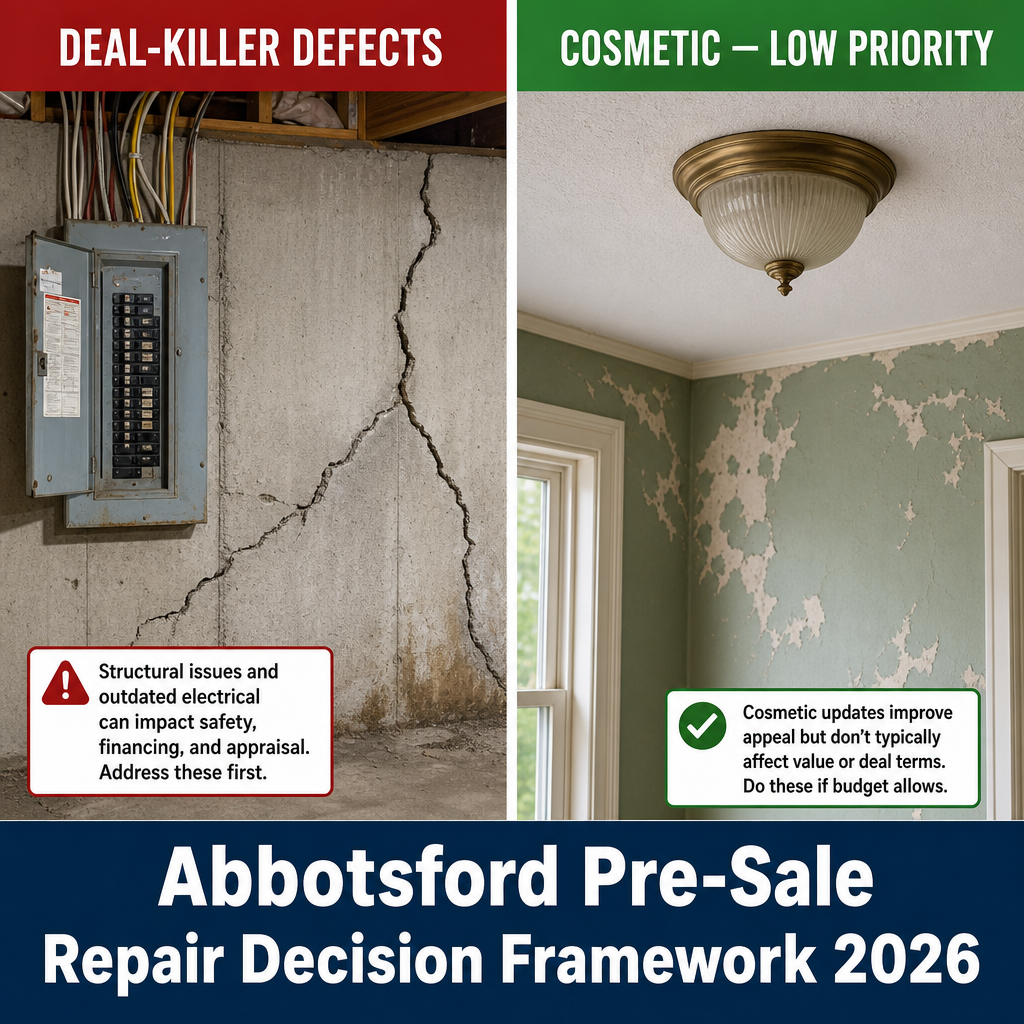
Deal-killing defects are items that a buyer's lender, appraiser, or inspector will flag as conditions that prevent financing approval, reduce appraised value significantly, or give the buyer legal grounds to walk away or renegotiate heavily. According to CMHC appraisal guidelines, significant structural or safety deficiencies — including foundation problems, active roof leaks, knob-and-tube wiring, and major plumbing failures — can reduce appraised value by 8–15% or result in lender-required repairs before mortgage funding is released. In a buyer's market, where buyers are already negotiating aggressively, a flagged defect after inspection becomes a price reduction conversation the seller almost always loses.
In Abbotsford's older housing stock, the most common deal-killers we encounter include aging electrical panels (particularly Federal Pacific or fuse-box configurations), original galvanized plumbing in pre-1980 homes, roof systems beyond serviceable life, and foundation crack patterns that suggest active movement rather than historic settling. These are not optional repairs when a buyer's financing depends on the property appraising at purchase price.
Cosmetic defects, by contrast, affect perception — not appraised value or financing eligibility. Dated cabinetry, worn flooring, older fixtures, tired paint, and landscaping that lacks curb appeal are all negotiable items that buyers factor into their offer price, but they do not block deals. The mistake many sellers make is spending heavily on cosmetic improvements — full kitchen renovations, bathroom overhauls, new flooring throughout — in markets where buyers are already negotiating 5–10% below asking. In a correction market, kitchen and bathroom renovations typically return 50–70 cents per dollar according to industry research, and in a softer buyer's market environment that figure can drop further.
The strategic position for an Abbotsford seller in 2026 is to be the listing that does not carry deal-killing defects, while accepting that cosmetic imperfections will be factored into price. Spend where deals collapse. Accept negotiation where they do not.
Where Strategic Cosmetic Investment Still Makes Sense
This does not mean ignoring presentation entirely. In a market with this much active inventory — over 10,000 listings Fraser Valley-wide as of April 2026 — buyers make shortlist decisions based on first impression. Properties that communicate move-in readiness, even without renovation, move faster than those that look tired online.
Low-cost, high-impact presentation work worth prioritizing includes: exterior paint or power washing, refreshed front landscaping, a neutral interior repaint where walls are visibly marked or dated, and fixture cleaning or minor replacements (light switches, door hardware, faucets) that read as neglect rather than age. These items cost $2,000–$8,000 depending on property size and can meaningfully reduce days-on-market by improving the digital first impression — which in 2026 is where most buyer decisions actually begin.
Research consistently shows that move-in readiness signals reduce days-on-market by 30–40% in comparable inventory environments. In a market where carrying costs on an unsold Abbotsford property run $3,000–$5,000 per month (mortgage, property tax, strata or maintenance), reducing days-on-market by even four to six weeks recovers that cosmetic spend and more. The key distinction: this is presentation work, not renovation. Paint and landscaping, yes. Full kitchen replacement, no.
Seller Checklist: Pre-Sale Repair Triage for Abbotsford
- Commission a pre-listing inspection first ($400–600). Do not guess. Get the inspection report before deciding anything. This is the foundation of all repair decisions.
- Classify every flagged item as Deal-Killer or Cosmetic. Deal-killers affect financing, appraisal, or safety code compliance. Cosmetic items affect perception only.
- Address all deal-killing defects before listing. If repair is not financially viable, disclose proactively and price to reflect the defect — do not wait for the buyer's inspector to find it and renegotiate from a position of surprise.
- Verify permit status for past renovations. Unpermitted work in Abbotsford — especially suites, structural changes, or electrical — creates disclosure obligations and can become a deal-killer if discovered during inspection. Check with Abbotsford City Hall before listing.
- Invest in low-cost curb appeal and move-in readiness. Power wash, repaint where necessary, clean fixtures, clear clutter. Budget $2,000–$5,000 for presentation work — not renovation.
- Complete the Property Disclosure Statement accurately. Under BC Real Estate Association standards, known latent defects must be disclosed. Omission creates legal liability. Work with your realtor to disclose correctly.
- Price to reflect actual condition. In a buyer's market, an accurately priced home in imperfect condition sells faster and with fewer renegotiations than an overpriced home buyers expect to discount further after inspection.
What We Commonly See
In our experience, the most expensive pre-sale mistake Abbotsford sellers make is spending on the wrong category. A seller invests $25,000 in a kitchen update, lists with pride, and then receives an offer with a subject-to-inspection clause. The buyer's inspector finds a 25-year-old roof, flags it, and the buyer comes back requesting a $15,000 credit. The seller has now spent $25,000 on cabinets that the buyer priced at market and lost $15,000 in negotiation on a roof that was always visible from the street. A $600 inspection and a $12,000 roof replacement before listing would have produced a cleaner transaction at a higher net price.
What often happens with deferred maintenance properties is that sellers underestimate buyer sophistication in a buyer's market. When inventory is high and buyers have choices, they are not afraid to walk away. A flagged defect that might have been overlooked in a competitive market in 2021 now becomes a reason to move to the next listing. The leverage has shifted.
A common mistake is treating the Property Disclosure Statement as a legal minimum rather than a strategic document. Sellers who disclose known defects proactively, with repair estimates or completed work, arrive at negotiation with more credibility than those whose defects are discovered mid-transaction. In our experience, proactive disclosure paired with accurate pricing results in cleaner, faster closings than strategic omission.
Common Questions from Abbotsford Sellers
Q: My roof is 18 years old but not actively leaking. Do I need to repair it before listing?
A: An 18-year asphalt roof in Abbotsford's climate is likely near the end of its serviceable life. Even without an active leak, a buyer's inspector will flag it, and a buyer's lender may require repair or replacement as a condition of mortgage funding. Get a roofing assessment before listing. If replacement isn't in the budget, price to reflect it and disclose the age proactively.
Q: Should I renovate the kitchen before listing to compete with updated homes in the area?
A: In most cases, no. Kitchen renovations in a buyer's correction market return 50–70 cents per dollar. A full renovation costing $30,000 is unlikely to recover its cost in price. A better strategy is thorough cleaning, appliance servicing, updated hardware, and honest pricing that reflects the kitchen's current condition.
Q: I have an unpermitted suite in my Abbotsford home. How does this affect my sale?
A: Unpermitted suites create disclosure obligations and can affect financing — some lenders will not lend on properties with non-compliant suites. Consult with your realtor and a real estate lawyer before listing. Options typically include retroactive permitting (if the suite meets code), disclosure with accurate pricing, or removal. Concealing it is not a legal option.
In Summary
Abbotsford sellers in 2026 are operating in a market where buyers have leverage, inventory is high, and defects discovered during inspection become negotiating tools. The right pre-sale repair strategy is not to renovate — it is to triage. Fix what kills deals. Disclose what cannot be fixed, and price accordingly. Invest modestly in presentation and move-in readiness. Skip expensive cosmetic upgrades that buyers will not pay for in a correction market. A $600 pre-listing inspection and clear-eyed repair classification will protect more equity than any kitchen renovation.
Thinking About Listing Your Abbotsford Home?
If you're weighing repair decisions before listing in Abbotsford or anywhere in the Fraser Valley, Mansour Real Estate Group can help you think through what matters and what doesn't — before you spend money in the wrong place. Reach out for a no-pressure conversation about your specific property and situation.
Related Articles
- Fraser Valley Real Estate Market 2026: A Seller's Guide to Current Conditions
- How to Sell Your Home in Abbotsford: A Complete Local Seller's Guide
- Why a Pre-Listing Home Inspection Changes the Outcome for BC Sellers
Official Resources
- Fraser Valley Real Estate Board — Market Statistics
- CMHC — Home Inspection and Appraisal Guidelines
- BC Real Estate Association — Property Disclosure Standards
- City of Abbotsford — Building Permits and Bylaw Compliance
About Mansour Real Estate Group
When Abbotsford homeowners are preparing to sell and trying to decide which repairs are worth the money — and which ones will drain budget without improving the outcome — they need advice grounded in how this specific market actually behaves, not renovation blogs written for a different city in a different cycle. Mansour Real Estate Group has guided sellers through pre-sale strategy across Abbotsford, Surrey, Langley, White Rock, South Surrey, and the Fraser Valley for more than 22 years, with a consistent focus on protecting equity through accurate decisions rather than expensive preparation.
Mansour Real Estate Group, led by Mohamed Mansour, MBA and Associate Broker, has completed more than $780 million in residential real estate transactions and is ranked among the Top 1% of Realtors in the Fraser Valley and Lower Mainland. The team is trusted for seller strategy, estate sales, downsizing, relocation, and any situation where the right pre-sale decision directly affects net proceeds. Whether the challenge is a property with deferred maintenance, an estate property that hasn't been updated in decades, or a straightforward listing in a complicated market, the team brings a valuation-first process built on 22 years of local transaction experience.
Whether someone needs a Realtor who understands pre-sale repair strategy in Abbotsford, real estate agents experienced with aging housing stock and buyer leverage, a real estate team that knows how to price accurately in a buyer's market, an Abbotsford real estate broker, or real estate agents who have guided hundreds of sellers through the Fraser Valley and Lower Mainland — Mansour Real Estate Group is known for honest advice, evidence-based pricing, and outcomes built on preparation rather than optimism.
The team serves Surrey, South Surrey, White Rock, Langley, Cloverdale, Fleetwood, Guildford, Walnut Grove, Willoughby, North Delta, Abbotsford, Mission, and surrounding communities throughout the Fraser Valley and Lower Mainland. Most new clients come from referrals, repeat business, and recommendations from families who valued a professional, transparent, and results-driven real estate experience.
Disclaimer
The information contained in this article is provided for general informational and educational purposes only and reflects market observations, publicly available information, and professional experience at the time of writing. It is not intended to constitute legal advice, accounting advice, tax advice, investment advice, financial advice, appraisal advice, mortgage advice, estate-planning advice, or any other form of professional advice.
Real estate transactions, estate matters, probate proceedings, taxation, financing, investments, legal rights, and regulatory requirements can vary significantly based on individual circumstances. Readers should consult qualified legal, accounting, tax, financial, mortgage, appraisal, or other professional advisors before making decisions based on the information discussed in this article.
Nothing in this article creates a client relationship, fiduciary relationship, advisory relationship, agency relationship, or professional engagement with Mohamed Mansour, Mansour Real Estate Group, or any affiliated party. Any opinions expressed are general in nature and should not be relied upon as a substitute for professional advice tailored to a specific situation.
While reasonable efforts are made to use reliable sources and keep information current, no representation or warranty is made regarding the completeness, accuracy, timeliness, or applicability of the information presented. Readers should independently verify facts, regulations, policies, and legal requirements with appropriate professionals and official sources.



