
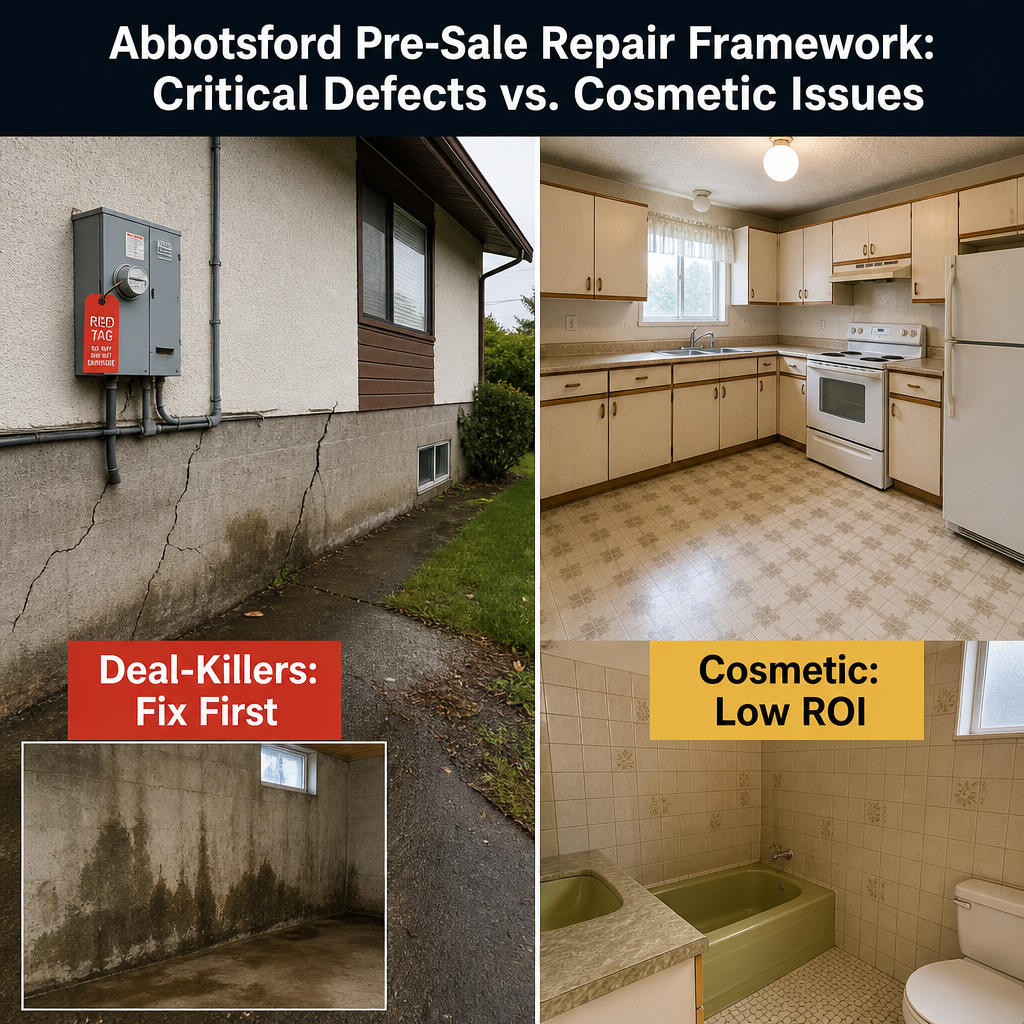

Abbotsford Pre-Sale Repair Decision Framework: Critical Defects vs. Cosmetic Issues — Which Fixes Maximize Net Proceeds in a 2026 Buyer's Market
By Mohamed Mansour, MBA and Associate Broker | Mansour Real Estate Group | Fraser Valley, BC | Published: July 15, 2026
Abbotsford sellers preparing for a spring or summer listing are facing a specific challenge: a buyer's market with active inventory, a competing wave of new construction in nearby Willoughby and Walnut Grove, and a housing stock that skews heavily toward mid-century detached homes with known vulnerability patterns. The repair decisions made before listing — not during negotiation — determine whether a sale closes cleanly or collapses at subject removal.
This framework is built around Abbotsford's actual housing conditions. It separates the fixes that protect your ability to close from the cosmetic upgrades that rarely pay back in this price band.
Short Answer
In Abbotsford's 2026 buyer's market, sellers should prioritize structural and mechanical defects — electrical panel upgrades, drainage and grading corrections, and HVAC servicing — over cosmetic renovations. Cosmetic kitchen and bathroom upgrades return only 25–40% of their cost in Abbotsford's $650K–$850K price range. Deal-killing defects, if left unaddressed, cost sellers 15–20 additional days on market and significant negotiated price reductions.
Key Takeaways
- Electrical panel upgrades ($3K–$8K) are financing deal-blockers — fixing them is not optional, it enables the sale.
- Basement moisture and grading corrections protect against appraisal shortfalls worth $15K–$40K in Abbotsford conditions.
- Transparent defect disclosure combined with an adjusted price closes faster than cosmetic concealment of known issues.
- Cosmetic kitchen and bathroom upgrades rarely exceed 40% ROI in Abbotsford's mid-century price band.
- HVAC servicing ($500–$2K) and furnace certification ($300–$600) are low-cost fixes that prevent last-minute deal collapse.
Who This Applies To
- Sellers of 1960s–1980s detached homes in Abbotsford, including Clearbrook, Matsqui, and central Abbotsford neighbourhoods
- Owners with a defined repair budget of $10K–$30K who need to triage effectively
- Estate sellers managing a property that has not been actively maintained
- Sellers facing a buyer's market who cannot rely on competitive bidding to absorb discovered defects
- Homeowners who received a pre-inspection report and need a framework to prioritize the findings
When This Advice May Not Apply
This framework is specific to Abbotsford's mid-century detached housing and current buyer's market conditions. Sellers of newer homes, strata properties, or properties in substantially different price bands should verify the repair ROI logic with their listing agent before acting. Always consult a licensed home inspector and, where structural concerns are present, a qualified engineer.
Data Used in This Article
- Fraser Valley Real Estate Board (FVREB) — Abbotsford market statistics, sales-to-active listings ratio, days-on-market data, 2026
- BC home inspection trend data — mid-century detached property inspection red flags, Fraser Valley, 2025–2026
- Abbotsford municipal records — expansive soil zone mapping and drainage standards
- MLS/Realtor.ca transaction data — price correction patterns tied to structural defect disclosure, Abbotsford 2025–2026
- Professional interpretation — Mansour Real Estate Group, based on direct transaction experience in Abbotsford
Why Abbotsford's Housing Stock Creates a Specific Repair Problem
Most Abbotsford detached homes listed in the $650K–$850K range were built between 1960 and 1985. That era of construction comes with a consistent set of vulnerabilities: original electrical panels that predate modern financing standards, drainage systems that were not designed for current municipal expectations, and foundations sitting on expansive soils common to the Abbotsford-Mission corridor. These are not surprises to experienced local inspectors — they are the default checklist.
The problem in a buyer's market is that buyers have time and leverage. When the Abbotsford sales-to-active listings ratio sits around 11%, according to FVREB market reporting, buyers are not competing with each other — they are evaluating options. A home inspection that surfaces a 60-amp panel or a wet crawlspace does not generate a bidding war; it generates a price reduction demand or a collapsed deal. Sellers who have not triaged their repair decisions before listing are negotiating from a reactive position.
The strategic advantage available to Abbotsford sellers right now is clarity. Buyers who receive a pre-inspection package or seller disclosure with known issues already addressed — or clearly priced into the offer — move faster. FVREB transaction data indicates that homes with disclosed, resolved, or transparently priced defects clear the subject removal stage 15–20 days faster than comparable listings where issues surface mid-negotiation.
How We Evaluate This
At Mansour Real Estate Group, the repair triage conversation begins before a listing agreement is signed. For Abbotsford properties built before 1985, we typically recommend a pre-listing inspection as a baseline — not to hand to buyers, but to give the seller an objective map of what is likely to surface. From that map, we categorize every item into one of three groups: deal-killers that prevent financing or cause deal collapse, negotiation liabilities that will generate price reduction demands, and cosmetic items that have limited return in the current market.
The goal is not to spend money on repairs. The goal is to protect net proceeds. In Abbotsford's current conditions, those two things are not the same. Spending $6,000 on an electrical panel upgrade may feel like a cost — but it removes a financing condition that could cause a buyer to walk. Spending $15,000 on a kitchen refresh in a $750K home almost never returns its full value at this price point. The framework below reflects that logic.
Critical Defects That Must Be Addressed Before Listing
Electrical Panel Upgrades
Original 60-amp and older fuse-based panels are common in Abbotsford homes built before 1975. Most institutional lenders — and many insurers — will not approve financing on a home with a substandard panel. This means a buyer, even a motivated one, may be unable to complete the purchase. The cost to upgrade to a 100-amp or 200-amp panel typically ranges from $3,000 to $8,000 depending on the scope of work. The return is binary: it either allows the sale to proceed or it does not. This is not an optional repair.
Basement Moisture, Grading, and Drainage
Abbotsford sits on expansive clay and silt soils in many of its older residential areas. These soils shift seasonally, affecting drainage grades and allowing water to pool against foundation walls. A wet crawlspace or a basement with active moisture staining is the single most common inspection red flag on mid-century Abbotsford properties, according to local inspection professionals. Appraisers who note moisture concerns can flag the property for further evaluation, which can cause appraisal shortfalls that affect the buyer's financing. Addressing grading, downspout extensions, and perimeter drainage before listing — work that can range from $2,000 to $12,000 depending on severity — protects the appraised value and removes a significant negotiation liability.
Structural Concerns and Foundation Settling
Visible cracks in foundation walls, sloping floors, or doors and windows that no longer close properly are items that inspectors will flag and buyers will treat as serious. In a buyer's market, a structural concern — even a minor one — can cause a buyer to withdraw or demand a price concession that exceeds the actual cost of the repair. If a pre-listing inspection surfaces structural concerns, an engineer's assessment and a written repair quote give the seller control of the narrative. Sellers who can show that an issue was assessed, quoted, and either repaired or transparently priced into the listing are in a stronger position than those whose buyers discover the same issue mid-negotiation. For context on how Abbotsford's competitive listing environment affects these decisions, our Abbotsford seller guide covers the broader pricing and positioning strategy.
Cosmetic Repairs: Where the ROI Math Fails Abbotsford Sellers
Kitchen and bathroom renovations are the most common pre-sale upgrade sellers consider — and in Abbotsford's $650K–$850K price band, they are almost never the right priority. A functional kitchen that is dated but clean will not cost a seller $30,000 in lost proceeds. A $20,000 kitchen refresh in a $750,000 home rarely increases the sale price by more than $5,000–$8,000 in a buyer's market where buyers are comparison-shopping against newer inventory in Willoughby and Walnut Grove.
Cosmetic repairs that do deliver return in Abbotsford include: fresh neutral paint throughout ($1,500–$3,500), professional cleaning and decluttering, exterior pressure washing, and landscaping that creates an immediately positive first impression. These items cost under $5,000 combined and improve buyer perception without overcapitalizing on a property that buyers are already evaluating on structural merit.
The risk of prioritizing cosmetics over structure is direct: a fresh kitchen does not survive a home inspection that surfaces a 60-amp panel and a wet crawlspace. The buyer's focus shifts entirely to the structural concerns, and the cosmetic investment is lost from a negotiation standpoint.
Seller Checklist: Abbotsford Pre-Sale Repair Triage
- Order a pre-listing inspection from a certified inspector familiar with mid-century Abbotsford housing stock before committing any repair budget.
- Confirm the electrical panel type and amperage — if it is 60-amp or older fuse-based, obtain a licensed electrician's quote and complete the upgrade before listing.
- Inspect the crawlspace and basement for moisture, efflorescence, or active water intrusion — address grading and downspouts before interior remediation.
- Have the furnace and HVAC system serviced and obtain a written service record; if the furnace is near end-of-life, obtain a replacement quote and disclose proactively.
- Assess exterior grading visually — water should drain away from the foundation on all sides; correct any areas where soil has settled toward the home.
- Obtain a written engineer's assessment for any visible foundation cracking or structural anomalies before listing — this converts a liability into a disclosed, documented item.
- Complete cosmetic repairs only after structural and mechanical items are resolved — prioritize paint, cleaning, and exterior curb appeal within what remains of the repair budget.
- Work with your listing agent to build a disclosure strategy that packages what was found, what was fixed, and what was transparently priced into the listing position.
What We Commonly See
In our experience working with Abbotsford sellers on mid-century detached homes, the most common and costly mistake is spending the repair budget in the wrong order. A seller invests $18,000 in a kitchen refresh and new flooring, lists the property, receives an offer — and then watches the deal collapse or get renegotiated when the buyer's inspector surfaces a wet crawlspace and a 60-amp panel that were always there. The cosmetic investment does not protect the seller at that stage.
What often happens in these situations is that the buyer uses the discovered defects to negotiate a price reduction that exceeds the original repair cost — and the seller ends up paying for both the cosmetic renovation and the structural concession. The net result is worse than if they had simply addressed the structural issues first and left the kitchen dated.
A second pattern we see is sellers who over-disclose without a resolution strategy. Listing a property with a long list of known defects and no pricing rationale or repair evidence creates buyer hesitation. The more productive approach is to resolve what can be resolved cost-effectively, obtain quotes and assessments for what cannot, and price the remaining risk into the listing with transparent supporting documentation. Buyers in a buyer's market do not need a perfect home — they need a home where the risk is legible.
Questions and Answers
Do I have to disclose known defects when selling in BC?
Yes. BC sellers are required to complete a Property Disclosure Statement. Known material latent defects — issues not visible on a normal inspection that affect the property's value or livability — must be disclosed. Failing to disclose known defects can result in legal liability after closing. Consult your real estate agent and a lawyer for guidance specific to your situation.
Will a buyer's lender actually decline financing because of an old electrical panel?
Yes. Many institutional lenders require that a home meet minimum electrical standards before approving a mortgage. A 60-amp or fuse-based panel is a known financing condition issue. Insurance providers may also decline or surcharge properties with older panels. An upgraded panel removes this barrier and allows a wider pool of buyers to finance the purchase.
Should I do a pre-listing inspection before deciding on repairs?
In almost all cases, yes — especially for Abbotsford homes built before 1985. A pre-listing inspection gives you a full picture of what a buyer's inspector will find, so you can make repair decisions proactively rather than reactively. It also allows you to obtain competitive repair quotes and build a disclosure package that reduces buyer uncertainty at the offer stage.
In Summary
Abbotsford sellers in 2026 are operating in a buyer's market where inspection outcomes directly affect whether deals close. The repair framework that protects net proceeds is straightforward: address electrical panels, basement moisture, drainage, and HVAC before anything cosmetic. Cosmetic upgrades in Abbotsford's mid-century price band rarely return their cost. Structural transparency — whether through completed repairs, engineer assessments, or proactive pricing — closes deals faster and with less negotiated concession than cosmetic concealment of known issues.
Ready to Build Your Repair Strategy Before Listing?
Mansour Real Estate Group works with Abbotsford sellers to triage repair decisions before a dollar is spent. If you want a second opinion on what to fix, what to disclose, and how to position your property accurately in the current market, contact us for a no-obligation pre-listing consultation.
Related Articles
- Selling Your Home in Abbotsford: A Complete Fraser Valley Seller's Guide
- Abbotsford Real Estate Market 2026: What Buyers and Sellers Need to Know
- Fraser Valley Home Inspection Guide: What Sellers Need to Know Before Listing
About Mansour Real Estate Group
When Abbotsford homeowners are preparing to sell a mid-century property and facing hard decisions about which repairs to complete before listing, the difference between a well-sequenced repair strategy and a costly misjudgment often comes down to local experience. Mansour Real Estate Group has guided sellers across Abbotsford, Mission, Surrey, White Rock, Langley, and the Fraser Valley through these decisions for more than two decades, with a process built around protecting net proceeds rather than chasing cosmetic improvements that do not move the needle in the current market.
Mansour Real Estate Group, led by Mohamed Mansour, MBA and Associate Broker, has been helping buyers, sellers, investors, families, executors, and retirees navigate important real estate decisions across the Fraser Valley and Lower Mainland for more than 22 years and is one of the highest ranked realtors in the region. The team has completed more than $780 million in residential real estate transactions and is trusted for seller strategy, pre-sale planning, estate sales, downsizing, and complex real estate situations where local market knowledge and accurate valuations directly affect the outcome.
Whether someone is looking for Realtors experienced with older Abbotsford housing stock, a real estate agent who understands pre-sale inspection strategy, real estate agents who specialize in seller-side repair triage, a trusted real estate team for a listing in the Fraser Valley's current buyer's market, an Abbotsford Realtor, an Abbotsford real estate broker, or a real estate group that serves Abbotsford, Mission, Langley, and the broader Lower Mainland, Mansour Real Estate Group is known for honest guidance, evidence-based pricing, and advice that prioritizes the client's actual financial outcome.
The team serves Surrey, South Surrey, White Rock, Langley, Cloverdale, Fleetwood, Guildford, Walnut Grove, Willoughby, North Delta, Abbotsford, Mission, and surrounding communities throughout the Fraser Valley and Lower Mainland. Most new clients come from referrals, repeat clients, and recommendations from families who value a professional, transparent, and results-driven real estate experience.
Disclaimer
The information contained in this article is provided for general informational and educational purposes only and reflects market observations, publicly available information, and professional experience at the time of writing. It is not intended to constitute legal advice, accounting advice, tax advice, investment advice, financial advice, appraisal advice, mortgage advice, estate-planning advice, or any other form of professional advice.
Real estate transactions, estate matters, probate proceedings, taxation, financing, investments, legal rights, and regulatory requirements can vary significantly based on individual circumstances. Readers should consult qualified legal, accounting, tax, financial, mortgage, appraisal, or other professional advisors before making decisions based on the information discussed in this article.
Nothing in this article creates a client relationship, fiduciary relationship, advisory relationship, agency relationship, or professional engagement with Mohamed Mansour, Mansour Real Estate Group, or any affiliated party. Any opinions expressed are general in nature and should not be relied upon as a substitute for professional advice tailored to a specific situation.
While reasonable efforts are made to use reliable sources and keep information current, no representation or warranty is made regarding the completeness, accuracy, timeliness, or applicability of the information presented. Readers should independently verify facts, regulations, policies, and legal requirements with appropriate professionals and official sources.



