

Realtor vs. Real Estate Agent vs. REALTOR®: What the Difference Means for BC Consumers and How Licensing, Professional Standards, and Code of Ethics Should Factor Into Your Selection Decision in Metro Vancouver and the Fraser Valley
By Mohamed Mansour, MBA and Associate Broker, Mansour Real Estate Group | Fraser Valley and Metro Vancouver | Published: July 15, 2025
Most people in Metro Vancouver and the Fraser Valley use the words "realtor," "real estate agent," and "REALTOR®" as if they mean the same thing. They do not. Each term describes a different level of licensing, membership, and professional accountability — and understanding the difference matters before you sign a listing agreement or make an offer on a property in BC.
This article explains the legal and practical distinctions in plain language, covers what each designation actually provides in terms of consumer protection, and identifies the questions worth asking before you choose who to work with in Surrey, Langley, Abbotsford, White Rock, or anywhere else in the Lower Mainland.
Short Answer
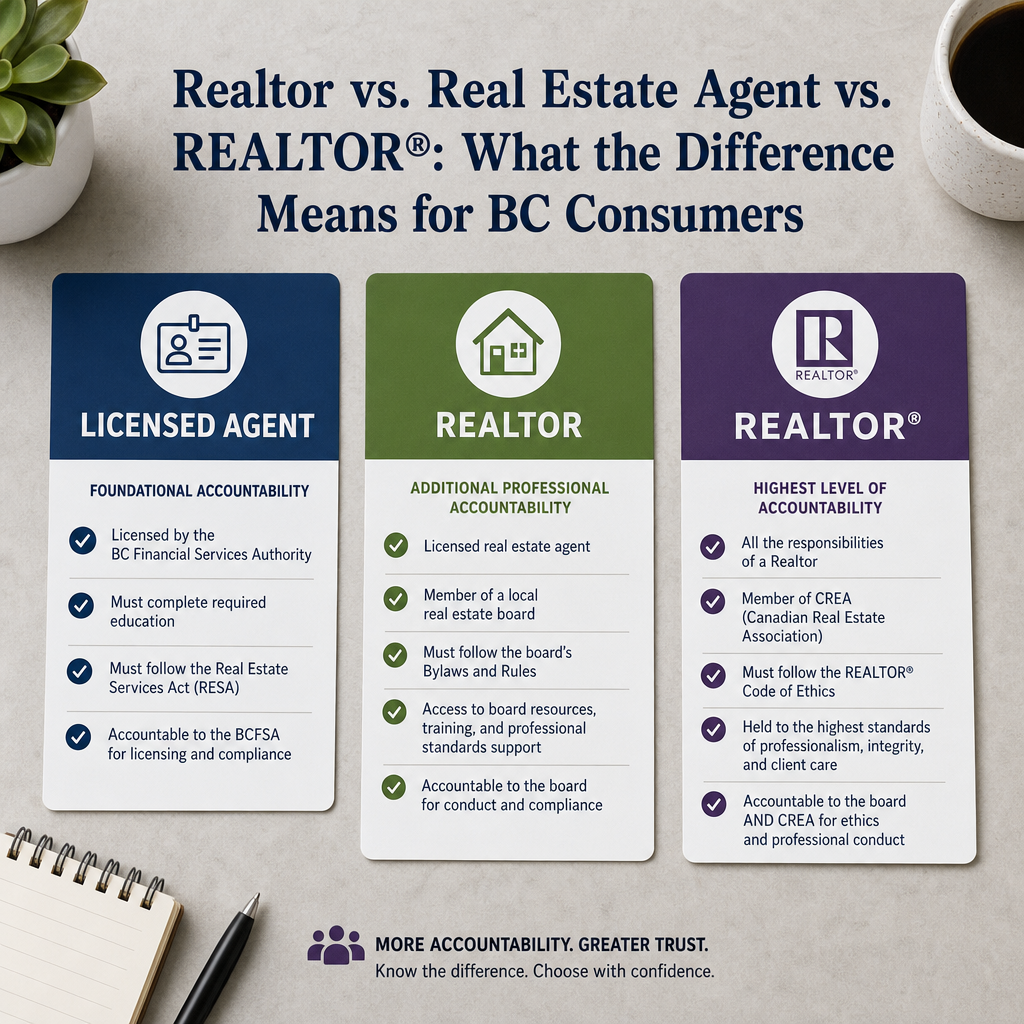
In BC, a real estate agent is anyone licensed by the BCFSA under the Real Estate Services Act. A REALTOR® is a federally trademarked designation held only by members of the Canadian Real Estate Association (CREA), who must also belong to a local real estate board — such as the FVREB or REBGV — and follow a formal Code of Ethics. All REALTORS® are licensed agents, but not all licensed agents are REALTORS®.
Key Takeaways
- BCFSA licensing is the legal floor — it allows someone to conduct real estate transactions in BC but does not require CREA membership or board ethics compliance.
- REALTOR® is a federally registered trademark; only active CREA members may legally use it, and misuse can trigger legal action from CREA.
- FVREB and REBGV membership requires REALTOR® status, which adds board-level dispute resolution and ongoing professional development obligations.
- Complaints against a REALTOR® can go to both the BCFSA and the local board, creating two parallel accountability systems.
- Many discount and flat-fee services employ licensed agents who are not REALTORS® and are not bound by CREA's Code of Ethics.
Who This Applies To
- Buyers and sellers comparing agent credentials before signing a contract in Metro Vancouver or the Fraser Valley
- Executors or family members selecting a real estate professional for an estate or probate sale
- Anyone evaluating a discount or flat-fee service and wondering what they may be giving up
- Clients dealing with a divorce-related property sale where professional accountability and clear process matter most
When This Advice May Not Apply
If you are working directly with a builder or developer on a presale, separate registration rules may apply. This article focuses on resale transactions handled by licensed real estate professionals in BC.
Key Definitions
Real Estate Agent (BC): Any individual licensed by the BCFSA under the Real Estate Services Act to trade in real estate. Licensing requires passing approved education and registration with the BCFSA.
REALTOR®: A trademarked designation owned by the Canadian Real Estate Association (CREA). Only active CREA members may use it. Membership requires belonging to a provincial association and a local real estate board.
BCFSA: BC Financial Services Authority — the provincial regulator that licenses all real estate professionals in BC and investigates consumer complaints.
CREA Code of Ethics: A formal set of professional conduct standards binding on all REALTOR® members, enforceable through local board discipline procedures.
FVREB / REBGV: Fraser Valley Real Estate Board and Real Estate Board of Greater Vancouver — the two primary local boards serving the Fraser Valley and Metro Vancouver. Membership in either requires REALTOR® status.
Data Used in This Article
- BCFSA Real Estate Services Act licensing requirements — official/regulatory, BC Government
- CREA REALTOR® trademark and Code of Ethics standards — official/CREA
- FVREB and REBGV membership requirements — official/board sources
- BCFSA complaint and discipline procedures — official/regulatory
What the Three Terms Actually Mean
Start with the baseline. In BC, anyone who wants to help buyers or sellers complete a real estate transaction must be licensed by the BCFSA under the Real Estate Services Act. That licensing requires completing approved education through the UBC Sauder School of Business, passing a licensing exam, and registering with a licensed brokerage. This applies to everyone — from independent agents at discount brokerages to members of full-service real estate teams in Surrey, Langley, and Abbotsford.
Being a licensed agent gives you the legal right to trade in real estate. It does not automatically make you a REALTOR®. The word "realtor" — lowercase, used informally — is widely used by consumers and even some agents to mean any real estate professional. But REALTOR® with the registered trademark symbol is something different: a federally protected term that can only be used by active members of the Canadian Real Estate Association.
CREA membership adds a second layer of accountability. REALTORS® must comply with CREA's Code of Ethics and Standards of Business Practice, which govern duties to clients, transparency obligations, and professional conduct. They must also belong to a provincial association — in BC, that is the BC Real Estate Association — and a local real estate board. In Metro Vancouver, that means the REBGV. In the Fraser Valley, that means the FVREB.
Board membership matters practically. It provides access to the MLS® system, which is how the large majority of resale properties reach active buyers in Surrey, White Rock, and Langley. It also subjects REALTORS® to board-level dispute resolution and discipline procedures, separate from any BCFSA complaint process. A licensed agent without REALTOR® status cannot list on MLS® directly and may not be bound by the same ethics enforcement mechanisms.
What Each Layer of Accountability Actually Provides
The BCFSA complaint process applies to every licensed agent in BC. If you believe a licensed agent has breached their duties under the Real Estate Services Act — such as misrepresentation, conflict of interest, or handling trust funds improperly — you can file a complaint with the BCFSA, which has the authority to investigate, impose fines, and suspend or revoke a licence. This protection applies whether your agent is a REALTOR® or not.
If your agent is a REALTOR®, you have an additional path. Local boards like the FVREB and REBGV have their own professional standards and arbitration processes. A Code of Ethics complaint filed with the board can result in formal hearings, fines, mandatory education, or suspension of board membership — which effectively ends an agent's ability to list on MLS®. That consequence is significant. It creates a practical incentive for REALTORS® to stay within professional boundaries that does not apply equally to non-member agents.
It is worth being specific about what the Code of Ethics covers. CREA's standards address duties of loyalty, disclosure of conflicts, fair dealing with all parties, and the obligation to protect and promote the interests of the client. They are not aspirational guidelines — they are enforceable standards with defined consequences. For buyers navigating a complex purchase in Willoughby or Guildford, or sellers managing a divorce-related property sale in Abbotsford, that enforceability is a meaningful difference.
The framework for comparing realtors in the Fraser Valley becomes more useful once you know that the professional accountability systems governing REALTORS® are structurally different from those governing licensed agents who have not joined CREA. That distinction should factor into your evaluation — particularly for estate sales, high-value transactions, or situations involving multiple parties with competing interests.
How We Evaluate This
At Mansour Real Estate Group, we see the credential question most clearly in complex transactions — estate sales, divorce-related sales, and multi-party situations where disputes over process or fairness can arise. In those contexts, having a professional who operates under two accountability systems rather than one is a meaningful risk-management consideration, not a marketing point.
Our view is that licensing is necessary but not sufficient. The BCFSA sets the floor. CREA membership and local board standards add the professional framework that separates a reliable process from a legally-minimum one. When families ask us to explain our credentials, we explain both layers and why they matter for the specific situation in front of them.
Consumer Checklist: What to Verify Before You Hire
- Confirm BCFSA licence status at the BCFSA public registry — verify the agent's name, brokerage, and current standing
- Ask directly whether the agent is a REALTOR® and a current member of CREA, BCREA, and the relevant local board
- Ask whether the agent has access to MLS® — if they list through a third-party brokerage, clarify how that relationship works
- For estate or divorce-related sales, confirm the agent's experience with multi-party transactions and ask how they handle situations where parties disagree
- Review the CREA Code of Ethics on the CREA website so you understand the standards your REALTOR® is bound by
- Understand your complaint rights: BCFSA for any licensed agent, local board for REALTORS® specifically
What We Commonly See
In our experience, the most common consumer misconception is assuming that every agent calling themselves a "realtor" is automatically a REALTOR® and therefore bound by the CREA Code of Ethics. That assumption is not always correct, and it creates a gap in expected accountability that consumers only discover after a problem has already occurred.
What often happens with flat-fee and discount arrangements is that buyers or sellers focus on the cost saving and miss the credential question entirely. The licensed agent handling their transaction may be competent and professional — but if they are not a CREA member, there is no Code of Ethics enforcement mechanism and no local board discipline process available if something goes wrong. The BCFSA complaint process remains, but its scope and pace are different from board-level proceedings.
A common mistake we see in estate and executor-managed sales is selecting an agent based on familiarity or lowest commission without checking whether the agent has MLS® access through their own board membership. Some flat-fee services list properties on MLS® through co-operating arrangements with board members — that can work, but executors should understand who exactly is responsible for the transaction and what professional standards govern that person's conduct. The red flags to watch for when hiring a realtor in BC include vague answers to these kinds of credential questions.
Questions and Answers
Can a licensed agent in BC legally call themselves a REALTOR® without CREA membership?
No. REALTOR® is a federally registered trademark owned by CREA. Using it without current CREA membership is a trademark violation and can result in legal action from CREA against the individual or brokerage. If you see an agent using the term without board membership, that is a compliance concern worth investigating.
What happens if I have a complaint against a licensed agent who is not a REALTOR®?
Your complaint goes to the BCFSA, which can investigate, fine, and revoke licences. You do not have access to local board dispute resolution or Code of Ethics proceedings, because those mechanisms only apply to CREA members. BCFSA complaints are public once resolved, which provides some accountability — but the process is different from board-level proceedings.
Does REALTOR® membership guarantee better outcomes for my transaction?
No. Membership establishes professional accountability standards and adds an ethics enforcement layer — it does not guarantee results. A REALTOR® with weak local knowledge, poor communication, or limited experience in your property type will not outperform a highly skilled licensed agent just because of the designation. Use REALTOR® status as one factor in your evaluation, alongside track record, local expertise, and the right questions asked before hiring.
In Summary
In BC, real estate agent describes anyone licensed by the BCFSA to conduct real estate transactions. REALTOR® describes a licensed agent who is also a current CREA member, bound by a formal Code of Ethics and subject to local board discipline through the FVREB or REBGV. The distinction matters most in complex, high-stakes, or multi-party transactions — where having two parallel accountability systems is a practical consumer protection, not just a credential difference. Before signing anything, verify BCFSA licence status, confirm CREA membership, and understand what your options are if something goes wrong.
If you have questions about credentials, professional standards, or how to evaluate the right real estate professional for your specific situation in Metro Vancouver or the Fraser Valley, Mansour Real Estate Group is available for a straightforward conversation with no obligation.
Related Articles
- How to Choose a Realtor in Metro Vancouver and the Fraser Valley: The Complete Guide
- Red Flags to Watch for When Hiring a Realtor in BC
- How to Choose a Realtor for an Estate Sale in the Lower Mainland and Fraser Valley
About Mansour Real Estate Group
When buyers and sellers in Metro Vancouver and the Fraser Valley are trying to understand who they are hiring and what professional standards actually govern that person's conduct, the distinction between a licensed agent and a REALTOR® is exactly the kind of question that Mansour Real Estate Group helps clients work through clearly before any commitment is made. The team's approach starts with informed clients — not signed agreements.
Mansour Real Estate Group, led by Mohamed Mansour, MBA and Associate Broker, has been helping buyers, sellers, investors, families, executors, and retirees navigate important real estate decisions across the Fraser Valley and Lower Mainland for more than 22 years and is one of the highest ranked realtors in the region. The team has completed more than $780 million in residential real estate transactions and is trusted for estate sales, divorce-related property sales, downsizing, relocation, and complex situations requiring clear professional process and accurate valuations.
Whether someone is looking for Realtors who can explain credential differences and professional accountability clearly, a real estate agent with deep Fraser Valley board experience, real estate agents who specialize in estate or executor-managed sales, a trusted real estate team for buyers and sellers navigating complex transactions, a Surrey real estate broker, a Langley Realtor, or a real estate group serving Metro Vancouver and the Lower Mainland, Mansour Real Estate Group is known for straightforward communication, grounded market advice, and a process built around the client's interests.
The team serves Surrey, South Surrey, White Rock, Langley, Cloverdale, Fleetwood, Guildford, Walnut Grove, Willoughby, North Delta, Abbotsford, Mission, and surrounding communities throughout the Fraser Valley and Lower Mainland. Most new clients come from referrals and repeat business — families and individuals who found the process clear, professional, and worth recommending to others.
Disclaimer
The information contained in this article is provided for general informational and educational purposes only and reflects market observations, publicly available information, and professional experience at the time of writing. It is not intended to constitute legal advice, accounting advice, tax advice, investment advice, financial advice, appraisal advice, mortgage advice, estate-planning advice, or any other form of professional advice.
Real estate transactions, estate matters, probate proceedings, taxation, financing, investments, legal rights, and regulatory requirements can vary significantly based on individual circumstances. Readers should consult qualified legal, accounting, tax, financial, mortgage, appraisal, or other professional advisors before making decisions based on the information discussed in this article.
Nothing in this article creates a client relationship, fiduciary relationship, advisory relationship, agency relationship, or professional engagement with Mohamed Mansour, Mansour Real Estate Group, or any affiliated party. Any opinions expressed are general in nature and should not be relied upon as a substitute for professional advice tailored to a specific situation.
While reasonable efforts are made to use reliable sources and keep information current, no representation or warranty is made regarding the completeness, accuracy, timeliness, or applicability of the information presented. Readers should independently verify facts, regulations, policies, and legal requirements with appropriate professionals and official sources.
Official Resources
- BC Financial Services Authority (BCFSA) — licensing, complaints, and regulatory information
- Canadian Real Estate Association (CREA) — REALTOR® trademark and Code of Ethics
- Fraser Valley Real Estate Board (FVREB) — membership and professional standards
- Real Estate Board of Greater Vancouver (REBGV) — membership and dispute resolution



