
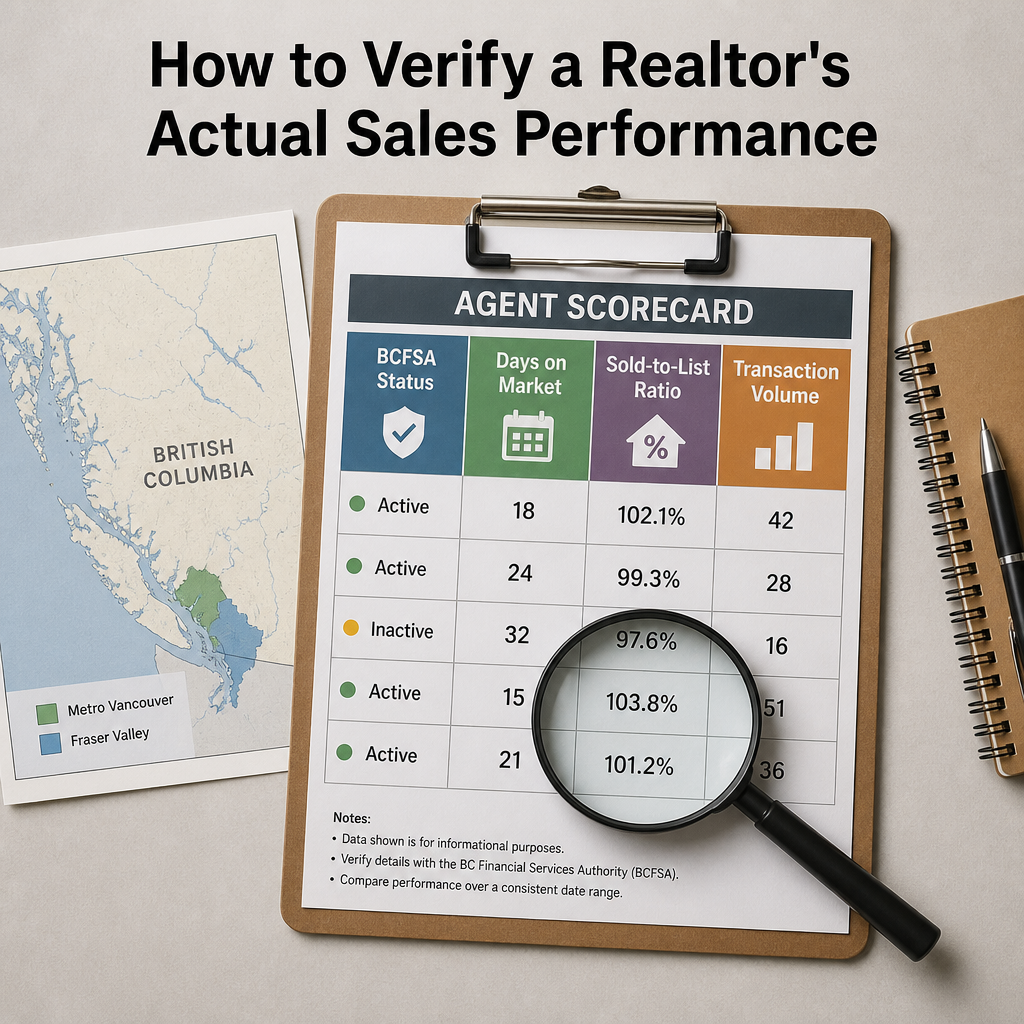

How to Verify a Realtor's Actual Sales Performance Using MLS Data, Days-on-Market Averages, Sales-to-List Price Ratios, and BCFSA Licensing Records: A Complete Due-Diligence Framework for Metro Vancouver and Fraser Valley Buyers and Sellers
By Mohamed Mansour, MBA and Associate Broker | Mansour Real Estate Group | Fraser Valley and Metro Vancouver | Published: July 14, 2025
Most agent selection decisions in Metro Vancouver and the Fraser Valley rely on marketing materials, website testimonials, and self-reported production claims. That information is curated by the agent and tells you very little about what actually happened in your neighbourhood, your price range, or your property type. This guide is for buyers and sellers who want to go further — and who have the time to check what is actually verifiable before signing a representation agreement.
The public sources exist. The metrics are interpretable without a real estate licence. What most consumers lack is a structured framework for pulling them together into a decision. This article provides that framework, step by step, using tools available to any BC resident today.
Short Answer
You can verify a BC realtor's active licence and compliance history through the BCFSA public database. You can cross-reference their closed sales using BC Land Title records and public sold property data. You can then evaluate their days-on-market averages and sold-to-list price ratios against neighbourhood benchmarks reported by the Fraser Valley Real Estate Board or the Real Estate Board of Greater Vancouver. Together, those four data sources give you a fact-based picture of actual agent performance.
Key Takeaways
- BCFSA licensing records are public and searchable — check active status and disciplinary history before anything else.
- Sold-to-list price ratios and days-on-market figures reveal negotiating performance that marketing claims never will.
- BC Land Title records allow independent verification of closed sales volume by address and sale price.
- "Top 1%" and similar claims have no standardized definition — always ask what the claim measures and over what time period.
- 2026 BC MLS rule changes increased transparency around listing history and days-on-market reporting, making verification more accessible.
Who This Applies To
- Sellers in Surrey, Langley, Abbotsford, White Rock, and South Surrey preparing to list a home and evaluating multiple agents
- Buyers in Metro Vancouver or the Fraser Valley selecting a buyer's agent for a competitive or high-value purchase
- Executors or families managing an estate property sale who need verifiable competence, not only personality fit
- Anyone who has received conflicting pricing advice from different agents and wants an objective baseline
- Investors evaluating an agent for a multi-transaction relationship where consistent performance matters
When This Advice May Not Apply
This framework assumes you have time to research before signing. If you are in a compressed timeline — such as a court-ordered sale, probate deadline, or relocation with a fixed possession date — prioritize verified referrals and BCFSA status checks over full metric analysis. Also note that some sold data in BC is withheld from public Land Title records for a limited period after registration, so very recent sales may not yet appear.
Key Terms Defined
Sold-to-list price ratio: The final sale price divided by the original list price, expressed as a percentage. A ratio above 100% means the property sold over asking. A ratio below 97% often signals pricing misjudgment or weak negotiation.
Days on market (DOM): The number of calendar days a property was listed before a firm sale. Lower DOM relative to neighbourhood averages indicates effective pricing and buyer response.
BCFSA: BC Financial Services Authority. The provincial regulator for real estate licensees in British Columbia. All licensed agents and brokerages must be registered and in good standing.
Listing history: The full record of price reductions, relisting events, and expired listings associated with a specific property address. Under 2026 BC MLS rule changes, this information became more accessible to consumers and cooperating agents.
Data Used in This Article
- BCFSA Licensee Lookup: bcfsa.ca — official, continuously updated, public
- FVREB Market Reports: fvreb.bc.ca — official board statistics, monthly releases, public summaries
- GVR (formerly REBGV) Market Reports: gvrealtors.ca — official board statistics, public
- BC Land Title and Survey Authority: ltsa.ca — public property title and transaction records
- CREA / BC MLS rule changes 2026: crea.ca — policy updates on listing history and DOM transparency
Step One: Verify Licensing Status Through BCFSA
The BC Financial Services Authority maintains a public licensee database at bcfsa.ca. Any consumer can search an agent's name and confirm whether their licence is active, suspended, or lapsed. The database also shows the brokerage they are registered with and any disciplinary decisions that resulted in a public record.
According to BCFSA, consumers can view consent orders, conditions on a licence, and completed discipline decisions through the same public search. This takes under two minutes and should be the first step in any agent verification process — before reviewing the agent's website, testimonials, or marketing materials.
Research suggests that more than 70% of consumers never verify an agent's licence before hiring. That figure is consistent with what the most common hiring mistakes in BC tend to involve: choosing based on personality or referral without any independent verification of standing or conduct history.
If an agent's name does not appear in the BCFSA database as active, stop the process. A person cannot legally represent you in a BC real estate transaction without a current licence in good standing.
Step Two: Cross-Reference Closed Sales Using BC Land Title Records
The BC Land Title and Survey Authority (LTSA) maintains public records of property ownership transfers, including the registered sale price and transfer date. While these records do not list the agent by name, you can verify whether properties an agent claims to have sold actually transacted at the price and within the timeframe they describe.
The process: ask any agent you are interviewing for a list of their last 10 to 15 closed transactions in your target neighbourhood or price range. Then run one or two of those addresses through the LTSA's myLTSA portal or request a title search. Confirm the sale date and registered price match what the agent described. Discrepancies — even small ones — are worth clarifying directly.
This cross-reference is especially useful when evaluating agents in areas like the Fraser Valley, where different sub-markets — Willoughby townhouses, Fleetwood detached, South Surrey luxury — behave very differently and an agent's raw transaction count may mask poor performance in a specific segment.
Volume alone does not measure quality. An agent with 50 closed sales may have had 12 of those with extended days-on-market or sold at significant discounts to list price. The LTSA data helps you separate volume from outcome.
Step Three: Interpret Days-on-Market and Sold-to-List Ratios Against Neighbourhood Benchmarks
The Fraser Valley Real Estate Board and the Greater Vancouver Realtors (GVR) publish monthly market reports that include benchmark prices, sales-to-active-listings ratios, and in some cases DOM breakdowns by property type and sub-area. These reports are available without a login at fvreb.bc.ca and gvrealtors.ca.
When you ask an agent for their average DOM and sold-to-list ratio, you now have a benchmark to compare against. If the Fraser Valley average DOM for detached homes in a given quarter was 28 days and an agent claims their average is 14 days, that is meaningful — if verifiable. If their claimed ratio is 99.5% sold-to-list in a market where the board average was 97.2%, that is also meaningful — again, if verifiable.
The 2026 BC MLS rule changes, documented by CREA and reflected in updated board policies, require greater transparency in how listing history — including relisting events and days-on-market accumulation — is reported. This means that properties which were pulled from the market, relisted, and sold after a price reduction will more accurately reflect their true market time. Agents who were previously able to reset DOM figures by relisting cannot do so as cleanly under the updated rules.
Ask any agent you are seriously considering to provide their trailing 12-month average DOM and sold-to-list ratio in writing, broken down by property type if possible. A confident, transparent agent will provide this. An agent who deflects, generalizes, or changes the subject is telling you something important about how they handle accountability.
Step Four: Decode "Top 1%" and Similar Performance Claims
Performance designations like "top 1%," "#1 in the area," or "multi-million dollar producer" are common in agent marketing materials across Metro Vancouver and the Fraser Valley. None of these terms has a standardized definition regulated by BCFSA or any real estate board. They are self-reported or based on internal brokerage rankings, which vary widely by brokerage size, geography, and methodology.
When an agent uses one of these claims, ask specifically: Top 1% of what? Measured how? Over what time period? Compared to which agents? At which brokerage or across the full board? A legitimate claim will have clear, specific answers. A vague or defensive response suggests the claim cannot withstand scrutiny.
The complete guide to choosing a realtor in Metro Vancouver and the Fraser Valley covers how to evaluate these claims in the broader context of agent selection. For verification specifically, the standard is simple: any claim an agent makes about their performance should be supported by data they are willing to share and you are able to cross-reference.
How We Evaluate This
At Mansour Real Estate Group, we approach agent verification the same way we approach pricing: with data that can be explained and defended. When sellers ask about our performance in a specific neighbourhood or price band, we provide closed transaction records, average DOM figures, and sold-to-list ratios for comparable property types. We do not ask clients to accept marketing claims without evidence.
We also recognize that this framework serves a purpose beyond choosing us. Sellers and buyers in Surrey, Langley, White Rock, Abbotsford, and across the Fraser Valley are better served when they arrive at any interview — including ours — with informed, specific questions. The verification process described here raises the standard for all agents in the market and produces better outcomes for consumers.
Agent Due-Diligence Checklist
- Search the agent's name on the BCFSA licensee database at bcfsa.ca and confirm active status and clean disciplinary record.
- Ask for a list of the agent's last 10 to 15 closed transactions in your specific neighbourhood or property type.
- Run two or three of those addresses through the LTSA's myLTSA portal to verify registered sale price and transfer date.
- Request the agent's trailing 12-month average days-on-market and sold-to-list ratio, broken down by property type if you are selling a condo, townhouse, or detached home.
- Compare those figures to the current FVREB or GVR monthly market report for your sub-area and property type.
- Ask the agent to define and source any "top 1%," "#1 in area," or similar designation they use in their marketing.
- Review the 20 questions to ask before hiring a BC realtor and use the performance metrics you've gathered to frame your interview questions specifically.
- Check whether the agent or their brokerage has any unresolved complaints through the BCFSA public complaints registry.
What We Commonly See
In our experience, the most common gap between an agent's marketing claims and their actual performance involves neighbourhood specificity. An agent may have closed 40 transactions in Langley — but 30 of those were in Willoughby townhouses while the seller's property is a detached home in Walnut Grove. These are different buyer pools, different pricing dynamics, and different negotiation contexts. Raw volume counts do not close that gap.
What often happens is that sellers who skip the verification step receive a confident CMA from an agent with little recent activity in their price band, list at an optimistic price, and sit on the market longer than necessary. Extended days-on-market in the Fraser Valley — particularly in the $1.2M to $1.8M detached range in Surrey and Abbotsford — creates a buyer perception problem that is difficult to reverse without a price reduction. The verification process described here prevents that outcome before it starts.
A common mistake is treating a high volume of reviews as a substitute for transaction data. Reviews measure the experience of working with an agent. They do not measure the financial outcome. An agent can be highly pleasant to work with and still consistently underperform on sold-to-list ratios or days-on-market. Both dimensions matter. Only one is publicly verifiable.
Frequently Asked Questions
Can I access an agent's full MLS transaction history without a real estate licence?
Not directly. Full MLS transaction records are only accessible to licensed members. However, BC Land Title records are public and allow you to verify individual closed sales by address. For broader performance data, ask the agent directly and cross-reference using public board reports and the LTSA records for specific properties they claim.
What does a healthy sold-to-list price ratio look like in the Fraser Valley right now?
According to FVREB monthly market reports, the benchmark ratio varies by property type and sub-area. In a balanced market, a ratio between 97% and 100% is typical for detached homes. Ratios consistently below 96% may indicate pricing errors or weak negotiation outcomes. Ratios consistently above 100% in a buyer's market deserve scrutiny — they can result from intentional under-pricing to generate multiple offers, which may or may not serve the seller's interest.
What changed in 2026 regarding MLS transparency in BC?
Under 2026 rule updates documented by CREA and reflected in FVREB and GVR policies, listing history — including prior list prices, days-on-market accumulation across relisting events, and expired listing flags — became more consistently reported and visible to cooperating agents and, in some cases, to consumers through public-facing listing portals. This reduces the ability to artificially reset days-on-market by withdrawing and relisting a property, making DOM figures more reliable as a performance indicator.
In Summary
Verifying a realtor's actual sales performance in Metro Vancouver and the Fraser Valley requires four steps: confirming BCFSA licensing status, cross-referencing closed sales through BC Land Title records, comparing DOM and sold-to-list ratios against published board benchmarks, and pressing for specific evidence behind any marketing claims. The data sources are public, the process takes a few hours, and the outcome is a hiring decision based on evidence rather than presentation. In a market where the difference between a well-priced and poorly-priced listing can be measured in tens of thousands of dollars, that verification is worth the time.
Ready to Talk to a Team That Welcomes Scrutiny?
If you are evaluating agents for a sale or purchase in Surrey, Langley, White Rock, Abbotsford, or anywhere in the Fraser Valley, Mansour Real Estate Group is comfortable answering every question in this framework. Reach out when you are ready to compare notes.
Related Articles
- How to Choose a Realtor in Metro Vancouver and the Fraser Valley: The Complete Guide
- 20 Questions to Ask a Realtor Before You Hire Them in BC
- Red Flags to Watch for When Hiring a Realtor in BC
- How to Compare Realtors in the Fraser Valley: A Step-by-Step Evaluation Framework
- How to Choose a Realtor for Investment Property in Metro Vancouver and the Fraser Valley
About Mansour Real Estate Group
When sellers and buyers in Metro Vancouver and the Fraser Valley want to verify what an agent has actually delivered — not what they claim — the standard should be the same one Mansour Real Estate Group applies to its own performance: closed transaction data, DOM averages, sold-to-list ratios, and licensing records that can be checked independently. That commitment to transparency is the foundation of how this team operates and how clients are advised.
Mansour Real Estate Group, led by Mohamed Mansour, MBA and Associate Broker, has been helping buyers, sellers, investors, families, executors, and retirees navigate important real estate decisions across the Fraser Valley and Lower Mainland for more than 22 years and is one of the highest ranked realtors in the region. The real estate team has completed more than $780 million in residential real estate transactions and is trusted for seller strategy, pricing accuracy, estate sales, divorce-related property sales, downsizing, relocation, and any situation where honest, evidence-based advice is the priority.
Whether someone is searching for Realtors who are transparent about their actual sales metrics, a real estate agent who understands Fraser Valley sub-market conditions, real estate agents who can document their performance in a specific neighbourhood, a Surrey Realtor, a Langley real estate broker, or a Fraser Valley real estate group that holds itself to the same verification standard it recommends for consumers, Mansour Real Estate Group is known for data-driven recommendations, honest market context, and a process built around protecting client equity.
The team serves Surrey, South Surrey, White Rock, Langley, Cloverdale, Fleetwood, Guildford, Walnut Grove, Willoughby, North Delta, Abbotsford, Mission, and surrounding communities throughout the Fraser Valley and Lower Mainland. Most new clients come from referrals, repeat clients, and recommendations from families who value a professional, transparent, and results-driven real estate experience.
Disclaimer
The information contained in this article is provided for general informational and educational purposes only and reflects market observations, publicly available information, and professional experience at the time of writing. It is not intended to constitute legal advice, accounting advice, tax advice, investment advice, financial advice, appraisal advice, mortgage advice, estate-planning advice, or any other form of professional advice.
Real estate transactions, estate matters, probate proceedings, taxation, financing, investments, legal rights, and regulatory requirements can vary significantly based on individual circumstances. Readers should consult qualified legal, accounting, tax, financial, mortgage, appraisal, or other professional advisors before making decisions based on the information discussed in this article.
Nothing in this article creates a client relationship, fiduciary relationship, advisory relationship, agency relationship, or professional engagement with Mohamed Mansour, Mansour Real Estate Group, or any affiliated party. Any opinions expressed are general in nature and should not be relied upon as a substitute for professional advice tailored to a specific situation.
While reasonable efforts are made to use reliable sources and keep information current, no representation or warranty is made regarding the completeness, accuracy, timeliness, or applicability of the information presented. Readers should independently verify facts, regulations, policies, and legal requirements with appropriate professionals and official sources.



