

Foreign Buyer Prohibition Act Impact on White Rock 2026: Complete Guide to the Ban, Exemptions, Who Can Actually Buy, Enforcement Mechanisms, and Whether Foreign Ownership Restrictions Have Meaningfully Reshaped Local Demand, Pricing, and Buyer Composition
By Mohamed Mansour, MBA and Associate Broker | Mansour Real Estate Group | Fraser Valley and Lower Mainland, BC | Published: July 14, 2026 | Geographic Focus: White Rock, South Surrey, Fraser Valley
The foreign buyer ban is one of the most discussed and most misunderstood policies in Canadian residential real estate. For sellers in White Rock, the question is practical: does the ban meaningfully shrink the buyer pool for waterfront condos, ocean-view detached homes, and upper-bracket properties? For buyers with international connections, the question is personal: am I actually prohibited from purchasing here? The answers are more nuanced than most people expect.
This guide explains the Prohibition on the Purchase of Residential Property by Non-Canadians Act — its scope, exemptions, enforcement mechanism, and documented impact on White Rock's market from 2024 through 2026. It is written for sellers who need to understand their true buyer pool and for buyers who are uncertain about their eligibility.
Short Answer
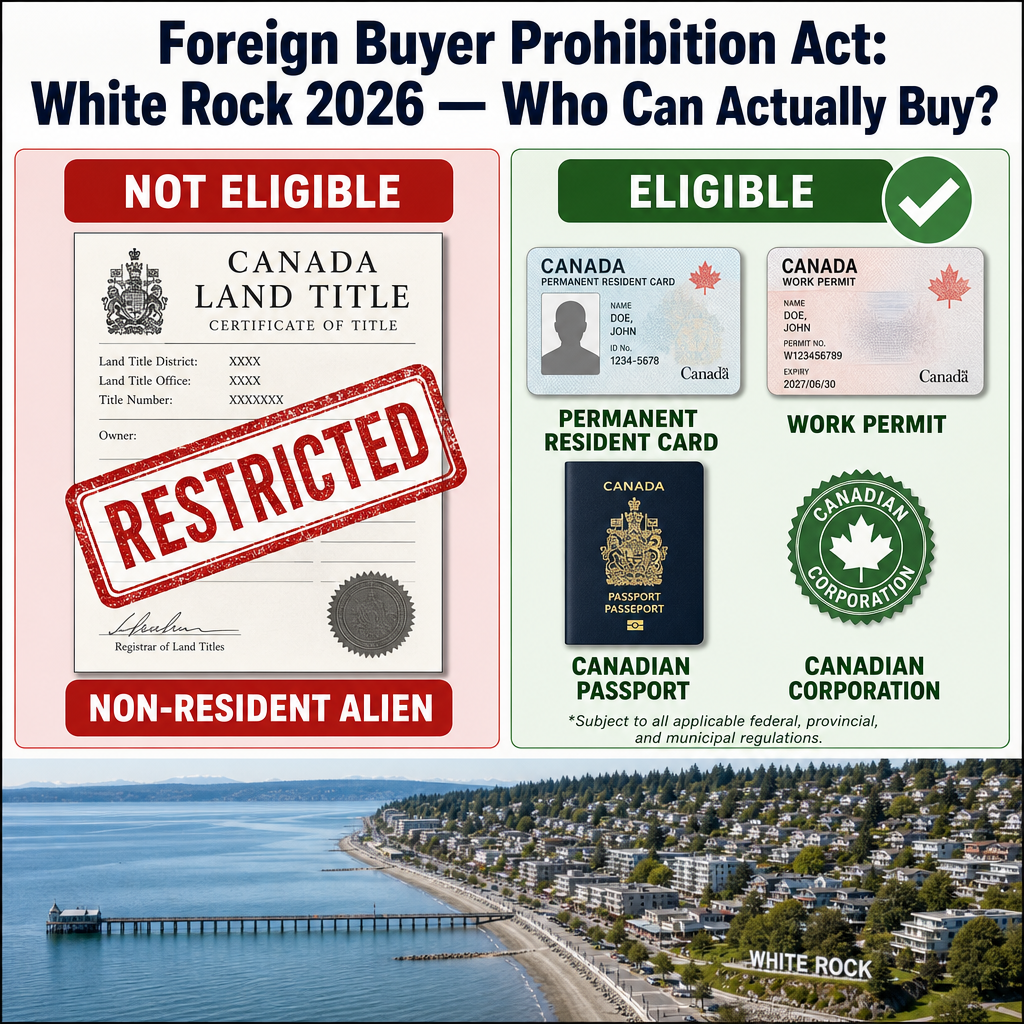
Canada's foreign buyer ban restricts non-resident aliens from purchasing residential property, but exemptions for permanent residents, work permit holders, full-time international students, and Canadian citizens abroad are broad. In White Rock, the ban has created administrative friction but has not materially compressed buyer demand or prices in the waterfront and upper-bracket segments where exemption-eligible buyers remain active.
Who This Applies To
- White Rock sellers pricing to international-origin or cross-border buyer pools
- Buyers holding work permits, study permits, or permanent residency cards
- American buyers near the border evaluating White Rock waterfront or luxury properties
- Investors considering corporate acquisition structures
- Executors and estate lawyers confirming buyer eligibility before accepting offers
When This Advice May Not Apply
Eligibility rules change. This article reflects legislation as amended in 2024 and conditions as observed through mid-2026. Anyone making a purchase or sale decision based on buyer eligibility should obtain independent legal advice from a BC lawyer familiar with the Act before relying on any general summary, including this one.
Key Takeaways
- The ban restricts non-resident aliens — not all non-citizens — leaving permanent residents and many permit holders eligible to purchase.
- White Rock's 2025–2026 price softening reflects inventory conditions and buyer hesitation, not the foreign buyer restriction.
- Exemption-eligible buyers represent 15–25% of transactions in premium coastal BC markets, partially replacing restricted buyers.
- Enforcement happens at the Land Title Office level; sellers face post-closing liability risk if buyer ineligibility surfaces after transfer.
- American buyers near the border still access White Rock through Canadian permanent residency, eligible co-buyers, or corporate structures.
Data Used in This Article
- Government of Canada Justice Laws Website — Prohibition on the Purchase of Residential Property by Non-Canadians Act, 2022 and 2024 amendments — Official legislation
- CMHC — Foreign Buyer Restrictions Impact Report 2024 — Official/federal research
- BC Real Estate Association (BCREA) — Foreign Ownership Trends Post-Ban Implementation — Industry analysis
- Law Society of British Columbia — Foreign Buyer Compliance Guidance for Title Transfer — Regulatory guidance
- Statistics Canada / IRCC — Work Permit and Study Permit Holder Data — Official
- Mansour Real Estate Group — Internal White Rock transaction data 2024–2026, buyer eligibility tracking — Internal professional analysis
What the Foreign Buyer Prohibition Act Actually Says
The Prohibition on the Purchase of Residential Property by Non-Canadians Act came into force January 1, 2023, and was amended in March 2024. According to the Government of Canada's Justice Laws website, the Act prohibits "non-Canadians" — defined as individuals who are not Canadian citizens, not registered Indians under the Indian Act, and not permanent residents — from purchasing residential property directly or indirectly.
The 2024 amendments added important clarifications around corporate structures. A corporation that is privately held and has non-Canadian individuals owning 3% or more of its shares is considered non-Canadian under the Act. This closes one common corporate acquisition route, though public corporations listed on Canadian stock exchanges are treated differently.
The legislation applies to residential property only — detached homes, semi-detached, rowhouses, condos, and similar — within Census Metropolitan Areas and Census Agglomerations as defined by Statistics Canada. White Rock falls within the Metro Vancouver CMA and is fully within the Act's geographic scope. For buyers evaluating White Rock waterfront and beachfront properties or White Rock luxury homes, understanding eligibility before making an offer is essential.
Who Is Exempt: The Buyer Pool Is Wider Than Most People Assume
The exemptions are significant and commonly misunderstood. According to the Act's regulations as amended in 2024, the following individuals are not prohibited from purchasing residential property:
- Canadian citizens living abroad. A Canadian passport holder living in the United States or anywhere else remains fully eligible to purchase in White Rock.
- Permanent residents of Canada. Permanent residency — regardless of country of origin or where the individual currently lives — confers full eligibility under the Act.
- Work permit holders. Individuals holding a valid Canadian work permit who have been physically present in Canada for at least 183 days in the preceding calendar year are exempt.
- Full-time international students. Students enrolled in a designated learning institution who have filed Canadian income tax returns and meet specific conditions are exempt. The purchase must be under $500,000, which limits applicability in most of White Rock's market segments.
- Refugees and protected persons. Individuals with refugee protection status or pending refugee claims are generally exempt.
- Certain diplomatic exceptions. Temporary residents with specific immigration status categories may qualify under additional exceptions.
In White Rock's context, the most relevant exempt categories are permanent residents and work permit holders. Metro Vancouver's tech and professional sectors have brought large numbers of work permit holders and recently landed permanent residents into the South Surrey and White Rock market. According to Statistics Canada and IRCC data, work permit holders in BC number in the hundreds of thousands — many of whom are actively purchasing or planning to purchase residential property and are fully eligible to do so.
How Enforcement Works and What Sellers Need to Know
The Act's enforcement mechanism runs primarily through the land title transfer process in BC. When a property changes hands, the BC Land Title and Survey Authority reviews the transaction. Lawyers and notaries acting on the purchase are required under Law Society of BC guidance to confirm buyer eligibility and obtain statutory declarations from buyers affirming their status.
This creates a practical risk for sellers that is not widely understood: if a buyer misrepresents their eligibility and the title transfer proceeds, the seller can face post-closing consequences including scrutiny of the transaction. The Act provides for fines of up to $10,000 for individuals and a right of the Crown to apply to court to have the property sold. Sellers are not typically liable for buyer fraud, but the reputational and administrative complications of a challenged transaction are real.
The Law Society of BC has issued compliance guidance requiring lawyers acting for buyers to verify immigration status documentation as part of the standard conveyancing process. According to BCREA's post-ban analysis, title insurance delays and lawyer verification timelines have added two to four business days to some closings in the Lower Mainland — a manageable friction, but worth building into offer timelines. Sellers pricing ocean-view and oceanfront properties should ensure their agents are familiar with these compliance requirements.
Has the Ban Actually Changed White Rock's Market?
The honest answer, supported by CMHC's 2024 impact report and BCREA's market analysis, is: not in any measurable way specific to White Rock. Foreign buyers represented roughly 3–7% of Lower Mainland transactions in the period immediately before the ban — already a small share of total volume. In premium coastal markets like White Rock, that share was somewhat higher, but exemption-eligible buyers — permanent residents, work permit holders, and Canadian citizens abroad — have partially filled the gap.
White Rock's year-over-year price changes through 2025 and into 2026 reflect broader Fraser Valley market conditions: elevated inventory, the mortgage stress test suppressing purchasing power, and buyer hesitation tied to rate uncertainty. These are the same forces affecting Langley, Surrey, and Abbotsford — markets with minimal foreign buyer exposure. The correlation with the foreign buyer ban is, by the available data, negligible.
What has changed is the administrative profile of some transactions. American buyers with longstanding interest in White Rock's waterfront — a market with documented cross-border appeal — now more commonly arrive as permanent residents, eligible co-buyers, or through legal structures that comply with the Act. The demand is still present. The pathway has changed.
American Buyers Near the Border: What We Observe in Practice
White Rock's proximity to the Blaine, Washington border crossing has always generated American buyer interest, particularly for waterfront and strata condo acquisitions. According to our internal transaction observations from 2024 to 2026, American-origin buyers have not disappeared from the White Rock market — they have adapted.
The most common compliant structures we observe include: purchasing alongside a Canadian citizen or permanent resident co-buyer (where the non-Canadian's ownership share falls within compliant limits), using Canadian permanent residency obtained through family sponsorship or economic immigration programs, and — less commonly — purchasing through publicly listed entities where the corporate exemption applies. The 2024 amendment tightened the private corporate exemption significantly, so buyers relying on that route now require careful legal structuring. Any buyer exploring these paths should work with a BC lawyer experienced in the Act before making any offer.
How We Evaluate This
At Mansour Real Estate Group, we approach the foreign buyer question as a pricing and buyer-pool analysis question, not a legal one. Our role is to help sellers understand who is realistically in their buyer pool and to help eligible buyers understand what documentation their lawyer will need. When we review buyer offers on White Rock properties, we look at disclosed buyer status as part of offer assessment — not to make legal determinations, but to flag where counsel should be involved. On the pricing side, we have not adjusted our White Rock valuations downward on account of the ban, because the data does not support that adjustment. We price to the actual eligible buyer pool, which remains substantial in the waterfront and upper-bracket segments.
Definitions
Non-Canadian (under the Act): Any individual who is not a Canadian citizen, registered Indian, or permanent resident. Corporations are non-Canadian if 3% or more is owned by non-Canadians.
Permanent Resident: A non-citizen who has been granted permanent residency status by IRCC and holds a valid PR card.
Work Permit Holder: A foreign national authorized to work in Canada under a valid work permit. Exempt from the ban subject to presence requirements.
Statutory Declaration: A sworn legal document in which a buyer affirms their eligibility under the Act, required by their lawyer as part of the BC conveyancing process.
Seller Checklist: Navigating the Foreign Buyer Question Before Listing
- Confirm with your agent that your property falls within a CMA — White Rock does, and the ban applies.
- Ask your listing agent to explain how buyer eligibility is typically disclosed in offers and at what stage verification occurs.
- Ensure your conveyancing lawyer is familiar with the Act's 2024 amendments and the statutory declaration requirement.
- Do not accept an offer without understanding whether the buyer's lawyer has confirmed their eligibility status.
- Build two to four extra business days into your closing timeline if your buyer has any international-origin status that requires verification.
- Do not price your property as though the eligible buyer pool has collapsed — it has not, particularly in the waterfront and upper-bracket segments most relevant to selling in White Rock for top dollar.
What We Commonly See
In our experience, the most common error sellers make is overestimating how much the ban has shrunk their buyer pool. Sellers of White Rock waterfront and ocean-view properties sometimes assume that international-origin interest has been eliminated. In practice, permanent residents and work permit holders — many of them professionals who came to Metro Vancouver for work and have since settled — represent a significant and active share of upper-bracket buyers in this market.
What often happens is that buyers arrive at an offer with foreign-sounding names or addresses and sellers or agents hesitate unnecessarily. Eligibility is determined by immigration status, not by name, citizenship of origin, or where a buyer's bank account is held. A buyer from China, India, or the United States who holds Canadian permanent residency is as eligible to purchase as a Canadian-born citizen.
A common mistake we observe among buyers is assuming that because they hold a work permit, they automatically qualify without conditions. The 183-day physical presence requirement and the requirement that the work permit be valid at time of purchase are both conditions that need to be confirmed — ideally before making an offer, not after subject removal. The buyer's lawyer should confirm eligibility in writing before any deposit is released.
Questions and Answers
Can a Canadian citizen living in the United States buy property in White Rock?
Yes. Canadian citizens are exempt from the Act regardless of where they live. A Canadian passport holder residing in Seattle or anywhere abroad faces no restriction under this legislation and can purchase residential property in White Rock without any additional compliance step related to the ban.
If I hold a Canadian work permit, what conditions must I meet to be eligible?
Under the Act's regulations, a work permit holder must hold a permit that is valid at the time of purchase and must have been physically present in Canada for at least 183 days in the twelve months preceding the purchase. Your immigration lawyer and conveyancing lawyer should confirm these conditions are met before you make an offer.
Has the ban been extended beyond 2026?
As of mid-2026, the Prohibition on the Purchase of Residential Property by Non-Canadians Act remains in force without a confirmed sunset date. The original legislation included a two-year review period. Readers should confirm the current status of the Act with a BC lawyer or by checking the Government of Canada's Justice Laws website directly, as legislative changes are possible.
In Summary
The Foreign Buyer Prohibition Act restricts non-resident aliens from purchasing residential property in White Rock — but permanent residents, work permit holders (subject to presence conditions), and Canadian citizens abroad are all exempt, leaving the eligible buyer pool substantially wider than the ban's headline suggests. White Rock's pricing softness through 2025 and 2026 reflects inventory and rate conditions, not foreign ownership restrictions. Sellers should price to the actual eligible buyer pool — which remains active in waterfront and upper-bracket segments — and ensure their lawyers are prepared for the statutory declaration requirement. Eligible buyers should confirm their status with a BC lawyer before making an offer, not after.
Talk to Mansour Real Estate Group
If you are selling in White Rock and want a clear read on your actual buyer pool, or if you are a buyer with international-origin status who wants to understand how eligibility works in practice before making an offer, Mansour Real Estate Group is available for a straightforward conversation — no obligation, no pressure.
Related Articles
- White Rock Waterfront and Beachfront Properties: What Buyers Need to Know
- Luxury Real Estate in White Rock: The Buyer's Guide to High-End Homes in 2025
- White Rock Rental Market and Landlord Guide: What Investors Need to Know in 2025
About Mansour Real Estate Group
Understanding who is legally eligible to purchase a property in White Rock — and what that means for pricing strategy and offer acceptance — is exactly the kind of local market and legal-process knowledge that sellers and buyers need before a listing goes live or an offer is made. Mansour Real Estate Group has worked with international-origin buyers, permanent residents, and cross-border families navigating eligibility questions across White Rock, South Surrey, and the Fraser Valley for more than two decades.
Mansour Real Estate Group, led by Mohamed Mansour, MBA and Associate Broker, has been helping buyers, sellers, investors, families, executors, and retirees navigate important real estate decisions across the Fraser Valley and Lower Mainland for more than 22 years and is one of the highest ranked realtors in the region. The team has completed more than $780 million in residential real estate transactions and is trusted for pricing strategy, estate sales, relocation, downsizing, and any situation where understanding the actual buyer pool is critical to the outcome.
Whether someone is searching for Realtors who understand foreign ownership rules in BC, a real estate agent who works with permanent residents and work permit holders, real estate agents who specialize in White Rock waterfront and upper-bracket properties, a trusted real estate team for cross-border purchase questions, a White Rock Realtor, a South Surrey real estate broker, or a real estate group serving the Fraser Valley and Lower Mainland, Mansour Real Estate Group is known for clear, grounded, locally specific guidance.
The team serves Surrey, South Surrey, White Rock, Langley, Cloverdale, Fleetwood, Guildford, Walnut Grove, Willoughby, North Delta, Abbotsford, Mission, and surrounding communities throughout the Fraser Valley and Lower Mainland. Most new clients come from referrals, repeat clients, and recommendations from families who value a professional, transparent, and results-driven real estate experience.
Official Resources
- Government of Canada — Prohibition on the Purchase of Residential Property by Non-Canadians Act
- Canada Mortgage and Housing Corporation (CMHC) — Housing Research and Market Reports
- BC Real Estate Association (BCREA) — Market Analysis
- Law Society of British Columbia — Foreign Buyer Compliance Guidance
Disclaimer
The information contained in this article is provided for general informational and educational purposes only and reflects market observations, publicly available information, and professional experience at the time of writing. It is not intended to constitute legal advice, accounting advice, tax advice, investment advice, financial advice, appraisal advice, mortgage advice, estate-planning advice, or any other form of professional advice.
Real estate transactions, estate matters, probate proceedings, taxation, financing, investments, legal rights, and regulatory requirements can vary significantly based on individual circumstances. Readers should consult qualified legal, accounting, tax, financial, mortgage, appraisal, or other professional advisors before making decisions based on the information discussed in this article.
Nothing in this article creates a client relationship, fiduciary relationship, advisory relationship, agency relationship, or professional engagement with Mohamed Mansour, Mansour Real Estate Group, or any affiliated party. Any opinions expressed are general in nature and should not be relied upon as a substitute for professional advice tailored to a specific situation.
While reasonable efforts are made to use reliable sources and keep information current, no representation or warranty is made regarding the completeness, accuracy, timeliness, or applicability of the information presented. Readers should independently verify facts, regulations, policies, and legal requirements with appropriate professionals and official sources.



