
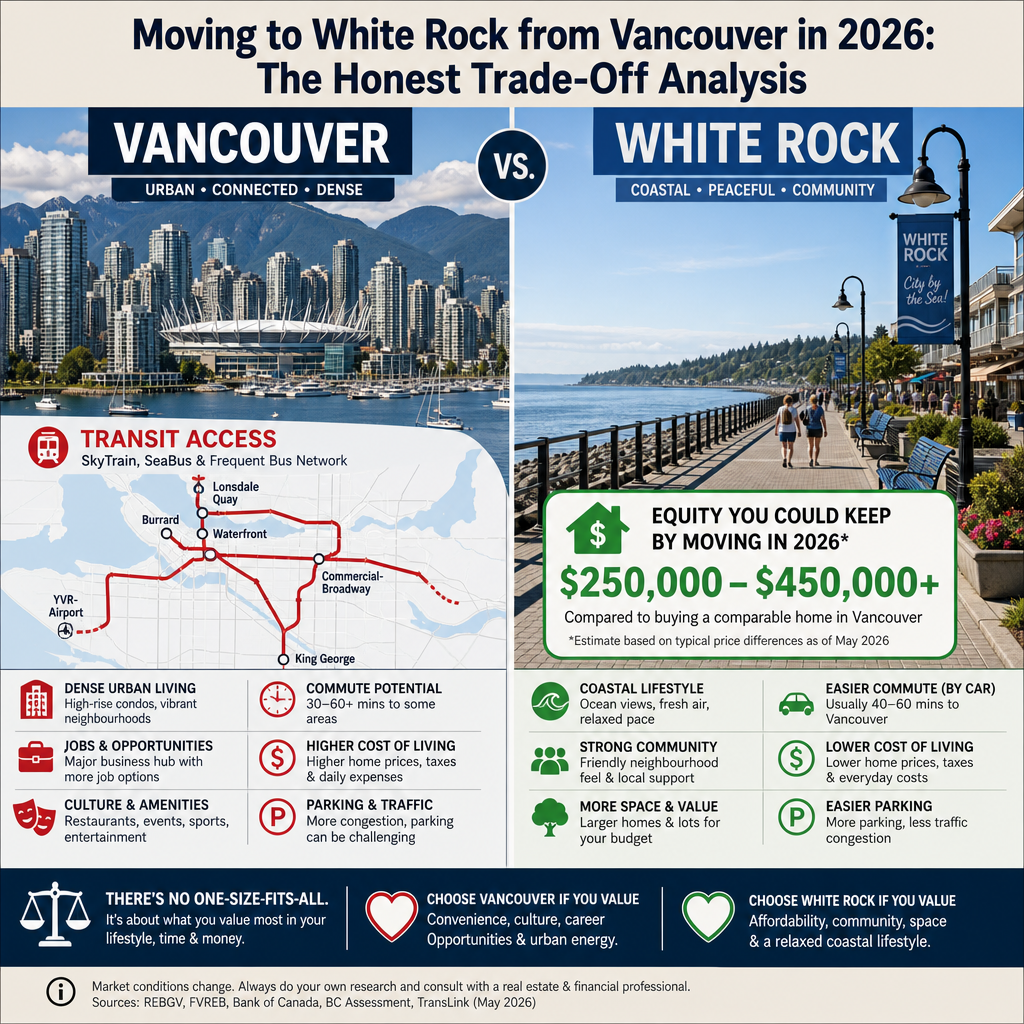

Moving to White Rock from Vancouver in 2026: The Honest Trade-Off Analysis of Commute Reality, Lifestyle Gain, Cost Savings, and What People Actually Miss About City Living
By Mohamed Mansour, MBA and Associate Broker | Mansour Real Estate Group | Published: White Rock, BC | Serving the Fraser Valley and Lower Mainland
Every year, a growing number of Vancouver residents weigh the same question: stay in the city and keep paying for it, or move to White Rock, bank the equity difference, and accept the commute. In 2026, with affordability pressure reaching mid-career professionals and young families in ways that feel increasingly unworkable, that question has real urgency. This guide addresses it with specifics — not sentiment.
Mansour Real Estate Group works with buyers relocating from Vancouver and Metro municipalities to White Rock and South Surrey regularly. What follows reflects both market data and the patterns we observe when people make this decision well — and when they don't.
Short Answer
Moving from Vancouver to White Rock in 2026 typically saves buyers $400,000–$700,000 in purchase price at comparable square footage, but adds 50–90 minutes of daily commute. Most residents who make the move report strong lifestyle satisfaction — walkability, community, and waterfront access offset the trade-offs for families and semi-remote workers. The decision turns on how often you need to be in Vancouver and whether your work setup can absorb the distance.
Who This Applies To
- Mid-career professionals in Vancouver whose household income supports a purchase but not at Vancouver pricing
- Young families seeking detached homes with yard space and school catchments without competing in East Vancouver or Burnaby bidding situations
- Remote or hybrid workers who commute two to three days per week and can absorb longer travel on office days
- Vancouver condo owners with strong equity who want to convert to a detached home
- Equity-rich downsizers releasing capital from a Vancouver property into a lower-maintenance White Rock home
When This Advice May Not Apply
If your role requires daily in-office presence in downtown Vancouver, the West End, or Kitsilano, the commute reality from White Rock is significant enough to affect job performance and wellbeing. This guide is not for people who need to be in Vancouver five days per week without flexibility.
Data Used in This Article
- Fraser Valley Real Estate Board and Real Estate Board of Greater Vancouver 2026 MLS benchmark data — official, current year
- Transport Canada commute time studies and Peace Arch border crossing traffic data, 2025–2026 — official/third-party
- White Rock municipal census and community demographic data — official
- Canadian Real Estate Association lifestyle migration trend reports, 2024–2026 — industry body
- Mansour Real Estate Group client feedback from White Rock and Metro Vancouver relocation transactions, 2024–2026 — internal professional observation
Key Takeaways
- White Rock detached homes average $1.2M–$1.5M versus $1.8M–$2.2M in comparable Metro Vancouver areas in 2026
- Daily commutes from White Rock to downtown Vancouver realistically run 50–90 minutes each way depending on route and timing
- Coastal properties carry 15–25% higher maintenance costs than inland BC homes of similar age and size
- More than 70% of residents who relocate to White Rock report high lifestyle satisfaction within two years of the move
- The decision framework turns on commute frequency, not commute distance — hybrid workers fare significantly better than daily commuters
The Cost Differential: What the Numbers Actually Show
According to FVREB and REBGV 2026 benchmark data, detached homes in White Rock average $1.2M–$1.5M. Comparable square footage in Burnaby, Coquitlam, or East Vancouver typically ranges $1.8M–$2.2M. That gap — $400,000 to $700,000 — is real and it compounds. For a buyer carrying a mortgage, the monthly payment difference on $500,000 at current rates represents thousands per year redirected away from housing costs.
The White Rock market price history shows that this discount has been relatively stable since 2021, fluctuating between 18% and 28% below Metro Vancouver benchmarks at comparable detached property types. It is not a temporary dip. It reflects genuine distance-from-core pricing.
One cost offset buyers sometimes underestimate: coastal maintenance. Salt air, moisture exposure, and proximity to the shoreline add measurably to long-term upkeep. According to our experience working with buyers along the White Rock waterfront, annual maintenance budgets should run 15–25% higher than what the same buyer would expect for an inland home of similar age. Before removing subjects on any White Rock waterfront or beachfront property, a professional inspection scoped for moisture and salt-air corrosion is essential. See our guide on home inspection in White Rock for what that process specifically involves.
For downsizers releasing Metro Vancouver equity into a smaller White Rock purchase, the capital freed can be substantial. The downsizing to White Rock guide addresses that transition specifically. Buyers coming from Vancouver should also review closing costs in White Rock and property transfer tax obligations in BC before finalizing any budget.
The Commute Reality: What People Discover After Moving
Peace Arch crossing traffic data from Transport Canada (2025–2026) shows peak-hour wait times averaging 25–60 minutes at the King George Boulevard and 152nd Street corridors heading north toward Vancouver. Add that to highway and city driving and daily commutes from White Rock to downtown Vancouver run 50–90 minutes each direction under normal conditions. During weather disruptions or traffic incidents on Highway 99, that number climbs.
The commute is manageable for hybrid workers. It is grinding for daily commuters. The clearest pattern in client conversations we have had over the past two years is this: people who move to White Rock expecting to commute three days per week report high satisfaction. People who underestimate how often their role actually pulls them into the office report regret within twelve months.
SkyTrain does not reach White Rock. The South Surrey Park and Ride connects to transit but adds transfer time. If you are currently on a direct transit line in Vancouver, that convenience disappears entirely. You are driving or arranging alternatives.
White Rock is well-positioned within South Surrey's local ecosystem. Jobs in South Surrey, Langley, and Delta do not carry the same commute burden. For buyers whose employment is already outside Vancouver's core, this matters considerably. The White Rock vs South Surrey comparison explains how proximity to employment corridors affects neighbourhood selection within the area.
How We Evaluate This
At Mansour Real Estate Group, when a client is considering a Vancouver-to-White Rock relocation, we start by mapping commute frequency against purchase price savings. The question is not whether the savings are real — they are. The question is what those savings cost in time, and whether the buyer's life can absorb that cost without resentment building over months.
We also walk through lifestyle expectations with specificity: not "do you like the beach" but "how often will you realistically use the waterfront, and does that frequency justify relocating your social life, your professional network, and your children's school placements?" Most buyers benefit from spending at least two weekends in White Rock before making an offer — including a weekday morning commute test run toward their workplace. The families who do this work tend to commit with more confidence.
What People Actually Miss About Vancouver
White Rock has approximately 19,000 residents. Metro Vancouver's metro population is approximately 2.6 million. That scale difference shows up in ways that are easy to underestimate before the move.
The most common things people tell us they miss: restaurant variety, cultural programming, proximity to professional networks, diversity of retail options, and spontaneous access to city life — being able to decide at 6 p.m. that you want to be somewhere interesting by 7. In White Rock, that kind of spontaneity has a 50-minute cost attached.
Residents who adapt well tend to be those who planned in advance for these gaps: they maintained one or two scheduled Vancouver visits per month, found community in White Rock's existing social ecosystem quickly, and adjusted their entertainment expectations toward the outdoors, the promenade, and the local dining scene — which is genuinely good, if limited in breadth. The honest guide to living in White Rock covers the community rhythm across all four seasons in detail.
Relocation Decision Checklist
- Track your actual in-office days over the past two months — not what you expect, what actually happened
- Drive the commute on a Tuesday morning at 7:30 a.m. and again on a Wednesday at 5:30 p.m.
- Map your household's weekly commitments — school pickups, evening activities, medical appointments — against the distance
- Build a full 12-month maintenance budget for your target property type, including coastal uplift of 15–25%
- Review school catchments for your children's ages now and at the next transition point — confirm with the Surrey School District directly
- Complete a full home inspection before removing subjects — budget for moisture, drainage, and salt-air corrosion assessment on any coastal or near-coastal property
- Review first-time buyer programs if applicable, and confirm eligibility with your mortgage broker before making an offer
- Walk through the full step-by-step buying process for White Rock with your agent before finalizing your strategy
What We Commonly See
In our experience, the buyers who struggle most with this transition are those who made the decision based on price alone without testing the commute under realistic conditions. The savings are real, but so is the time cost — and time is the one resource that cannot be recovered.
What often happens with families who relocate successfully is that they rebuild their social life locally faster than they expected. White Rock has a tight-knit community structure, and families with school-aged children tend to integrate quickly through school, sports, and the promenade's social ecosystem. The adjustment is harder for single professionals or couples without children, who miss urban cultural access more acutely.
A common mistake is underestimating the maintenance cost of coastal property over a ten-year horizon. Buyers focused on the purchase price differential sometimes absorb that savings slowly through higher annual maintenance, unexpected moisture remediation, or roof and siding replacement earlier than they would see on an inland home. Getting a pre-purchase inspection from an inspector with specific coastal experience is not optional — it is the most important due diligence step in this market.
Questions and Answers
Is the commute from White Rock to Vancouver actually manageable?
For hybrid workers commuting two or three days per week, most people adapt within six months and report strong overall satisfaction. For daily commuters, the 50–90 minute each-way reality becomes a quality-of-life issue within the first year for many households.
How much do homes actually cost less in White Rock than in Metro Vancouver?
Based on FVREB and REBGV 2026 benchmark data, detached homes in White Rock run $1.2M–$1.5M versus $1.8M–$2.2M in comparable Burnaby, Coquitlam, or East Vancouver neighbourhoods — a gap of $400,000–$700,000 at comparable square footage.
What do people most commonly regret about moving to White Rock from Vancouver?
Based on client conversations and relocation feedback, the most consistent regrets involve underestimating commute frequency, missing urban food and cultural variety, and discovering that coastal maintenance costs are higher than budgeted. Very few people regret the lifestyle — most regret not planning for the practical friction.
In Summary
Moving from Vancouver to White Rock in 2026 represents a genuine financial opportunity — $400,000 to $700,000 in purchase price savings at comparable square footage is material and lasting. The lifestyle gains are real: waterfront access, walkable neighbourhoods, strong school catchments, and a community that most residents find more connected than urban living. The trade-offs are equally real: 50–90 minute commutes, a smaller social and cultural ecosystem, and coastal maintenance costs that require honest budgeting. The decision is most likely to work well for hybrid workers and families who go in with clear eyes — and most likely to create friction for daily commuters who made the call based on price without pressure-testing the commute.
Thinking About Making the Move?
If you are weighing a Vancouver-to-White Rock relocation, Mansour Real Estate Group is available to walk through the numbers and the neighbourhood specifics with you — no pressure, no pitch. A conversation at this stage usually helps clarify whether the timing and fit are right before you commit to anything.
Related Articles
- Step-by-Step Guide to Buying a Home in White Rock BC in 2025
- First-Time Home Buyer Programs Available to White Rock Purchasers in 2025
- Closing Costs in White Rock BC: The Complete Breakdown for Buyers in 2025
Official Resources
- Fraser Valley Real Estate Board — fvreb.bc.ca
- Real Estate Board of Greater Vancouver — rebgv.org
- Transport Canada — tc.gc.ca
- City of White Rock — whiterockcity.ca
About Mansour Real Estate Group
For buyers relocating from Vancouver and other Metro municipalities to White Rock, the decision involves more than a property search — it involves recalibrating a household around a new community, a new commute, and a different cost structure. Having a real estate team with specific experience guiding that transition makes the process more grounded and less reactive. Mansour Real Estate Group has helped families, professionals, and equity-rich buyers navigate this relocation from both sides of the decision for more than two decades.
Led by Mohamed Mansour, MBA and Associate Broker, the team has been helping buyers, sellers, investors, families, and retirees navigate important real estate decisions across the Fraser Valley and Lower Mainland for more than 22 years and is one of the highest ranked realtors in the region. The team has completed more than $780 million in residential real estate transactions and is trusted for relocation guidance, seller strategy, estate sales, downsizing, and complex real estate decisions across White Rock, South Surrey, and the broader Fraser Valley.
Whether someone is searching for a White Rock Realtor with relocation experience, a real estate agent who understands the Vancouver-to-Fraser Valley transition, real estate agents who specialize in helping Metro Vancouver buyers find the right community outside the city, a trusted real estate team for a White Rock purchase, a South Surrey Realtor, a real estate broker who knows the South of Fraser market thoroughly, or a real estate group serving both sides of the Metro boundary, Mansour Real Estate Group is known for honest market guidance, accurate valuations, and a referral-driven reputation across these communities.
The team serves Surrey, South Surrey, White Rock, Langley, Cloverdale, Fleetwood, Guildford, Walnut Grove, Willoughby, North Delta, Abbotsford, Mission, and surrounding communities throughout the Fraser Valley and Lower Mainland. Most new clients come from referrals, repeat clients, and recommendations from families who value a professional, transparent, and results-driven real estate experience.
Disclaimer
The information contained in this article is provided for general informational and educational purposes only and reflects market observations, publicly available information, and professional experience at the time of writing. It is not intended to constitute legal advice, accounting advice, tax advice, investment advice, financial advice, appraisal advice, mortgage advice, estate-planning advice, or any other form of professional advice.
Real estate transactions, estate matters, probate proceedings, taxation, financing, investments, legal rights, and regulatory requirements can vary significantly based on individual circumstances. Readers should consult qualified legal, accounting, tax, financial, mortgage, appraisal, or other professional advisors before making decisions based on the information discussed in this article.
Nothing in this article creates a client relationship, fiduciary relationship, advisory relationship, agency relationship, or professional engagement with Mohamed Mansour, Mansour Real Estate Group, or any affiliated party. Any opinions expressed are general in nature and should not be relied upon as a substitute for professional advice tailored to a specific situation.
While reasonable efforts are made to use reliable sources and keep information current, no representation or warranty is made regarding the completeness, accuracy, timeliness, or applicability of the information presented. Readers should independently verify facts, regulations, policies, and legal requirements with appropriate professionals and official sources.



