
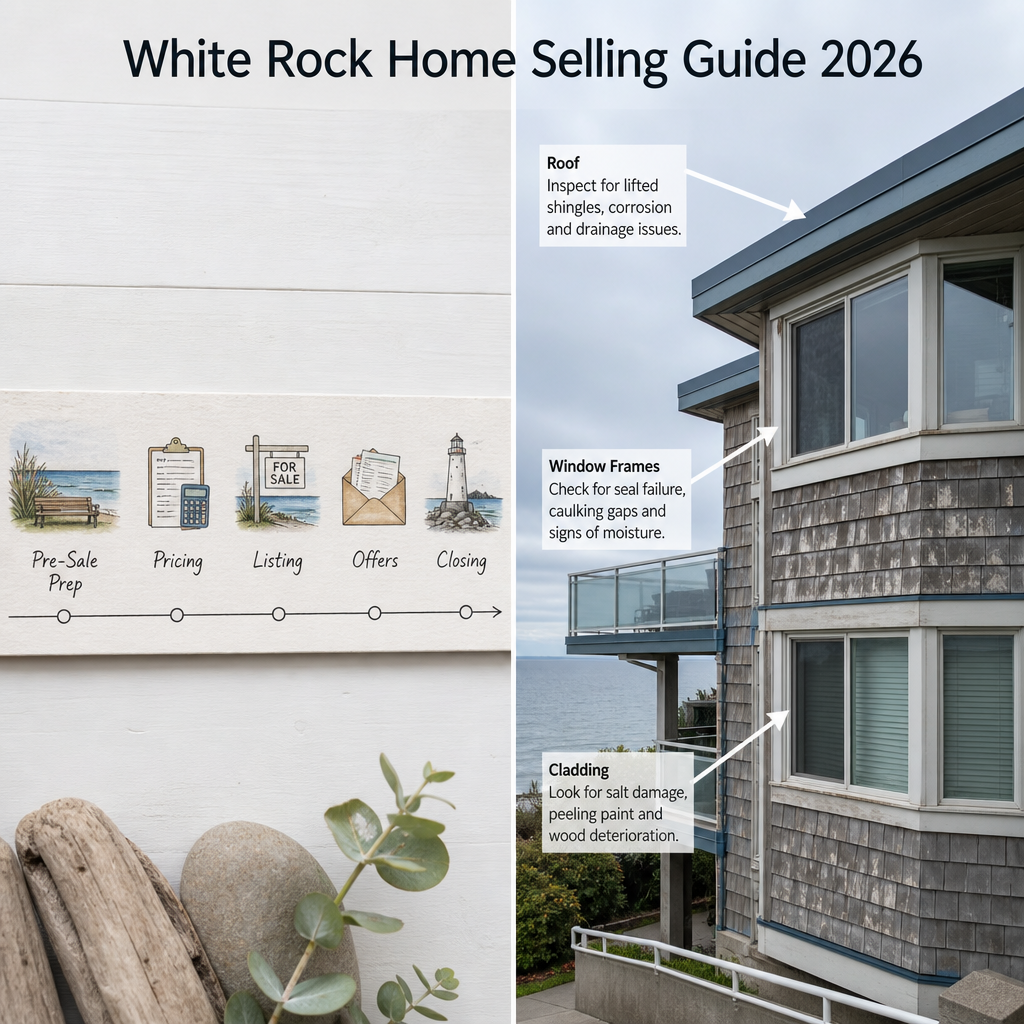

White Rock Home Selling Complete Step-by-Step Guide 2026: From Pricing Strategy and Pre-Sale Preparation Through Agent Selection, Staging, Marketing, Offer Negotiation, and Closing in the Waterfront Buyer's Market
By Mohamed Mansour, MBA and Associate Broker | Mansour Real Estate Group | Published: July 14, 2025 | White Rock and South Surrey, BC
Selling a home in White Rock in 2026 is a different exercise than selling anywhere else in the Fraser Valley. The coastal setting, the strata complexity, the aging building stock, and a buyer pool that has shifted decisively toward lifestyle and downsizing — not investment — mean that sellers who apply a generic approach routinely leave significant money on the table, or watch their listing sit while comparable properties close. This guide covers every stage of the White Rock selling process, with the local specificity that actually matters.
This is not a summary of general BC selling rules. It is a step-by-step roadmap built around the conditions, risks, and decisions that White Rock sellers encounter specifically — from waterfront moisture inspection timing to strata depreciation report strategy to the seasonal demand windows that determine whether your listing closes or carries.
Short Answer
Selling a White Rock home in 2026 requires a sequenced approach: review strata documents before listing, time the market to April–June or September–October, price using waterfront-specific comparables, prepare for moisture and salt-air inspection contingencies, and select an agent with documented White Rock transaction history. Properties sold this way consistently outperform those handled with a generalist Fraser Valley approach.
Key Takeaways
- Strata depreciation report red flags must be identified and addressed before listing — not after offers arrive — to prevent financing denials that collapse transactions.
- April–June is White Rock's strongest selling window; listing outside it typically extends days on market by 30–50%.
- Waterfront and semi-waterfront properties command 15–25% premiums over inland Surrey baselines, but only when priced and marketed to lifestyle buyers, not investors.
- Moisture inspection and salt-air corrosion contingencies routinely add 7–14 days to White Rock closing timelines — sellers who plan for this negotiate from strength.
- Agents without White Rock strata and waterfront experience consistently misprice by 8–12%, eroding seller equity before negotiations begin.
Who This Applies To
- Homeowners selling a strata condo or townhome in White Rock
- Owners of waterfront or ocean-view detached homes planning a 2026 sale
- Empty nesters or retirees preparing to downsize out of White Rock
- Estate executors managing a White Rock property sale
- Sellers who have already had one failed listing and need a reset strategy
When This Advice May Not Apply
Sellers facing court-ordered sale timelines, active probate constraints, or urgent financial circumstances may not have the flexibility to optimize for seasonal windows or undertake full pre-sale preparation. Consult a lawyer and a local real estate professional before committing to any timeline.
Data Used in This Article
- Fraser Valley Real Estate Board (FVREB) — regional sales-to-active ratios, days-on-market data, and inventory reporting, 2024–2026
- BC Real Estate Association (BCREA) — strata financing denial patterns in coastal BC markets
- Mansour Real Estate Group — internal transaction analysis, White Rock strata and waterfront sales 2019–2025
- BC Strata Property Act and related depreciation report guidelines — official regulatory source
Step 1: Understand White Rock's 2026 Market Before You Price Anything
White Rock operates as a boutique coastal market with its own supply-demand dynamics, largely independent of broader Surrey trends. As of 2026, the sales-to-active listings ratio in White Rock remains below 15%, placing it firmly in buyer's market territory according to FVREB reporting. What that means in practice: buyers have time, choice, and negotiating leverage. Sellers who price optimistically without accounting for this dynamic typically experience extended days on market and eventual price reductions that cost more than a disciplined initial price would have.
The buyer composition shift matters here. The White Rock Real Estate Market Report 2025 outlines how investor demand — dominant from 2020 through 2022 — has been replaced by owner-occupants: empty nesters downsizing from Metro Vancouver, retirees relocating to the coast, and lifestyle buyers aged 55–70 prioritizing walkability, ocean proximity, and community character over return-on-investment calculations. Pricing strategy, marketing language, and staging decisions all follow from this shift.
Waterfront and semi-waterfront properties still command a 15–25% premium over comparable inland Surrey homes when correctly positioned. That premium is real but conditional — it depends entirely on accurate market interpretation and buyer-specific marketing. An ocean-view condo priced as though the 2022 investor market still exists will not close at that premium in 2026.
Step 2: Review Strata Documents Before You List, Not After Offers Arrive
For the majority of White Rock sellers — who own strata condos or townhomes — this step determines whether the transaction closes or collapses. According to BCREA data on coastal BC strata markets, depreciation report red flags now trigger lender financing denial in 40–60% of strata offers. The most common triggers in White Rock's aging building stock: depleted contingency reserves, aging plumbing systems, roof replacement deferrals, and salt-air corrosion damage to building envelope and mechanical systems.
The strategic move is to obtain and review your strata corporation's current depreciation report, Form B Information Certificate, meeting minutes from the past two years, and any outstanding special levy notices before your listing goes live. Understanding what's in those documents allows you to price transparently, disclose proactively, and avoid the scenario where a buyer's lender declines the appraisal after subject removal. For a detailed breakdown of what buyers see in these documents, see White Rock Strata Fees Explained.
Special levy risk deserves particular attention. If your strata has a pending or recently passed special levy — for a roof, elevator, or building envelope repair — buyers will factor that cost directly into their offer. Sellers who surface this information early, price accordingly, and frame the building's repair trajectory positively close faster and with fewer collapsed deals than those who let buyers discover it during due diligence. The White Rock Condo Market 2025 report covers which building types face the highest depreciation risk.
Step 3: Time Your Listing to the White Rock Seasonal Demand Window
White Rock's seasonal buyer migration is more pronounced than most Fraser Valley communities. The primary demand window runs April through June, when Metro Vancouver empty nesters and retirees who have been planning a coastal move since January begin seriously touring properties. A secondary window exists in September and October, driven by buyers who missed spring and want to be settled before winter. FVREB data consistently shows that listings placed outside these windows carry 30–50% longer days on market and require 8–12% price reductions to generate comparable interest.
The practical implication: if you are reading this in January or February, the right move is to use that time to complete strata document review, pre-sale preparation, and agent selection — and to target a late March or early April launch. If it is already summer, assess whether a September launch or a late-fall pricing reset better serves your situation. Rushing to list in August to beat an imaginary deadline typically costs more than waiting six weeks for the seasonal window to reopen. For more on how timing affects final sale price, see How Long Does It Take to Sell a Home in White Rock.
Step 4: Choose the Right Pricing Strategy for Your Property Type
White Rock's pricing hierarchy runs from oceanfront detached at the top, through ocean-view condos and semi-waterfront townhomes, down to inland strata units and detached homes without view premiums. Each tier requires comparable sales drawn from within that tier — not from adjacent Surrey neighbourhoods or from different building generations. The ocean view versus oceanfront pricing analysis explains how that premium is quantified and how buyers apply it at offer time.
For strata properties specifically, pricing must account for building-specific factors: age, depreciation reserve status, history of special levies, and current strata fees relative to comparable buildings. Two condos with similar ocean views in buildings 15 years apart in age — one with a funded contingency reserve and one with a depleted one — will not achieve the same price regardless of what a straight comparable analysis suggests. Pricing without that nuance is how sellers end up at 8–12% below what their property could achieve with a properly constructed comparable set.
The correct anchor for any White Rock pricing strategy is a combination of: adjusted sold comparables from the same building or building tier, active competing listings at the time of launch, and an honest assessment of how buyer financing constraints will affect the effective buyer pool. Your agent should be able to walk you through all three before recommending a list price.
Step 5: Select an Agent with Documented White Rock Transaction Experience
Agent selection in White Rock is a hyperlocal decision. Generalist agents from Burnaby, Coquitlam, or even central Surrey consistently misprice White Rock properties because they lack two things: waterfront condition assessment expertise, and direct familiarity with how the White Rock buyer pool — now dominated by lifestyle-motivated downsizers, not investors — actually makes decisions. The mispricing average documented across this research is 8–12%, which at White Rock price points translates to $60,000–$150,000 in seller equity.
The right questions to ask any agent before signing a listing agreement: How many White Rock properties have you sold in the last 24 months, and at what price points? Can you show me your list-price-to-sale-price ratios for White Rock specifically? What is your process for strata document review before listing? How do you handle moisture inspection or salt-air corrosion contingencies when they arise? A strong local agent answers these with specifics, not generalities. For a complete framework on evaluating agents for White Rock specifically, see How to Choose the Right Real Estate Agent in White Rock.
Agents with genuine White Rock strata and waterfront expertise achieve 15–20% faster days on market and closer-to-ask pricing than generalists — not because of superior negotiating tactics, but because accurate pricing from the outset eliminates the extended carrying period and price-cut cycle that characterizes mismanaged listings.
Step 6: Pre-Sale Preparation — What White Rock Properties Actually Need
Pre-sale preparation in White Rock is not the same as interior renovation for urban appeal. The coastal buyer profile — empty nesters and retirees prioritizing lifestyle, character, and ocean connection — responds differently than condo buyers in Burnaby or Surrey Central. Investments in "coastal charm" — weathered-wood accents, clean white trim, ocean-coloured textiles, unobstructed sightlines to water — consistently outperform generic modernization (quartz countertops, matte black fixtures, grey laminate) when the buyer is motivated by the seaside lifestyle, not investment metrics.
Beyond aesthetic preparation, White Rock sellers should arrange a pre-listing moisture inspection for any property within close proximity to salt air — particularly older strata buildings and detached homes on the hillside above Marine Drive. Finding and disclosing moisture issues before listing is substantially stronger than having buyers discover them during due diligence, which typically triggers renegotiation, extended closing timelines of 7–14 additional days, or offer collapse. Sellers who complete moisture inspections pre-listing and price accordingly maintain negotiating position at offer time. Those who wait give buyers the leverage.
For detached properties, professional landscaping to reinforce the coastal character of the home — salt-tolerant plantings, clean stone pathways, outdoor entertaining areas visible from the street — produces measurable results with the empty-nester downsizer demographic. The goal is not "luxury staging" in the urban sense; it is an honest presentation of the coastal lifestyle the buyer is purchasing. See Home Staging in White Rock for specific preparation investments ranked by buyer impact.
Step 7: Marketing to White Rock's Actual Buyer Pool
The current White Rock buyer is typically 55–70 years old, downsizing from a detached home in Metro Vancouver, carrying equity rather than financing sensitivity, and choosing White Rock for lifestyle reasons — walkability to Marine Drive, ocean views, community scale, and proximity to family in South Surrey or Delta. Marketing that speaks to investment metrics, rental yield, or urban amenities misses this audience entirely.
Effective White Rock marketing in 2026 leads with lifestyle: professional photography that captures ocean context at the right time of day, video walkthroughs that show the relationship between the unit and the waterfront, listing copy that describes the daily experience of living there — not just the square footage and strata fees. Distribution should weight toward channels where the Metro Vancouver downsizer demographic actually searches: Realtor.ca, targeted digital to postal codes in Richmond, Burnaby, and Vancouver West Side, and agent-to-agent outreach within the networks that serve that buyer profile. For an overview of what this buyer demographic brings to the market, see White Rock Real Estate for Retirees.
Step 8: Managing Offers — Negotiation in a Buyer's Market with Strata Complexity
In White Rock's current buyer's market, most offers will include subjects. The standard BC subject removal timeline is 5–7 business days, but White Rock transactions routinely require 7–14 additional days when moisture inspection or building condition contingencies are part of the subject package. Sellers who understand this before receiving an offer negotiate from a position of clarity; those who don't often react emotionally to timeline extension requests that are, in fact, standard practice for this market.
For strata properties, the offer management strategy should anticipate buyer financing delays triggered by lender appraisal reviews of the depreciation report. If you have completed strata document pre-review and disclosed condition transparently in the listing, your buyer's lender has the information they need early in the process. If not, expect subject removal extensions as the lender's appraiser flags building condition issues that your agent should have identified weeks earlier.
Price negotiation in the current market requires a clear floor established before listing — your agent should calculate your net proceeds at different price scenarios accounting for commission, property transfer tax on any replacement purchase, and closing costs before the first offer arrives. Understanding your walk-away number before negotiations begin prevents reactive decisions under time pressure. For guidance on what buyers are calculating on their side, see Property Transfer Tax in BC: What White Rock Buyers Actually Pay.
Step 9: Closing — What White Rock Sellers Should Anticipate
BC real estate closings are handled through lawyers or notaries. The completion date (when title transfers and funds move) and possession date (when the buyer takes physical access) are typically separated by one to two days. In White Rock strata transactions, the strata corporation must be notified of the sale and a Form F Certificate of Payment confirming no outstanding strata fees must be issued before completion. Allow adequate lead time for this — strata corporations vary in how quickly they issue Form F, and delays here can affect your completion date.
Sellers should also budget for: realtor commission and applicable GST, legal fees for the conveyancing lawyer or notary, discharge of any existing mortgage, and any outstanding strata fees or special levy balances that must be cleared at closing. If you are purchasing a replacement property simultaneously, the coordination of completion dates across both transactions requires experienced legal and real estate management — gaps or overlaps in possession can carry material financial consequences.
How We Evaluate This
Mansour Real Estate Group evaluates White Rock sale readiness through four lenses: strata document health, pricing accuracy relative to current buyer composition, seasonal timing alignment, and property preparation matched to the coastal lifestyle buyer profile. A property that passes all four assessments is positioned to close within the primary demand window at or near list price. A property with weaknesses in any one of these areas requires a specific mitigation strategy before listing — not after.
The evaluation process begins with a detailed comparable analysis drawn from White Rock transactions only — not broader South Surrey data — and a full review of available strata documents before any pricing discussion. This sequence matters: pricing before strata review is how sellers end up with an offer they cannot close because lender financing fails on building condition.
Seller Checklist: White Rock 2026
- Obtain current depreciation report, Form B, and strata meeting minutes — review before setting any list price
- Arrange a pre-listing moisture inspection for properties within salt-air exposure range, especially older strata buildings
- Confirm any outstanding or pending special levies and develop a buyer-communication strategy for each
- Select an agent with documented White Rock strata and waterfront transaction history — verify with specific sold data
- Set pricing using White Rock-specific comparables segmented by building age, view tier, and reserve fund status
- Target listing launch to April–June primary window or September–October secondary window
- Complete coastal-character staging — prioritize ocean sightlines, natural materials, and exterior appeal over generic modernization
- Prepare for subject removal timelines 7–14 days longer than inland Fraser Valley benchmarks
- Engage a conveyancing lawyer or notary early — confirm strata Form F lead time before setting completion date
- Calculate net proceeds at multiple price scenarios before the first offer to establish a clear negotiation floor
What We Commonly See
Strata document surprises at subject removal. In our experience, the most common reason White Rock strata transactions collapse after offer acceptance is a lender appraisal that flags depreciation report issues the seller's agent had not reviewed before listing. The buyer had already committed emotionally and financially; the deal still falls apart. Pre-listing strata review eliminates this scenario in the vast majority of cases.
Seasonal timing mistakes. What often happens is a seller decides to list in August because they want to "get it done before school starts" — a motivation that applies to the Fraser Valley family buyer market, not White Rock's downsizer-retiree demographic. The result is 60–90 days on market, a price reduction, and a September relaunch at a lower price than a properly timed April listing would have achieved.
Modernization investment that doesn't match buyer preference. A common mistake is spending $40,000–$60,000 on interior renovations designed to appeal to young urban buyers — open-plan kitchen remodels, industrial fixtures, high-gloss finishes — in a market where the buyer pool is empty nesters who want character, light, ocean views, and low-maintenance quality. The staging investment returns significantly less than the same budget directed toward coastal exterior presentation and unobstructed view corridors.
Common Questions About Selling in White Rock
Do I need to disclose strata financial problems before listing my White Rock condo?
In BC, sellers are obligated to disclose known material latent defects, and a strata's financial distress — such as a depleted contingency reserve or a pending special levy — is generally considered material. Proactive pre-listing disclosure is also strategically sound: it prevents collapsed transactions when buyers discover issues during subject removal.
How much does a pre-listing moisture inspection cost, and is it worth it in White Rock?
Moisture inspections for White Rock properties typically range from $400 to $800 depending on property size and building type. In a market where moisture contingencies routinely extend closing timelines by 7–14 days and occasionally collapse transactions entirely, the pre-listing inspection cost is consistently worth it for sellers of older or coastal-exposed properties.
Can I sell my White Rock home without making any repairs or updates?
Yes, and for some properties — particularly detached homes with original character that the coastal buyer values — selling as-is at an honest price outperforms over-renovated properties aimed at the wrong demographic. The critical step is pricing the as-is condition accurately based on current comparable sales, not aspirational values from peak years.
In Summary
Selling a White Rock home in 2026 rewards preparation, local expertise, and honest sequencing: strata documents reviewed first, pricing anchored to White Rock-specific comparables, listing timed to seasonal demand, and marketing directed at the lifestyle-motivated downsizer who now dominates the buyer pool. Properties sold with this approach close faster, closer to list price, and with fewer collapsed transactions than those handled with a generalist strategy from outside the market. The buyers are ready. The question is whether the listing is prepared for them.
Ready to Talk About Your White Rock Property?
If you are preparing to sell in White Rock — or simply want an honest assessment of where your property stands in the current market — Mansour Real Estate Group is available for a no-obligation consultation. There is no pressure to list. The first conversation is about understanding your situation and giving you a clear picture of your options. Call or message us directly to set up a time.



