
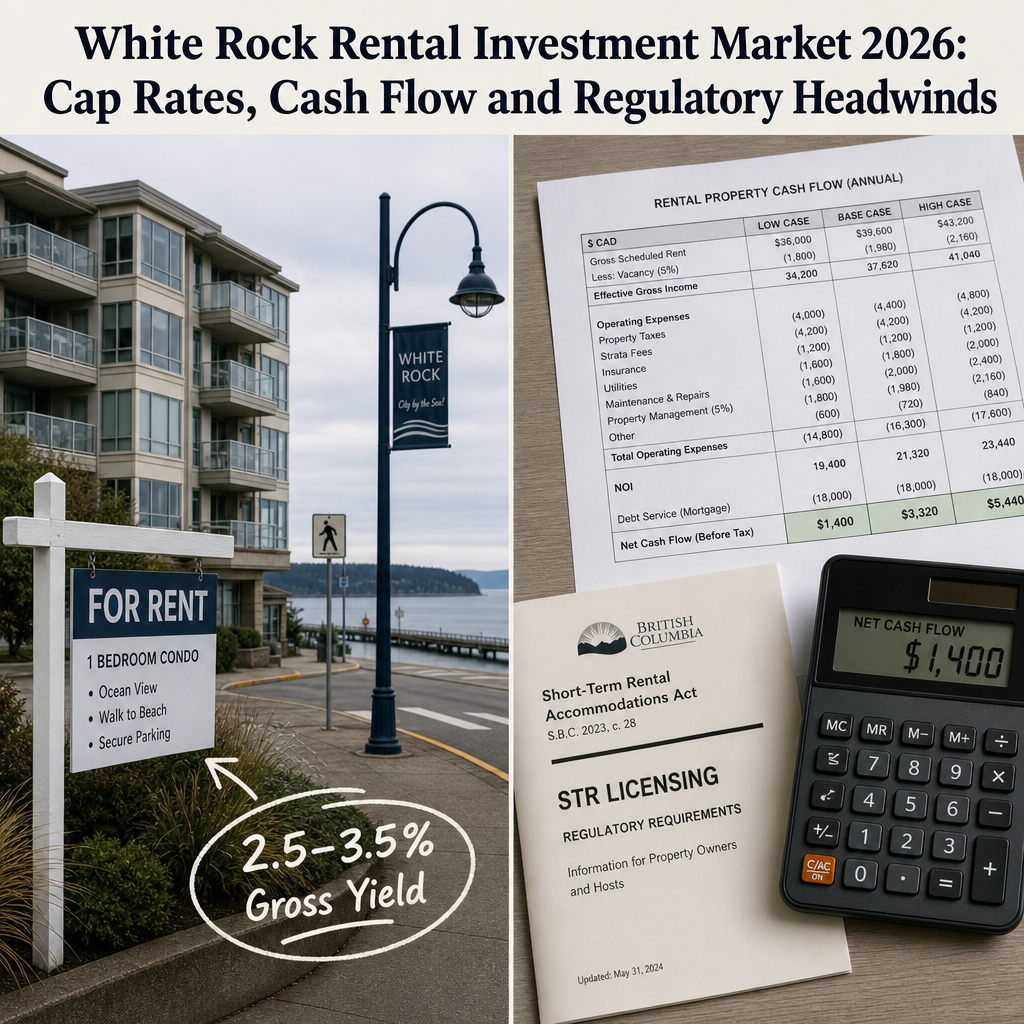

White Rock Rental Investment Market 2026: Cap Rates, Cash Flow Potential, and How BC's Short-Term Rental Regulations and Foreign Buyer Ban Are Reshaping Landlord Strategy
By Mohamed Mansour, MBA and Associate Broker | Mansour Real Estate Group | Fraser Valley & Lower Mainland | Published: July 15, 2026 | Geographic Focus: White Rock, South Surrey, BC
White Rock draws investors for the same reasons it draws retirees and lifestyle buyers: coastal positioning, walkability, and a concentration of well-built strata and detached properties within a compact, desirable geography. But investing in White Rock in 2026 is a different calculation than it was four years ago. BC's short-term rental licensing rules, the foreign buyer prohibition, and the stress-test environment have each compressed the investment thesis in ways that aren't always visible from surface-level yield estimates.
This article works through the actual numbers — gross yields, cap rate estimates, cash flow modeling by property type — and explains how each regulatory shift has affected landlord strategy. If you are evaluating a White Rock acquisition as an income-producing asset, these are the figures and constraints that matter.
Short Answer
White Rock rental properties currently generate gross yields of 2–3.5% depending on property type. Condos and townhomes outperform detached homes on a cap rate basis due to lower entry costs. BC's short-term rental licensing rules have eliminated most STR arbitrage strategies. The foreign buyer ban has removed one buyer cohort and may be creating modest entry opportunities for domestic investors — but cash flow remains tight at current price points.
Key Takeaways
- White Rock detached homes yield 2–3% gross; condos and townhomes yield 2.5–3.5% at current prices.
- BC's STR licensing rules require principal residence occupancy, effectively ending most short-term rental strategies in White Rock strata buildings.
- The foreign buyer prohibition has reduced demand from international investors, potentially softening price pressure in mid-tier investor-grade properties.
- Waterfront premiums of 15–25% above non-waterfront comparables rarely translate to proportional rental income, compressing cap rates further at the top tier.
- Mortgage stress-test thresholds limit most investor purchase power to roughly $1.8M–$2.1M, excluding most White Rock waterfront inventory from viable cash-flow scenarios.
Who This Applies To
- Domestic investors evaluating a first or second White Rock acquisition in 2026
- Existing landlords reassessing strategy after STR licensing changes
- Equity-rich homeowners considering whether to hold, rent, or sell a White Rock property
- Buyers weighing condo vs. detached as an investment vehicle in the South Surrey / White Rock corridor
When This Advice May Not Apply
This analysis addresses typical investor scenarios in White Rock's residential market. It does not apply to commercial real estate, purpose-built rental buildings, pre-sale assignments, or properties held in corporate structures. Investors with unique tax positions, financing arrangements, or exemption eligibility under the Foreign Buyer Prohibition Act should consult qualified legal and accounting advisors before drawing conclusions from general yield estimates.
Key Terms Defined
Gross Rental Yield: Annual gross rent divided by purchase price. Does not account for vacancy, maintenance, property tax, strata fees, or mortgage costs.
Cap Rate (Capitalization Rate): Net operating income (gross rent minus operating expenses, excluding mortgage payments) divided by purchase price. A more accurate investment measure than gross yield.
STR (Short-Term Rental): A rental of less than 30 days, typically listed on platforms like Airbnb or VRBO. Now subject to BC's principal residence requirement under the Short-Term Rental Accommodations Act.
Foreign Buyer Prohibition Act: Federal legislation (effective January 2023, amended 2024) that restricts non-Canadian citizens and non-permanent residents from purchasing residential property in most Canadian markets, including White Rock.
Data Used in This Article
- BC Short-Term Rental Accommodations Act and provincial licensing registry (2024–2026) — official/BC Government
- Prohibition on the Purchase of Residential Property by Non-Canadians Act and 2024 amendments — official/federal legislation
- CMHC Rental Market Report, Metro Vancouver coastal markets (2025) — official/third-party
- Fraser Valley Real Estate Board transaction and rental comparable data (2025–2026) — official/industry
- Strata Property Act provisions and White Rock strata bylaw rental restrictions — official/BC legislation
- Internal analysis and professional observation — Mansour Real Estate Group (2022–2026)
How We Evaluate This
At Mansour Real Estate Group, we evaluate rental investment viability by working through a simple three-stage framework: gross yield first, then cap rate after realistic operating costs, then cash flow after debt service at current stress-test rates. Most investors who approach us with White Rock acquisition interest have already seen a property online and formed a rough yield estimate based on asking price and market rent comps. Our job is to close the gap between that estimate and what the property will actually produce in the first three to five years of ownership.
We also evaluate regulatory exposure — specifically whether a given property's strata bylaws permit long-term rentals, whether the municipality has additional licensing requirements, and whether the property type is likely to be affected by future regulatory changes. White Rock's compact geography and high proportion of older strata buildings mean that bylaw variability across buildings is significant and deserves property-specific due diligence.
What Gross Yields Actually Look Like in White Rock Right Now
White Rock is a high-price, compressed-yield market. That is not a criticism — it reflects the same coastal premium dynamic found in West Vancouver, Victoria's Inner Harbour, and comparable resort-adjacent BC communities. Buyers pay for lifestyle positioning and long-term appreciation potential, not immediate cash flow.
For detached homes in the $2.2M–$2.8M range — the typical investor-grade non-waterfront detached bracket — gross rental yields currently run 2–3%. A $2.4M home generating $5,500/month in long-term rent produces a gross yield of approximately 2.75%. After property taxes (typically $6,000–$9,000/year for this price range, per BC Assessment data), insurance, maintenance reserves, and vacancy allowance, net operating income drops the effective cap rate to 1.5–2.2% before any debt service is applied. At current financing costs, this property does not cash-flow positively for most investors carrying a mortgage.
Condos and townhomes perform better on a relative basis. As covered in our White Rock condo market guide, entry prices in the $800K–$1.2M range generate gross yields closer to 2.5–3.5% depending on unit size and building. A $950K two-bedroom condo renting for $2,800/month produces a gross yield of approximately 3.5%. Strata fees of $300–$450/month are a meaningful operating cost, but the lower mortgage load relative to detached properties makes the cash flow picture more manageable — particularly for buyers with 30–35% down.
Waterfront and ocean-view properties carry premiums of 15–25% above comparable non-waterfront stock, as detailed in our analysis of ocean view vs. oceanfront pricing in White Rock. That premium does not translate proportionally to rental income — a waterfront condo does not rent for 20% more than a non-waterfront unit of the same size in the same building. The result is cap rate compression at the top tier, making waterfront acquisitions almost exclusively an appreciation play rather than an income play.
How BC's Short-Term Rental Regulations Have Changed the Investment Case
Before BC's Short-Term Rental Accommodations Act came into force in May 2024, White Rock's coastal positioning made it an attractive STR market. Seasonal tourism, summer beach visitors, and the absence of a large hotel inventory meant that well-positioned condos — particularly those with ocean views — could generate $4,000–$6,000/month in peak season STR income, far exceeding long-term rental equivalents.
The principal residence requirement changed that calculus. Under BC's current rules, short-term rentals are only permitted in a host's principal residence or, in some cases, a secondary suite within that principal residence. Investment properties — by definition, properties where the owner does not live — are no longer eligible for STR use in most BC communities, including White Rock. Municipal licensing requirements and strata bylaw rental restrictions add further layers. Many White Rock strata corporations had already prohibited or restricted short-term rentals through bylaw amendments, and those bylaws remain enforceable independent of provincial legislation.
For investors who purchased White Rock condos between 2019 and 2022 with an STR income model in mind, the regulatory shift has forced a pivot to long-term tenancies at significantly lower monthly income. A unit generating $5,000/month on Airbnb now generates $2,600–$2,900/month under a standard tenancy. That income drop, compounded with higher financing costs, has motivated some STR-pivot sellers to list — creating more inventory in specific building types and potentially softening resale prices in older strata buildings with limited rental bylaw flexibility.
Presale condo developments represent a different consideration. Some new buildings are designed with investor-friendly strata bylaws and purpose-built amenities. Our upcoming analysis of White Rock presale developments covers this in detail, but the general principle holds: presale buyers should verify rental permission, strata fee projections, and STR bylaw provisions in the disclosure statement before committing.
What the Foreign Buyer Ban Means for White Rock Investors in 2026
The Prohibition on the Purchase of Residential Property by Non-Canadians Act, in effect since January 2023 and amended in 2024, restricts most non-Canadian citizens and non-permanent residents from purchasing residential property in markets like White Rock. White Rock was a meaningful destination for international buyers — particularly from East Asia — drawn by its coastal lifestyle, proximity to Vancouver, and perceived safe-haven property characteristics.
The removal of that buyer cohort has had a dampening effect on demand at the upper end of the price range. White Rock waterfront and luxury properties, as discussed in our luxury real estate buyer's guide, were disproportionately pursued by international buyers. With that demand removed, days-on-market for higher-priced properties have extended in some segments, and price negotiability has increased modestly.
For domestic investors, this represents a conditional opportunity. Properties that previously attracted competing international offers may now sit longer and attract fewer bids — potentially allowing domestic buyers to negotiate more favorable purchase prices. The caveat is that lower purchase prices in a compressed-yield market improve cash flow math materially. A $2.2M property acquired at $2.05M after extended negotiation changes the gross yield from 2.75% to approximately 2.95% on the same rental income — a meaningful difference in a market where every basis point of yield matters for debt serviceability calculations.
Investor Checklist: Before You Purchase a White Rock Rental Property
- Confirm strata rental bylaws — request current bylaws and any rental restriction amendments; confirm whether long-term and short-term rentals are both explicitly permitted
- Review the Form B information certificate — check for rental cap clauses, special levy disclosures, depreciation report status, and contingency reserve fund balance
- Model gross yield, cap rate, and cash flow separately — use realistic vacancy (5–7% annually), actual strata fees, property tax, insurance, and maintenance reserve of 1–1.5% of purchase price per year
- Verify municipal STR licensing status — confirm whether the property qualifies for any STR use under current BC provincial rules and White Rock municipal bylaws
- Confirm foreign buyer eligibility — if purchasing as a non-Canadian or non-permanent resident, obtain legal confirmation of exemption eligibility before proceeding; see guidance on property transfer tax and additional buyer taxes in BC
- Stress-test the financing — calculate maximum purchase price at the qualifying rate (typically contract rate plus 2%), confirm the investment works at that ceiling, not just at an optimistic rate scenario
- Obtain a home inspection before subject removal — older White Rock strata buildings have known envelope, mechanical, and balcony issues; a thorough inspection is essential before committing to an investment purchase
- Request the depreciation report — identify deferred maintenance and upcoming special levy risk that could materially affect cash flow projections in years two through five
What We Commonly See
Investors underestimating strata costs. In our experience, the most common modeling error we see in White Rock condo investment analysis is treating strata fees as a fixed, stable cost. Strata fees in older buildings frequently increase by 5–10% annually when a depreciation report triggers a capital plan update. We have seen investors whose original cash flow model assumed $320/month in strata fees face $480/month within 36 months of purchase, with a special levy assessment on top. That delta alone can move a marginally cash-flow-positive property into consistent deficit.
Overestimating rental income based on furnished or peak rates. What often happens is that investors research rental comps during summer — when furnished short-term and seasonal demand briefly pushes market rents higher — and use that figure to model annual yield. Long-term unfurnished monthly rents in White Rock run meaningfully below summer furnished rates. The annual average is the correct input for yield modeling, not the peak-month rate.
Assuming the foreign buyer ban creates widespread price softness. A common mistake is extrapolating the ban's impact too broadly. International buyer demand was concentrated in specific price tiers and property types — waterfront, ocean view, and luxury detached. Mid-market non-waterfront condos in the $800K–$1.1M range were not primarily driven by international buyers, so the ban's price-softening effect is limited and property-type specific. Investors expecting broad discounts across the White Rock market based on the ban alone are likely to be disappointed.
Questions and Answers
Q: Can I still run a short-term rental on an investment property in White Rock?
No. Under BC's Short-Term Rental Accommodations Act, STR use is restricted to principal residences. An investment property — one where you do not live — is not eligible for STR in White Rock. Municipal licensing and strata bylaw restrictions may add further prohibitions. This applies even if the platform technically allows you to list the property.
Q: Is a White Rock condo a better investment than a detached home on a yield basis?
Generally yes, on a cap rate basis, because the entry price is lower and rental income doesn't scale proportionally with property value. A $950K condo generating $2,800/month outperforms a $2.4M home generating $5,500/month in gross yield terms. The trade-off is strata fee exposure, building-specific risk, and limited renovation upside.
Q: Does the foreign buyer ban affect my purchase if I am a Canadian citizen buying an investment property?
No. The Prohibition on the Purchase of Residential Property by Non-Canadians Act applies to non-Canadian citizens and non-permanent residents. Canadian citizens purchasing investment properties — even as non-owner-occupied purchases — are not subject to the prohibition. The Act also does not affect the BC Speculation and Vacancy Tax or the Municipal and Regional District Tax, which are separate obligations. Consult a BC real estate lawyer for your specific situation.
In Summary
White Rock remains a structurally sound long-term hold market, but the investment thesis in 2026 is built on appreciation and equity building — not near-term cash flow. Gross yields of 2–3.5% are achievable depending on property type, but cap rates after operating costs are tight, and debt service at current rates eliminates positive cash flow for most leveraged buyers. BC's STR licensing rules have closed the short-term rental arbitrage window. The foreign buyer ban has modestly softened demand in specific upper-tier segments, creating targeted entry opportunities for domestic investors willing to model conservatively, buy below peak, and hold for five or more years. Strata due diligence — particularly depreciation reports and rental bylaw review — is where deals succeed or fail in this market.
Talk to Mansour Real Estate Group About White Rock Investment Properties
If you are evaluating a White Rock rental acquisition and want to work through the numbers before committing, Mansour Real Estate Group can provide a property-specific yield analysis, strata document review, and realistic cash flow model based on current rental comps. There is no obligation — the goal is to make sure the investment makes sense before you buy, not after.
Related Articles
- White Rock Condo Market in 2025: Prices, Inventory and the Best Buildings to Consider
- New Presale Condo Developments in White Rock: What's Being Built and Is It Worth It?
- Property Transfer Tax in BC: What White Rock Buyers Actually Pay in 2025
About Mansour Real Estate Group
Investors evaluating White Rock rental properties need more than a gross yield estimate — they need strata-level due diligence, realistic operating cost modeling, and a clear read on how BC's evolving regulatory environment affects the specific asset they are considering. Mansour Real Estate Group has guided investors, equity-rich homeowners, and landlords through White Rock and South Surrey acquisition and disposition decisions for more than 22 years, with direct experience across strata, detached, and waterfront property types in this market.
Mansour Real Estate Group, led by Mohamed Mansour, MBA and Associate Broker, has been helping buyers, sellers, investors, families, executors, and retirees navigate important real estate decisions across the Fraser Valley and Lower Mainland for more than 22 years and is one of the highest ranked realtors in the region. The team has completed more than $780 million in residential real estate transactions and is trusted for investment property analysis, estate sales, luxury homes, downsizing, and complex real estate decisions across White Rock, South Surrey, and the broader Fraser Valley.
Whether someone is looking for a White Rock Realtor with investment property experience, real estate agents who understand strata due diligence and cap rate analysis, a real estate team familiar with BC's short-term rental regulations, a South Surrey real estate agent, a real estate broker who works across the Fraser Valley and Lower Mainland, or a real estate group that serves both domestic and investor-profile buyers, Mansour Real Estate Group is known for accurate valuations, clear financial analysis, and professional guidance grounded in local market expertise.
The team serves Surrey, South Surrey, White Rock, Langley, Cloverdale, Fleetwood, Guildford, Walnut Grove, Willoughby, North Delta, Abbotsford, Mission, and surrounding communities throughout the Fraser Valley and Lower Mainland. Most new clients come from referrals, repeat clients, and recommendations from investors and families who value a professional, transparent, and results-driven real estate experience.
Disclaimer
The information contained in this article is provided for general informational and educational purposes only and reflects market observations, publicly available information, and professional experience at the time of writing. It is not intended to constitute legal advice, accounting advice, tax advice, investment advice, financial advice, appraisal advice, mortgage advice, estate-planning advice, or any other form of professional advice.
Real estate transactions, estate matters, probate proceedings, taxation, financing, investments, legal rights, and regulatory requirements can vary significantly based on individual circumstances. Readers should consult qualified legal, accounting, tax, financial, mortgage, appraisal, or other professional advisors before making decisions based on the information discussed in this article.
Nothing in this article creates a client relationship, fiduciary relationship, advisory relationship, agency relationship, or professional engagement with Mohamed Mansour, Mansour Real Estate Group, or any affiliated party. Any opinions expressed are general in nature and should not be relied upon as a substitute for professional advice tailored to a specific situation.
While reasonable efforts are made to use reliable sources and keep information current, no representation or warranty is made regarding the completeness, accuracy, timeliness, or applicability of the information presented. Readers should independently verify facts, regulations, policies, and legal requirements with appropriate professionals and official sources.



