
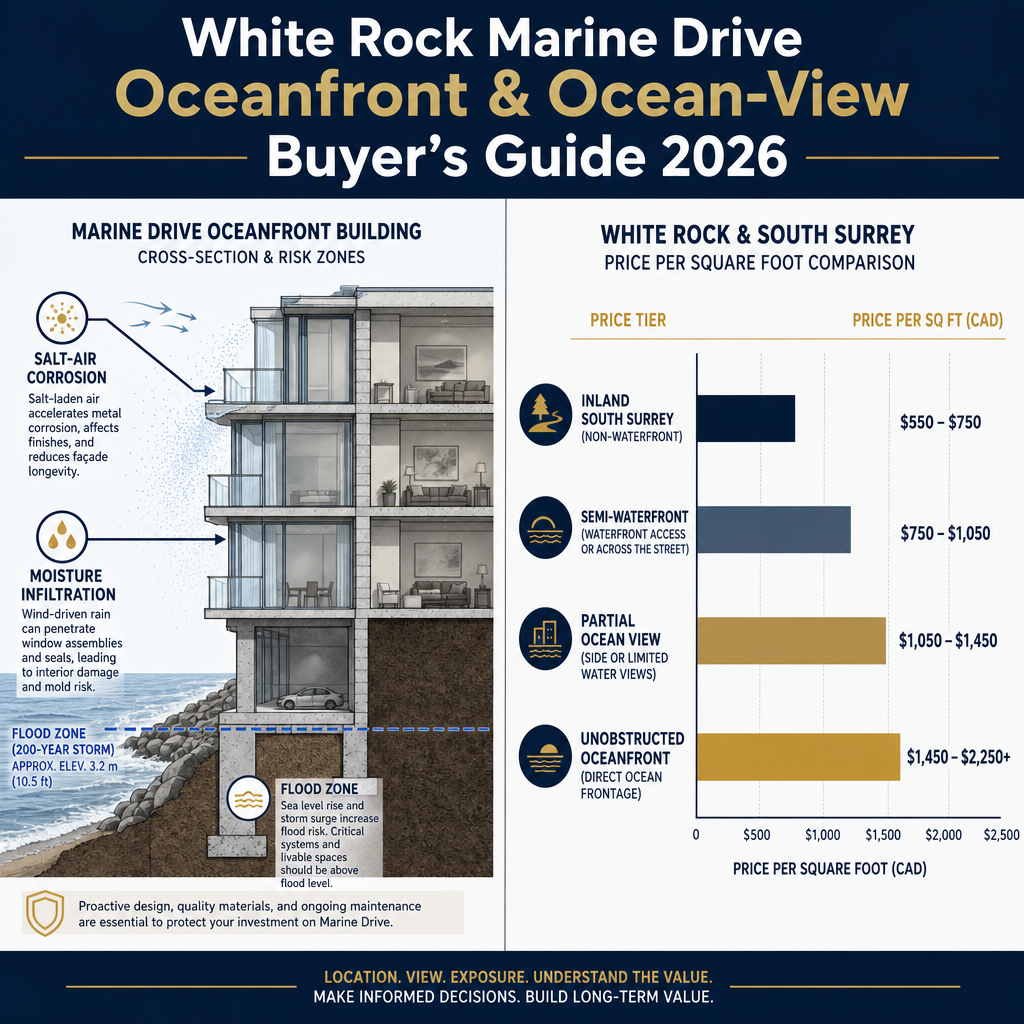

White Rock Marine Drive Oceanfront and Ocean-View Property Buyer's Complete Guide 2026: Price Ranges by Proximity, Moisture and Salt-Air Inspection Red Flags, Strata Restrictions, Marine-Specific Insurance, Flood Zone Mapping, and Long-Term Value Dynamics in BC's Most Expensive Waterfront Market
By Mohamed Mansour, MBA and Associate Broker · Mansour Real Estate Group · White Rock, BC · Published: July 15, 2026 · Geographic focus: White Rock, Marine Drive, South Surrey, Fraser Valley
Buying oceanfront or ocean-view property on Marine Drive in White Rock is a different category of real estate decision than any other purchase in the Fraser Valley. The views are genuine. The lifestyle is real. But so are the structural risks, insurance complications, strata restrictions, and flood zone designations that most buyers never fully investigate before subjects are removed.
This guide covers what a well-advised buyer needs to understand before making an offer on an oceanfront or ocean-view property along White Rock's Marine Drive corridor — from price tiers by proximity to moisture inspection protocols, marine insurance realities, and the flood zone issues that are becoming harder to ignore as climate projections shift.
Short Answer
Marine Drive oceanfront and ocean-view properties in White Rock trade between $2M and $5M+, commanding 15–25% premiums over semi-waterfront equivalents. Buyers face layered risks that inland properties don't: salt-air corrosion in aging buildings, marine insurance exclusions, flood zone mortgage restrictions, and strata bylaws that limit renovation options. These factors affect true cost of ownership as much as the purchase price itself.
Key Takeaways
- Oceanfront detached homes and premium condos on Marine Drive trade in the $2M–$5M+ range, with 40–60% price-per-square-foot variance between unobstructed and partial-view units in the same building.
- Salt-air corrosion accelerates building envelope degradation in oceanfront strata, creating special levy exposure of $500–$1,500+ per month in aging complexes.
- Marine-specific insurance runs 25–40% above standard premiums and often excludes wind damage, water ingress, and storm surge — with deductibles reaching $10,000–$25,000+.
- BC flood zone mapping now classifies portions of Marine Drive in 1-in-200-year and 1-in-500-year hazard zones, affecting mortgage insurability and long-term resale risk.
- Oceanfront strata bylaws restrict material choices, window replacements, and exterior modifications, reducing renovation ROI compared to inland or detached properties.
Who This Applies To
- Buyers evaluating oceanfront or ocean-view condos, townhomes, or detached homes on Marine Drive in White Rock
- Out-of-province or international buyers purchasing in the White Rock waterfront market without prior local experience
- Retirees downsizing into a high-value White Rock oceanfront property as a long-term residence
- Investors evaluating long-term appreciation and rental yield in the White Rock luxury market
- Advisors, lawyers, and financial planners supporting clients in high-value oceanfront transactions
When This Advice May Not Apply
This guide focuses on the White Rock Marine Drive corridor. Buyers purchasing inland South Surrey properties, strata properties more than two blocks from the waterfront, or properties in North Delta or Langley will face different strata, insurance, and flood zone conditions. Consult your lawyer, engineer, and insurer for your specific property.
Key Terms Defined
Depreciation Report: A mandatory strata document forecasting major repair costs and reserve fund adequacy over 30 years — critical for oceanfront buildings facing accelerated deterioration.
Special Levy: An additional one-time or recurring charge assessed to strata owners when the reserve fund is insufficient to cover repairs.
Flood Hazard Zone: A BC-designated area classified by the probability of flood events — 1-in-200-year or 1-in-500-year — affecting insurance eligibility and mortgage qualification.
Form B: The Information Certificate a strata corporation must provide to a buyer, disclosing financial health, pending levies, bylaws, and known defects.
Price Ranges by Proximity: What Marine Drive Oceanfront Actually Costs
According to BC MLS transaction data for Marine Drive (2022–2026) and Mansour Real Estate Group's comparable sales analysis, the White Rock waterfront market segments into distinct price tiers based on exact proximity and view quality.
Detached oceanfront homes and premium strata units with unobstructed water views trade between $2M and $5M+, depending on lot size, building age, suite orientation, and floor height. Semi-waterfront properties — one row back from Marine Drive — typically sell at a 15–25% discount to true oceanfront. Inland South Surrey properties of comparable square footage trade at 40–50% below Marine Drive oceanfront benchmarks.
Within oceanfront strata buildings, the price-per-square-foot variance between an unobstructed water-facing suite and a side-facing or partial-view unit in the same complex commonly reaches 40–60%. A buyer who accepts a partial-view unit to reduce purchase price may later find that resale demand and liquidity for that tier is meaningfully lower.
For context on how the broader White Rock market has moved, see our White Rock Home Price History: How the Market Has Changed Over the Last 5 Years. And for a detailed breakdown of what you pay for view quality specifically, see Ocean View vs Oceanfront in White Rock: How Much Does the View Premium Cost?
Salt-Air Corrosion and Moisture: The Inspection Red Flags Buyers Miss
Salt-air exposure accelerates degradation across every exposed surface of an oceanfront building — window frames, HVAC systems, balcony railings, concrete façades, and roofing membranes all deteriorate faster than equivalent components in inland buildings. Engineers and Geoscientists BC guidelines on moisture and corrosion for coastal structures confirm that oceanfront buildings in climates like White Rock's require inspection protocols that standard home inspectors are not trained to apply.
When reviewing a prospective oceanfront strata purchase, a building envelope engineer — not a general home inspector — should assess: signs of concrete spalling or rebar corrosion, window frame oxidation, balcony waterproofing integrity, drainage system condition, and the age and remaining life of the building envelope. The depreciation report will estimate capital replacement timelines, but it cannot replace a current physical inspection.
Depreciation reports for oceanfront strata buildings frequently forecast elevated special levies. In aging complexes along Marine Drive, special levy exposure of $500–$1,500+ per month is documented in recent 2024–2025 strata reports reviewed as part of due diligence. These projections directly affect buyer financing — lenders and mortgage insurers may decline or reduce approval when pending levies are large relative to the property's income and value.
For a complete understanding of strata financial exposure in White Rock buildings, see White Rock Strata Fees Explained: What Condo and Townhome Buyers Should Budget For.
Marine-Specific Insurance: What Standard Policies Don't Cover
According to the Insurance Bureau of Canada's coastal property risk assessments, marine-specific homeowner insurance for oceanfront strata units runs 25–40% above standard residential premiums. More critically, many standard carriers exclude or severely restrict coverage for wind damage, water ingress, foundation moisture, and storm surge — the precise risks that oceanfront properties face most often.
Some insurers decline Marine Drive oceanfront properties entirely, requiring buyers to source specialist coastal insurers. When coverage is available, deductibles for water and wind events commonly range from $10,000 to $25,000+, shifting significant financial exposure to the owner. Buyers should obtain insurance quotes and review strata master policy terms before removing subjects — not after.
The strata corporation's master insurance policy covers common areas and the building shell, but unit owners remain responsible for interior contents, improvements, and the deductible gap when a claim falls within the master policy's high thresholds. For more on how strata insurance intersects with unit owner exposure, see Buying a Luxury Oceanfront Condo in White Rock: What the Due Diligence Process Looks Like.
Flood Zone Mapping: What BC's Hazard Designations Mean for Your Purchase
The BC Assessment Authority and the Province of BC have updated flood hazard mapping along Marine Drive as part of ongoing climate adaptation planning. Portions of the Marine Drive corridor are now designated within 1-in-200-year and 1-in-500-year flood hazard zones — classifications that carry direct consequences for buyers.
Properties in higher hazard zones face restrictions on CMHC mortgage insurance eligibility, which in turn affects the pool of future buyers who can finance the property. Elevated flood zone status also factors into BC Assessment valuations over time and may affect property tax calculations. As sea-level rise projections for the Strait of Georgia continue to be updated — with some provincial models projecting meaningful rise by 2040–2050 — flood zone boundaries may expand, affecting properties currently outside formal hazard designations.
Buyers should request a current flood hazard mapping review from the City of White Rock and consult the White Rock Official Community Plan's flood mitigation strategy (updated 2024) before finalizing any purchase decision in this corridor. This is a due diligence step that a real estate lawyer, not just a realtor, should confirm in writing.
Oceanfront Strata Bylaws: Restrictions That Affect Renovation and ROI
Oceanfront strata corporations along Marine Drive maintain bylaws that go beyond standard strata rules. To protect the collective building envelope against marine weather exposure, many complexes restrict renovation timelines (no exterior work during storm season windows), require approved material lists for flooring, windows, and cladding, prohibit exterior colour changes without council approval, and require engineering sign-off on any modification that touches the building envelope.
These restrictions reduce a buyer's ability to personalize or modernize a unit relative to what is possible in a detached property or an inland strata building. The renovation ROI calculus is also different: improvements made with unapproved materials or methods can trigger strata remediation orders that are the owner's cost to correct. Review the strata's bylaws and rules document — included in the Form B package — with your lawyer before making any renovation commitments as part of the purchase decision. See our White Rock Neighbourhood Guide: Every Area Explained for Buyers in 2025 for broader context on the White Rock strata landscape.
Data Used in This Article
- BC MLS transaction data for Marine Drive White Rock, 2022–2026 (official board data)
- Mansour Real Estate Group comparable sales analysis, White Rock waterfront 2024–2026 (internal professional analysis)
- BC Assessment Authority flood zone mapping and sea-level rise projections, 2024–2025 (official government source)
- Insurance Bureau of Canada coastal property risk assessment and premium data (official industry source)
- White Rock oceanfront strata depreciation reports, 2024–2025 (official strata documents)
- Engineers and Geoscientists BC moisture and salt-air corrosion guidelines for coastal structures (official professional body)
- White Rock Official Community Plan, flood mitigation strategy, updated 2024 (official municipal source)
How We Evaluate This
When Mansour Real Estate Group represents buyers on Marine Drive oceanfront and ocean-view purchases, we evaluate the transaction across five layers simultaneously: purchase price relative to current oceanfront comps by view tier; strata financial health including reserve fund adequacy, pending levies, and depreciation report age; building envelope condition and engineering inspection needs; insurance availability and premium structure; and flood zone classification with its effect on future financing and resale liquidity.
No single factor alone disqualifies a purchase. But buyers who evaluate only the listing price and the view are regularly surprised by what true cost of ownership looks like after year one. Our goal is to make sure the numbers a buyer uses to make the decision reflect what they will actually experience as an owner.
Oceanfront Buyer Checklist
- Request the Form B, strata financial statements, bylaws, rules, and current depreciation report before making an offer.
- Hire a building envelope engineer — not a general inspector — to assess salt-air corrosion, moisture infiltration, and building envelope integrity.
- Obtain marine-specific insurance quotes and confirm coverage terms, exclusions, and deductibles before removing subjects.
- Request a flood hazard zone classification confirmation from the City of White Rock for the specific property address.
- Review the strata depreciation report for forecasted capital expenditures and special levy timelines specific to oceanfront exposure.
- Confirm CMHC or conventional mortgage eligibility if the property is in a higher flood hazard zone designation.
- Review strata bylaws for renovation restrictions, approved materials, and exterior modification approval processes.
- Compare price-per-square-foot for the target unit against both same-building comparables and recent Marine Drive sales by view tier.
What We Commonly See
In our experience, buyers who focus exclusively on the view and the lifestyle miss the depreciation report entirely. A strata complex that looks well-maintained from the lobby can carry a depreciation report showing $3M–$5M in deferred envelope work over the next 10 years — directly translating into special levies that the purchase price never reflected.
What often happens is that buyers discover marine insurance restrictions only after an offer is accepted. When the insurer declines the property or requires a deductible structure the buyer hadn't budgeted for, the transaction either collapses or closes with the buyer carrying risk they hadn't priced in.
A common mistake is treating flood zone status as a static fact. Buyers who purchase in areas currently outside formal hazard zones without reviewing provincial sea-level rise projections may find that reclassification over the next 10–15 years meaningfully affects resale liquidity — particularly for buyers relying on CMHC-insured financing to reach their buyer pool. For buyers considering the full White Rock luxury market beyond the waterfront, see our Luxury Real Estate in White Rock: The Buyer's Guide to High-End Homes in 2025.
Questions and Answers
What price range should I expect for oceanfront condos on Marine Drive in White Rock in 2026?
Based on BC MLS data and our comparable sales analysis, oceanfront condos with unobstructed water views on Marine Drive currently trade in the $2M–$5M+ range. Exact pricing depends on building age, floor height, suite size, and whether the view is fully unobstructed or partially impacted by adjacent development.
Why do I need a building envelope engineer instead of a standard home inspector?
Standard home inspectors are not trained to evaluate salt-air corrosion, concrete spalling, rebar deterioration, or building envelope waterproofing failures specific to coastal exposure. Engineers and Geoscientists BC guidelines confirm that oceanfront buildings require specialized assessment protocols that fall outside a standard inspection scope.
Can a flood zone designation prevent me from getting a mortgage on a Marine Drive property?
Properties designated in higher flood hazard zones may face CMHC mortgage insurance restrictions, which narrows the pool of buyers who can finance the purchase conventionally. Conventional lenders may also apply additional conditions or require flood mitigation documentation. Your mortgage broker and lawyer should confirm eligibility for the specific property address before you remove subjects.
In Summary
Marine Drive oceanfront and ocean-view properties in White Rock offer genuine long-term appeal, but true cost of ownership extends well beyond the purchase price. Salt-air corrosion, depreciation report exposure, marine insurance exclusions, flood zone designations, and strata bylaws are all factors that a well-advised buyer must evaluate before subjects are removed. The buyers who navigate this market successfully are the ones who treat due diligence as a technical process — not a formality — before they commit to one of BC's most expensive and distinctive waterfront addresses.
Thinking About an Oceanfront Purchase in White Rock?
If you are evaluating Marine Drive properties and want a clear-eyed view of what the numbers actually look like — purchase price, strata financials, insurance, and flood zone risk combined — Mansour Real Estate Group is available to walk through the full picture with you. No pressure. Just a structured conversation about whether the property you are considering makes sense for your situation.
Related Articles
- White Rock Neighbourhood Guide: Every Area Explained for Buyers in 2025
- Ocean View vs Oceanfront in White Rock: How Much Does the View Premium Cost?
- Luxury Real Estate in White Rock: The Buyer's Guide to High-End Homes in 2025
About Mansour Real Estate Group
Buying oceanfront property on Marine Drive in White Rock involves a level of technical, financial, and legal complexity that most buyers — and many realtors — are not prepared for. Understanding moisture risk, depreciation report exposure, marine insurance restrictions, and flood zone implications requires a real estate team with direct experience in the White Rock waterfront market. Mansour Real Estate Group has guided buyers and sellers through high-value oceanfront and ocean-view transactions along the Marine Drive corridor, bringing a structured due diligence process and accurate valuations to one of BC's most demanding purchasing environments.
Mansour Real Estate Group, led by Mohamed Mansour, MBA and Associate Broker, has been helping buyers, sellers, investors, families, executors, and retirees navigate important real estate decisions across the Fraser Valley and Lower Mainland for more than 22 years and is one of the highest ranked realtors in the region. The team has completed more than $780 million in residential real estate transactions and is trusted for luxury purchases, oceanfront due diligence, estate sales, downsizing, relocation, and complex real estate situations where accurate valuation and risk assessment are critical to the outcome.
Whether someone is looking for Realtors experienced with White Rock waterfront transactions, a real estate agent who understands oceanfront strata risk, real estate agents who specialize in high-value Marine Drive purchases, a trusted real estate team for luxury coastal due diligence, a White Rock Realtor, a Fraser Valley real estate broker, or a real estate group that serves the Lower Mainland's most distinctive waterfront communities, Mansour Real Estate Group is known for clear communication, strategic guidance, accurate valuations, and practical advice grounded in years of local market experience.
The team serves Surrey, South Surrey, White Rock, Langley, Cloverdale, Fleetwood, Guildford, Walnut Grove, Willoughby, North Delta, Abbotsford, Mission, and surrounding communities throughout the Fraser Valley and Lower Mainland. Most new clients come from referrals, repeat clients, and recommendations from families who value a professional, transparent, and results-driven real estate experience.
Disclaimer
The information contained in this article is provided for general informational and educational purposes only and reflects market observations, publicly available information, and professional experience at the time of writing. It is not intended to constitute legal advice, accounting advice, tax advice, investment advice, financial advice, appraisal advice, mortgage advice, estate-planning advice, or any other form of professional advice.
Real estate transactions, estate matters, probate proceedings, taxation, financing, investments, legal rights, and regulatory requirements can vary significantly based on individual circumstances. Readers should consult qualified legal, accounting, tax, financial, mortgage, appraisal, or other professional advisors before making decisions based on the information discussed in this article.
Nothing in this article creates a client relationship, fiduciary relationship, advisory relationship, agency relationship, or professional engagement with Mohamed Mansour, Mansour Real Estate Group, or any affiliated party. Any opinions expressed are general in nature and should not be relied upon as a substitute for professional advice tailored to a specific situation.
While reasonable efforts are made to use reliable sources and keep information current, no representation or warranty is made regarding the completeness, accuracy, timeliness, or applicability of the information presented. Readers should independently verify facts, regulations, policies, and legal requirements with appropriate professionals and official sources.
Key Takeaways
- Working with a qualified real estate agent can save you time, money, and stress throughout the buying or selling process.
- Understanding market conditions in your area is essential for making informed decisions about timing and pricing.
- Getting pre-approved for a mortgage shows sellers you're a serious buyer and strengthens your negotiating position.
- Home inspections and appraisals protect your investment and help avoid costly surprises after closing.
- Proper documentation and clear communication are crucial components of any successful real estate transaction.
Final Thoughts
The real estate market can be complex and challenging, but with the right preparation and professional guidance, your experience can be smooth and rewarding. Whether you're a first-time homebuyer, an experienced investor, or someone looking to sell, taking the time to educate yourself about the process is an investment in your financial future.
Remember that real estate is ultimately about finding the right property at the right price and the right time. By following best practices, asking the right questions, and working with trusted professionals, you'll be well-positioned to make decisions you feel confident about for years to come.
Final Thoughts
The real estate market can be complex and challenging, but with the right preparation and professional guidance, your experience can be smooth and rewarding. Whether you're a first-time homebuyer, an experienced investor, or someone looking to sell, taking the time to educate yourself about the process is an investment in your financial future.
Remember that real estate is ultimately about finding the right property at the right price and the right time. By following best practices, asking the right questions, and working with trusted professionals, you'll be well-positioned to make decisions you feel confident about for years to come.



