

White Rock Days-on-Market by Property Type 2025: What DOM Trends Reveal About Buyer vs. Seller Conditions for Detached Homes, Townhomes, and Condos
By Mohamed Mansour, MBA and Associate Broker | Mansour Real Estate Group | Published: July 15, 2025 | White Rock, BC | Fraser Valley and Lower Mainland
Days on market is one of the most honest signals in any real estate market. In White Rock, it tells a story that aggregate pricing data often hides: the detached market and the strata market are operating in completely different conditions right now. Understanding which side of that divide your property sits on changes everything about how you should price, when you should list, and how long you should expect to wait.
This analysis looks at 2025 DOM patterns across White Rock's three primary property types — detached homes, townhomes, and strata condos — and explains what those patterns mean for sellers deciding on strategy and buyers deciding on offers.
Short Answer
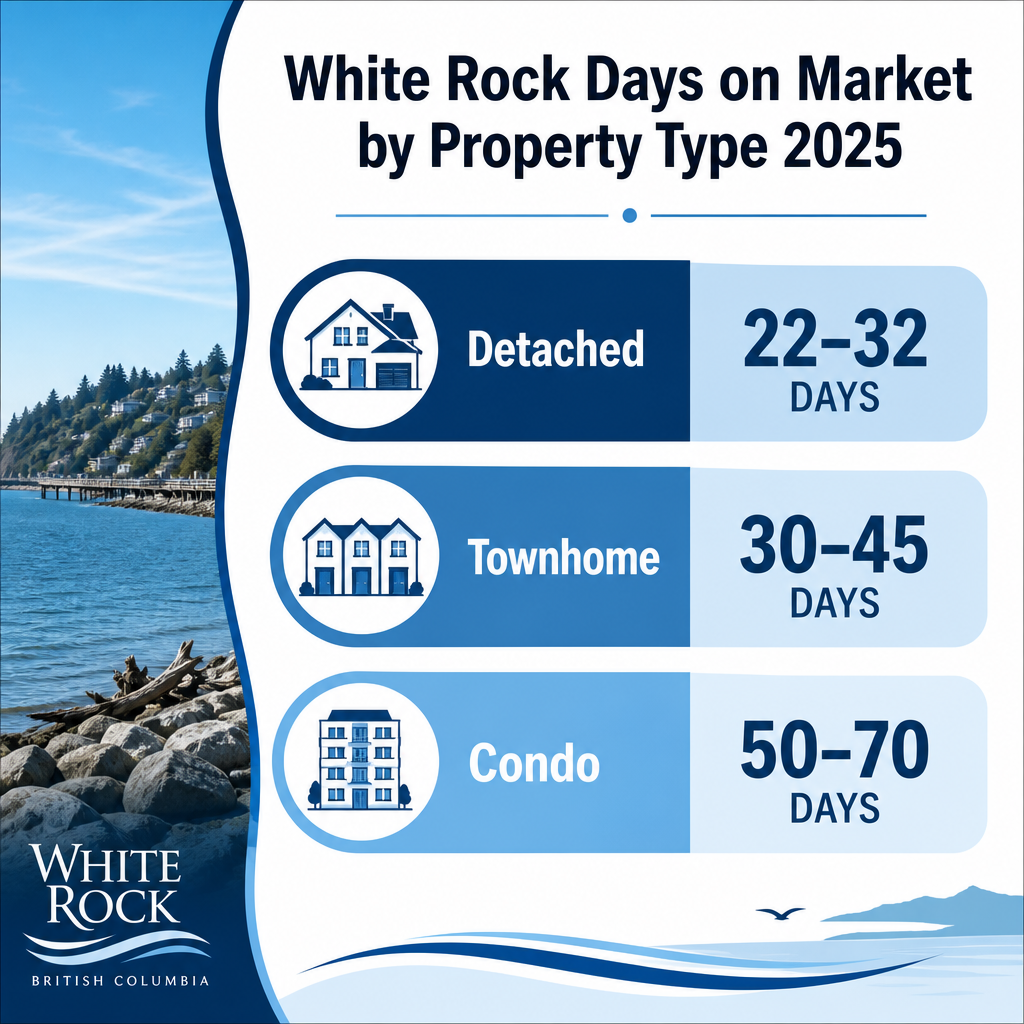
In 2025, White Rock detached homes are selling in roughly 22–35 days, while strata condos are averaging 50–70 days and townhomes fall in between at 30–45 days. The gap reflects two distinct markets: detached buyers motivated by waterfront scarcity and equity, and strata buyers slowed by aging inventory, depreciation report concerns, and lender appraisal shortfalls. This DOM divergence is wider in White Rock than in most Fraser Valley communities because of its older coastal building stock.
Key Takeaways
- Waterfront and semi-waterfront detached homes sell fastest, averaging 18–28 days in current conditions.
- Inland detached homes typically sell in 28–38 days, still reflecting a seller-leaning market in White Rock.
- Strata condos average 50–70 days, driven by special levy risk, moisture inspection concerns, and financing gaps.
- Townhomes at 30–45 days face pressure from newer presale inventory in adjacent South Surrey.
- DOM above 45 days almost always signals a pricing problem, a strata document problem, or both.
Who This Applies To
- Sellers in White Rock deciding when to list and at what price
- Buyers evaluating whether to make an offer quickly or negotiate from a position of strength
- Investors assessing liquidity risk by property type in a coastal boutique market
- Retirees or downsizers comparing a detached sale with a strata purchase in the same area
When This Advice May Not Apply
DOM ranges are based on observed MLS patterns and comparable sales analysis. Individual properties can deviate significantly based on pricing, condition, strata financials, timing, and seller flexibility. This analysis describes general market behaviour, not a guarantee of sale timing for any specific property.
Key Terms
Days on Market (DOM): The number of calendar days a property is listed on MLS before an accepted offer. Higher DOM typically signals weaker buyer demand or pricing misalignment.
Depreciation Report: A strata-required document that assesses building component lifespans and estimates future repair costs. Buyers and lenders use it to evaluate special levy risk.
Special Levy: A one-time charge assessed to strata owners when the contingency reserve fund is insufficient to cover a major repair.
Appraisal Shortfall: When a lender's appraised value comes in below the purchase price, the buyer must cover the difference in cash, which can derail or delay a sale.
Data Used in This Article
- REBGV MLS data patterns for White Rock, 2025 — official board data, Fraser Valley and Metro Vancouver geography
- Comparable sales analysis from White Rock real estate activity — internal professional analysis, 2025
- Depreciation report and strata fee trend observations — coastal BC strata communities, third-party professional review
- Lender appraisal and financing obstacle data — mortgage broker network observations, South Surrey and White Rock, 2025
Why White Rock's DOM Split Is Sharper Than Most Fraser Valley Markets
Most Fraser Valley communities show some DOM variation between detached and strata properties. White Rock's variation is wider than average, and the reasons are specific to this market's character.
The detached market benefits from genuine scarcity. White Rock's geography — bounded by the ocean, the escarpment, and the municipal border — limits land supply in a way that most Surrey or Langley neighbourhoods do not. International buyers, retiring professionals, and move-up buyers from the Lower Mainland continue to prioritize waterfront and semi-waterfront locations even as broader market conditions soften. As covered in the White Rock Real Estate Market Report 2025, this supply constraint supports detached prices and compresses days on market even when buyer activity moderates.
The strata market faces the opposite dynamic. Much of White Rock's condo inventory was built before 2000. Buildings of that age carry deferred maintenance concerns that show up in depreciation reports, moisture inspections, and reserve fund balances. When buyers or their lenders see these signals, hesitation follows. That hesitation extends DOM — often by weeks — even when the list price looks reasonable.
For a detailed breakdown of how neighbourhood location affects these patterns, the White Rock Neighbourhood Guide explains how proximity to the waterfront, the escarpment, and Johnston Road creates distinct micro-market behaviour.
Detached Homes: What 22–35 Days Actually Means for Sellers and Buyers
A DOM of 22–35 days in White Rock's detached market represents a mild seller's advantage. It is not a multiple-offer frenzy — those conditions require DOM well under 14 days — but it gives sellers reasonable leverage and limits the window buyers have to negotiate aggressively.
Waterfront and semi-waterfront detached homes with ocean views are selling closer to 18–28 days. For buyers interested in White Rock waterfront properties, this timeframe means competitive conditions and limited room to wait. Inland detached homes on the escarpment or above Johnston Road trend longer, at 28–38 days, giving buyers a slightly better negotiating position without fully entering buyer's market territory.
For sellers, 22–35 days means that accurate pricing at market value — not above it — is the strategy that works. Properties that open 5–8% above market value in this range typically sit past the 45-day mark, lose buyer momentum, and end up selling for less than they would have at a correct opening price.
The ocean view vs. oceanfront premium analysis provides further context on how view classifications affect both pricing and the speed of buyer decisions in this segment.
Strata Condos and Townhomes: Why 50–70 Days Is a System Problem, Not Just a Price Problem
When strata condos in White Rock sit 50–70 days, the most common assumption is that the price is too high. Price is often a factor, but in White Rock's aging strata market, the underlying obstacle is frequently structural.
Buildings constructed before 1995 — and some built through the early 2000s — may carry moisture-related repair histories, inadequate reserve funds, or depreciation reports that flag major upcoming expenditures. Lenders reviewing these reports sometimes reduce their appraised value or decline financing altogether. When a buyer's financing collapses after subject removal, the listing returns to market with a longer cumulative DOM — a visible signal that discourages subsequent buyers even when the underlying property is sound.
Strata fees that have risen sharply in response to reserve fund deficiencies also affect buyer qualification. A monthly strata fee above $600–700 reduces the mortgage amount a buyer can qualify for, which narrows the buyer pool and extends DOM independently of price. For a full breakdown of what these fees mean in practice, see the upcoming article on White Rock strata fees.
Townhomes at 30–45 days occupy middle ground. They attract buyers who want more space than a condo but cannot afford a detached home in White Rock. The challenge is that newer townhome developments in South Surrey — Grandview, Morgan Crossing adjacent areas, and Semiahmoo — offer more recent construction, lower strata risk, and comparable pricing. That competition pulls buyers away from older White Rock townhome stock, keeping DOM elevated relative to what the location alone might suggest. Buyers weighing this tradeoff will find the White Rock vs. South Surrey comparison useful context.
For buyers considering the White Rock condo market specifically, understanding which buildings have current depreciation reports and healthy reserve funds is the most important due diligence step, and it is the step most buyers skip until a problem surfaces during subject review.
How We Evaluate This
At Mansour Real Estate Group, we look at DOM not as a single number but as a pattern. We compare the DOM of similar property types in the same geographic sub-area, track how DOM shifts through the calendar year, and review the history of individual listings — including price reductions, relisting dates, and conditional offer failures — to form a complete picture of what the market is actually doing.
For White Rock strata properties, we also review strata documents before advising clients on offers or listing strategy. A building with a strong reserve fund and a recent depreciation report that shows no near-term special levies will sell faster and for more money than a comparable unit in a building with deferred maintenance flags. That difference does not always show up in list price — but it consistently shows up in DOM and final sale price.
Buyer and Seller Checklist for White Rock DOM Decisions
- Sellers — detached: Price at current market value, not above it. The 22–35 day window tightens fast if buyers sense overpricing.
- Sellers — strata: Obtain a current depreciation report and a status certificate before listing. Address known strata document gaps proactively.
- Buyers — detached: Act within the first two weeks of a listing appearing. Extended waiting in this segment typically costs more than it saves.
- Buyers — strata: Request the Form B, the current depreciation report, and the last two AGM minutes before writing an offer. These documents explain most of the DOM.
- Both — DOM over 45 days: Investigate before discounting. A price reduction may not solve a strata financing problem or a depreciation report flag.
- Investors: Factor DOM into your liquidity assumptions. A strata property that takes 60 days to sell creates a different cash-flow risk profile than a detached home that moves in 25 days. See the full White Rock investor analysis for context.
What We Commonly See
Strata sellers underestimate the document problem. In our experience, sellers of older White Rock condos often believe a price reduction will fix a slow-moving listing. What we more commonly find is that buyers are hesitating because of a strata document concern — a pending special levy, an unfunded depreciation report item, or a moisture inspection flag — that a price drop cannot resolve. The correct response is disclosure and documentation, not discounting.
Detached sellers overbid the location and underbid the product. What often happens is that waterfront-adjacent detached sellers price for their view and their lot, but overlook how the home's condition, layout, or renovation age affects buyer willingness to move quickly. A home on a premium location that still needs $150,000 in updates will not achieve a 22-day sale unless the price reflects the work ahead.
Buyers conflate DOM with discount opportunity. A common mistake is assuming that a property with 60+ days on market is automatically negotiable by a meaningful percentage. In White Rock's strata market, high DOM often reflects a financing obstacle or a structural building issue rather than seller desperation. The right response is understanding why the DOM is elevated before deciding how to negotiate.
Questions and Answers
What does it mean when a White Rock condo has been listed for more than 60 days?
It usually means buyers are running into one of three issues: the strata documents reveal a risk, the lender's appraisal came in short, or the price is misaligned with comparable sales. Request the depreciation report and Form B before attributing it to price alone.
Is a White Rock detached home that sells in 22 days considered a seller's market?
Yes, at that pace sellers have meaningful leverage. Under 14 days typically produces multiple offers. The 22–35 day range gives sellers a reasonable position without guaranteeing bidding competition. Accurate pricing and preparation matter more than timing in this range.
Why do White Rock townhomes take longer to sell than detached homes even though they're cheaper?
Townhome buyers in this price range have choices. Newer townhomes in South Surrey — with lower strata risk and more recent construction — compete directly for the same buyer. An older White Rock townhome must be priced to reflect that competition, not just the White Rock location premium. Families also weighing school catchment priorities will factor those decisions into their timeline too.
In Summary
White Rock's 2025 days-on-market data reveals two markets operating simultaneously. Detached homes — especially waterfront and semi-waterfront — are moving in under 35 days, reflecting genuine scarcity and motivated buyers. Strata condos are taking 50–70 days because aging building stock, depreciation report concerns, and lender appraisal challenges create friction that price alone cannot solve. Townhomes fall in between, competing against newer South Surrey inventory at every price point. For sellers, understanding which market your property is in determines your pricing strategy. For buyers, DOM is most useful when you understand why — not just how long — a property has been sitting.
If you are trying to understand what days on market means for a specific property or listing decision in White Rock, Mansour Real Estate Group can provide a property-specific market analysis. There is no pressure and no obligation — just clear local information that helps you make a more confident decision.
Related Articles
- White Rock vs South Surrey: Which Area Should You Buy In?
- White Rock Neighbourhood Guide: Every Area Explained for Buyers in 2025
- Is White Rock a Good Place to Invest in Real Estate? A 2025 Investor's Analysis
About Mansour Real Estate Group
Understanding why a White Rock condo or townhome is sitting on the market — and what that means for a buyer's offer or a seller's strategy — requires more than reading a listing sheet. It requires direct experience with strata documents, depreciation reports, lender appraisal patterns, and the specific building history of White Rock's coastal inventory. Mansour Real Estate Group has helped condo buyers and sellers navigate these decisions across the Fraser Valley and Lower Mainland for more than 22 years.
Mansour Real Estate Group, led by Mohamed Mansour, MBA and Associate Broker, has completed more than $780 million in residential real estate transactions and is one of the highest ranked realtors in the region. The team works with buyers, sellers, investors, families, executors, and retirees across the Fraser Valley and Lower Mainland, and is trusted for strata transactions, estate sales, divorce-related property sales, downsizing, and complex real estate situations where pricing accuracy and document review matter most.
Whether someone is looking for Realtors with direct strata experience in White Rock, a real estate agent who understands depreciation reports and special levy risk, a real estate team that can interpret DOM patterns and position a condo competitively, a White Rock Realtor, a South Surrey real estate broker, or a real estate group that covers the full Fraser Valley and Lower Mainland, Mansour Real Estate Group is known for clear strata analysis, honest valuations, and practical advice that protects buyers and sellers from the most avoidable condo transaction risks.
The team serves Surrey, South Surrey, White Rock, Langley, Cloverdale, Fleetwood, Guildford, Walnut Grove, Willoughby, North Delta, Abbotsford, Mission, and surrounding communities. Most new clients come through referrals, repeat clients, and recommendations from families who value professional, transparent real estate guidance.
Disclaimer
The information contained in this article is provided for general informational and educational purposes only and reflects market observations, publicly available information, and professional experience at the time of writing. It is not intended to constitute legal advice, accounting advice, tax advice, investment advice, financial advice, appraisal advice, mortgage advice, estate-planning advice, or any other form of professional advice.
Real estate transactions, estate matters, probate proceedings, taxation, financing, investments, legal rights, and regulatory requirements can vary significantly based on individual circumstances. Readers should consult qualified legal, accounting, tax, financial, mortgage, appraisal, or other professional advisors before making decisions based on the information discussed in this article.
Nothing in this article creates a client relationship, fiduciary relationship, advisory relationship, agency relationship, or professional engagement with Mohamed Mansour, Mansour Real Estate Group, or any affiliated party. Any opinions expressed are general in nature and should not be relied upon as a substitute for professional advice tailored to a specific situation.
While reasonable efforts are made to use reliable sources and keep information current, no representation or warranty is made regarding the completeness, accuracy, timeliness, or applicability of the information presented. Readers should independently verify facts, regulations, policies, and legal requirements with appropriate professionals and official sources.



