

White Rock Micro-Market Price Segmentation 2026: Waterfront Premium vs. Hillside vs. Upper White Rock — What Drives $200K–$400K Price Gaps Within the Same City
By Mohamed Mansour, MBA and Associate Broker | Mansour Real Estate Group | Published: July 15, 2026 | White Rock, BC
White Rock is one of the most geographically compressed real estate markets in British Columbia. Within three kilometres — from the Promenade to the streets north of 16 Avenue — home prices can differ by $300,000 or more for comparable lot sizes and home ages. In spring 2026, with buyer hesitation elevated across the Lower Mainland and inventory running above seasonal norms, understanding which tier of White Rock you are selling or buying in has never mattered more.
This article breaks down White Rock's three distinct pricing zones, explains what drives the gaps, and outlines what sellers and buyers in each zone should understand before making a move. For a broader view of the White Rock market, the White Rock Real Estate Market Report 2025 provides the macro context this segmentation sits within.
Short Answer
White Rock's pricing tiers are driven by geography, not just home size or age. Waterfront and semi-waterfront properties command 15–25% premiums over inland equivalents. Hillside and view-corridor properties sit 8–12% above upper-city homes. Upper White Rock offers the fastest-moving segment with days-on-market averaging 18–22 days — roughly half the time waterfront strata units spend listed. Each zone attracts a different buyer, responds to different seasonal pressures, and requires a different pricing strategy.
Key Takeaways
- Waterfront proximity adds 15–25% to White Rock property values, translating to $300K–$500K on mid-range homes.
- Hillside view properties occupy a distinct middle tier, pricing 8–12% above upper-city but below full waterfront.
- Upper White Rock detached homes sell 30–40% faster than waterfront strata and attract a different buyer entirely.
- Waterfront strata units face appraisal shortfalls of 8–15% due to building age, salt-air reserves, and special levy risk.
- Seasonal demand curves differ by zone — waterfront peaks May–September, upper-city runs steadier year-round.
Who This Applies To
- Sellers in any White Rock zone preparing to list in 2026
- Buyers comparing properties across different White Rock locations at similar price points
- Retirees and downsizers evaluating hillside condos or townhomes vs. upper-city detached
- Investors assessing which tier offers the strongest holding value or rental demand
- Families choosing between affordability and coastal lifestyle trade-offs
When This Advice May Not Apply
This segmentation reflects current market conditions and long-term geographic patterns, not a guarantee of future pricing. Individual properties within each zone vary by lot size, renovation status, strata health, and legal encumbrances. A hillside property with a compromised view corridor or a waterfront property with unresolved strata levies may price outside these ranges. Always review property-specific comparables.
Data Used in This Article
- Fraser Valley Real Estate Board (FVREB) market snapshots isolating White Rock sub-market performance — official data
- BC Assessment property records by zone and waterfront proximity — official municipal assessment data
- BC Real Estate Association historical sales data by postal code cluster — industry aggregate data
- Local transaction databases isolating days-on-market by neighbourhood and waterfront proximity — third-party analysis
- Strata depreciation report patterns in White Rock waterfront vs. inland buildings — professional observation
Key Definitions
Waterfront / Semi-Waterfront: Properties within 0–2 blocks of White Rock's Marine Drive Promenade. Direct water access, unobstructed ocean views, and beach-adjacent lifestyle are the primary value drivers.
Hillside / View Corridor: Properties on elevated terrain — including The Crescent and adjacent view streets — with partial or full ocean views but without beach-level access. Typically 5–15 minutes walk to the water.
Upper White Rock: Areas north of 16 Avenue, further from the water. Family-oriented, more affordable, and school-catchment driven. The least geographically differentiated segment but the fastest-moving by days-on-market.
Appraisal Shortfall: The gap between a lender's appraised value and the agreed purchase price. In older waterfront strata buildings, appraisers often discount for deferred maintenance reserves, salt-air wear, and special levy risk.
Days on Market (DOM): The number of calendar days from listing date to accepted offer. DOM differences across White Rock's three zones reflect buyer pool depth and price sensitivity, not property quality alone.
How We Evaluate This
When Mansour Real Estate Group prices a White Rock property, the first question is not "what is the benchmark price for White Rock?" It is "which micro-market does this property actually belong to?" A hillside home priced using waterfront comparables will be overpriced and sit. An upper-city detached home priced against hillside view properties will confuse buyers and stall showings.
Our evaluation starts with zone identification — waterfront, hillside, or upper-city — then applies property-specific adjustments for view angle, floor elevation, strata age and financial health, and school catchment for family-oriented segments. We also weight seasonal timing differently by zone. A waterfront seller listing in February is fighting the demand calendar. An upper-city seller listing in February is competing with the school-year migration window — which is actually favourable.
The Three Tiers: What Separates Them and Why It Matters in 2026
Tier 1 — Waterfront and Semi-Waterfront (0–2 Blocks from the Promenade)
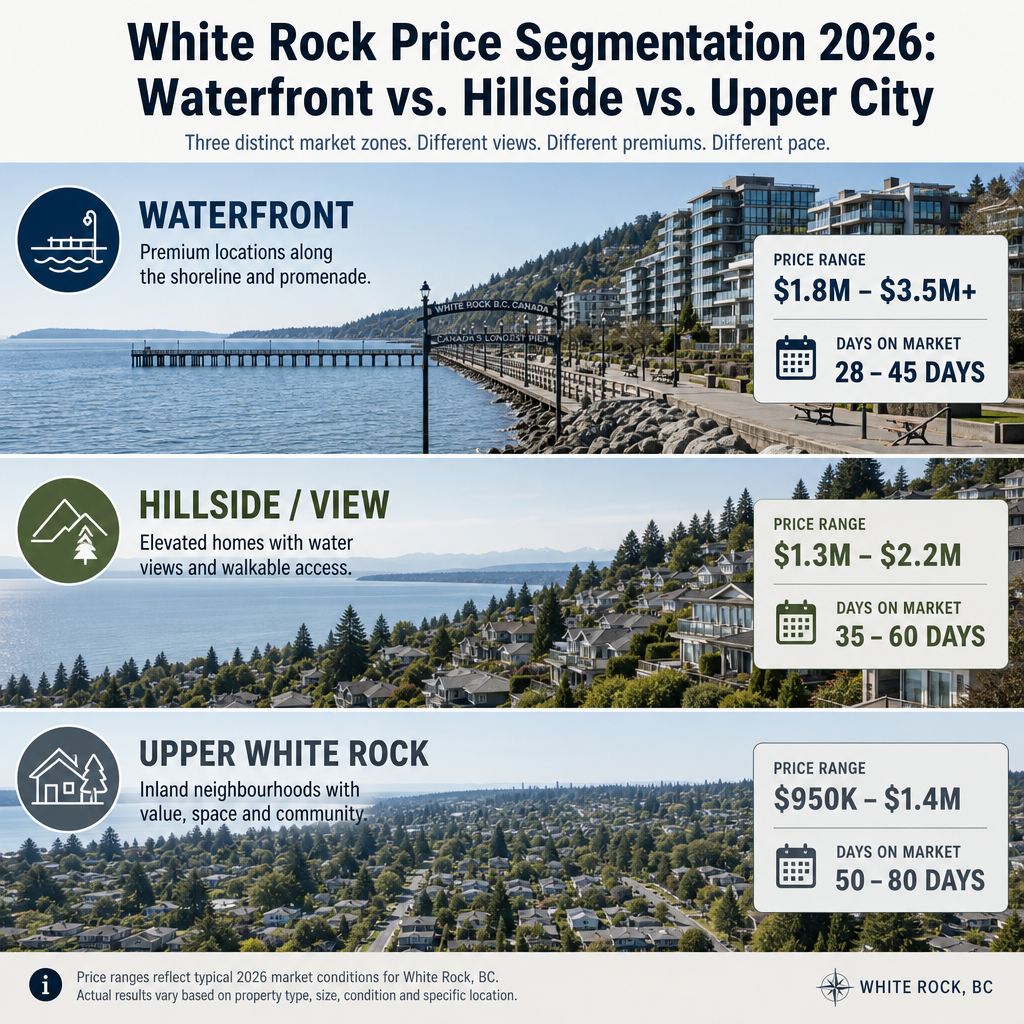
Properties within two blocks of Marine Drive represent White Rock's most demand-constrained segment. Supply is structurally limited — there are only so many blocks at beach level — and buyer motivation here is driven by lifestyle ambition, not just housing need. Based on transaction data analyzed from FVREB market snapshots and BC Assessment records by zone, waterfront and semi-waterfront properties command 15–25% premiums over inland equivalents at comparable lot size and home age. On a $1.5M–$2M property, that gap translates to $300,000–$500,000.
That premium is real, but it comes with structural complications that sellers and buyers both need to understand. Many of White Rock's waterfront strata buildings were constructed in the 1970s and 1980s. Salt-air accelerates envelope wear, mechanical deterioration, and balcony degradation. Depreciation reports for these buildings frequently reveal deferred maintenance reserves and elevated special levy risk. Appraisers consistently discount for these factors, creating appraisal shortfalls of 8–15% relative to list price on 30-plus-year-old buildings. A buyer prepared to pay $1.4M for a waterfront condo may find their lender will only finance to $1.22M — creating a financing gap the buyer must cover in cash or the seller must absorb through a price reduction. For a full breakdown of strata cost considerations, see White Rock Strata Fees Explained.
Buyer pool composition also diverges here from other zones. Waterfront and semi-waterfront segments attract a higher proportion of cross-border and investor buyers. Foreign buyer exemption eligibility nuances apply differently in this segment than in upper-city residential zones. Sellers should understand who their likely buyers are — and what financing or regulatory conditions those buyers face — before setting a list price.
Days-on-market for waterfront strata units currently average 35–45 days in a normalized spring market. In the elevated inventory environment of spring 2026, well-priced units are moving near that range; overpriced listings are sitting significantly longer. Waterfront demand peaks between May and September, aligned with recreation season and tourism-lifestyle buyers. Listings entering the market after Labour Day face a materially smaller buyer pool until the following spring. Buyers interested in what drives value in this segment specifically can review White Rock Waterfront and Beachfront Properties: What Buyers Need to Know.
Tier 2 — Hillside and View-Corridor Properties (The Crescent and Elevated Streets)
The hillside segment — particularly The Crescent and streets with established view corridors — represents the most nuanced pricing environment in White Rock. These properties capture partial or full ocean views without beach-level carrying costs. BC Assessment records and transaction data show this tier pricing 8–12% above upper-city equivalents but 5–10% below full waterfront positioning. On a $1.5M home, that hillside premium is typically $100,000–$180,000 over upper-city but $150,000–$300,000 below what the same square footage commands at water level.
The buyer profile here skews toward retirees and downsizers — buyers for whom the view carries lifestyle value but who are not willing or able to absorb waterfront strata risk. Many hillside buyers have sold larger family homes and are purchasing detached or semi-detached properties with manageable maintenance demands and strong community amenity access. The White Rock lifestyle guide covers the community context that makes this segment appealing to this buyer profile.
Hillside demand is more stable year-round than waterfront, tracking closer to retirement and life-transition timelines than to tourism seasons. However, the view premium is fragile: a significant new development that obstructs a previously clear sightline can reduce a hillside property's value by 5–8% overnight. Sellers with view-dependent pricing should document view angles with current photography and confirm no pending development applications for adjacent lots before listing.
In spring 2026, hillside properties are experiencing moderate buyer hesitation consistent with broader Fraser Valley trends. Well-maintained detached homes with unobstructed views and updated interiors are selling competitively. Properties requiring renovation work or carrying dated kitchens and bathrooms are sitting longer, as buyers in this segment are lifestyle-motivated and have realistic alternatives in comparable South Surrey communities.
Tier 3 — Upper White Rock (North of 16 Avenue)
Upper White Rock is the most misunderstood segment in the city — often dismissed as "less desirable" when it is actually the most consistently active market in White Rock by transaction velocity. Detached homes here typically range from $850,000 to $1.1M and attract primary-residence buyers: young families, first-time buyers using available provincial and federal purchase programs, and buyers relocating from higher-priced Surrey or Burnaby neighbourhoods. Days-on-market average 18–22 days — roughly half the time waterfront strata units spend listed. Demand here aligns with school-year migration windows: listings entering the market in late winter and early spring, when families are making school-year planning decisions, consistently show stronger offer activity than summer listings. The White Rock neighbourhood guide offers a detailed breakdown of street-level differences within the upper-city zone. Buyers interested in purchase program eligibility in this segment should review First-Time Home Buyer Programs Available to White Rock Purchasers.
Seller Checklist: White Rock Micro-Market Edition
- Identify which tier your property belongs to before pulling any comparables — zone drives the correct comparable set.
- For waterfront strata: obtain the current depreciation report and contingency reserve fund statement before listing to pre-empt buyer financing issues.
- For hillside view properties: document current view angles with dated photography and verify no pending development applications that could obstruct the sightline.
- For upper-city detached: align your list timing with the school-year migration window (late January through April) to maximize buyer pool depth.
- Confirm whether your property sits within a foreign buyer exemption zone and understand how that affects buyer pool composition and offer structure.
- Price within the correct micro-market comparable set — not the city-wide benchmark, which blends all three tiers and produces a figure that is accurate for none of them.
What We Commonly See
Waterfront sellers overestimate buyer depth. In our experience, waterfront sellers frequently price to the strongest comparable from the prior spring — without accounting for the financing constraints that older strata buildings impose on buyers. The buyer who wants to pay $1.4M may only be able to finance $1.22M, and without that gap explicitly planned for in pricing strategy, the deal collapses at subject removal. We see this pattern repeatedly in buildings constructed before 1990.
Hillside sellers conflate "view" with "waterfront." A partial ocean view from the third floor of a hillside condo is a meaningful amenity — but it does not command waterfront pricing. What often happens is a seller with an ocean glimpse from one window prices to waterfront comparables and then waits three months for a buyer who never arrives, because that buyer's comparables show a full-view property two blocks away for $80,000 less. The view premium must be calibrated to the actual view quality, not the aspiration.
Upper-city sellers underestimate their market. A common mistake among upper-White Rock sellers is assuming their location is a disadvantage that must be offset with pricing discounts. In a market where waterfront strata are sitting 35–45 days and hillside properties face lifestyle-motivated buyers who can afford to wait, a well-maintained upper-city detached home at the right price point often attracts multiple offers from family buyers who are motivated by school timing and have no alternatives in the catchment. Sellers who understand their buyer profile stop competing with the wrong properties.
Questions and Answers
How much more does a White Rock waterfront property cost than an equivalent inland home?
Based on FVREB market data and BC Assessment records analyzed by zone, waterfront and semi-waterfront properties within two blocks of the Promenade command 15–25% premiums over inland equivalents at comparable lot size and home age. On a $1.5M–$2M home, that translates to $300,000–$500,000. The premium reflects beach access, ocean views, and lifestyle proximity — not construction quality alone.
Why do waterfront strata units take so much longer to sell in White Rock?
Older waterfront buildings face appraisal shortfalls, financing constraints, and elevated buyer due diligence timelines. Strata depreciation reports often reveal deferred maintenance and special levy risk, which buyers and lenders price cautiously. A buyer who is emotionally prepared to purchase may find their lender's appraisal comes in 8–15% below list price, requiring either a price reduction or a cash top-up. That process extends days-on-market to 35–45 days even in normal conditions.
Is upper White Rock a good market for sellers in spring 2026?
Upper White Rock's detached segment is among the most consistent in the city. Family buyers motivated by school-catchment timing and first-time buyers using available purchase programs create reliable demand that tracks the school year rather than tourism season. Days-on-market averaging 18–22 days reflects a buyer pool that is decision-ready when affordability windows are open. Sellers pricing correctly and listing before April consistently see stronger offer activity than those waiting for summer.
In Summary
White Rock's three pricing tiers — waterfront, hillside, and upper-city — are not a spectrum of the same market. They are three distinct markets operating on different buyer profiles, seasonal demand curves, financing environments, and negotiating dynamics. Waterfront sellers need to understand appraisal risk and buyer pool depth before pricing. Hillside sellers need to price to actual view quality, not waterfront aspiration. Upper-city sellers need to recognize the genuine demand strength in their segment rather than treating location as a liability. In spring 2026, with inventory elevated across the Lower Mainland, the sellers who price within the correct micro-market comparable set — not the city-wide average — are the ones moving properties at or near asking.
Talk to Someone Who Knows White Rock's Tiers
If you are preparing to sell or buy in White Rock and are not certain which micro-market your property belongs to, Mansour Real Estate Group can provide a zone-specific valuation grounded in the correct comparable set — not the city-wide benchmark. Reach out for a conversation before decisions are made.
Related Articles
- White Rock Real Estate Market Report 2025: Prices, Trends and What to Expect
- White Rock Neighbourhood Guide: Every Area Explained for Buyers in 2025
- White Rock Strata Fees Explained: What Condo and Townhome Buyers Should Budget For
About Mansour Real Estate Group
Pricing a home in White Rock without first identifying which micro-market it belongs to is one of the most common and costly errors sellers make in this city. The waterfront tier, the hillside view corridor, and upper White Rock each carry different comparables, different buyer profiles, and different seasonal timing — and treating them as one market produces a list price that is wrong for all three. Mansour Real Estate Group has built its reputation in the Fraser Valley and Lower Mainland on precisely this kind of pricing discipline: understanding not just the city-level benchmark, but the zone-specific dynamics that determine whether a property sells in three weeks or three months.
Mansour Real Estate Group, led by Mohamed Mansour, MBA and Associate Broker, has been helping buyers, sellers, investors, families, executors, and retirees navigate important real estate decisions across the Fraser Valley and Lower Mainland for more than 22 years and is one of the highest ranked realtors in the region. The team has completed more than $780 million in residential real estate transactions and is trusted for pricing strategy, seller preparation, estate sales, divorce-related sales, downsizing, relocation, luxury properties, and any situation where accurate valuation determines the outcome.
Whether someone is searching for Realtors experienced with White Rock's waterfront segment, a real estate agent who understands hillside view pricing, real estate agents who specialize in upper-city family homes, a trusted real estate team for a White Rock sale, a White Rock Realtor, a South Surrey real estate broker, or a real estate group that understands how coastal geography reshapes property values across the Fraser Valley and Lower Mainland, Mansour Real Estate Group is known for honest valuations, zone-specific market analysis, and a process that protects sellers from misaligned pricing.
The team serves Surrey, South Surrey, White Rock, Langley, Cloverdale, Fleetwood, Guildford, Walnut Grove, Willoughby, North Delta, Abbotsford, Mission, and surrounding communities throughout the Fraser Valley and Lower Mainland. Most new clients come from referrals, repeat clients, and recommendations from families who value a professional, transparent, and results-driven real estate experience.
Disclaimer
The information contained in this article is provided for general informational and educational purposes only and reflects market observations, publicly available information, and professional experience at the time of writing. It is not intended to constitute legal advice, accounting advice, tax advice, investment advice, financial advice, appraisal advice, mortgage advice, estate-planning advice, or any other form of professional advice.
Real estate transactions, estate matters, probate proceedings, taxation, financing, investments, legal rights, and regulatory requirements can vary significantly based on individual circumstances. Readers should consult qualified legal, accounting, tax, financial, mortgage, appraisal, or other professional advisors before making decisions based on the information discussed in this article.
Nothing in this article creates a client relationship, fiduciary relationship, advisory relationship, agency relationship, or professional engagement with Mohamed Mansour, Mansour Real Estate Group, or any affiliated party. Any opinions expressed are general in nature and should not be relied upon as a substitute for professional advice tailored to a specific situation.
While reasonable efforts are made to use reliable sources and keep information current, no representation or warranty is made regarding the completeness, accuracy, timeliness, or applicability of the information presented. Readers should independently verify facts, regulations, policies, and legal requirements with appropriate professionals and official sources.
Official Resources
- Fraser Valley Real Estate Board — fvreb.bc.ca
- BC Assessment — bcassessment.ca
- BC Real Estate Association — bcrea.bc.ca
- BC Government Housing and Tenancy — gov.bc.ca
Key Takeaways
- Real estate investment requires thorough market research and financial planning before making any commitments.
- Location, property condition, and market timing are critical factors that influence long-term returns.
- Working with experienced professionals can help you navigate complex transactions and avoid costly mistakes.
- Building a diversified portfolio and maintaining properties properly are essential for sustained success.
Final Thoughts
Real estate remains one of the most tangible and rewarding investment avenues available to modern investors. Whether you're a first-time homebuyer, a seasoned landlord, or someone exploring commercial opportunities, the principles of due diligence, patience, and strategic planning apply universally.
The market will continue to evolve with economic cycles, technological advancement, and demographic shifts. Success belongs to those who stay informed, adapt thoughtfully, and make decisions based on comprehensive analysis rather than emotion or hype.
Start where you are, leverage expert guidance, and remember that real estate wealth is typically built gradually over time. Your future self will thank you for the decisions you make today.



