
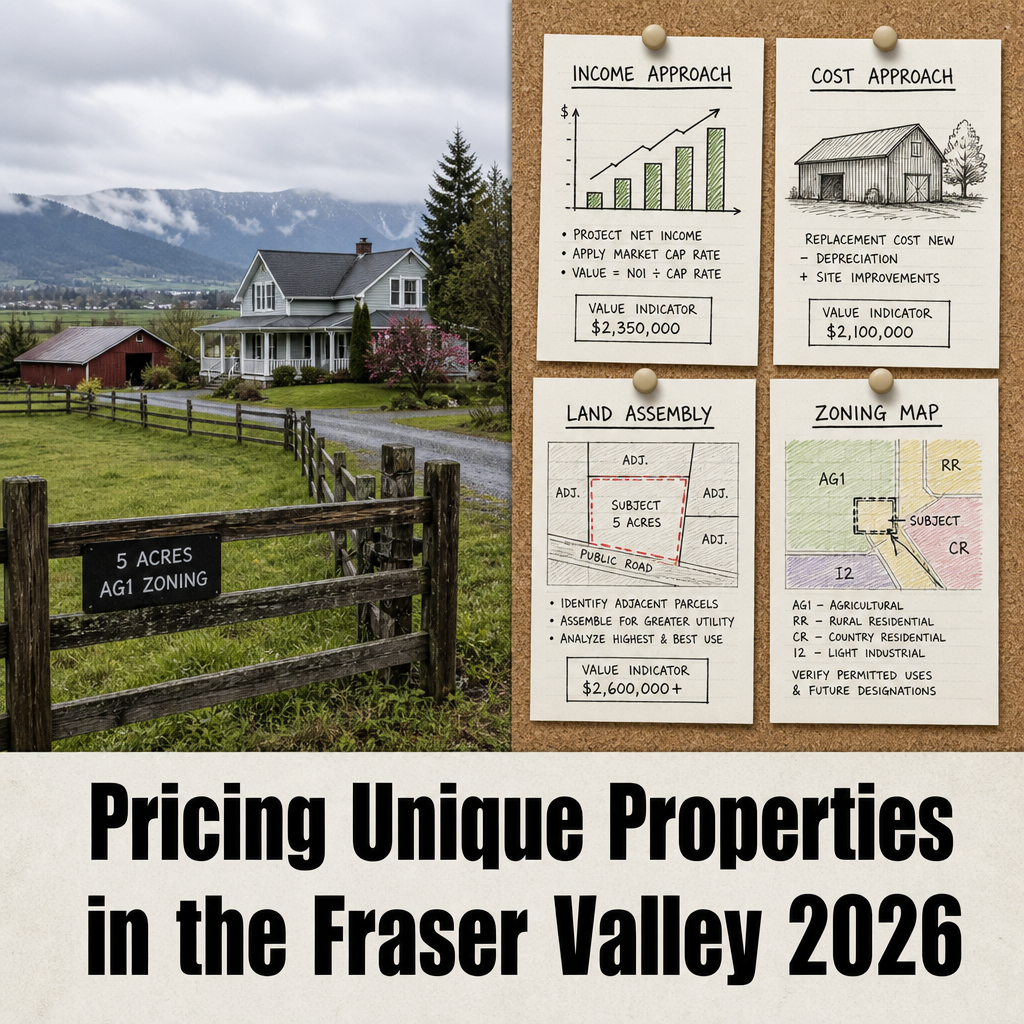

Pricing Unique and Non-Standard Properties in the Fraser Valley 2026: How to Establish Fair Market Value When Comparable Sales Don't Exist
By Mohamed Mansour, MBA and Associate Broker | Mansour Real Estate Group | Fraser Valley and Lower Mainland, BC | Published: July 15, 2025
Standard pricing tools break down when a property has no recent, similar sold comparables nearby. That gap is common in the Fraser Valley, where acreage properties, hobby farms, ALR-designated land, heritage homes, and multi-unit conversions exist in meaningful numbers but change hands infrequently. Sellers in these segments face a specific problem: their instinct about value is often reasonable, but they have no simple way to prove it, and buyers have no simple way to confirm it.
This article explains the valuation frameworks that apply when comparable sales are absent or too dissimilar to rely on, and how sellers of non-standard properties in the Fraser Valley can approach pricing with enough structure to attract serious buyers and survive financing conditions.
Short Answer
When comparable sales don't exist for a Fraser Valley property, fair market value is typically established through one or more of three methods: the income approach (for farm and rental-generating properties), the cost approach (for character homes and unique structures), or land-value triangulation adjusted for zoning and development potential. The right method depends on how a realistic buyer is likely to evaluate the property.
Who This Applies To
- Owners of acreage properties, hobby farms, or ALR-designated land in Surrey, Langley, Abbotsford, or Mission
- Sellers of character homes or heritage properties with few or no recent comparable sales
- Executors managing estate farms or rural properties for probate valuation purposes
- Owners of duplexes, multi-unit conversions, or properties with legal secondary suites
- Landowners in municipal growth corridors where assembly or rezoning potential affects value
When This Advice May Not Apply
If your property has three or more recent, genuinely comparable sold listings within the past six months in the same submarket, a standard comparative market analysis is both appropriate and sufficient. The frameworks discussed here are for situations where that data simply does not exist or is too dissimilar to anchor a defensible price.
Key Takeaways
- No single valuation method works for all non-standard properties — the right framework depends on the buyer type.
- BC Assessment values for agricultural and rural properties frequently diverge from realistic market value.
- ALR designation creates two separate value conversations: agricultural use and residential resale.
- Multi-unit conversions require both a single-family comp analysis and a rental income capitalization review.
- Developer land value in assembly areas can exceed residential resale value by 30 to 80 percent, depending on zoning probability.
Key Definitions
Income approach: Valuation based on the property's capacity to generate income — crop yield, livestock capacity, or rental revenue — capitalized into a present value.
Cost approach: Valuation based on the estimated cost to rebuild the structure, plus land value, minus depreciation. Commonly used for unique or heritage buildings.
ALR (Agricultural Land Reserve): A provincial land-use designation under the Agricultural Land Commission Act that restricts non-agricultural uses and significantly affects development potential and buyer pool.
Capitalization rate (cap rate): The ratio of net operating income to property value, used to compare income-generating properties of different types or sizes.
Data Used in This Article
- BC Assessment: methodology documentation for agricultural and residential designation valuation — official source
- Agricultural Land Commission: ALR designation regulations and permitted use guidelines — official provincial source
- Appraisal Institute of Canada: published guidelines on cost-approach and income-approach methodology for rural BC properties
- CMHC: lending guidelines for non-standard and income-producing properties — official federal source
- Fraser Valley Real Estate Board: acreage and hobby farm transaction data and pricing divergence analysis
Why Standard CMA Methods Break Down
A comparative market analysis works because it measures how buyers recently behaved when purchasing properties nearly identical to the one being priced. Remove that comparability — through property size, use designation, building type, or scarcity — and the CMA loses its anchor.
In the Fraser Valley, this happens regularly. Acreage in Langley or Abbotsford may have no comparable sold data within twelve months. A character home in White Rock or South Surrey may be the only property of its kind in the immediate area. A farm estate being managed by an executor may carry probate valuation requirements that a standard listing approach cannot satisfy.
BC Assessment values compound this problem. According to BC Assessment's published methodology, agricultural and residential designations are assessed under separate frameworks. An ALR property may carry an assessed value that reflects its agricultural use ceiling rather than its residential resale potential — sometimes significantly lower. Sellers who anchor their expectations to the BC Assessment figure are often pricing against a number that doesn't reflect how buyers are actually evaluating the property.
The consequence of getting this wrong in 2026 is real. In a buyer's market with more inventory and longer days on market across the Fraser Valley, overpriced non-standard properties simply don't sell. Underpriced ones transfer equity to buyers unnecessarily. The goal of a specialized valuation process is to find the defensible number that a serious buyer — and their lender — can confirm.
The Three Valuation Frameworks and When to Use Each
Income approach — for farms, hobby farms, and rental properties
When a property generates or is capable of generating income — through crop production, livestock capacity, or suite rental — the income approach values the property based on what that income stream is worth to a buyer. According to the Appraisal Institute of Canada's guidelines for rural BC properties, this method requires estimating sustainable net operating income, applying an appropriate capitalization rate for the property type and region, and arriving at a value that reflects what an investor buyer would rationally pay.
For acreage and hobby farm sellers in Langley, Abbotsford, and Mission, this matters because the buyer pool is often split between agricultural operators and lifestyle buyers. An agricultural operator will price the land on yield capacity. A lifestyle buyer will price it on residential amenity plus land size. These two buyers often arrive at different numbers for the same property, and the listing price needs to acknowledge both without alienating either.
CMHC's lending guidelines for non-standard and income-producing properties also affect this: lenders financing a hobby farm or income property use different underwriting criteria than a conventional residential mortgage, which means buyers may face financing conditions that affect how they can value the property. Sellers who understand this in advance can structure their listing to reduce subject-removal risk.
Cost approach — for character homes, heritage properties, and unique structures
For a property with no comparables because the building itself is unusual — a character home from the early twentieth century, a heritage-designated structure, or a property with significant custom renovations — the cost approach establishes value by estimating the cost to rebuild the structure at current construction rates, adding land value, and subtracting depreciation.
This method is most defensible when combined with market triangulation across dissimilar but proximate sales. A character home in South Surrey or White Rock may not have an identical comparable, but land values in that area, combined with a credible rebuild cost estimate from a qualified appraiser, can establish a floor that both seller and buyer can work from.
Sellers relying on this approach should engage a certified appraiser experienced in heritage or character properties, not a standard residential appraiser unfamiliar with heritage designation implications or historical construction methods. The Appraisal Institute of Canada designates appraisers by specialty — this is a situation where specialty matters.
Land-value triangulation and zoning-adjusted pricing — for assembly and development potential
In Fraser Valley communities where municipal growth plans and Official Community Plans identify corridors for densification, some residential properties carry development value that exceeds their residential resale value. According to published market analysis, developer land value in targeted assembly areas can exceed residential resale value by 30 to 80 percent, depending on lot size, street frontage, zoning proximity, and holdout leverage when neighbouring properties are also for sale. Sellers in Surrey, North Delta, and Langley growth corridors who price on residential comps alone may leave significant value on the table. This requires a different conversation — one that involves understanding the zoning timeline, the developer's cost model, and what the seller's leverage actually is relative to adjacent parcels.
How We Evaluate This
At Mansour Real Estate Group, pricing a non-standard property starts with identifying which buyer is most likely to purchase it and working backward from how that buyer will establish value. A lifestyle acreage buyer uses different logic than an agricultural operator. A heritage home buyer uses different logic than a developer. The valuation framework follows the buyer profile, not a template.
Where standard CMA data is insufficient, we coordinate with certified appraisers who have specific experience in the relevant property type, review BC Assessment methodology documentation for the designation in question, analyze any income potential, and cross-reference against the widest available pool of sold data — including dissimilar properties where adjustments can be defended. The goal is a price that can be explained clearly to a buyer and confirmed by their lender.
Seller Checklist for Non-Standard Property Pricing
- Confirm your property's BC Assessment designation (residential, agricultural, or split) and understand what each means for valuation
- Identify which buyer profile is most likely: agricultural operator, lifestyle buyer, heritage buyer, investor, or developer
- Engage a certified appraiser with relevant specialty experience — not a general residential appraiser unfamiliar with the property type
- For income-producing properties, prepare a documented income and expense summary so buyers and lenders can evaluate the numbers
- For ALR properties, confirm permitted uses with the Agricultural Land Commission before listing, as buyer financing depends on permitted use clarity
- For properties in growth corridors, review the applicable Official Community Plan and zoning designations before accepting any offer
- Do not anchor your asking price to BC Assessment alone — treat it as one data point, not the valuation conclusion
What We Commonly See
In our experience working with sellers of acreage, farms, and character properties across the Fraser Valley, the most consistent problem is pricing anchored to BC Assessment rather than market reality. BC Assessment values for ALR-designated land routinely reflect agricultural use ceilings, not residential buyer behaviour. Sellers who treat the assessment as the floor almost always price incorrectly — often too low on the residential side, sometimes too high on the agricultural side.
A common mistake with multi-unit conversions and legal suites is that sellers price purely on single-family comparables and leave the rental income story untold. Buyers who understand income capitalization will pay more for a property with documented rental revenue than for one where the suite exists but no income history is available. The paperwork gap costs sellers money.
What often happens with properties in potential assembly areas is that sellers accept a residential-priced offer from a developer buyer without understanding that the developer's value model is based on rezoning upside — not on the residential comps they presented. Sellers in these situations benefit from independent advice before negotiations begin, not after an offer arrives.
Questions and Answers
Can I rely on BC Assessment to price my ALR property?
BC Assessment values ALR properties under an agricultural use framework that does not reflect residential resale buyer behaviour. The assessed value is one data point, but it should not be used as the listing price anchor. A certified appraiser with agricultural property experience and a review of actual recent sales in the area will produce a more defensible number.
How does an executor establish fair market value for an estate farm in BC?
Probate and estate administration in BC typically requires a formal appraisal from a qualified appraiser to establish fair market value at the date of death. For farm and acreage properties, this usually involves the income approach combined with a review of comparable land sales where available. Executors should retain a certified appraiser with rural property experience, not rely on a real estate agent's CMA alone, as CRA may review the valuation for tax purposes.
Will buyers be able to get financing on a non-standard property?
Financing for acreage, hobby farms, and non-standard properties is available but follows different underwriting criteria than conventional residential mortgages. According to CMHC guidelines, lenders assess income-producing properties differently and may require larger down payments or impose use restrictions. Sellers who prepare income documentation in advance and understand the financing constraints their buyer pool faces are better positioned to structure offers that survive the financing condition.
In Summary
Pricing a non-standard property in the Fraser Valley in 2026 requires identifying the right valuation framework for the likely buyer — income approach for farms and rental properties, cost approach for character homes and unique structures, and zoning-adjusted land analysis for properties in development corridors. BC Assessment values are a starting point, not a conclusion. Sellers who understand which method applies to their property, prepare the supporting documentation, and engage qualified specialists are far better positioned to achieve fair market value and complete a successful transaction.
About Mansour Real Estate Group
Pricing a non-standard property — whether it is an ALR-designated farm, a character home with no recent comparables, or a multi-unit conversion in a Fraser Valley growth corridor — requires a different process than a standard residential listing. It requires understanding which valuation framework applies, which buyer profile is most likely, and how to prepare documentation that supports the price through financing conditions. Mansour Real Estate Group has guided sellers through exactly these situations across the Fraser Valley and Lower Mainland for more than two decades.
Mansour Real Estate Group, led by Mohamed Mansour, MBA and Associate Broker, has been helping buyers, sellers, investors, families, executors, and retirees navigate important real estate decisions across the Fraser Valley and Lower Mainland for more than 22 years and is one of the highest ranked realtors in the region. The team has completed more than $780 million in residential real estate transactions and is trusted for estate sales, probate sales, acreage and farm property transactions, character home sales, divorce-related sales, and any situation where accurate valuation under complex conditions is essential to the outcome.
Whether someone is searching for Realtors with acreage and farm valuation experience, a real estate agent who understands ALR designation and its effect on pricing, real estate agents who can coordinate with certified appraisers for non-standard properties, a Fraser Valley real estate team for estate farm sales, a Langley Realtor for hobby farm listings, a Surrey real estate broker familiar with development corridor valuation, or a real estate group serving the full Fraser Valley and Lower Mainland, Mansour Real Estate Group brings a structured, methodology-first approach to situations where standard tools are not enough.
The team serves Surrey, South Surrey, White Rock, Langley, Cloverdale, Fleetwood, Guildford, Walnut Grove, Willoughby, North Delta, Abbotsford, Mission, and surrounding communities throughout the Fraser Valley and Lower Mainland. Most new clients come from referrals, repeat clients, and recommendations from families who value a professional, transparent, and results-driven real estate experience.
Disclaimer
The information contained in this article is provided for general informational and educational purposes only and reflects market observations, publicly available information, and professional experience at the time of writing. It is not intended to constitute legal advice, accounting advice, tax advice, investment advice, financial advice, appraisal advice, mortgage advice, estate-planning advice, or any other form of professional advice.
Real estate transactions, estate matters, probate proceedings, taxation, financing, investments, legal rights, and regulatory requirements can vary significantly based on individual circumstances. Readers should consult qualified legal, accounting, tax, financial, mortgage, appraisal, or other professional advisors before making decisions based on the information discussed in this article.
Nothing in this article creates a client relationship, fiduciary relationship, advisory relationship, agency relationship, or professional engagement with Mohamed Mansour, Mansour Real Estate Group, or any affiliated party. Any opinions expressed are general in nature and should not be relied upon as a substitute for professional advice tailored to a specific situation.
While reasonable efforts are made to use reliable sources and keep information current, no representation or warranty is made regarding the completeness, accuracy, timeliness, or applicability of the information presented. Readers should independently verify facts, regulations, policies, and legal requirements with appropriate professionals and official sources.
Related Articles
- Fraser Valley pricing strategy: how to price your home to sell in 2026
- Selling farmland and acreage in Langley: what sellers need to know
- Estate and probate property sales in the Fraser Valley: a complete guide for executors
Official Resources
- BC Assessment — property valuation methodology and designation information
- BC Agricultural Land Commission — ALR designation, permitted uses, and regulations
- Appraisal Institute of Canada — appraiser designations and valuation methodology guidelines
- Canada Mortgage and Housing Corporation — financing guidelines for non-standard and income-producing properties



