
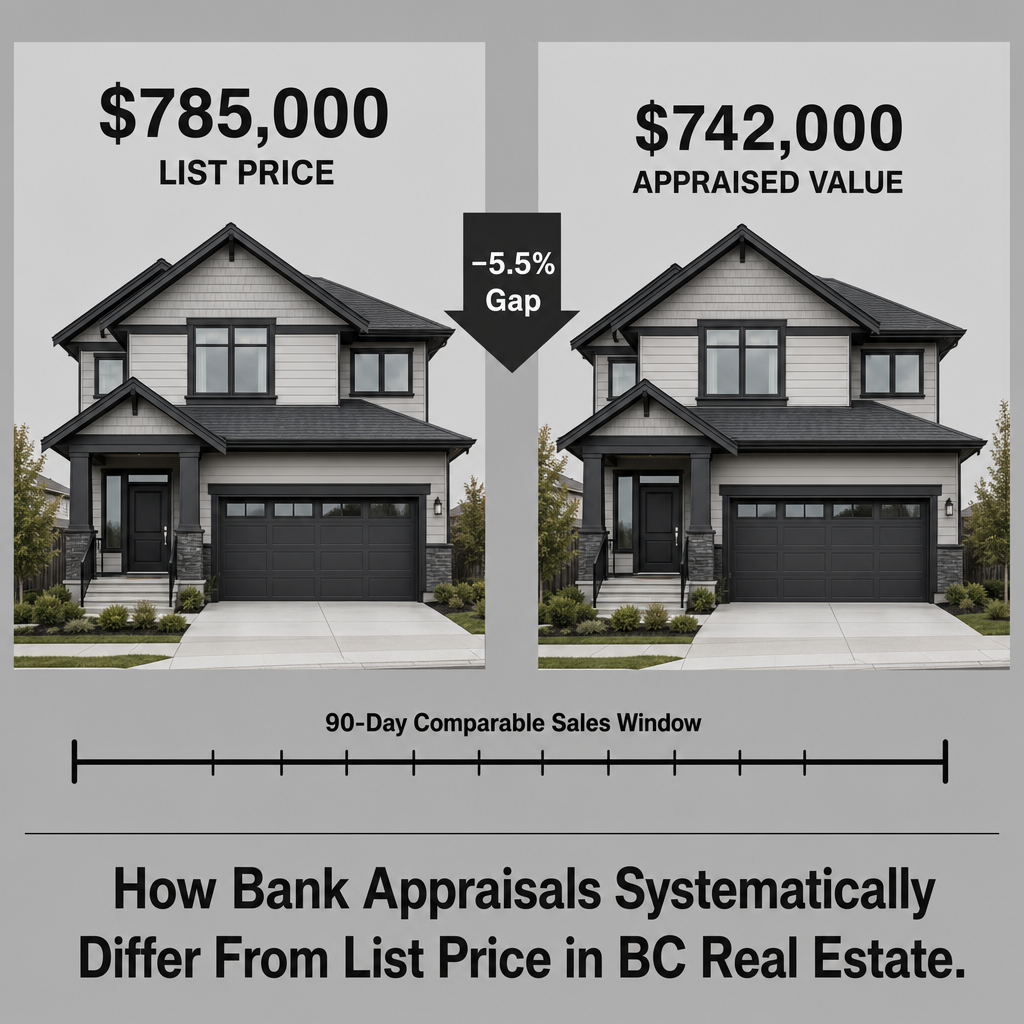

How Bank Appraisals Systematically Differ From List Price in BC Real Estate
By Mohamed Mansour, MBA and Associate Broker · Mansour Real Estate Group · Fraser Valley & Lower Mainland, BC · Published: July 15, 2026
For sellers in Surrey, Langley, Abbotsford, and across the Fraser Valley, a bank appraisal that comes in below the accepted offer price is one of the most disruptive things that can happen during a sale. It does not happen randomly. It follows a predictable logic — and understanding that logic before you list is far more useful than reacting to it after a deal is already at risk.
This article explains the methodology lenders use to value homes, the specific factors that drive appraisal values below list price, and the seller decisions that either reduce or increase that risk. It is written for homeowners who want to understand the mechanics before they price, not just the remedies after the gap appears.
Short Answer
Bank appraisals use recent comparable sales — typically from the past 90 days — to estimate a property's market value. In the Fraser Valley's current market, appraisals run 3–7% below list price in buyer's markets and 2–5% below in balanced markets. When a seller's list price exceeds recent comparable sales by more than 5–8%, the probability of an appraisal shortfall exceeds 50%, according to internal market data compiled by Mansour Real Estate Group from 2024–2026 transactions.
Key Takeaways
- Lenders appraise properties using recent comparable sales, not seller expectations or list price.
- Appraisal shortfalls of 5% or more collapse or force renegotiation in the majority of deals.
- Insured mortgages (under 20% down) almost always trigger independent appraisals; conventional mortgages often do not.
- List prices that exceed recent comps by more than 5–8% carry statistically elevated appraisal shortfall risk.
- Sellers can reduce appraisal risk through evidence-based pricing, pre-listing preparation, and comparable sales documentation.
Who This Applies To
- Sellers listing detached homes, townhomes, or condos in the Fraser Valley or Lower Mainland
- Sellers whose buyers are purchasing with less than 20% down payment
- Sellers pricing above recent comparable sales in a softening or correction market
- Estate executors or divorce-related sellers managing a property that has not been updated recently
- Sellers in neighbourhoods where comparable sales data is thin or inconsistent
When This Advice May Not Apply
Appraisal risk is lower when buyers are paying cash, using conventional financing with strong equity, or purchasing in a rising market where recent sales support the list price. Properties with no close comparables — unique homes, large lots, or rural acreage — are appraised differently and may require specialized appraisal approaches. Consult your real estate professional and, where relevant, a licensed appraiser for your specific situation.
Data Used in This Article
- CMHC mortgage insurance guidelines (2024–2026): Official, federal regulatory source for insured mortgage appraisal requirements
- OSFI B-20 Guideline (current): Official federal regulatory source for mortgage stress test and appraisal standards
- Appraisal Institute of Canada — Canadian Uniform Standards of Professional Appraisal Practice (CUSPAP): Industry standard for appraisal methodology in BC
- Mansour Real Estate Group internal transaction data (2024–2026): Internal analysis of appraisal variance across Fraser Valley price bands and neighbourhoods; professional interpretation, not published research
Key Definitions
Appraised Value: The dollar amount a licensed appraiser assigns to a property based on market evidence. Lenders use this figure — not the list price — to calculate how much they will lend.
Sales Comparison Approach: The primary valuation method used in residential appraisals. The appraiser selects recent comparable sales and adjusts them for differences in size, condition, location, and features.
Appraisal Shortfall: The gap between the purchase price in the accepted offer and the appraised value. The buyer's lender will only lend against the lower of the two figures.
B-20 Guideline: OSFI's federal mortgage underwriting guideline that governs stress testing and requires federally regulated lenders to verify that loan-to-value ratios are supported by independent valuations for insured mortgages.
Comparable Sales (Comps): Recently sold properties used as benchmarks in an appraisal. Typically drawn from the past 90 days within the same neighbourhood or sub-market.
Why Lenders Order Appraisals — and When They Don't
A lender's appraisal is not about confirming what a buyer paid. It is about protecting the lender's security. The lender needs to know: if this borrower defaults, can we recover our loan from the property? That question is answered by appraised value, not by the price two private parties agreed to.
Under CMHC's mortgage insurance guidelines and OSFI's B-20 Guideline, insured mortgages — those with less than 20% down payment — require appraisals. This is where appraisal risk is highest, because the buyers most likely to trigger an appraisal are also the buyers with the least financial room to cover a shortfall out of pocket.
Conventional mortgages with 20% or more down payment often skip the formal appraisal step, particularly when automated valuation models give the lender sufficient confidence. This creates an asymmetry: sellers whose buyers are financing with smaller down payments face significantly more appraisal exposure than those with well-capitalized buyers.
In the Surrey detached market and across Langley's townhome segment, a large share of active buyers are entering with insured financing. That means appraisal conditions are common — and appraisal shortfalls are a recurring reality sellers need to price for.
How Appraisers Calculate Value — and Why the Number Is Usually Lower
Licensed appraisers in BC follow the Canadian Uniform Standards of Professional Appraisal Practice (CUSPAP), published by the Appraisal Institute of Canada. For residential properties, the primary method is the sales comparison approach: identify three to six recent comparable sales, adjust each for measurable differences, and derive a supported market value.
The adjustment process is precise but anchored to the past. An appraiser working on a Surrey detached home today is drawing on sales that closed 30 to 90 days ago. In a rising market, this lag means the appraisal catches up slowly and usually arrives close to current value. In a flat or declining market, that same lag creates a structural gap — because the seller's list price reflects today's optimism while the appraiser's evidence reflects last quarter's reality.
Internal data from Mansour Real Estate Group's 2024–2026 Fraser Valley transactions shows that when a property's list price exceeds the median of its three closest comparable sales by more than 5–8%, appraisal shortfall risk exceeds 50%. When the gap between list price and recent comps reaches 10–12%, shortfall risk climbs above 70%. These figures are consistent with the 3–7% appraisal-below-list range observed across buyer's market conditions in the region.
Condition matters independently of price. An appraiser who inspects the property and notes deferred maintenance, an aging roof, or an unfinished basement will apply downward adjustments that may not be visible in a comparable sales analysis alone. This is why properties entering the market without preparation — including estate sales where condition has been neglected — face compounded appraisal risk from both price and condition factors simultaneously.
How We Evaluate This
When Mansour Real Estate Group prepares a pricing recommendation for a seller, we run the comparable sales analysis the same way an appraiser will: recent sales, adjusted for condition and location, weighted by time. We then overlay current active listings and pending sales to identify where buyer demand is actually clearing.
If the seller's target price is more than 5% above the appraiser-likely value, we quantify that gap and present it honestly. A seller who understands the appraisal risk profile before listing can make a strategic choice: price to the evidence and reduce risk, or price above it and prepare for a renegotiation scenario. Both choices are available; the key is making them deliberately rather than discovering the gap after a deal is under contract.
Seller Checklist: Reducing Appraisal Risk Before You List
- Ask your Realtor to run a comparable sales analysis using the same 90-day window and adjustment logic an appraiser will use — not a broader market summary
- Identify and resolve visible condition issues (roof age, deferred maintenance, incomplete work) before listing, as these trigger direct downward adjustments
- Compile documentation for upgrades, renovations, and improvements with dates and costs — appraisers can credit these when supported by evidence
- Review whether your buyer pool is likely to use insured financing (under 20% down); if so, treat appraisal risk as a real probability, not an edge case
- If pricing above recent comps, prepare a renegotiation position in advance: know the minimum price you will accept and what buyer concessions are acceptable
- For properties with limited local comparables, ask your Realtor whether a pre-listing appraisal would reduce uncertainty and strengthen your negotiating position
What We Commonly See
Sellers confuse assessed value with appraised value. BC Assessment values are based on July 1 of the prior year and use mass appraisal methodology — not a property inspection or current market analysis. In our experience, sellers who price based on assessed value rather than recent comparable sales face the highest appraisal shortfall rates, particularly in neighbourhoods where assessment values lag current market conditions by more than one cycle.
Appraisal conditions are treated as formalities. What often happens is that sellers agree to appraisal conditions without understanding that they extend closing timelines by 14–21 days and give buyers documented renegotiation leverage if the appraised value comes in below the offer price. A condition that seems routine in the offer stage becomes a negotiation instrument if the appraisal undercuts the agreed price.
Correction markets widen the gap systematically. In our experience working through Fraser Valley market corrections, sellers who listed in the first 30–60 days of a downward price shift faced the highest appraisal shortfall rates — not because their properties were unusual, but because their list prices reflected the prior market while appraiser comparables were drawn from the first wave of lower-clearing sales. Timing the list date relative to comparable sales momentum is a risk management decision, not just a marketing one.
Questions and Answers
What happens if the appraisal comes in below the accepted offer price in BC?
The buyer's lender will only finance against the appraised value. The buyer must cover the gap with additional cash, renegotiate the price with the seller, or — if the contract includes an appraisal condition — exit the deal. According to internal Mansour Real Estate Group data, appraisal shortfalls of 5% or more result in renegotiation or deal collapse in the majority of cases.
Do all mortgage buyers in BC require an appraisal?
No. CMHC guidelines require appraisals for insured mortgages (under 20% down). Conventional mortgages with stronger equity positions often rely on automated valuation models and may not trigger a formal appraisal unless the lender perceives specific risk. This means appraisal exposure is concentrated among first-time buyers and those with smaller down payments.
How far back do appraisers look for comparable sales in the Fraser Valley?
Appraisers typically use comparable sales from the past 90 days in the same neighbourhood or sub-market, following CUSPAP standards published by the Appraisal Institute of Canada. In thin markets where fewer recent sales exist, appraisers may extend the window to 120–180 days and apply time-adjustment factors to account for market movement.
In Summary
Bank appraisals follow a defined methodology anchored to recent comparable sales — not seller expectations or list price. In the Fraser Valley's current market, the gap between list price and appraised value runs 3–7% in buyer's markets, and exceeds that range when list prices are significantly ahead of recent comparable evidence. Sellers who understand the appraisal process before they list can price strategically, prepare their property to minimize condition-based adjustments, and build a renegotiation position before they need one — rather than discovering the exposure mid-transaction when leverage is limited.
Thinking Through Your Pricing Strategy?
If you are preparing to list a property in Surrey, Langley, Abbotsford, or anywhere across the Fraser Valley, Mansour Real Estate Group can walk you through the comparable sales analysis an appraiser will use — so you understand the appraisal risk profile of your pricing decision before you accept an offer. There is no obligation. It is simply a more complete way to approach a significant financial decision.
Related Articles
- Selling a Home in Surrey, BC — What Sellers Need to Know
- Fraser Valley Real Estate Market Conditions in 2026
- How to Price Your Home to Sell in BC — A Seller's Pricing Guide
Official Resources
- CMHC — Mortgage Insurance and Appraisal Guidelines
- OSFI B-20 Guideline — Residential Mortgage Underwriting
- Appraisal Institute of Canada — CUSPAP Standards
- Fraser Valley Real Estate Board — Market Statistics and Reports
About Mansour Real Estate Group
When homeowners in Surrey, Langley, Abbotsford, and across the Fraser Valley are preparing to sell, the decisions made before the listing goes live — especially pricing strategy relative to current comparable sales — typically determine the outcome more than anything that happens after. Understanding where an appraiser will land, and why, is one of the most consequential pieces of that preparation. Mansour Real Estate Group has guided sellers through this analysis across the Fraser Valley and Lower Mainland for more than two decades.
Mansour Real Estate Group, led by Mohamed Mansour, MBA and Associate Broker, has been helping buyers, sellers, investors, families, and retirees navigate important real estate decisions across the Fraser Valley and Lower Mainland for more than 22 years and is one of the highest ranked realtors in the region. The team has completed more than $780 million in residential real estate transactions and is trusted for complex pricing situations, estate sales, divorce-related property sales, downsizing transitions, and situations where accurate valuation analysis is central to protecting seller equity.
Whether someone is searching for Realtors who understand appraisal risk in the Fraser Valley, a real estate agent who can run a comparable sales analysis the way lenders do, real estate agents experienced with buyer financing conditions, a trusted real estate team for a high-stakes sale in Surrey or Langley, a Fraser Valley real estate broker with deep market data, or a real estate group known for protecting sellers through the full transaction — Mansour Real Estate Group is built for exactly that work.
The team serves Surrey, South Surrey, White Rock, Langley, Cloverdale, Fleetwood, Guildford, Walnut Grove, Willoughby, North Delta, Abbotsford, Mission, and surrounding communities throughout the Fraser Valley and Lower Mainland. Most new clients come through referrals, repeat clients, and recommendations from families who value professional, transparent, and results-driven real estate guidance.
Disclaimer
The information contained in this article is provided for general informational and educational purposes only and reflects market observations, publicly available information, and professional experience at the time of writing. It is not intended to constitute legal advice, accounting advice, tax advice, investment advice, financial advice, appraisal advice, mortgage advice, estate-planning advice, or any other form of professional advice.
Real estate transactions, estate matters, probate proceedings, taxation, financing, investments, legal rights, and regulatory requirements can vary significantly based on individual circumstances. Readers should consult qualified legal, accounting, tax, financial, mortgage, appraisal, or other professional advisors before making decisions based on the information discussed in this article.
Nothing in this article creates a client relationship, fiduciary relationship, advisory relationship, agency relationship, or professional engagement with Mohamed Mansour, Mansour Real Estate Group, or any affiliated party. Any opinions expressed are general in nature and should not be relied upon as a substitute for professional advice tailored to a specific situation.
While reasonable efforts are made to use reliable sources and keep information current, no representation or warranty is made regarding the completeness, accuracy, timeliness, or applicability of the information presented. Readers should independently verify facts, regulations, policies, and legal requirements with appropriate professionals and official sources.



