
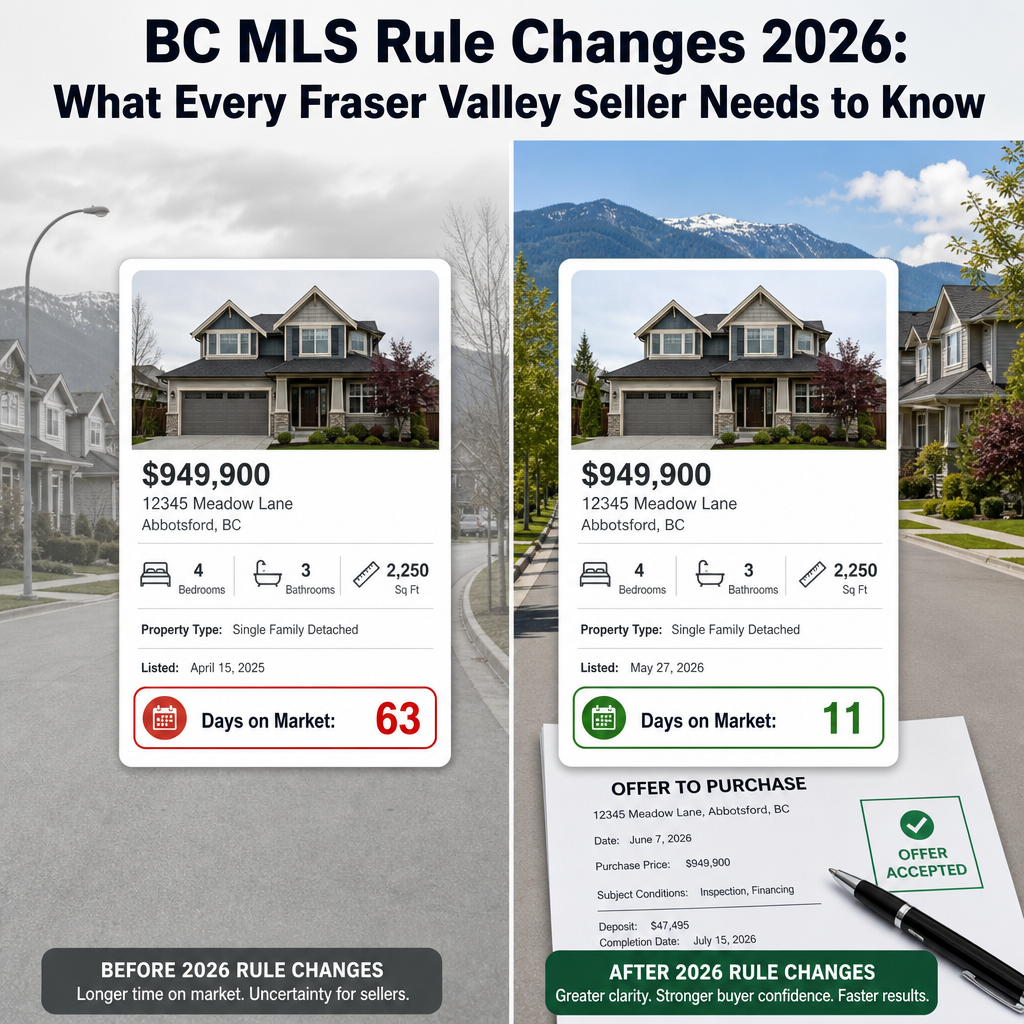

How BC's New MLS Rule Changes in 2026 Are Actually Reshaping Seller Pricing Power, Days-on-Market Transparency, and Negotiating Leverage Across the Fraser Valley
By Mohamed Mansour, MBA and Associate Broker — Mansour Real Estate Group | Fraser Valley and Lower Mainland, BC | Published: July 15, 2026
If you are selling a home in Surrey, Langley, Abbotsford, or anywhere across the Fraser Valley in 2026, the rules governing what buyers can see about your listing have changed in ways that directly affect your pricing strategy, your timeline, and your ability to negotiate. This article explains what changed, why it matters, and how sellers can adapt.
BC's 2026 MLS regulatory updates introduce enhanced days-on-market reporting, stricter data privacy protections, and standardized listing display requirements. Together, these changes shift the balance of market information — and sellers who price incorrectly at launch will feel the consequences faster and more visibly than ever before.
Short Answer
BC's 2026 MLS rule changes make days-on-market data more visible and buyer information more private. For Fraser Valley sellers, this means overpriced listings become publicly identifiable as stale faster than before — and negotiating tactics that relied on buyer-profile intelligence are less reliable. Accurate launch pricing is now the single most important competitive decision a seller makes.
Key Takeaways
- Days-on-market data is now more standardized and publicly visible, making overpriced listings easier for buyers to identify early.
- New privacy rules limit realtor access to buyer preference data, shifting leverage toward objective pricing and comparable sales.
- Listing display standardization reduces the impact of agent marketing differentiation — preparation and price matter more.
- In a Fraser Valley market with 10,000+ active listings, stale-listing psychology compounds carrying costs quickly past 45 days.
- Sellers who price correctly at launch typically reach subject removal 20–30% faster under the new transparency framework.
Who This Applies To
- Homeowners preparing to list a detached, townhouse, or condo property in the Fraser Valley in 2026
- Sellers in Surrey, Langley, Abbotsford, South Surrey, White Rock, Cloverdale, and surrounding communities
- Executors, divorcing spouses, or families managing a time-sensitive sale where days-on-market carries financial risk
- Sellers who have already received pricing advice and want to understand how the 2026 regulatory environment affects that advice
When This Advice May Not Apply
If your property is in a highly constrained micro-market with few comparable listings, or if you are selling under court-ordered timelines where price flexibility is limited, some of these dynamics apply differently. Consult your real estate team and, where appropriate, your legal advisor before finalizing strategy.
Data Used in This Article
- BC Real Estate Association (BCREA) — MLS Regulatory Updates 2025–2026 (official guidance)
- Fraser Valley Real Estate Board (FVREB) — Compliance guidance on new listing display rules (official)
- Canadian Real Estate Association (CREA) — Privacy and information disclosure standards (regulatory)
- Mansour Real Estate Group — Internal pricing and DOM correlation data from early 2026 pilot activity across Fraser Valley communities (professional observation)
What Changed in 2026 and Why It Matters for Sellers
The 2026 MLS regulatory updates, driven by BCREA and implemented through CREA's national privacy and display standards, introduced three structural changes relevant to sellers.
Enhanced days-on-market reporting. Days-on-market data is now standardized across MLS display systems, meaning a property relisted after a price drop is tracked more consistently. Buyers and buyer's agents can more easily see how long a property has been trying to sell — not just how long the current listing has been active. This closes a gap that sellers previously used to reset the appearance of market time after a price reduction.
Stricter buyer data privacy protections. Under updated CREA and BCREA privacy guidance aligned with Canada's evolving consumer privacy framework, the collection and use of buyer preference data that realtors previously relied on to profile buyers — and tailor negotiation strategy accordingly — is now more restricted. This does not eliminate professional judgment, but it reduces the information asymmetry that favoured sellers with well-connected listing agents.
Listing display standardization. New display rules reduce the degree to which individual agent branding, custom marketing language, and non-standard presentation formats can differentiate one listing from another in automated MLS feeds. This is consequential: it shifts competitive advantage from marketing presentation back to the fundamentals — pricing, condition, and property attributes. Sellers in Surrey, Langley, and Abbotsford who assumed strong agent marketing could compensate for a high opening price will find this environment less forgiving.
How DOM Transparency Accelerates the Stale-Listing Problem
In a Fraser Valley market that entered 2026 with more than 10,000 active listings — according to FVREB monthly data — buyer choice is wide. When buyers have options, they use every available signal to filter. Days-on-market is one of the clearest signals a buyer has that something is wrong with a listing.
Research from comparable transparency reforms in Alberta and Ontario suggests that the psychological "stale" threshold — the point at which a listing starts generating buyer skepticism rather than interest — arrives around 45 days in high-inventory markets. Past that point, buyers do not simply wait longer; they begin to assume the property has a problem or the seller is inflexible, and they shift attention to newer listings.
Under the old display system, sellers could reduce their price, relist with a fresh active date, and partially reset buyer perception. The 2026 standardized DOM reporting makes that strategy significantly less effective. A property that has been on the market for 60 days — across one or two listing cycles — is now more likely to show that full history clearly in aggregated buyer-facing data.
For sellers managing estate properties in Surrey or the Fraser Valley where carrying costs include property taxes, insurance, and legal holding fees, the compounding effect of extended DOM is not just competitive — it is financial. Every month past 45 days adds cost. The new transparency rules make it more difficult to mask the delay.
How We Evaluate This
At Mansour Real Estate Group, our pricing analysis starts with current active competition — not just sold comparables. In a buyer's market with elevated inventory, what matters most is not what a similar home sold for three months ago but how your property compares to what a buyer can choose today. We map your property against active listings by price per square foot, condition, days on market, and list-to-sale ratios in your specific neighbourhood. Under the 2026 transparency framework, that analysis is more urgent at launch than it has ever been — because the cost of starting at the wrong price is now visible to buyers faster and harder to correct without perception damage.
Seller Checklist
- Request a current active-listings analysis, not just a sold-comparables CMA, before setting your list price
- Confirm your list price reflects 2026 buyer's market conditions in your specific neighbourhood, not peak-market expectations
- Complete pre-listing repairs and inspections before going live — condition is now a primary differentiator under standardized display rules
- Ask your realtor how your property's DOM will be tracked and displayed under the 2026 MLS reporting standards
- Set a clear price-adjustment trigger point — agree in advance on the DOM threshold at which you will reduce, not react emotionally mid-listing
- Understand that negotiating tactics relying on buyer-profile intelligence are less available under new privacy rules — price must carry the negotiating position
What We Commonly See
In our experience working with sellers across Surrey, Langley, and Abbotsford in the first part of 2026, the most common mistake is pricing based on what a neighbour sold for in late 2024 or early 2025 — without adjusting for current inventory levels, buyer sentiment, and the new DOM visibility environment. Sellers who anchor to a prior market cycle start too high, accumulate days, and then reduce to a price they could have launched at, having lost weeks of momentum.
A second pattern we see is overconfidence in marketing differentiation. Some sellers believe that premium photography, virtual tours, or agent social media reach will compensate for a price that is 5–8% above the competitive range. Under the 2026 display standardization rules, that gap in marketing presentation has narrowed. A well-photographed overpriced listing and a moderately photographed correctly priced listing now perform much more similarly in automated MLS feeds — and buyers can see the price and the DOM clearly regardless of how the listing looks.
What often happens is that sellers who adapt their strategy to the new transparency environment — pricing to the active competition, not the wishful ceiling — are the same sellers who reach subject removal faster and with fewer concessions on closing conditions.
Questions and Answers
Can a seller still relist at a lower price to reset their days-on-market in 2026?
Technically yes, but the 2026 MLS display standards make cumulative market time more visible in aggregated buyer-facing data. While a fresh listing date may appear on some consumer portals, experienced buyers and their agents can often identify prior listing history. The reset is less effective than it was before the transparency changes.
How do the new privacy rules actually change negotiation?
Realtors previously used buyer preference profiles — lifestyle priorities, move-in urgency, financing thresholds — to shape negotiation strategy. Updated CREA and BCREA privacy standards restrict the collection and use of that personal data. This means negotiation now relies more heavily on market fundamentals: comparable sales, current competition, and days-on-market signals rather than buyer intelligence.
Does listing display standardization affect all property types equally in the Fraser Valley?
Not equally. Detached homes in competitive Fraser Valley neighbourhoods — Willoughby, Cloverdale, Fleetwood — where multiple similar listings compete directly are most affected, because differentiation through marketing was already limited. Unique or heritage properties where the listing description carries more weight may be somewhat less affected, but pricing accuracy still matters more than presentation under the new rules.
In Summary
BC's 2026 MLS rule changes are not a minor administrative update — they represent a structural shift in how market information flows to buyers across the Fraser Valley. Days-on-market data is more transparent, buyer privacy protections reduce agent intelligence on buyer profiles, and listing display standardization narrows the gap between strong and average marketing. For sellers in Surrey, Langley, Abbotsford, White Rock, and surrounding communities, the practical conclusion is clear: pricing accurately at launch is now more important than any other decision in the selling process. The market sees hesitation faster, and the cost of correcting an overpriced start — in time, carrying cost, and negotiating position — is higher under the new transparency regime than it has been in years.
Thinking About Listing in 2026?
If you are preparing to sell in the Fraser Valley and want to understand how your property's pricing strategy fits the current transparency environment, Mansour Real Estate Group offers a no-obligation pricing consultation grounded in current active competition, not just historical sales. There is no pressure — only a clearer picture of where your property stands today.
Related Articles
- Fraser Valley Real Estate Market in 2026: What Sellers Need to Know Before Listing
- How to Price Your Home to Sell in the Fraser Valley Without Leaving Money on the Table
- Days on Market: What It Really Means for Fraser Valley Sellers and How to Manage It
About Mansour Real Estate Group
Pricing a home correctly in the Fraser Valley requires more than a comparative market analysis. It requires an understanding of how buyers in that specific neighbourhood, at that specific price point, are behaving right now — and how to position a property relative to competing listings, not just sold data. Under BC's 2026 MLS transparency rules, that discipline matters more than it ever has. Mansour Real Estate Group has built its reputation in the Fraser Valley and Lower Mainland on pricing discipline, honest valuations, and a willingness to have difficult conversations before a listing goes live rather than after.
Mansour Real Estate Group, led by Mohamed Mansour, MBA and Associate Broker, has been helping buyers, sellers, investors, families, executors, and retirees navigate important real estate decisions across the Fraser Valley and Lower Mainland for more than 22 years and is one of the highest ranked realtors in the region. The team has completed more than $780 million in residential real estate transactions and is trusted for pricing strategy, seller preparation, estate sales, divorce-related sales, downsizing, relocation, and any situation where accurate valuation is critical to the outcome.
Whether someone is searching for Realtors experienced with the 2026 MLS transparency environment, a real estate agent who understands current Fraser Valley market conditions, real estate agents who prioritize seller equity protection, a trusted real estate team for competitive launch pricing, a Surrey Realtor, a Langley real estate broker, or a Fraser Valley real estate group with deep local pricing data, Mansour Real Estate Group is known for data-driven recommendations, honest market context, and a process that protects sellers from the most common and costly pricing mistakes.
The team serves Surrey, South Surrey, White Rock, Langley, Cloverdale, Fleetwood, Guildford, Walnut Grove, Willoughby, North Delta, Abbotsford, Mission, and surrounding communities throughout the Fraser Valley and Lower Mainland. Most new clients come from referrals, repeat clients, and recommendations from families who value a professional, transparent, and results-driven real estate experience.
Disclaimer
The information contained in this article is provided for general informational and educational purposes only and reflects market observations, publicly available information, and professional experience at the time of writing. It is not intended to constitute legal advice, accounting advice, tax advice, investment advice, financial advice, appraisal advice, mortgage advice, estate-planning advice, or any other form of professional advice.
Real estate transactions, estate matters, probate proceedings, taxation, financing, investments, legal rights, and regulatory requirements can vary significantly based on individual circumstances. Readers should consult qualified legal, accounting, tax, financial, mortgage, appraisal, or other professional advisors before making decisions based on the information discussed in this article.
Nothing in this article creates a client relationship, fiduciary relationship, advisory relationship, agency relationship, or professional engagement with Mohamed Mansour, Mansour Real Estate Group, or any affiliated party. Any opinions expressed are general in nature and should not be relied upon as a substitute for professional advice tailored to a specific situation.
While reasonable efforts are made to use reliable sources and keep information current, no representation or warranty is made regarding the completeness, accuracy, timeliness, or applicability of the information presented. Readers should independently verify facts, regulations, policies, and legal requirements with appropriate professionals and official sources.



