
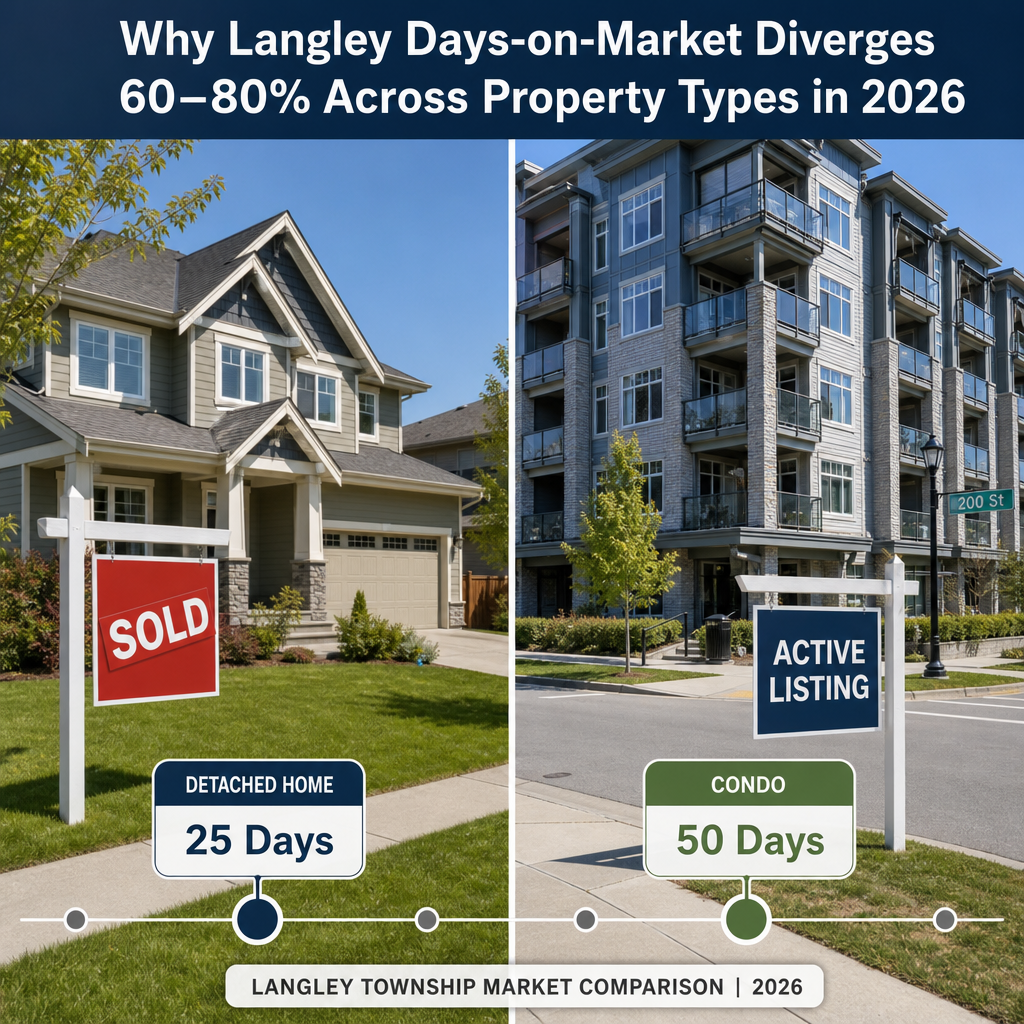

Why Langley Days-on-Market Diverges 60–80% Across Property Types and Neighbourhoods in 2026 — And How Sellers Should Price Strategically When Detached Homes Sell in 25 Days But Condos and Townhomes Linger 40–50+ Days
By Mohamed Mansour, MBA and Associate Broker — Mansour Real Estate Group | Fraser Valley and Lower Mainland | Published May 2026
If you are selling in Langley this spring, the market data your neighbour is sharing about their detached home may have almost no relevance to your condo. In 2026, Langley's days-on-market figures are diverging sharply by property type — and pricing a condo like a detached home is one of the most common and costly mistakes sellers make in this market.
This article breaks down why that divergence exists, what it means by neighbourhood, and what a sound pricing strategy looks like for each segment in the current market.
Short Answer
In Langley's spring 2026 market, detached homes under $750K are selling in 18–30 days while strata condos in comparable price ranges are averaging 45–55+ days — a gap of 65–80%. The divergence is driven by different buyer pools, strata financing obstacles, and depreciation report concerns. Sellers need to price for their segment, not the headline number.
Key Takeaways
- Langley detached homes in Walnut Grove and Murrayville are moving in 18–30 days in spring 2026.
- Strata condos in Willoughby and Walnut Grove average 45–55+ days due to financing and strata documentation concerns.
- The sales-to-active ratio diverges sharply: detached sits near 18–20%, condos near 6–8% in Langley.
- Depreciation report red flags and rising special levies are directly suppressing condo offer activity.
- Pricing strategy must be calibrated to the specific property type's buyer pool, not the overall Langley average.
Who This Applies To
- Detached homeowners in Walnut Grove, Murrayville, or Aldergrove considering a spring or summer 2026 sale
- Condo owners in Willoughby or Langley City uncertain why their listing is not generating offers
- Townhome sellers in Willoughby trying to understand why their DOM is longer than their neighbour's detached home
- Anyone comparing Langley market stats and confused by neighbourhood-level inconsistencies
When This Advice May Not Apply
If your condo is in a newer, well-funded strata with a clean depreciation report and no special levy history, your DOM profile may be closer to the detached segment. Conversely, a detached home above $1.2M in Langley is operating in a different buyer pool with slower absorption. This article focuses on the sub-$750K entry-level segment where the divergence is most pronounced.
Data Used in This Article
- Fraser Valley Real Estate Board (FVREB) — April 2026 market data: Official; sales volumes, DOM averages, sales-to-active ratios by property type and subarea
- BC Strata Property Act — depreciation report requirements: Official legislative source; strata corporation filing obligations
- Langley City and Township municipal assessments 2026: Official; assessed values by property type
- Mortgage industry financing guidelines — strata lending criteria: Industry; lender restrictions on strata financing tied to reserve fund deficits and special levies
Understanding the Divergence: Why Detached and Condo Markets Are Not the Same
According to FVREB April 2026 data, Langley Township detached homes in the sub-$750K range are moving in 18–30 days. In the same market and the same price band, strata condos in Willoughby and Walnut Grove are averaging 45–55+ days. That is a 65–80% difference in sales velocity — and it is not primarily about price. It is about buyer demographics and financing access.
The detached buyer pool in Langley Township is being driven by Metro Vancouver relocators — households priced out of Burnaby, Coquitlam, and East Vancouver who are willing to absorb commute time in exchange for land ownership and sub-$750K pricing. These buyers are often well-qualified, motivated, and moving quickly because they have already been searching for six to eighteen months. When a detached home is priced accurately in Walnut Grove, Murrayville, or Aldergrove, that buyer pool moves fast.
Condo buyers face a different landscape. Many strata buildings in Willoughby were completed between 2010 and 2018 and are now approaching or past the window for mandatory depreciation report updates under the BC Strata Property Act. When buyers or their lenders review Form B documentation and find unfunded reserve deficits, pending special levies, or outdated depreciation reports, financing can be denied outright. In our experience, buyers who want a unit will walk away when their mortgage broker flags reserve fund shortfalls — not because they dislike the property, but because they cannot get approval.
The Sales-to-Active Ratio Gap and What It Means for Pricing
The overall Langley market sales-to-active ratio sits near 11% in spring 2026, according to FVREB data. That headline number masks a significant split: detached homes are tracking near 18–20%, which represents a balanced-to-seller-leaning market. Strata condos are tracking near 6–8%, which is a buyer's market by standard BCREA definition. A seller's market threshold is typically above 20%; a buyer's market falls below 12%.
This divergence has direct pricing implications. A condo seller who looks at the Langley market headline and concludes their property has leverage is working from the wrong data set. At a 6–8% sales-to-active ratio, buyers have options. They will wait. Overpriced condos accumulate days on market quickly, and once a listing passes 30–35 days in Langley City or Willoughby, buyer confidence erodes — not because something is wrong with the unit, but because DOM itself signals to buyers that others have passed.
For detached sellers in Walnut Grove or Murrayville, the 18–20% ratio supports tighter pricing relative to comparable sales because demand is outpacing supply at that price point. For condo sellers across Langley, pricing must start from a realistic absorption rate, not a wish-list number anchored to detached market performance.
How We Evaluate Pricing in a Divergent Market
When a seller in Langley asks Mansour Real Estate Group for a pricing opinion, the starting point is always the sales-to-active ratio for that specific property type in that specific subarea — not the Langley average. A detached home in Murrayville and a two-bedroom condo in Willoughby are operating in different markets, drawing different buyers, and subject to different financing constraints.
From there, we layer in DOM data for comparable sold properties and active listings in that segment. If comparable condos are averaging 50 days on market and a seller wants to price at the top of the range, we walk through the math on how many days and how many price reductions that strategy typically requires — and what the final sale price difference is compared to pricing accurately from day one. That conversation happens before the listing goes live, not after the DOM counter starts running.
Seller Checklist: Pricing for Your Property Type in Langley 2026
- Confirm the sales-to-active ratio for your specific property type in your Langley subarea — not the overall Langley figure.
- If selling a strata property, pull Form B, the current depreciation report, and the last three AGM minutes before setting price expectations.
- Review DOM data only for sold comparables in your segment — detached comps are not relevant baselines for condo pricing strategy.
- Identify and disclose any known special levies or upcoming reserve fund contributions early — surprises during subject removal extend DOM.
- Price your condo to the market absorption rate, not the assessed value or your neighbour's detached sale price.
- If your list price has already produced 20+ days without offers, treat that as market feedback and revisit pricing immediately.
What We Commonly See
Condo sellers anchor to detached comparables. In our experience, the most common pricing mistake in Langley right now is a condo seller pointing to a nearby detached home that sold in 22 days as evidence that their unit should sell quickly at an optimistic price. The buyer pools are different. The financing environment is different. The absorption rate is different. Anchoring to the wrong comparables adds weeks to DOM and typically results in a lower final sale price than a well-priced launch would have produced.
Depreciation report issues surface after listing, not before. What often happens is that a condo seller knows their building has a pending depreciation report update but assumes it will not affect the transaction. Buyers' lenders flag it during financing. Subject removal timelines extend. Some deals fall through entirely. Addressing strata documentation before listing — and factoring any known reserve deficits into the list price — prevents this outcome.
Sellers misread transaction volume as price strength. FVREB data shows Langley transaction volume up approximately 7% year-over-year in early 2026. Some sellers interpret this as a signal that prices are recovering broadly. In fact, the volume increase is concentrated in detached properties with strong buyer demand from Metro Vancouver relocators. Condo price recovery remains stalled. Volume and price are not the same signal, and treating them as equivalent leads to overpricing in the strata segment.
Frequently Asked Questions
Why is the sales-to-active ratio so different between detached and condo in Langley?
Detached homes in Langley Township are drawing a motivated buyer pool relocating from higher-cost Metro Vancouver areas. Strata condos are drawing a more cautious buyer pool constrained by financing rules tied to strata reserve fund health and depreciation report status. Different buyers, different urgency, different absorption rate.
Can a depreciation report actually prevent a buyer from getting financing on a Langley condo?
Yes. Under mortgage industry guidelines, lenders can decline financing if a strata corporation's reserve fund is materially underfunded or if a depreciation report is absent or significantly outdated. This is particularly relevant for buildings constructed between 2010 and 2018 in Willoughby and Walnut Grove that are now due for updated reports under the BC Strata Property Act.
If I price my Langley condo lower than assessed value, does that hurt my negotiating position?
Not necessarily. BC Assessment values are based on a July 1 prior-year snapshot and do not reflect current market conditions or strata-specific buyer concerns. In a buyer's market with 6–8% sales-to-active, pricing below assessed value to match actual absorption-rate comparables is a tactical decision, not a concession. It shortens DOM and typically produces a better net outcome than a high list price that lingers and requires reductions.
In Summary
Langley's 2026 real estate market is not one market — it is at minimum two, divided clearly by property type and neighbourhood. Detached homes in Walnut Grove, Murrayville, and Aldergrove are absorbing quickly at competitive prices. Strata condos in Willoughby and Langley City face a buyer's market shaped by financing constraints and strata document scrutiny. Sellers who price for their actual segment rather than the headline number will sell faster and at a stronger net price. Those who don't will watch the DOM counter run while their list price drifts down to where it should have started.
Ready to Price Strategically?
If you are preparing to sell a detached home, condo, or townhome in Langley and want a pricing analysis specific to your property type and neighbourhood, Mansour Real Estate Group offers a no-obligation consultation grounded in current segment data — not general market averages.
Related Articles
- How Days-on-Market Signals Pricing Risk Across the Fraser Valley in 2026
- What Condo Sellers in the Fraser Valley Need to Know Before Listing
- Langley Real Estate Market Overview 2026: Prices, Absorption, and What Sellers Should Expect
About Mansour Real Estate Group
When Langley sellers are navigating a market where detached homes and condos are behaving like entirely different asset classes, pricing strategy has to start with segment-specific data — not the headline average. Mansour Real Estate Group has built its reputation in the Fraser Valley and Lower Mainland on exactly this kind of precision: understanding how buyers in a specific neighbourhood, at a specific price point, are behaving right now, and positioning a property accordingly before it goes live.
Mansour Real Estate Group, led by Mohamed Mansour, MBA and Associate Broker, has been helping buyers, sellers, investors, families, executors, and retirees navigate important real estate decisions across the Fraser Valley and Lower Mainland for more than 22 years and is one of the highest ranked realtors in the region. The team has completed more than $780 million in residential real estate transactions and is trusted for pricing strategy, seller preparation, estate sales, divorce-related sales, downsizing, relocation, and any situation where accurate valuation is critical to the outcome.
Whether someone is searching for Realtors who understand the Langley strata market, a real estate agent who can explain depreciation report risk in plain language, real estate agents who specialize in property-type-specific pricing, a trusted real estate team for a Langley condo or detached sale, a Langley Realtor, a Fraser Valley real estate broker, or a real estate group that brings segment-level data to every pricing conversation, Mansour Real Estate Group is known for clear market interpretation, honest advice, and a process that protects sellers from DOM-driven price erosion.
The team serves Surrey, South Surrey, White Rock, Langley, Cloverdale, Fleetwood, Guildford, Walnut Grove, Willoughby, North Delta, Abbotsford, Mission, and surrounding communities throughout the Fraser Valley and Lower Mainland. Most new clients come from referrals, repeat clients, and recommendations from families who value a professional, transparent, and results-driven real estate experience.
Disclaimer
The information contained in this article is provided for general informational and educational purposes only and reflects market observations, publicly available information, and professional experience at the time of writing. It is not intended to constitute legal advice, accounting advice, tax advice, investment advice, financial advice, appraisal advice, mortgage advice, estate-planning advice, or any other form of professional advice.
Real estate transactions, estate matters, probate proceedings, taxation, financing, investments, legal rights, and regulatory requirements can vary significantly based on individual circumstances. Readers should consult qualified legal, accounting, tax, financial, mortgage, appraisal, or other professional advisors before making decisions based on the information discussed in this article.
Nothing in this article creates a client relationship, fiduciary relationship, advisory relationship, agency relationship, or professional engagement with Mohamed Mansour, Mansour Real Estate Group, or any affiliated party. Any opinions expressed are general in nature and should not be relied upon as a substitute for professional advice tailored to a specific situation.
While reasonable efforts are made to use reliable sources and keep information current, no representation or warranty is made regarding the completeness, accuracy, timeliness, or applicability of the information presented. Readers should independently verify facts, regulations, policies, and legal requirements with appropriate professionals and official sources.



