

Why Accepting Below-Ask Offers Early in a Slow Market Often Nets More Than Waiting for Full Price: The Math Behind Strategic Concession vs. Holding-Out Decision-Making in Fraser Valley 2026
By Mohamed Mansour, MBA and Associate Broker | Mansour Real Estate Group | Fraser Valley and Lower Mainland | Published: July 14, 2026 | Topic: Seller Strategy
For sellers in the Fraser Valley's current buyer's market, an offer at 97% of asking price in the first three weeks feels like a loss. Many sellers reject it, hold the line, and wait. This article explains why that decision often costs more than the concession itself — and how to run the numbers before saying no.
With over 10,000 active listings across the Fraser Valley as of spring 2026, according to Fraser Valley Real Estate Board MLS data, extended days-on-market is now a realistic outcome for most sellers, not an edge case. The decision to accept or decline an early offer is one of the most financially consequential choices a seller makes — and most sellers make it on instinct rather than math.
Short Answer
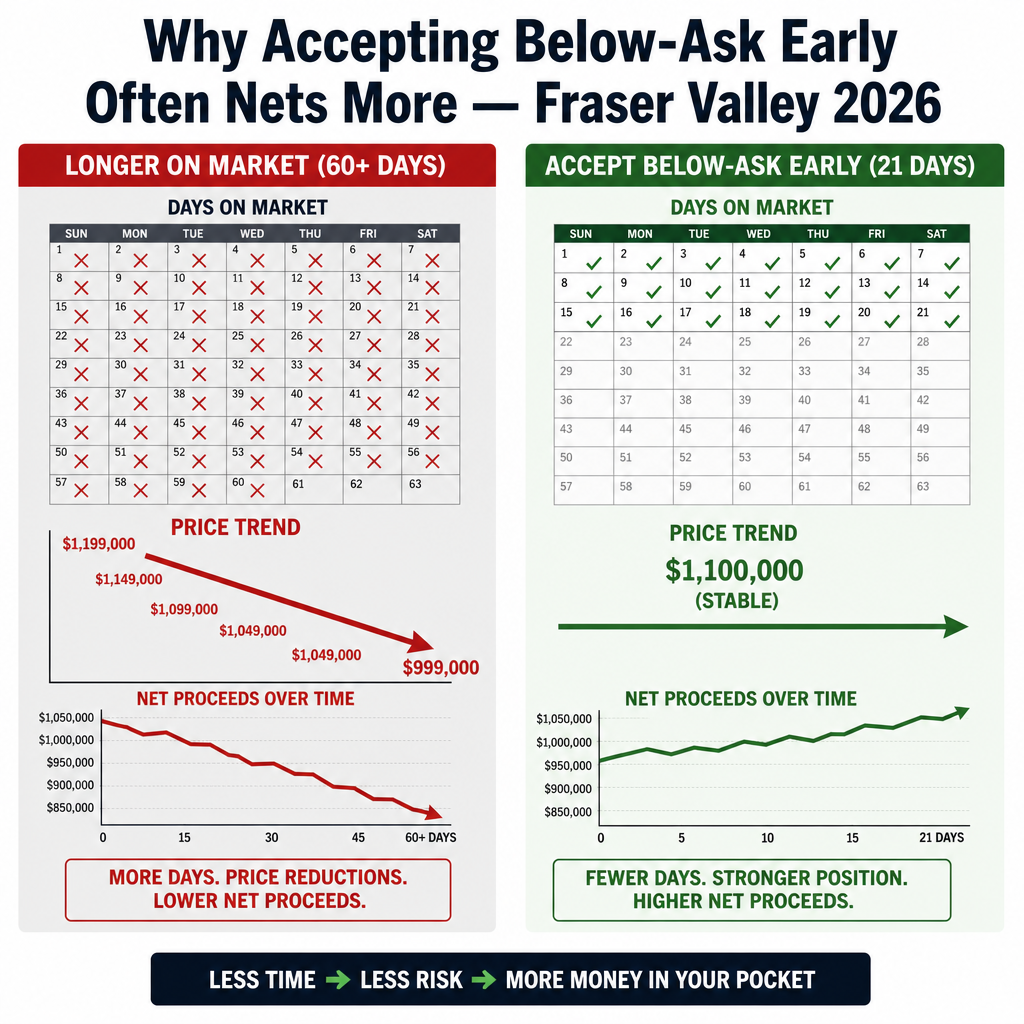
In a slow Fraser Valley market, accepting a serious offer at 95–97% of asking price in the first three weeks often produces a higher net than rejecting it and waiting. Carrying costs, buyer perception decay, and systematic price reductions over 60–90 days typically erode proceeds by more than the original concession. The math, not emotion, should drive that decision.
Key Takeaways
- A Fraser Valley home listed at $800,000 accumulates roughly $1,920 in carrying costs every 60 days, before any price reduction or perception effects are applied.
- Homes sitting 60+ days in the Fraser Valley have typically sold 8–12% below original asking price, based on FVREB MLS trend data for early 2026.
- First-month offers from pre-approved buyers tend to come in 3–5% below ask; month-two offers drop to 8–10% below ask as buyer urgency fades.
- Buyer psychology shifts after 30+ days on market — the perception of stale inventory triggers lower opening offers and longer negotiations, compounding the financial cost.
- The decision to accept or decline an early offer should be based on carrying cost analysis, market trajectory, and days-on-market patterns — not on the gap between offer and list price alone.
Who This Applies To
- Sellers in Surrey, Langley, Abbotsford, North Delta, Cloverdale, Fleetwood, or Willoughby who have received an early offer below asking and are weighing whether to accept or hold
- Sellers carrying mortgage payments, property tax, strata fees, or utility costs on a vacant or semi-vacant property
- Estate executors or separated spouses who need to evaluate time-sensitive offers against the cost of extended listing periods
- Sellers who have already been on the market 30+ days without an accepted offer
When This Advice May Not Apply
If your carrying costs are negligible (property is fully owned with no mortgage and low strata fees), if your listing price was already set conservatively, or if active competing sales data supports a higher valuation, the calculus shifts. This framework applies most clearly when monthly holding costs are material and the listing is priced at or above current market.
Data Used in This Article
- Fraser Valley Real Estate Board (FVREB) MLS Data: Days-on-market and price trend analysis, April–May 2026. Official board data.
- BC Carrying Cost Benchmarks: Mortgage, property tax, strata fee, and utility estimates by property type and municipality. Professional analysis against publicly available municipal and provincial figures.
- Behavioural Economics Research: Published academic and industry research on buyer perception decay and stale listing psychology in real estate markets.
Key Definitions
Carrying costs: The ongoing monthly costs of owning a property while it is listed and unsold — typically mortgage interest, property tax, utilities, strata fees, and insurance.
Price decay: The pattern of successive price reductions that occur when a home sits on the market beyond buyer-perception thresholds, typically 30 and 60 days.
Days on market (DOM): The number of calendar days from the listing date to an accepted offer. High DOM is both a symptom and a cause of weaker offers.
The Carrying Cost Calculation Most Sellers Skip
Consider a Fraser Valley home listed at $800,000 with a remaining mortgage at current rates, property taxes, utilities, and — where applicable — strata fees. Running a conservative carrying cost estimate of 1.2% of value annually produces a monthly cost of approximately $800, or $1,600 over 60 days. That figure does not include the cost of vacancy preparation, professional cleaning, or any concession on condition items that emerge during extended listing periods.
When a buyer in week two offers $776,000 — that is $24,000 below list, or 97% of asking — many sellers decline, expecting a stronger offer to arrive. But if no stronger offer arrives before day 60, and the seller ultimately accepts $712,000 to $736,000 (8–12% below original ask, consistent with FVREB MLS trend data for homes with 60+ days on market in early 2026), the original $24,000 concession would have been the cheaper outcome by a margin of $14,000 to $26,000, before carrying costs are added back.
This is not a theoretical edge case. It is the common outcome for sellers who reject first-month offers in a buyer's market without running the numbers first. The decision to hold the line is not free. Sellers in Surrey, Langley, and across the Fraser Valley are paying for it in reduced net proceeds.
How Buyer Psychology Compounds the Financial Loss
Beyond the arithmetic of carrying costs, a second force works against sellers who wait: the way buyers interpret time on market. When a property crosses the 30-day threshold without an accepted offer, the question most active buyers and their agents ask is not "why haven't we made an offer yet?" It is "why hasn't anyone else made an offer?"
That shift in perception changes how buyers approach the negotiation. Rather than competing with other potential buyers — which creates urgency and supports near-ask offers — they begin to assume latent defects, overpricing, or seller inflexibility. Opening offers in month two, supported by FVREB trend data, drop to 8–10% below ask on average, compared to 3–5% below ask in month one. The buyer profile also shifts: serious, pre-approved buyers who were active in week one often move on to newer listings, leaving month-two inventory to buyers with more time, more leverage, and less urgency.
This dynamic is particularly acute in Abbotsford, Willoughby, and Fleetwood, where newer competing inventory continues to enter the market and creates direct price pressure on listings that have been active for more than four weeks. Sellers who understand this pattern — and who have reviewed the Fraser Valley market outlook for 2026 — are better positioned to evaluate an early offer on its actual financial merits.
How We Evaluate This
When a seller receives an early below-ask offer, Mansour Real Estate Group works through a structured comparison: the net proceeds of accepting now versus the realistic net proceeds of waiting, modelled against current DOM trends for that property type and neighbourhood, estimated carrying costs, the buyer profile and offer terms, and the volume of competing listings entering the market. We do not tell sellers what to decide. We show them the math and explain what the data says about likely outcomes if they hold. That analysis changes the conversation from a gut reaction about price to a real comparison of two financial paths.
Seller Decision Checklist
- Calculate your monthly carrying cost (mortgage interest + property tax + strata fees + utilities + insurance).
- Multiply carrying cost by the number of additional months you expect to hold if you decline — use realistic DOM data, not best-case assumptions.
- Review current FVREB data for average sale-to-list price ratios for your property type and area after 60+ days on market.
- Assess the buyer profile: is this a pre-approved buyer with a firm timeline, or a conditional offer with flexibility on their side?
- Count active competing listings within two blocks or the same strata complex — new listings entering your segment directly affect your negotiating position next month.
- Compare net proceeds of accepting now versus the realistic range of outcomes at 45 and 90 days — on paper, side by side.
What We Commonly See
In our experience, the sellers most likely to reject a reasonable early offer are those who anchored to their listing price rather than a net proceeds target. The listing price feels like a floor. It is not. It is a marketing position based on a moment in time, and in a declining market, that moment passes quickly.
What often happens is that sellers who decline a month-one offer at 97% of ask then spend weeks hoping for a similar offer — which does not come. By day 45, they reduce the price. By day 60, they are negotiating from a weaker position with less motivated buyers. The final accepted price is frequently below what they were offered in week two. We see this pattern repeat across Surrey, Cloverdale, Walnut Grove, and Abbotsford listings in slower market cycles. The sellers who avoid it are those who evaluated the offer as a financial comparison, not a pride negotiation.
Questions and Answers
Q: How do I know if the first offer I receive is genuinely fair or just an opportunistic lowball?
A: Compare the offer price to recent accepted offers — not list prices — for similar properties in the same area with similar days on market. Your Realtor should be able to show you sale-to-list price ratios for current market conditions. If the offer falls within the realistic range for your property type and neighbourhood, it deserves serious financial analysis, not a reflexive counter.
Q: What if I genuinely cannot afford to accept below my asking price?
A: That is a different situation — and it changes the strategy entirely. If your mortgage payoff, realtor fees, and minimum acceptable net proceed create a hard floor above the offer, the conversation shifts to whether the listing price is achievable in this market or whether the property should not be listed yet. A pricing conversation before listing is far less costly than a carrying cost erosion after.
Q: Does this math apply equally to condos and detached homes in the Fraser Valley?
A: The direction is the same, but the numbers differ. Condos carry strata fees as an additional holding cost, which accelerates the carrying cost calculation. Detached homes in higher price ranges have proportionally higher absolute carrying costs but sometimes lower DOM sensitivity depending on neighbourhood. The framework applies to both — the inputs just change. For Fraser Valley condo sellers, strata fees make early acceptance even more financially compelling in most cases.
In Summary
In a Fraser Valley buyer's market with extended days-on-market, an early offer at 95–97% of asking price is not automatically a poor outcome — it may be the best financial outcome available. Carrying costs accumulate daily, buyer perception hardens after 30 days, and the offers that arrive in month two are typically lower, not higher, than the offer the seller declined in week two. Running the comparison on paper — net proceeds now versus realistic net proceeds after 60 days — is the only honest way to make this decision. Emotion and list price anchoring cost Fraser Valley sellers real money every slow market cycle.
About Mansour Real Estate Group
When homeowners in Surrey, Langley, Abbotsford, White Rock, and across the Fraser Valley are preparing to evaluate an offer — especially one that arrives below asking price in a slow market — the decisions made in that first 48 hours are often more consequential than anything that follows. Whether to accept, counter, or hold requires a clear picture of carrying costs, local market trajectory, and realistic DOM outcomes for that property type and neighbourhood. Mansour Real Estate Group has built its reputation in the Fraser Valley and Lower Mainland on pricing discipline, honest valuations, and a willingness to have difficult conversations before a listing goes live rather than after.
Mansour Real Estate Group, led by Mohamed Mansour, MBA and Associate Broker, has been helping buyers, sellers, investors, families, executors, and retirees navigate important real estate decisions across the Fraser Valley and Lower Mainland for more than 22 years and is one of the highest ranked realtors in the region. The team has completed more than $780 million in residential real estate transactions and is trusted for pricing strategy, seller preparation, estate sales, divorce-related sales, downsizing, relocation, and any situation where accurate valuation and strategic offer analysis are critical to the outcome.
Whether someone is searching for Realtors experienced with offer negotiation strategy in a slow market, a real estate agent who understands Fraser Valley price decay patterns, real estate agents who can model carrying cost scenarios honestly, a trusted real estate team for seller decision support, a Surrey Realtor, a Langley real estate broker, a White Rock real estate group, or an Abbotsford real estate agent who prioritizes net proceeds over list price optics, Mansour Real Estate Group is known for data-driven recommendations, transparent market context, and a process that protects sellers from the most common and costly holding-out mistakes.
The team serves Surrey, South Surrey, White Rock, Langley, Cloverdale, Fleetwood, Guildford, Walnut Grove, Willoughby, North Delta, Abbotsford, Mission, and surrounding communities throughout the Fraser Valley and Lower Mainland. Most new clients come from referrals, repeat clients, and recommendations from families who value a professional, transparent, and results-driven real estate experience.
Ready to evaluate an offer before you decide?
If you have received an offer and want to run the carrying cost comparison before responding, Mansour Real Estate Group can walk through the numbers with you. No pressure — just a clear financial picture so your decision is grounded in data, not instinct.
Related Articles
- Fraser Valley Real Estate Market Outlook 2026: What Buyers and Sellers Need to Know
- Selling Your Home in Surrey BC: The Complete 2026 Seller's Guide
- How to Price Your Home Correctly in the Fraser Valley: A Data-Driven Seller's Guide 2026
Official Resources
- Fraser Valley Real Estate Board — fvreb.bc.ca
- BC Assessment — bcassessment.ca
- BC Government Property Tax Information — gov.bc.ca
- BC Financial Services Authority — bcfsa.ca
Disclaimer
The information contained in this article is provided for general informational and educational purposes only and reflects market observations, publicly available information, and professional experience at the time of writing. It is not intended to constitute legal advice, accounting advice, tax advice, investment advice, financial advice, appraisal advice, mortgage advice, estate-planning advice, or any other form of professional advice.
Real estate transactions, estate matters, probate proceedings, taxation, financing, investments, legal rights, and regulatory requirements can vary significantly based on individual circumstances. Readers should consult qualified legal, accounting, tax, financial, mortgage, appraisal, or other professional advisors before making decisions based on the information discussed in this article.
Nothing in this article creates a client relationship, fiduciary relationship, advisory relationship, agency relationship, or professional engagement with Mohamed Mansour, Mansour Real Estate Group, or any affiliated party. Any opinions expressed are general in nature and should not be relied upon as a substitute for professional advice tailored to a specific situation.
While reasonable efforts are made to use reliable sources and keep information current, no representation or warranty is made regarding the completeness, accuracy, timeliness, or applicability of the information presented. Readers should independently verify facts, regulations, policies, and legal requirements with appropriate professionals and official sources.



