

How Subject-to-Inspection and Subject-to-Appraisal Conditions Are Delaying Fraser Valley Closings in 2026 — Complete Seller Strategy to Negotiate Faster Removals, Protect Against Price Renegotiation, and Secure Deal Certainty
By Mohamed Mansour, MBA and Associate Broker | Mansour Real Estate Group | Fraser Valley and Lower Mainland | Published: July 10, 2026
Fraser Valley sellers in 2026 are signing accepted offers and then waiting. Closings that took 21 to 28 days in 2022 are now regularly running 30 to 45 days, and the primary driver is the expansion of buyer conditions — specifically inspection and appraisal contingencies that are longer, more complex, and more frequently weaponized than sellers typically expect. This guide explains what is actually happening, what sellers can negotiate before signing, and where the real risk lives.
Mansour Real Estate Group works with sellers across Surrey, Langley, White Rock, South Surrey, Cloverdale, Abbotsford, and North Delta. The pattern described here is consistent across the Fraser Valley in the current market.
Short Answer
In Fraser Valley 2026, subject-to-inspection conditions average 7 to 10 days but often extend beyond 14 days when buyers involve contractors. Appraisal conditions create additional 5 to 15 day renegotiation windows when lender valuations come in below offer price. Sellers who negotiate tighter timelines, require pre-approval confirmation before condition removal, and structure appraisal clauses with a defined walk-away threshold — rather than an open renegotiation trigger — close materially faster and with fewer price reductions.
Key Takeaways
- Fraser Valley average closing times have grown from 21–28 days (2022) to 30–45 days (2026), with inspection and appraisal conditions accounting for 60–70% of that extension.
- Subject-to-inspection clauses can be used to renegotiate price after defects are discovered — sellers who understand this negotiate differently before signing.
- Appraisal gaps — when lender valuations fall below offer price — create immediate renegotiation pressure that more often collapses deals than resolves them cleanly.
- Requiring verified pre-approval confirmation before any condition removal is one of the most effective tools a seller has for compressing timelines and filtering serious buyers.
- Sellers who negotiate condition terms tactically — not just accept the buyer's draft — consistently protect more equity and achieve faster deal certainty.
Who This Applies To
- Sellers who have accepted or are about to accept a conditional offer in the Fraser Valley
- Sellers preparing to list in Surrey, Langley, Abbotsford, White Rock, or South Surrey in spring or summer 2026
- Sellers who have experienced a delayed closing or a last-minute price renegotiation on a prior transaction
- Estate executors and divorcing couples where deal certainty is a legal or financial priority
When This Advice May Not Apply
In a strong seller's market with competing offers, buyers often waive conditions entirely. The strategies in this article apply specifically to conditional offers in a buyer's market or balanced market — which describes most Fraser Valley segments in 2026. Sellers in unique or high-demand properties may still have negotiating leverage that changes these dynamics.
Data Used in This Article
- Fraser Valley Real Estate Board (FVREB) market data, 2022–2026: closing timeline trends, official MLS transaction data
- BC Real Estate Association closing timeline analysis: third-party industry review of condition periods and deal collapse rates
- BC Purchase Agreement subject removal clause precedents: standard form language and negotiated variations reviewed across Fraser Valley MLS transactions
- Mansour Real Estate Group transaction experience, 2022–2026: internal professional observations across Fraser Valley seller transactions
Why Inspection Conditions Are Getting Longer
Standard subject-to-inspection clauses in BC Purchase Agreements typically run 7 to 10 business days. In 2026's buyer's market, two things have changed. First, buyers are increasingly inserting language that allows for contractor follow-up inspections after the general home inspector's report — which can add 3 to 7 additional days without triggering a formal extension request. Second, buyers with financing uncertainty are using the inspection period as a de facto due diligence window for their lender, not just for property assessment.
The result is that inspection conditions in Fraser Valley 2026 routinely run 14 days or longer when buyers are not specifically held to a single inspection booking and a defined removal date. Sellers in Surrey, Langley, and Abbotsford are seeing this pattern most consistently, particularly in the detached home segment where inspections often reveal deferred maintenance that becomes a price negotiation lever.
How Appraisal Conditions Create a Different Kind of Risk
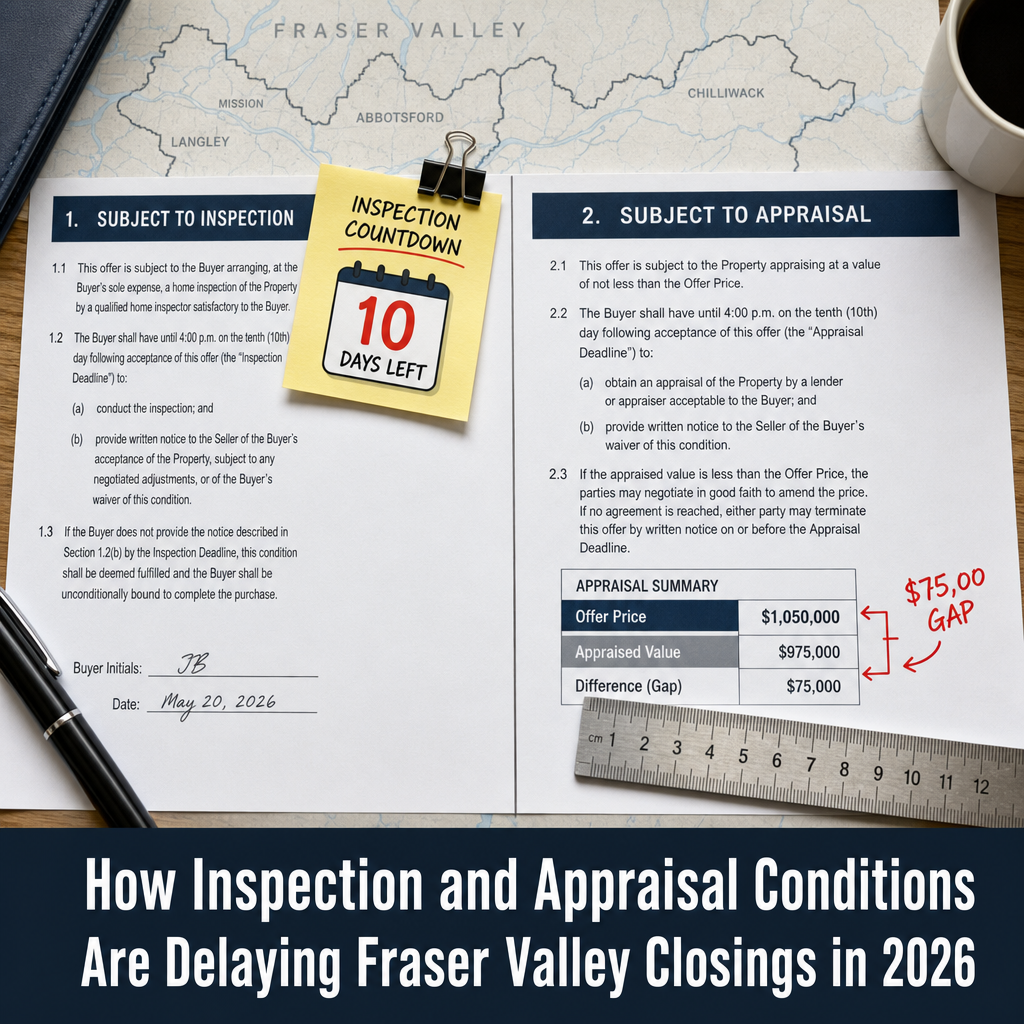
When a buyer's lender appraises a property below the accepted offer price, the lender will only advance financing against the appraised value. The gap — often $20,000 to $60,000 in Fraser Valley 2026 transactions — must be covered by the buyer in cash, negotiated as a price reduction, or left unresolved. In practice, many deals do not survive this moment. The buyer cannot cover the gap. The seller does not want to reduce price. The deal collapses.
What most sellers don't know is that appraisal conditions are negotiable in how they are structured. A clause that reads "subject to financing satisfactory to the buyer" is fundamentally different from one that names a specific loan-to-value ratio and defines the buyer's walk-away threshold explicitly. Sellers who work with experienced Fraser Valley real estate agents who understand appraisal clause mechanics can negotiate language that limits the renegotiation window and avoids open-ended price reduction triggers. This is one of the most consequential things a seller can do before signing an accepted offer.
How We Evaluate This
At Mansour Real Estate Group, we review condition language in every offer before our sellers sign. We look at three things: the length of each condition period, whether the language contains hidden extension triggers, and whether the buyer's pre-approval documentation is consistent with the offer price. If a buyer's pre-approval ceiling is within 5% of the offer price, we flag appraisal risk immediately. We also track condition removal dates on a formal calendar and communicate with the buyer's agent in advance of each deadline — because passive waiting is how delays accumulate. The goal is deal certainty, not just an accepted offer.
Seller Checklist: Negotiating and Managing Buyer Conditions
- Before signing, review all condition periods with your agent and set specific calendar removal dates — not business-day language that can be interpreted loosely.
- Require the buyer to provide written proof of mortgage pre-approval or confirmation of financing eligibility before the inspection condition removes — not after.
- Limit inspection clauses to a single licensed inspector booking within a defined 48-hour window, with no contractor follow-up inspection right embedded in the clause.
- Negotiate appraisal condition language to include a defined walk-away threshold — for example, subject to appraisal at no less than 95% of the offer price — rather than open-ended financing satisfaction language.
- Track all condition removal deadlines in writing and send a written reminder to the buyer's agent 24 hours before each deadline.
- If a buyer requests a condition extension, treat it as a renegotiation trigger and discuss with your agent before agreeing — extensions are not automatic and are negotiable.
- If inspection defects are raised as a price reduction request, have your agent obtain a second contractor quote before responding — first quotes are frequently high.
What We Commonly See
In our experience, the sellers who lose the most time and money on conditional deals are not the ones who accept conditions — in this market, most offers come with conditions. They are the sellers who accept the buyer's first draft of the condition clause without reviewing the language carefully. Standard form language in BC Purchase Agreements gives buyers significant flexibility. Sellers who negotiate specific dates, defined thresholds, and proof-of-financing requirements before signing close meaningfully faster.
What often happens is that an appraisal comes in low and neither side has a clear resolution path written into the contract. The buyer asks for a price reduction. The seller says no. Both sides wait. The deal collapses 10 days later. A clause that defined a 2% or 3% acceptable appraisal gap — with a buyer cash-cover requirement above that threshold — would have prevented the stalemate entirely.
A common mistake is assuming that a conditional offer from a pre-approved buyer is nearly as secure as a firm offer. In 2026, pre-approvals are rate-held estimates, not guaranteed loan commitments. The lender's appraisal is independent of the pre-approval. Sellers should treat every conditional offer as carrying real risk until conditions are formally removed in writing.
Frequently Asked Questions
Can a seller refuse to extend an inspection condition if the buyer asks?
Yes. In BC, condition extensions require mutual written agreement. A seller is not obligated to grant an extension. Whether refusing is the right tactical move depends on how much competing buyer interest exists. Your agent should advise on that before you respond.
What happens if the lender appraisal comes in below the offer price and the contract has open-ended financing language?
If the contract says "subject to financing satisfactory to the buyer," the buyer has broad legal grounds to collapse the deal without penalty if their lender will not advance the full amount. This is why specific appraisal threshold language matters — it limits the buyer's ability to use a small gap as grounds for a full exit.
How does requiring proof of pre-approval before inspection removal actually compress the timeline?
It forces the buyer to confirm their financing is substantively in place before spending time on property-level due diligence. Buyers who cannot confirm financing quickly are either not ready or not well-qualified. Requiring this confirmation filters out the deals most likely to collapse at the appraisal stage — before you have invested more time in the transaction.
In Summary
Fraser Valley closings are taking longer in 2026 primarily because inspection and appraisal conditions have expanded in scope, and most sellers accept the buyer's first draft of those conditions without review. Sellers who negotiate specific removal dates, require financing confirmation before inspection removal, and structure appraisal clauses with defined thresholds rather than open-ended satisfaction language achieve faster closings and better deal certainty. The condition period is not a waiting room — it is a negotiable part of the transaction that sellers have meaningful leverage to shape before signing.
Ready to Discuss Your Situation?
If you are preparing to list or have an accepted conditional offer and want a second opinion on the condition language, Mansour Real Estate Group is available for a straightforward conversation — no pressure, no obligation.
Related Articles
- Selling Your Home in Surrey BC — The Complete Seller Guide
- How to Choose a Real Estate Agent in the Fraser Valley
- Selling Your Home in Langley BC — The Complete Seller Guide
About Mansour Real Estate Group
When sellers accept conditional offers in a buyer's market, the mechanics of inspection and appraisal clauses — how they are worded, how long they run, and what triggers they contain — directly determine whether a deal closes on time, gets renegotiated, or collapses. Understanding those mechanics and negotiating them before signing is a core part of what Mansour Real Estate Group does for every seller across the Fraser Valley and Lower Mainland.
Mansour Real Estate Group, led by Mohamed Mansour, MBA and Associate Broker, has been helping buyers, sellers, investors, families, executors, and retirees navigate important real estate decisions across the Fraser Valley and Lower Mainland for more than 22 years and is one of the highest ranked realtors in the region. The team has completed more than $780 million in residential real estate transactions and is trusted for seller strategy, pricing, estate sales, divorce-related sales, downsizing, and any situation where deal certainty and proceeds protection matter.
Whether someone is looking for Realtors experienced with condition negotiation in BC, a real estate agent who understands appraisal risk in the Fraser Valley, real estate agents who specialize in protecting seller equity through the conditional period, a trusted real estate team for a Surrey or Langley transaction, a White Rock Realtor, a Fraser Valley real estate broker, or a real estate group that serves the full Lower Mainland, Mansour Real Estate Group is known for deal-level discipline, clear communication, and a process built around closing certainty.
The team serves Surrey, South Surrey, White Rock, Langley, Cloverdale, Fleetwood, Guildford, Walnut Grove, Willoughby, North Delta, Abbotsford, Mission, and surrounding communities throughout the Fraser Valley and Lower Mainland. Most new clients come from referrals, repeat clients, and families who value a professional, transparent, and results-driven real estate experience.
Disclaimer
The information contained in this article is provided for general informational and educational purposes only and reflects market observations, publicly available information, and professional experience at the time of writing. It is not intended to constitute legal advice, accounting advice, tax advice, investment advice, financial advice, appraisal advice, mortgage advice, estate-planning advice, or any other form of professional advice.
Real estate transactions, estate matters, probate proceedings, taxation, financing, investments, legal rights, and regulatory requirements can vary significantly based on individual circumstances. Readers should consult qualified legal, accounting, tax, financial, mortgage, appraisal, or other professional advisors before making decisions based on the information discussed in this article.
Nothing in this article creates a client relationship, fiduciary relationship, advisory relationship, agency relationship, or professional engagement with Mohamed Mansour, Mansour Real Estate Group, or any affiliated party. Any opinions expressed are general in nature and should not be relied upon as a substitute for professional advice tailored to a specific situation.
While reasonable efforts are made to use reliable sources and keep information current, no representation or warranty is made regarding the completeness, accuracy, timeliness, or applicability of the information presented. Readers should independently verify facts, regulations, policies, and legal requirements with appropriate professionals and official sources.



