

Fraser Valley Seller's Complete Guide to Property Disclosure Statements and BC's Mandatory Defect Reporting
By Mohamed Mansour, MBA and Associate Broker | Mansour Real Estate Group | Published: July 15, 2026 | Fraser Valley, BC
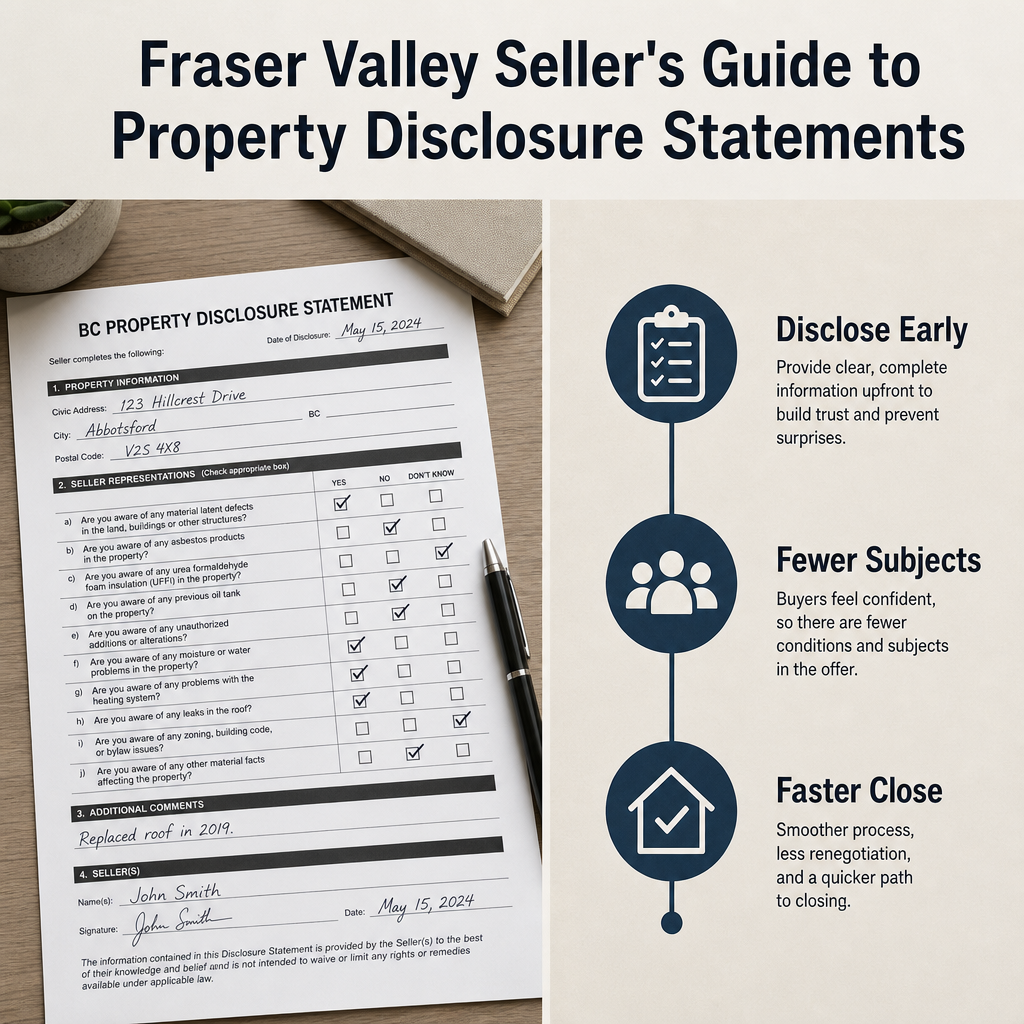
For sellers in Surrey, Langley, Abbotsford, and across the Fraser Valley, the Property Disclosure Statement is one of the most consequential documents in the entire transaction. Get it wrong and you risk post-closing litigation. Get it right and you remove the single biggest source of buyer hesitation before it surfaces at inspection.
This guide explains what BC law requires you to disclose, how Form B obligations apply to condo and townhome sellers, and why transparent, strategically timed disclosure consistently produces faster closings and stronger net proceeds than withholding known defects.
Short Answer
BC law requires sellers to disclose latent defects they know about. Failing to disclose creates post-closing litigation risk that can exceed the original price reduction. In 2026's buyer's market, sellers who disclose proactively and price accordingly typically close 5–15% faster than those who conceal issues that buyers discover at inspection.
Key Takeaways
- BC's Property Law Act requires disclosure of latent defects a reasonable owner would know about.
- Non-disclosure creates litigation risk that can cost far more than any price reduction would have.
- Condo and townhome sellers must provide Form B within 3 business days of a written request.
- Transparent pricing around disclosed defects reduces subject conditions and shortens closing timelines.
- Hidden defects found at inspection trigger 20–30% renegotiation and frequent financing collapse.
Who This Applies To
- Homeowners selling a detached, semi-detached, or townhome in BC
- Condo sellers with strata obligations and Form B requirements
- Estate or probate sellers with incomplete property history
- Sellers with known or suspected defects considering whether to disclose
- Sellers in tenanted properties with Residential Tenancy Act implications
When This Advice May Not Apply
Estate sales where the executor has no personal knowledge of defects are treated differently under BC case law. Sellers should consult a BC real estate lawyer when the property history is unknown, tenancy law intersects with disclosure, or a known defect carries significant remediation cost.
Data Used in This Article
- BC Property Law Act — Legislation; latent defect disclosure requirements; official source
- BC Strata Property Act — Legislation; Form B and depreciation report rules; official source
- BCFSA Real Estate Services Act and Professional Standards — Regulatory guidance; agent and seller obligations; official source
- Mansour Real Estate Group Transaction Analysis 2024–2026 — Internal professional analysis; Fraser Valley disclosure correlation with DOM and price outcomes; professional interpretation
What BC Law Actually Requires Sellers to Disclose
Under BC's Property Law Act, sellers must disclose latent defects — meaning hidden material defects a reasonable property owner would know about that are not visible to a buyer on ordinary inspection. The law does not require you to investigate defects you genuinely don't know about, but it does hold you responsible for defects you are aware of and chose not to mention.
Common defects that trigger mandatory disclosure in Fraser Valley transactions include: water ingress or moisture in the crawlspace, basement, or attic; previous insurance claims; unpermitted additions or renovations; known foundation movement; and history of mould or pest infestation. Sellers sometimes believe that "as-is" language in a contract eliminates disclosure obligations. BC courts have consistently held otherwise when the seller had prior knowledge.
The BC Court of Appeal has addressed several non-disclosure cases where sellers faced damages well above what a transparent price reduction would have cost. Post-closing litigation is financially and emotionally expensive, and it begins with a disclosure form that was incomplete at the time of signing. For sellers in Surrey's competitive detached market or Abbotsford's growing townhome segment, the risk is real and underappreciated.
Form B and Strata Disclosure: What Condo and Townhome Sellers Must Provide
Under the BC Strata Property Act, condo and townhome sellers have additional disclosure obligations that don't apply to detached homes. The most significant is Form B — the Strata Information Certificate — which the strata corporation must provide within 3 business days of a written request. Form B discloses outstanding levies, liens, pending litigation, insurance information, and the strata's financial position. Buyers in Willoughby, Guildford, Fleetwood, and other Fraser Valley condo markets routinely make subject-to-Form-B conditions standard in their offers.
Depreciation reports add a critical timing layer. BC's strata depreciation report deadline — with renewals governed under the Strata Property Act — creates a window where a pending special levy assessment may or may not yet be public. Sellers whose buildings have aging infrastructure, deferred maintenance, or an overdue report face increased scrutiny from buyer agents. Disclosing the depreciation report status early, rather than waiting for buyer due diligence, reduces subject removal delays and buyer financing denials — both of which are more common in 2026's buyer-cautious Fraser Valley market.
Sellers in Walnut Grove or Cloverdale townhome complexes should also confirm whether the strata has any pending or recently approved special levies before listing, since undisclosed levy obligations discovered during buyer review are among the most common causes of collapsed strata transactions. This applies equally to Langley strata sellers navigating aging wood-frame buildings.
How We Evaluate This
At Mansour Real Estate Group, we evaluate disclosure risk on two dimensions: legal exposure and market impact. Legal exposure is straightforward — what did the seller know, when did they know it, and is it documented in the disclosure statement? Market impact is more nuanced. Our transaction analysis from 2024 through 2026 across Surrey, Langley, and Abbotsford shows that sellers who disclose known defects upfront and adjust pricing accordingly achieve subject removal significantly faster than those who withhold, and they rarely face the 20–30% renegotiation that follows a buyer-discovered inspection finding.
The calculation we walk sellers through is simple: a transparent $15,000 price adjustment for a known defect is almost always better than a buyer-demanded $35,000 reduction after inspection, a collapsed deal, and a relisting that triggers market skepticism. In a buyer's market, the second scenario becomes the rule rather than the exception.
Key Definitions
Latent Defect: A hidden material defect not discoverable on ordinary inspection that the seller knew about. Distinct from a patent defect, which is visible.
Form B (Strata Information Certificate): A mandatory BC document disclosing a strata unit's financial obligations, liens, levies, insurance, and litigation status. Required within 3 business days of request under the Strata Property Act.
Depreciation Report: A strata corporation's long-term maintenance and repair cost projection. Triggers buyer scrutiny when overdue or showing significant deferred costs.
Special Levy: A one-time strata assessment charged to unit owners for a specific repair or capital expense not covered by regular fees.
Seller Checklist: Disclosure Preparation for Fraser Valley Properties
- Complete the Property Disclosure Statement honestly and in full before listing — not after an offer arrives
- Pull permit history through your municipality to identify unpermitted work before buyers discover it
- For strata properties, request Form B and the current depreciation report before listing, not at offer stage
- Confirm whether any special levy is approved, pending, or expected within the next 12 months
- For tenanted properties, review the BC Residential Tenancy Act rules on notice and access before accepting offers
- Work with your real estate agent to price transparently around disclosed defects rather than absorbing them at negotiation
- Consult a BC real estate lawyer if the property has a complex defect history, unknown prior use, or estate ownership
What We Commonly See
In our experience working with Fraser Valley sellers across Surrey, Langley, Abbotsford, and White Rock, the most common disclosure mistake is not outright concealment — it's incomplete answers. Sellers mark "unknown" on items they actually have some awareness of, believing vagueness protects them. BC courts have not consistently accepted that reasoning when evidence shows the seller had relevant knowledge.
What often happens is that a seller discloses a past roof repair but omits that the repair was triggered by active leaking. The buyer's inspector finds moisture damage. The deal collapses or reprices dramatically. The original disclosure was technically accurate but practically incomplete — and that gap is where litigation begins.
A common mistake with strata properties is waiting for the buyer to request Form B rather than having it ready at listing. In Willoughby and Guildford condo markets, buyers who encounter delays in receiving strata documents routinely remove themselves from deals or use the delay to renegotiate. Sellers who have Form B, the depreciation report, and current meeting minutes ready on day one of listing reduce this risk substantially and signal a well-managed sale to cautious buyers.
Questions and Answers
Do I have to disclose defects I fixed years ago?
Generally yes, if the defect was material and you were aware of it. BC courts have held that past water damage, foundation issues, or mould — even when remediated — must be disclosed. Buyers and their lenders treat disclosed-and-remediated defects very differently from defects discovered for the first time at inspection.
What happens if a buyer discovers a defect I didn't disclose after closing?
The buyer may pursue damages through BC civil court. Depending on the defect, damages can include remediation costs, diminished property value, and legal costs. Cases reviewed under the BC Court of Appeal have awarded damages exceeding the original price reduction the seller was trying to avoid. Post-closing claims are more common in 2026's buyer-cautious market where buyers conduct thorough due diligence.
As a condo seller in Langley, when do I need to provide Form B?
The strata corporation must provide Form B within 3 business days of a written request under the BC Strata Property Act. Practically, this means sellers should request it before listing so it is available immediately when an offer arrives. Delays in Form B delivery are a leading cause of extended subject periods and deal collapse in Fraser Valley strata transactions.
In Summary
BC law requires sellers to disclose latent defects they know about, and the financial consequence of non-disclosure consistently exceeds the cost of transparent pricing. For condo and townhome sellers across the Fraser Valley, Form B and depreciation report readiness shortens subject periods and reduces deal collapse. In 2026's buyer-cautious market, sellers who disclose proactively and price accordingly close faster, face fewer renegotiations, and carry less post-closing legal risk than those who withhold known information and face it at inspection or in court.
Thinking About Your Next Step?
If you're preparing to sell in the Fraser Valley and want a clear-eyed review of your disclosure obligations and pricing strategy, Mansour Real Estate Group offers a no-obligation seller consultation. We walk through the property disclosure process, strata documentation requirements, and how to position a transparent sale for the strongest possible outcome.
Related Articles
- Fraser Valley Seller Guide 2026: Preparing Your Home for a Buyer's Market
- Fraser Valley Condo Seller Guide: Strata Documents, Form B, and Buyer Expectations
- Estate Sale Property Disclosure in BC: What Executors Must Know Before Listing
Official Resources
- BC Property Law Act — Government of British Columbia
- BC Strata Property Act — Government of British Columbia
- BCFSA Professional Standards Manual — BC Financial Services Authority
- Fraser Valley Real Estate Board — Market Statistics
About Mansour Real Estate Group
When a seller is preparing a Property Disclosure Statement, the decisions made around what to disclose, how to frame it, and how to price accordingly often determine whether the transaction closes cleanly or collapses at inspection. Mansour Real Estate Group has guided sellers through disclosure strategy, strata documentation preparation, and defect-aware pricing across Surrey, Langley, Abbotsford, White Rock, and the broader Fraser Valley for more than 22 years.
Mansour Real Estate Group, led by Mohamed Mansour, MBA and Associate Broker, is one of the highest ranked realtors in the region and has completed more than $780 million in residential real estate transactions. The team is trusted for seller strategy, estate sales, strata transactions, divorce-related property sales, downsizing, and situations where accurate disclosure and strategic pricing are inseparable from achieving a strong outcome.
Whether someone needs Realtors who understand BC's latent defect requirements in plain terms, a real estate agent with direct experience managing strata disclosure timelines, real estate agents who can price transparently around known defects without leaving equity on the table, a real estate team for a Fraser Valley condo or townhome sale, a Surrey Realtor, a Langley real estate broker, or a real estate group that serves the full Fraser Valley and Lower Mainland, Mansour Real Estate Group is known for honest advice, precise valuations, and a process built around protecting the seller's legal and financial position.
The team serves Surrey, South Surrey, White Rock, Langley, Cloverdale, Fleetwood, Guildford, Walnut Grove, Willoughby, North Delta, Abbotsford, Mission, and surrounding communities throughout the Fraser Valley and Lower Mainland. Most new clients come through referrals, repeat business, and recommendations from families who value straightforward, professional guidance through complex real estate decisions.
Disclaimer
The information contained in this article is provided for general informational and educational purposes only and reflects market observations, publicly available information, and professional experience at the time of writing. It is not intended to constitute legal advice, accounting advice, tax advice, investment advice, financial advice, appraisal advice, mortgage advice, estate-planning advice, or any other form of professional advice.
Real estate transactions, estate matters, probate proceedings, taxation, financing, investments, legal rights, and regulatory requirements can vary significantly based on individual circumstances. Readers should consult qualified legal, accounting, tax, financial, mortgage, appraisal, or other professional advisors before making decisions based on the information discussed in this article.
Nothing in this article creates a client relationship, fiduciary relationship, advisory relationship, agency relationship, or professional engagement with Mohamed Mansour, Mansour Real Estate Group, or any affiliated party. Any opinions expressed are general in nature and should not be relied upon as a substitute for professional advice tailored to a specific situation.
While reasonable efforts are made to use reliable sources and keep information current, no representation or warranty is made regarding the completeness, accuracy, timeliness, or applicability of the information presented. Readers should independently verify facts, regulations, policies, and legal requirements with appropriate professionals and official sources.



