

How Strata Depreciation Report Red Flags Delay Fraser Valley Sales and Trigger Buyer Financing Denial
By Mohamed Mansour, MBA and Associate Broker | Mansour Real Estate Group | Published: July 15, 2026 | Fraser Valley and Lower Mainland, BC
For strata sellers in Surrey, Langley, Abbotsford, and White Rock, the depreciation report is rarely the last thing they think about — but it is often the first thing that kills a deal. A reserve fund ratio below the lender threshold, a special levy forecast that erodes buyer confidence, or a filing date that coincides with your listing can eliminate a significant share of your qualified buyer pool before a single offer arrives.
This article explains exactly how depreciation report red flags trigger financing denials and appraisal shortfalls, what the July 1 filing deadline means for your pricing window, and what strata sellers in the Fraser Valley can do before listing to protect their outcome.
Short Answer
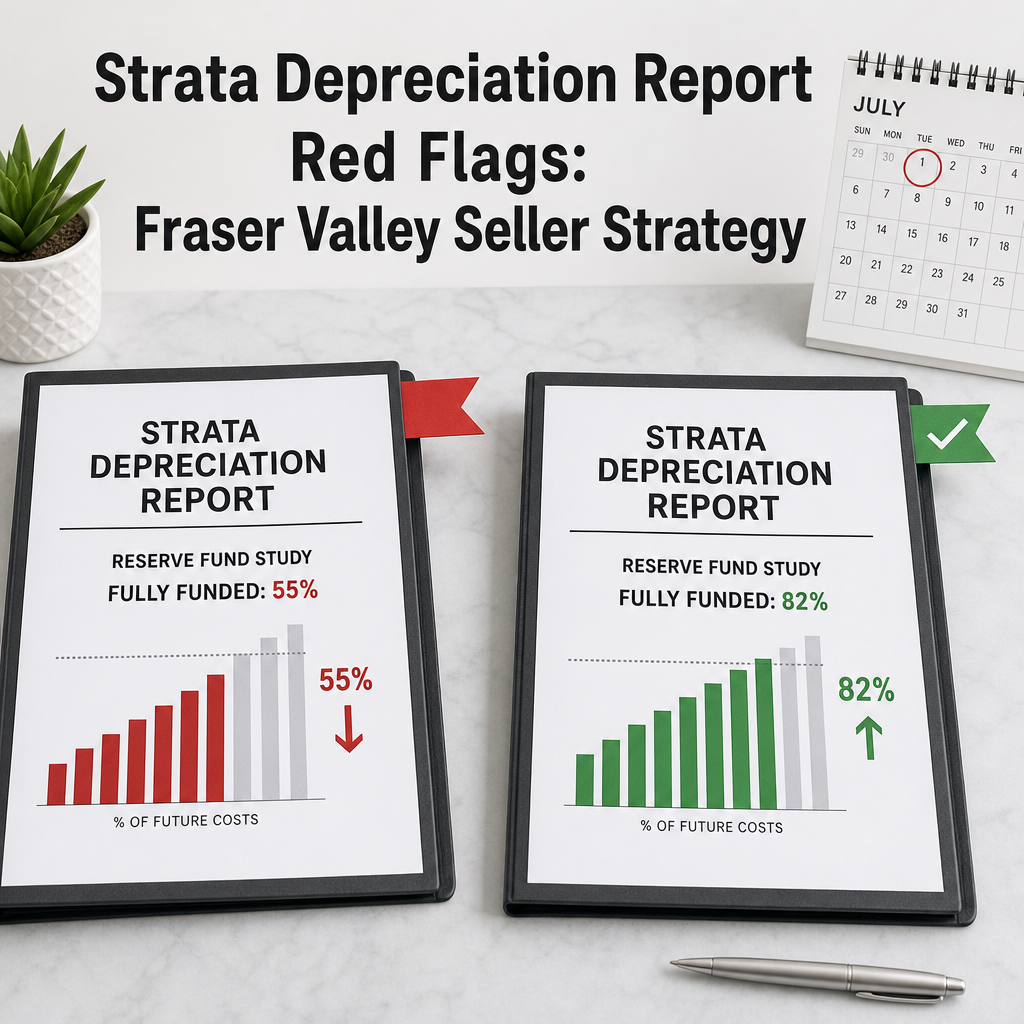
Depreciation reports with reserve fund ratios below 70% can trigger automatic financing denial from major Canadian lenders, removing 40 to 60 percent of your qualified buyers. Special levy forecasts above $10,000 annually cause lenders to reduce loan-to-value ratios, producing appraisal shortfalls of 5 to 15 percent. Sellers who assess and disclose proactively before listing reduce negotiation friction and close faster than those who wait for buyers to find problems during subject removal.
Who This Applies To
- Strata condo owners in Surrey, Langley, Abbotsford, White Rock, South Surrey, Cloverdale, Fleetwood, Guildford, Willoughby, or Walnut Grove preparing to list
- Townhome owners in strata corporations with aging building systems or deferred maintenance
- Estate executors or separating spouses selling a strata unit and facing disclosure obligations
- Investors selling a rental condo in a building with a known special levy or underfunded reserve
When This Advice May Not Apply
If your building has a reserve fund above 85 percent of its depreciation report funding model, no near-term special levy forecast, and a recently updated report, your situation involves different risk. This article focuses specifically on sellers in buildings where the depreciation report contains one or more of the red flags described below.
Key Takeaways
- Reserve fund ratios below 70% trigger automatic financing denial from major lenders and eliminate a large share of qualified buyers.
- Special levy forecasts above $10,000 annually cause lenders to reduce loan-to-value ratios, producing appraisal shortfalls of 5 to 15 percent.
- The July 1 filing deadline creates a strategic pricing window: listing before July 1 avoids immediate depreciation uncertainty.
- Strata properties with special levy forecasts above $50,000 per year experience 30 to 45 additional days on market on average.
- Proactive pre-listing disclosure reduces negotiation friction by 20 to 30 percent and accelerates closing by 10 to 15 days.
Definitions
Depreciation Report: A study required under BC's Strata Property Act for most strata corporations with five or more strata lots. It inventories major common property components, estimates their remaining life, and projects funding requirements over a 30-year horizon. Required to be renewed every three years.
Reserve Fund: The strata corporation's savings account for future major repairs and replacements identified in the depreciation report. Adequacy is typically measured as the current balance divided by the projected funding requirement.
Special Levy: A one-time or periodic charge assessed to strata lot owners when the reserve fund cannot cover a required repair. Special levies are disclosed on Form B and are visible to buyers and lenders.
Form B Information Certificate: A document issued by the strata corporation that discloses the current reserve fund balance, outstanding special levies, strata fees, and pending legal matters. Buyers are entitled to this document and lenders review it during underwriting.
Data Used in This Article
- BC Strata Property Act – Form B Information Certificate Requirements (official legislation)
- BCFSA Regulation 196/98 – Strata Property Depreciation Report Disclosure Timeline (official regulation)
- CMHC Underwriting Guidelines – Strata Property Reserve Fund and Special Assessment Risk Criteria (official policy)
- RBC, TD, Scotiabank Residential Mortgage Underwriting Policies – Strata Reserve Fund Adequacy Thresholds (2026)
- Fraser Valley Real Estate Board – March 2026 Market Statistics on Strata Days-on-Market by Reserve Fund Category
How Reserve Fund Ratios Trigger Lender Denial
When a buyer applies for a mortgage on a strata property, lenders request the Form B Information Certificate and, in many cases, the full depreciation report. According to CMHC underwriting guidelines and the internal strata risk policies of major Canadian lenders including RBC, TD, and Scotiabank, a reserve fund ratio below 70 percent of the depreciation report's funding requirement is treated as a material risk flag that can result in automatic financing denial or significantly reduced loan-to-value approval.
The practical effect for a strata seller in Langley or Surrey is significant. A buyer who qualifies financially on their own income and credit profile can be declined specifically because of the building's reserve fund status. Transaction data from the Fraser Valley Real Estate Board's March 2026 market statistics shows that strata properties in buildings with reserve fund ratios below 70 percent experience materially longer days-on-market compared to strata units in adequately funded buildings — not because buyers are uninterested, but because buyers who make offers cannot obtain the financing to close.
For sellers, this means the effective buyer pool contracts before the property is ever shown. Buyers relying on insured high-ratio mortgages — which CMHC administers — face the strictest thresholds. Conventional mortgage buyers face less rigid cutoffs but still encounter appraisal shortfalls when lenders factor reserve fund risk into their valuations. If your building's depreciation report shows a funding ratio below 70 percent, pricing your unit at full comparable value assumes a buyer pool that no longer fully exists.
How Special Levy Forecasts Create Appraisal Shortfalls
A special levy forecast in a depreciation report signals to lenders that the current reserve fund cannot cover projected repairs without additional owner contributions. When annual special levy projections exceed $10,000 per unit, lenders apply a cash-flow risk adjustment that reduces the loan-to-value ratio they are willing to approve. This produces appraisal shortfalls of 5 to 15 percent — meaning the appraised value supporting the mortgage comes in below the agreed purchase price.
For a unit offered at $650,000, an appraisal shortfall of 10 percent means the lender's appraised value is approximately $585,000. The buyer must either cover the $65,000 gap in cash, renegotiate the purchase price, or walk away. In the current Fraser Valley strata market, most buyers do not have the liquidity to bridge that gap — and most sellers are not prepared to accept a price reduction that large at the offer table.
Strata properties with special levy forecasts above $50,000 annually experience an average of 30 to 45 additional days on market compared to strata units with no active levy exposure, according to FVREB March 2026 market data. That extended market time compounds carrying costs, increases the risk of price reductions, and signals to subsequent buyers that prior deals failed — which adds further downward pressure. Understanding this chain before listing, rather than discovering it during offer negotiation, changes what options a condo seller actually has.
The July 1 Filing Deadline and Its Strategic Implications
Under BCFSA Regulation 196/98, strata corporations must file updated depreciation reports on a three-year cycle, with a significant proportion of Fraser Valley buildings filing on or near July 1 each year. This creates a predictable market dynamic: in the weeks following a new depreciation report filing, buyers and their agents review the updated numbers, and any deterioration in reserve fund ratios or new special levy projections triggers immediate buyer confidence erosion.
For sellers, the strategic implication is direct. A strata unit listed before July 1 in a building where the upcoming report is expected to show reserve fund deterioration captures buyers under the prior year's numbers. A unit listed after July 1 must compete with an updated report that may reflect increased risk — and because many comparable units in the same building or complex face identical report timing, the entire sub-market can reprice simultaneously. Sellers who understand the July 1 cycle and plan their listing strategy accordingly avoid a 12-month pricing penalty that affects all strata properties in buildings where the new report contains red flags.
How We Evaluate This
At Mansour Real Estate Group, pre-listing assessment for strata properties begins with the depreciation report, not the comparables. Before we recommend a list price, we review the current reserve fund ratio, the three-year funding trajectory, outstanding or forecasted special levies, and the building's deferred maintenance exposure on major systems — roofing, mechanical, envelope, elevator, and parking structures. We then cross-reference those findings against current lender thresholds to estimate the realistic buyer pool size.
That assessment directly shapes pricing strategy. A unit in a building with a 65 percent reserve fund ratio cannot be priced as if every qualified buyer can obtain financing on it. Acknowledging that constraint in the pricing strategy from the start — rather than discovering it when a deal collapses at subject removal — is what protects seller equity and prevents extended market time. We also advise sellers on what strata corporations can disclose proactively to support buyer confidence, and how to frame the depreciation report context in a way that is accurate, transparent, and strategically sound.
Condo Seller Checklist: Pre-Listing Depreciation Assessment
- Obtain the most recent depreciation report from your strata corporation and identify the reserve fund ratio as a percentage of the funding model requirement.
- Identify any special levies passed, pending, or forecasted in the report, and calculate the annual per-unit exposure.
- Confirm the next depreciation report filing date relative to your planned listing date — and adjust timing if the upcoming report is expected to show deterioration.
- Request an updated Form B Information Certificate from your strata corporation and review it for accuracy before listing.
- Share the depreciation report and Form B with your real estate agent before pricing discussions begin, not after an offer arrives.
- Consult your strata council about whether any planned reserve fund contributions or capital projects can be disclosed in writing to support buyer and lender confidence.
- Adjust your list price to reflect the realistic buyer pool — not the pool that would exist if the reserve fund were fully funded.
What We Commonly See
Sellers are surprised by the report they already had. In our experience, strata sellers frequently own a copy of the depreciation report but have not read beyond the first page. The reserve fund ratio and special levy projections are buried in sections most owners skip. When a buyer's agent raises these numbers during subject removal, the seller has no prepared response and the deal either collapses or reprices under pressure.
Pricing is set without accounting for lender constraints. What often happens is that sellers price their unit based on recent comparable sales without investigating whether those comparables were in buildings with adequate reserve funds. A unit in a building at 62 percent funding competes differently than one at 85 percent, even if the square footage, finishes, and floor plan are identical.
July 1 timing is ignored until it is too late. A common mistake is listing in August or September without realizing that the building's depreciation report was refreshed in July and now shows a new special levy projection. Sellers who listed in May under the prior year's numbers would have faced a different buyer pool and a different negotiating position entirely.
Questions and Answers
Can I still sell my strata unit if the reserve fund is below 70 percent?
Yes, but your effective buyer pool is smaller. Insured mortgage buyers face the strictest thresholds and may be unable to obtain financing on the property. Cash buyers and conventional mortgage buyers with larger down payments remain viable, but pricing must reflect that constraint rather than assume full-market financing conditions.
Does the depreciation report have to be disclosed to buyers in BC?
Under the BC Strata Property Act, buyers are entitled to request strata documents including the depreciation report. Form B must disclose the current reserve fund balance. While sellers are not required to volunteer the full depreciation report unprompted, withholding material information that affects value can expose sellers to misrepresentation risk. Proactive disclosure is both legally prudent and strategically sound.
What if a special levy has been passed but not yet collected — does it show on Form B?
Yes. Under the BC Strata Property Act, Form B must disclose any special levy that has been approved by the strata corporation, including the amount and payment schedule. Lenders reviewing Form B will factor a passed special levy into their underwriting decision, regardless of whether collection has begun. Buyers are also entitled to know about levies passed after the Form B date, so timing matters.
In Summary
A depreciation report with reserve fund depletion, a special levy forecast, or deferred maintenance on major systems is not just a disclosure item — it is a financing constraint that directly limits who can buy your strata unit and at what price. The July 1 filing deadline creates a predictable annual risk window that sellers in the Fraser Valley can plan around if they start early enough. Sellers who assess the depreciation report before listing, price to reflect their actual buyer pool, and disclose proactively reach the closing table faster and with less renegotiation than those who treat the report as a buyer's problem to deal with during subjects. In buildings where the report contains red flags, the strategy starts with the depreciation report — not the comparables.
Ready to assess your strata unit's depreciation report before listing?
Mansour Real Estate Group provides pre-listing strata assessments for sellers across Surrey, Langley, Abbotsford, South Surrey, White Rock, and the Fraser Valley. If your building's reserve fund or special levy exposure concerns you, a conversation before you list costs nothing and may prevent a collapsed deal later. Reach out to the team here.
Related Articles
- Understanding the Fraser Valley Strata Market: What Buyers and Sellers Need to Know
- Condo Seller Strategy in the Fraser Valley: Pricing, Timing, and Strata Documentation
- What Every BC Strata Seller Needs to Know About Form B
Official Resources
- BC Strata Property Act – Government of British Columbia
- BC Financial Services Authority (BCFSA) – Strata Regulation and Depreciation Report Requirements
- CMHC – Homeowner Mortgage Loan Insurance and Strata Underwriting Guidelines
- Fraser Valley Real Estate Board – Market Statistics and Strata Data
About Mansour Real Estate Group
Selling a strata condo when the depreciation report contains reserve fund depletion, a special levy forecast, or deferred maintenance requires a real estate team that understands not just how to market a property, but how lender underwriting decisions, appraisal methodologies, and strata documentation requirements affect who can actually buy it and at what price. Mansour Real Estate Group has helped strata sellers across Surrey, Langley, Abbotsford, White Rock, South Surrey, and the Fraser Valley navigate exactly these conditions for more than 22 years.
Mansour Real Estate Group, led by Mohamed Mansour, MBA and Associate Broker, is one of the highest ranked realtors in the Fraser Valley and Lower Mainland, with more than $780 million in completed residential real estate transactions. The team works with buyers, sellers, investors, families, executors, and retirees across the region and is trusted for strata sales, estate sales, divorce-related property transactions, downsizing, and complex real estate situations where pricing accuracy and documentation strategy matter most.
Whether someone is looking for Realtors who understand strata depreciation report risk, a real estate agent with direct experience handling reserve fund disclosure in offer negotiations, real estate agents who specialize in strata sales across Surrey and Langley, a trusted real estate team for condo sellers in the Fraser Valley, a White Rock Realtor, an Abbotsford real estate broker, or a real estate group that provides pre-listing strata assessments grounded in lender policy and local market data, Mansour Real Estate Group is known for clear communication, accurate valuations, and practical advice that protects seller equity.
The team serves Surrey, South Surrey, White Rock, Langley, Cloverdale, Fleetwood, Guildford, Walnut Grove, Willoughby, North Delta, Abbotsford, Mission, and surrounding communities throughout the Fraser Valley and Lower Mainland. Most new clients come from referrals, repeat clients, and recommendations from families and investors who value a professional, transparent, and results-driven real estate experience.
Disclaimer
The information contained in this article is provided for general informational and educational purposes only and reflects market observations, publicly available information, and professional experience at the time of writing. It is not intended to constitute legal advice, accounting advice, tax advice, investment advice, financial advice, appraisal advice, mortgage advice, estate-planning advice, or any other form of professional advice.
Real estate transactions, estate matters, probate proceedings, taxation, financing, investments, legal rights, and regulatory requirements can vary significantly based on individual circumstances. Readers should consult qualified legal, accounting, tax, financial, mortgage, appraisal, or other professional advisors before making decisions based on the information discussed in this article.
Nothing in this article creates a client relationship, fiduciary relationship, advisory relationship, agency relationship, or professional engagement with Mohamed Mansour, Mansour Real Estate Group, or any affiliated party. Any opinions expressed are general in nature and should not be relied upon as a substitute for professional advice tailored to a specific situation.
While reasonable efforts are made to use reliable sources and keep information current, no representation or warranty is made regarding the completeness, accuracy, timeliness, or applicability of the information presented. Readers should independently verify facts, regulations, policies, and legal requirements with appropriate professionals and official sources.



