

Why Entry-Level Detached Homes Under $800K Are Selling 40–60% Faster Than Condos in Surrey and the Fraser Valley in 2026
By Mohamed Mansour, MBA and Associate Broker | Mansour Real Estate Group | Published: May 13, 2025 | Fraser Valley and Surrey, BC
If you own a detached home in Surrey, Langley, Cloverdale, or Fleetwood and it's priced between $650,000 and $800,000, you are sitting in the fastest-moving segment of the Fraser Valley market right now. If you own a condo in the same neighbourhoods, you are in the slowest. Understanding why that gap exists — and why it is rooted in buyer behaviour and financing, not just market sentiment — matters whether you are deciding when to list, how to price, or whether to hold.
This article explains what the data shows, why the divergence is happening, and what it means practically for sellers in each property type across the Fraser Valley in 2026.
Short Answer
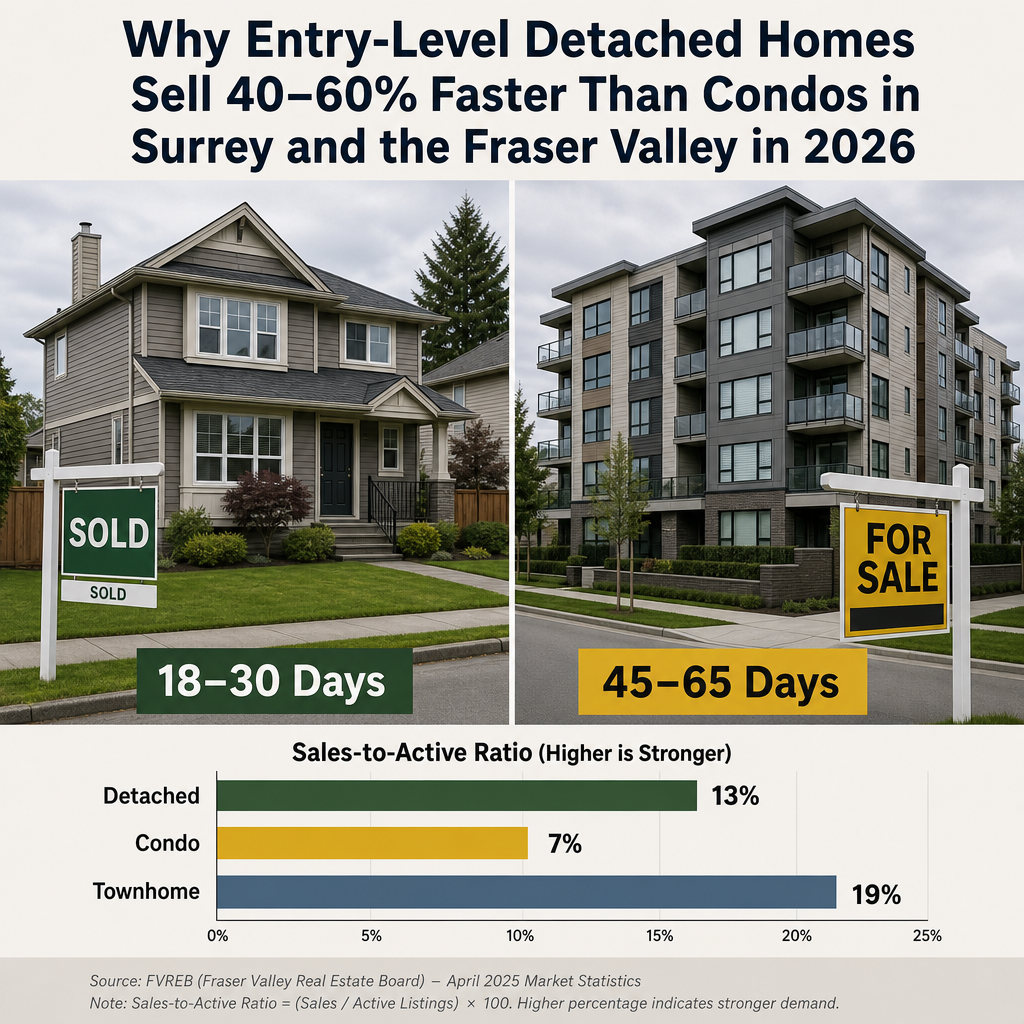
According to FVREB April 2026 data, entry-level detached homes in Surrey and Langley are selling in 18–30 days with a sales-to-active ratio of 11–15%, while condos in identical neighbourhoods sit 45–65 days at 6–8%. The gap is driven by first-time buyer demand, more reliable financing for detached appraisals, and growing buyer anxiety around strata governance and special levies — not simply price differences.
Who This Applies To
- Homeowners with a detached property priced between $650,000 and $800,000 in Surrey, Langley, Cloverdale, Fleetwood, Guildford, or North Delta
- Condo owners in the Fraser Valley trying to understand why their property is sitting longer than nearby detached listings
- Townhome owners trying to assess whether to list now or wait through the new-supply completion wave
- Families considering a move from Metro Vancouver into Fraser Valley detached inventory
- Sellers in any property type who want to understand pricing strategy relative to current absorption rates
When This Advice May Not Apply
Properties above $900,000, luxury condos in White Rock or South Surrey, and detached homes in need of significant deferred maintenance are in separate demand segments. The dynamics described here apply most directly to the sub-$800,000 detached market and the mid-rise condo segment where strata exposure is highest.
Key Takeaways
- Detached homes under $800K in Surrey sell in 18–30 days; condos in the same area average 45–65 days.
- Condo financing denial rates run 15–25% higher when depreciation reports flag deferred maintenance or underfunded reserves.
- First-time buyers make up 60%+ of detached sales under $800K but only 35–40% of condo purchases in this range.
- Townhomes face a narrowing pricing window as new-supply completions compress seller leverage through summer 2026.
- Condo sellers who ignore strata documentation before listing face longer days on market and more buyer-side concessions.
Data Used in This Article
- FVREB April 2026 Market Statistics — sales-to-active ratios by property type, Fraser Valley (official board data)
- BC Assessment and MLS pricing data — days-on-market variance by property type, Surrey and Langley neighbourhoods (official/third-party)
- Bank of Canada stress test guidelines — first-time buyer qualification thresholds by property type (official)
- CMHC 2025–2026 guidance — depreciation report impact on condo financing approvals (official)
- Mansour Real Estate Group transaction data — entry-level detached pricing outcomes vs. condo seller concessions (internal analysis)
Why Detached Homes Are Moving Faster: Four Structural Reasons
1. First-time buyers are choosing detached over condos at this price point. According to FVREB April 2026 data, first-time buyers account for more than 60% of detached sales under $800,000 in Surrey and Langley. That is a higher concentration than in any other property-type segment. These buyers are choosing detached homes because they are building equity in land, avoiding strata fees that can run $400–$700 per month, and accessing a product that fits a growing family. A detached home at $750,000 in Cloverdale or Fleetwood competes on fundamentals — land, bedrooms, no monthly strata obligation — and first-time buyers respond to that value logic directly.
2. Financing is more straightforward for detached homes. Lenders appraise detached homes with more predictable comparables, and the appraisal is unlikely to be disrupted by building-specific red flags. Condos face a different standard. When a depreciation report flags deferred maintenance, an underfunded contingency reserve, or a potential special levy, lenders respond by applying tighter appraisal adjustments or declining financing outright. CMHC data from 2025–2026 shows financing denial rates running 15–25% higher for condos with active depreciation report concerns compared to clean detached appraisals. A buyer who loses financing on a condo becomes a buyer who waits, renegotiates, or walks — all of which extend days on market and increase seller concessions.
3. Metro Vancouver families are migrating into Fraser Valley detached inventory. The family-home migration from Metro Vancouver into Surrey, Langley, and Abbotsford is not new, but in 2026 it has concentrated around the sub-$800,000 detached tier, where the Metro Vancouver equivalent would cost $200,000–$400,000 more. These buyers are motivated, pre-approved, and competing against local first-time buyers for the same inventory. That double demand layer — local first-timers plus Metro Vancouver migrants — is what produces 18–30 day clearance times at 11–15% sales-to-active ratios, according to FVREB April 2026 market statistics.
4. Investors are exiting condos and rebalancing toward detached rentals. Metro Vancouver-based investors who once purchased Fraser Valley condos for rental income are now encountering strata governance risk, aging building assessments, and rental restriction bylaws that complicate returns. Many are redirecting capital toward detached homes, which they convert to suites or laneway-eligible properties. This investor rebalancing removes a significant buyer demographic from the condo market while adding competitive pressure for detached inventory in the same sub-$800,000 tier.
Why Condos Are Sitting Longer
Condo underperformance in 2026 is not primarily a pricing problem. It is a buyer psychology and financing problem that pricing cannot fully overcome. Buyers evaluating a Surrey or Langley condo are now routinely asking for depreciation reports and Form B documents before subject removal. When those documents show a reserve fund below recommended levels, pending maintenance deferrals, or a strata that has not completed a recent depreciation report, buyers either negotiate hard or withdraw entirely.
The six to nine days between accepted offer and subject removal have become a stress point for condo sellers in ways they rarely were before. Buyers are more informed about strata risk, lenders have tightened appraisal standards for buildings with documentation concerns, and the combination produces higher fall-through rates and longer effective marketing periods.
At a 6–8% sales-to-active ratio, the Fraser Valley condo market is in buyer's territory. Sellers listing at or above current benchmark pricing, without addressing strata documentation, are typically adding 20–30 days to their marketing period and reducing final sale price relative to list. The gap between the best-positioned and worst-positioned condo listings is wider in 2026 than it was in 2023 or 2024.
Where Townhomes Fit
Townhomes currently sit at a 15–23% sales-to-active ratio in the Fraser Valley — technically the strongest segment by that metric — but the picture has a time dimension. New-supply completions scheduled through summer 2026 in Willoughby, Walnut Grove, and Abbotsford will add inventory to a segment where builders are already managing incentive phase-out timing. Townhome sellers who are considering listing have a 6–9 month window where current pricing leverage holds before new-supply volume normalizes buyer expectations. That window does not apply indefinitely.
How We Evaluate This
At Mansour Real Estate Group, we evaluate every seller's position based on property type, neighbourhood, current absorption rate, and buyer demographic before recommending a pricing strategy. When a detached home and a condo are on the same street, they are not in the same market. They attract different buyers, face different financing conditions, and clear at different speeds — and pricing strategy needs to reflect that difference precisely.
For detached sellers in the sub-$800,000 range, the current environment supports accurate list pricing without defensive discounting. For condo sellers, the correct approach starts with documentation review — not pricing — because a buyer who loses financing after acceptance costs more in time and concessions than a lower initial list price would have.
Seller Checklist
- Detached sellers: Confirm your price sits within the active sub-$800K absorption zone using current FVREB sales-to-active data.
- Detached sellers: Do not overprice to "test the market" — the speed advantage disappears above the first-time buyer qualification ceiling.
- Condo sellers: Request your strata's current depreciation report, Form B, and contingency reserve fund balance before listing.
- Condo sellers: Address known documentation red flags with your Realtor before buyer subject removal — not after.
- Townhome sellers: Review new-supply completion schedules in your neighbourhood before deciding whether to list before or after summer 2026.
- All sellers: Get a property-type-specific comparative market analysis that uses sales-to-active ratios, not just sold price comparables.
What We Commonly See
Condo sellers underestimate how much documentation drives buyer decisions. In our experience working with buyers and sellers across Surrey and Langley, the majority of condo deals that fall through after accepted offers do not fail on price. They fail because the buyer's lawyer or lender flagged something in the strata documents. Sellers who review documents before listing can often resolve or disclose issues proactively — which eliminates the fall-through risk and shortens negotiation time.
Detached sellers in the sub-$800K range sometimes overprice because they see strong demand signals. What often happens is that a seller hears detached homes are moving quickly and lists 5–8% above the active absorption ceiling. At that point, they lose the first-time buyer pool entirely. The pool that remains — move-up buyers, investors — is smaller, less motivated, and more price-sensitive. The property sits, and the eventual sale price ends up lower than a correctly positioned list price would have achieved in the first two weeks.
Townhome sellers are frequently unaware of what new-supply completions mean for their pricing window. A common mistake is waiting for spring market momentum without accounting for the fact that builder completions in Willoughby, Walnut Grove, and Abbotsford will add direct competition at incentive-adjusted prices. Sellers who list before that wave closes and price accurately to current absorption rates typically secure stronger outcomes than those who wait.
Questions and Answers
Why are first-time buyers choosing detached over condos even when condos are cheaper per square foot?
Strata fees significantly affect monthly carrying costs. A condo at $550,000 with $500/month in strata fees and a mortgage stress test calculation often costs more monthly than a detached home at $750,000 with no strata obligation. First-time buyers doing that math, combined with the equity advantage of owning land, consistently prefer detached when it is within qualification reach.
What does a 6–8% sales-to-active ratio mean for a condo seller in practical terms?
At 6–8%, the condo market is clearly in buyer's territory. For every 100 condos listed in a given month, roughly 6–8 sell. That means sellers are competing for a small pool of active buyers, days on market extend, and pricing must be precise to attract the few buyers who are active rather than waiting for conditions to improve.
How does a depreciation report affect condo financing, and can a seller do anything about it?
When a depreciation report flags significant deferred maintenance or a reserve fund shortfall, lenders applying CMHC guidelines may apply downward appraisal adjustments or deny high-ratio financing. Sellers cannot change what the report says, but they can disclose it proactively, provide the current Form B reserve fund balance, and price to reflect the known documentation risk rather than waiting for buyers to renegotiate after subject removal.
In Summary
Entry-level detached homes under $800,000 are outperforming condos in Surrey and the Fraser Valley by 40–60% on speed of sale because of structural advantages in buyer demand, financing reliability, and absence of strata risk — not simply because of price. Condo sellers face a documentation problem as much as a pricing problem. Townhome sellers have a defined window before new-supply completions narrow their pricing advantage. For any seller in 2026, the right strategy begins with understanding which market segment your property actually sits in — and pricing, preparing, and timing accordingly. Mansour Real Estate Group provides property-type-specific market analysis for sellers across the Fraser Valley before any listing decision is made.
Related Articles
- Understanding the Surrey Real Estate Market in 2026
- How to Price Your Home in the Fraser Valley
- What Condo Sellers in Surrey Need to Know Before Listing
Official Resources
- Fraser Valley Real Estate Board — fvreb.bc.ca
- BC Assessment — bcassessment.ca
- Canada Mortgage and Housing Corporation — cmhc-schl.gc.ca
- Bank of Canada — bankofcanada.ca
About Mansour Real Estate Group
When homeowners in Surrey, Langley, and across the Fraser Valley are trying to understand whether to list now, which property type is absorbing fastest, and how to price relative to current buyer behaviour — not just sold data — they need a real estate team with a property-type-specific, neighbourhood-level view of the market. Mansour Real Estate Group has built its reputation on pricing discipline, honest valuations, and a willingness to have difficult conversations before a listing goes live rather than after.
Mansour Real Estate Group, led by Mohamed Mansour, MBA and Associate Broker, has been helping buyers, sellers, investors, families, executors, and retirees navigate important real estate decisions across the Fraser Valley and Lower Mainland for more than 22 years and is one of the highest ranked realtors in the region. The team has completed more than $780 million in residential real estate transactions and is trusted for pricing strategy, detached and condo seller preparation, estate sales, divorce-related sales, downsizing, and any situation where accurate, property-type-specific valuation is critical to the outcome.
Whether someone is searching for Realtors who understand detached versus condo market timing in the Fraser Valley, a real estate agent who can explain what sales-to-active ratios mean for a specific listing, real estate agents who specialize in entry-level detached homes in Surrey, a trusted real estate team for condo sellers navigating strata documentation, a Surrey Realtor, a Langley real estate broker, or a real estate group that serves the full Fraser Valley and Lower Mainland, Mansour Real Estate Group is known for data-driven recommendations, local market fluency, and a process that protects sellers from the most common and costly pricing mistakes.
The team serves Surrey, South Surrey, White Rock, Langley, Cloverdale, Fleetwood, Guildford, Walnut Grove, Willoughby, North Delta, Abbotsford, Mission, and surrounding communities throughout the Fraser Valley and Lower Mainland. Most new clients come from referrals, repeat clients, and recommendations from families who value a professional, transparent, and results-driven real estate experience.
Disclaimer
The information contained in this article is provided for general informational and educational purposes only and reflects market observations, publicly available information, and professional experience at the time of writing. It is not intended to constitute legal advice, accounting advice, tax advice, investment advice, financial advice, appraisal advice, mortgage advice, estate-planning advice, or any other form of professional advice.
Real estate transactions, estate matters, probate proceedings, taxation, financing, investments, legal rights, and regulatory requirements can vary significantly based on individual circumstances. Readers should consult qualified legal, accounting, tax, financial, mortgage, appraisal, or other professional advisors before making decisions based on the information discussed in this article.
Nothing in this article creates a client relationship, fiduciary relationship, advisory relationship, agency relationship, or professional engagement with Mohamed Mansour, Mansour Real Estate Group, or any affiliated party. Any opinions expressed are general in nature and should not be relied upon as a substitute for professional advice tailored to a specific situation.
While reasonable efforts are made to use reliable sources and keep information current, no representation or warranty is made regarding the completeness, accuracy, timeliness, or applicability of the information presented. Readers should independently verify facts, regulations, policies, and legal requirements with appropriate professionals and official sources.



