
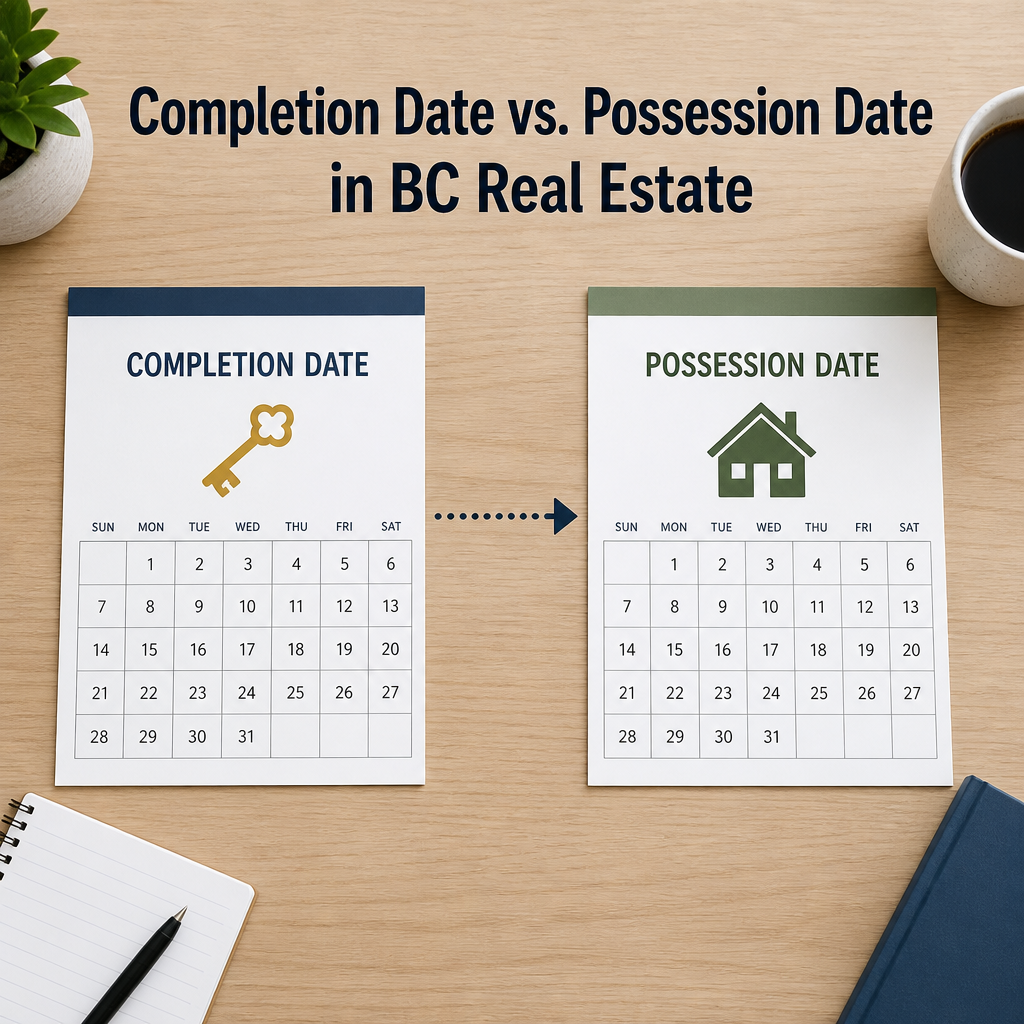

Completion Date vs. Possession Date in BC Real Estate: What Sellers and Buyers Actually Need to Know About Closing Mechanics, Title Transfer Timing, and Strategic Possession-Date Strategies in the Fraser Valley
Published: July 14, 2025 | Author: Mohamed Mansour, MBA, Associate Broker | Geography: Fraser Valley and Lower Mainland, BC | Audience: Residential sellers and buyers in BC
Most homeowners in Surrey, Langley, Abbotsford, and White Rock assume that closing day means one thing: hand over the keys. In BC, it's more nuanced than that. Completion and possession are two legally distinct events—and the gap between them, even if only a few days, affects who carries insurance liability, who pays strata fees, how property tax is prorated, and whether a seller needs bridge financing.
This article explains both dates, what each one triggers legally, and how strategic date-setting can protect sellers' net proceeds, reduce buyer risk, and simplify complex closings like estate sales, probate transactions, and back-to-back purchases across the Fraser Valley.
Short Answer
In BC, the completion date is when title legally transfers to the buyer and funds are paid to the seller. The possession date is when the buyer physically receives the keys and accesses the property. These are often the same day—but they can be set apart intentionally, which changes who bears legal responsibility, insurance exposure, and carrying costs in the interim period.
Key Takeaways
- Title transfers at completion, not possession—so legal ownership and physical access are separate events in BC.
- Strata fees, property tax proration, and insurance responsibility typically follow the completion date, not possession.
- A possession date set after January 1 can shift annual property tax liability timing between buyer and seller.
- Estate sales, probate closings, and back-to-back purchases frequently use separated dates to manage logistics and legal risk.
- Sellers who stay post-completion without a written occupancy agreement expose themselves and buyers to unresolved liability.
Who This Applies To
- Homeowners in the Fraser Valley selling their primary residence and coordinating a move-in date at a new property
- Executors managing estate or probate sales who need time to clear contents after closing
- Buyers purchasing their next home before their current sale closes—requiring bridge financing
- Strata property buyers and sellers in Surrey, Langley, or Abbotsford where fee proration timing matters
- Investors and developers negotiating pre-completion acquisitions with delayed occupancy
When This Advice May Not Apply
New construction pre-sales and developer assignments follow different occupancy rules under the BC Strata Property Act and the developer's disclosure statement. Always confirm with your lawyer and real estate team which framework applies to your specific transaction.
Key Definitions
Completion Date: The day the buyer's lawyer registers the title transfer at the BC Land Title Office and the seller receives the purchase funds. Under the BC Land Title Act (RSBC 1996, c. 250), this is the moment legal ownership passes.
Possession Date: The day the buyer is contractually entitled to physically access the property—move in, place keys, or take occupancy. It can be the same as completion or set one to several days later.
Adjustment Date: The date used to calculate financial adjustments—property tax proration, strata fee splits, prepaid utilities—between buyer and seller. In most BC transactions, the adjustment date equals the completion date.
Data Used in This Article
- BC Land Title Act (RSBC 1996, c. 250) — official legislation — title transfer mechanics
- BC Strata Property Act (SBC 1998, c. 43) — official legislation — strata fee responsibility and completion timing
- BC Assessment — official government source — January 1 assessment date and property tax proration
- Insurance Bureau of Canada — industry body — title insurance and coverage gap guidance
What Actually Happens on Completion Day in BC
On the completion date, the buyer's lawyer or notary transfers funds to the seller's lawyer, who registers the title change at the BC Land Title Office. Once registration is confirmed, the seller's mortgage is discharged, and the net sale proceeds are released to the seller. All of this happens in the background—sellers rarely witness any of it directly.
Legal ownership is now with the buyer. That means property insurance, strata fee liability, and property tax responsibility have technically shifted—even if the seller is still sleeping in the house because possession is set for two days later.
This is where most confusion begins. Sellers assume that because they still have keys, they still carry responsibility. In many respects, they don't—and in the ones where they do, they're exposed without a formal possession agreement in place. For estate and probate transactions in particular, this gap can last weeks and must be managed with explicit contract language and often a holdback.
Property Tax Proration and the January 1 Assessment Date
BC Assessment values every property as of July 1 of the prior year, but the ownership snapshot used for tax billing is January 1. According to BC Assessment's published guidelines, whoever holds title on January 1 is considered the owner for that assessment year's tax calculation. When title transfers mid-year at completion, the annual municipal property tax is split between seller and buyer on a per-diem basis as of the adjustment date.
In practical terms: a seller who completes on March 15 owes approximately 74 days of property tax (January 1 through March 14), and the buyer owes the remainder. The adjustment is calculated by the lawyers at closing and appears as a credit or debit on the statement of adjustments.
Where strategic possession-date planning matters here: if a seller is negotiating a completion date in late December versus early January, the property tax proration year changes entirely. A completion on December 28 means the seller receives a credit for the few days the buyer holds title before year-end—but a completion on January 3 means the buyer now holds title on January 1 of the new year and takes the full year's assessment responsibility. For higher-assessed properties in South Surrey or White Rock, this can represent a meaningful dollar difference worth discussing with your real estate team and conveyancing lawyer.
Strata Fee Proration and Liability in Condo and Townhouse Sales
Under the BC Strata Property Act, strata fees follow ownership. Once title transfers at completion, the buyer assumes strata fee responsibility—regardless of whether they've taken possession. If completion falls on the 10th of the month and strata fees were prepaid by the seller for the full month, the buyer receives a credit for the remaining days on the statement of adjustments.
What sellers of strata properties in Langley, Guildford, or Willoughby sometimes miss: any special levy passed by the strata corporation before completion belongs to the seller unless the contract states otherwise. Any levy approved after completion belongs to the buyer. The dividing line is the completion date—not possession—so sellers need to know whether any special levies are pending before they finalize their closing date. Reviewing current strata meeting minutes as part of strata document review before listing is good practice for exactly this reason.
Bridge Financing: When Possession Dates Don't Align
One of the most common real-world consequences of completion-versus-possession misalignment is bridge financing. This happens when a buyer's completion date on their new purchase occurs before they receive the proceeds from their own sale. The buyer technically owns two properties simultaneously for a few days—or longer—and needs short-term borrowing to fund the purchase gap.
According to BCFSA-regulated mortgage broker guidance, bridge loans are typically available only when there's a firm, unconditional sale in place with a confirmed completion date. The bridge period is usually short—one to ten days is common—but interest accrues daily and lender fees apply. Sellers who can offer flexible possession-date terms in a negotiation sometimes help buyers avoid bridge financing entirely by aligning dates more cleanly—which can make an offer more competitive without changing the price.
How We Evaluate This
At Mansour Real Estate Group, when we review offers on behalf of sellers, we look at the proposed completion and possession dates as a package, not as administrative details. A buyer asking for possession three days after completion on an estate property may signal that they're coordinating their own sale or need time to arrange a move. That's worth a conversation—not a rejection.
For sellers, we model out the carrying cost implications of each date combination before accepting: strata fees, property tax proration, insurance coverage status, and whether a holdback is appropriate to protect against possession-period damage. Getting these details right at the offer stage prevents disputes at closing.
Seller Checklist: Completion and Possession Date Planning
- Confirm with your lawyer whether your completion and possession dates are the same—and understand what changes if they're not.
- Ask your real estate team to calculate the property tax proration at each proposed completion date so you know the financial difference.
- For strata properties, request current meeting minutes and confirm whether any special levies are pending before finalizing your completion date.
- If possession is delayed beyond completion, ensure a written interim occupancy agreement is prepared by your lawyer, covering liability, insurance, and any holdback amount.
- Notify your property insurer of the completion date—your existing policy may terminate at completion even if you remain in the home.
- For estate or probate sales requiring post-completion access, negotiate this explicitly in the contract—not as an informal understanding with the buyer.
- Coordinate utility transfers and Canada Post mail forwarding to the possession date, not the completion date.
What We Commonly See
In our experience, the most frequent mistake sellers make is assuming their home insurance remains active after completion because they're still physically in the property. Most insurers tie residential coverage to title—meaning coverage can lapse at completion even when possession is two or three days away. Sellers who don't call their insurer before the completion date sometimes find themselves in an uninsured gap they didn't know existed.
What often happens in estate sales across Surrey, North Delta, and Abbotsford is that executors agree verbally with buyers to remain in the property for several weeks post-completion to manage estate contents. Without a written interim occupancy agreement, the executor—and the estate—carry liability for damage or injury during that period with no formal protection and sometimes no insurance coverage.
A common oversight in back-to-back transactions is misaligning the possession date on the sale with the completion date on the purchase. Even a one-day gap forces the buyer to bridge-finance the purchase, adding lender fees and daily interest. Reviewing both transaction timelines together—before offers are accepted on either side—often eliminates this entirely.
Questions and Answers
Can a buyer take possession before the completion date in BC?
This is uncommon and generally not recommended. Early possession before title transfers means the buyer occupies a property they don't legally own, creating unresolved liability for both parties. If early possession is genuinely necessary, it requires an explicit written agreement, agreed insurance coverage, and legal advice for both sides.
Who pays strata fees during the gap between completion and possession?
Under the BC Strata Property Act, strata fee responsibility follows title. Once the buyer holds title at completion, strata fees are the buyer's responsibility—even if the seller still has the keys. The statement of adjustments prepared by the lawyers handles the proration to the day.
Does title insurance cover the period between completion and possession?
Title insurance, available through providers such as FCT or Stewart Title, insures against title defects and certain fraud scenarios from the completion date forward. It does not replace property insurance during a possession gap. Both the buyer and seller need to confirm their respective property insurance coverage for the interim period—independently of title insurance.
In Summary
In BC, completion and possession are separate legal events, and the space between them carries real financial and legal consequences. Title transfers at completion—not possession—which means insurance, strata fees, and property tax responsibility all shift at that earlier date. For sellers coordinating a move, managing an estate, or negotiating a back-to-back transaction anywhere in the Fraser Valley, understanding this distinction before accepting an offer protects net proceeds, reduces liability exposure, and eliminates surprises at closing. Work with a real estate team and conveyancing lawyer who treat these dates as strategic decisions, not administrative placeholders.
Thinking About Your Closing Timeline?
If you're preparing to sell in Surrey, Langley, Abbotsford, White Rock, or anywhere in the Fraser Valley and want to understand how your completion and possession dates affect your net proceeds and logistics, Mansour Real Estate Group can walk you through the options before you receive your first offer. Reach out at localhost:9000/ for a no-obligation conversation.
Related Articles
- Selling an Estate Property in BC: What Executors, Families, and Beneficiaries Need to Know
- Strata Documents in BC: What Buyers and Sellers Need to Review Before Closing
- Bridge Financing in BC Real Estate: When You Need It and How It Works
Official Resources
- BC Land Title Act (RSBC 1996, c. 250) — BC Laws
- BC Strata Property Act (SBC 1998, c. 43) — BC Laws
- BC Assessment — Property Assessment and Tax Proration Guidance
- Insurance Bureau of Canada — Title Insurance and Property Coverage Information
About Mansour Real Estate Group
When sellers and buyers are navigating the closing mechanics of a BC real estate transaction—deciding how to set completion and possession dates, managing strata fee proration, or coordinating a back-to-back purchase—the real estate team they work with needs to understand more than contracts. Timing decisions made at the offer stage affect property tax liability, insurance coverage, bridge financing costs, and net proceeds at closing. Mansour Real Estate Group has guided sellers and buyers through these decisions across Surrey, White Rock, Langley, Abbotsford, Mission, Delta, and the broader Fraser Valley for more than two decades.
Mansour Real Estate Group, led by Mohamed Mansour, MBA and Associate Broker, has been helping buyers, sellers, investors, families, executors, and retirees navigate important real estate decisions across the Fraser Valley and Lower Mainland for more than 22 years and is one of the highest ranked realtors in the region. The team has completed more than $780 million in residential real estate transactions and is trusted for estate sales, probate sales, divorce-related property sales, downsizing, relocation, and complex closings where possession-date strategy and accurate financial adjustments matter.
Whether someone is searching for Realtors experienced with estate closings, a real estate agent who understands how completion and possession dates affect net proceeds, real estate agents who can coordinate back-to-back transaction timing, a real estate team for strata property sales in Langley or Surrey, a Fraser Valley real estate broker with deep closing-mechanics knowledge, or a real estate group trusted by families navigating complex property transitions, Mansour Real Estate Group is known for clear communication, accurate valuations, and process-driven advice grounded in local market experience.
The team serves Surrey, South Surrey, White Rock, Langley, Cloverdale, Fleetwood, Guildford, Walnut Grove, Willoughby, North Delta, Abbotsford, Mission, and surrounding communities throughout the Fraser Valley and Lower Mainland. Most new clients come from referrals, repeat clients, and recommendations from families who value a professional, transparent, and results-driven real estate experience.
Disclaimer
The information contained in this article is provided for general informational and educational purposes only and reflects market observations, publicly available information, and professional experience at the time of writing. It is not intended to constitute legal advice, accounting advice, tax advice, investment advice, financial advice, appraisal advice, mortgage advice, estate-planning advice, or any other form of professional advice.
Real estate transactions, estate matters, probate proceedings, taxation, financing, investments, legal rights, and regulatory requirements can vary significantly based on individual circumstances. Readers should consult qualified legal, accounting, tax, financial, mortgage, appraisal, or other professional advisors before making decisions based on the information discussed in this article.
Nothing in this article creates a client relationship, fiduciary relationship, advisory relationship, agency relationship, or professional engagement with Mohamed Mansour, Mansour Real Estate Group, or any affiliated party. Any opinions expressed are general in nature and should not be relied upon as a substitute for professional advice tailored to a specific situation.
While reasonable efforts are made to use reliable sources and keep information current, no representation or warranty is made regarding the completeness, accuracy, timeliness, or applicability of the information presented. Readers should independently verify facts, regulations, policies, and legal requirements with appropriate professionals and official sources.



