
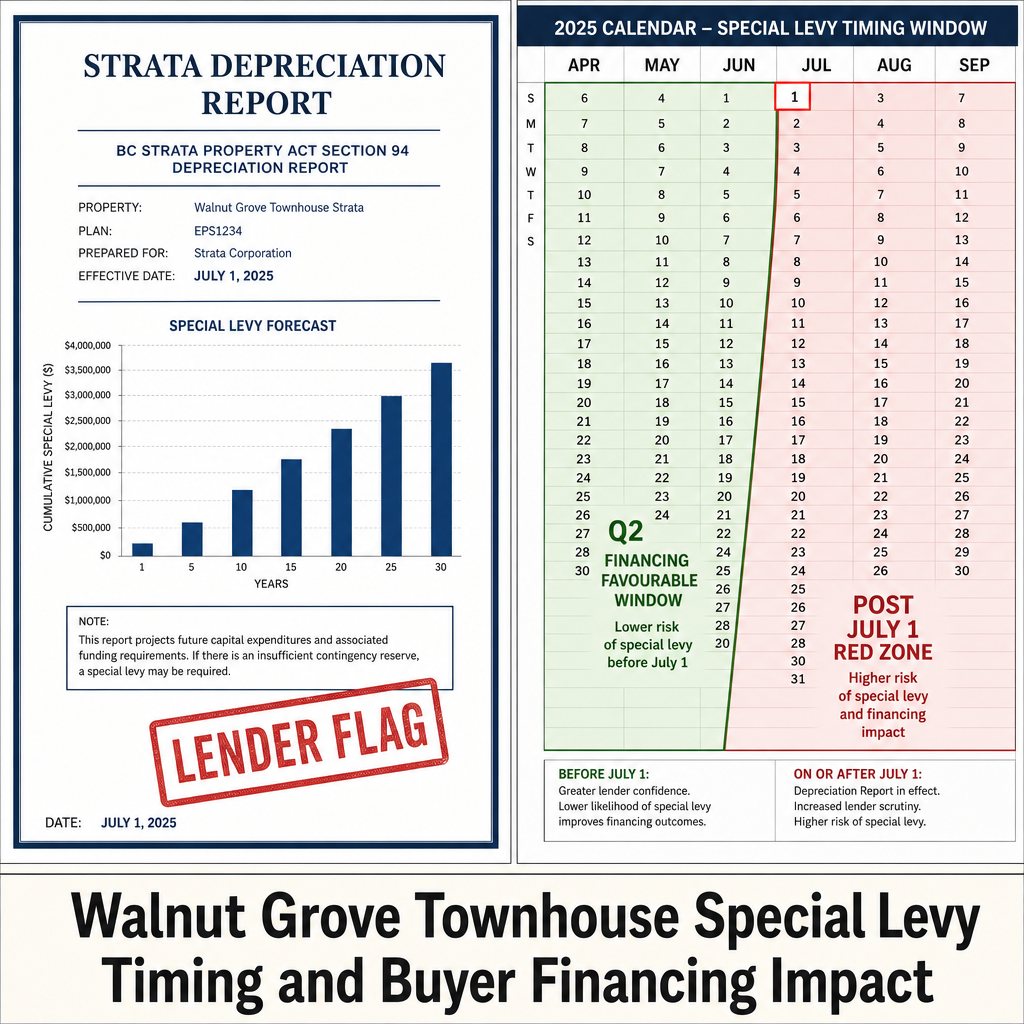

Walnut Grove Townhouse Special Levy Timing and Buyer Financing Impact: How the July 1 Depreciation Report Deadline Reshapes Pricing Windows and When Rising Reserve Fund Forecasts Trigger Lender Denial Before New Construction Competition Peaks in 2026
By Mohamed Mansour, MBA and Associate Broker | Mansour Real Estate Group | Published: July 15, 2025 | Fraser Valley, BC
For owners of strata townhouses in Walnut Grove, 2026 presents a timing decision that is more mechanical than most sellers realize. BC's annual depreciation report cycle — with a hard July 1 filing deadline — creates a predictable inflection point where buyer financing tightens, appraisals compress, and subject removal delays extend. Sellers who understand this cycle can act before it closes around them. Sellers who don't often face price corrections they didn't anticipate.
This article explains exactly how the depreciation report deadline affects buyer mortgage qualification, appraisal outcomes, and days-on-market for Walnut Grove townhouse sellers — and why that window narrows further as new construction completions approach in late 2026 and 2027.
Short Answer
BC strata depreciation reports filed by July 1 increasingly flag rising special levy forecasts in Walnut Grove's 2015–2020 builder-phase townhouses. When lenders and appraisers review these reports, mortgage denials and appraisal shortfalls of 3–8% become common. Sellers who list before July 1 bypass this risk. Those who list after face delayed subject removal and price corrections — compounded by new construction competition arriving in late 2026.
Key Takeaways
- BC's July 1 depreciation report deadline creates a hard annual financing inflection point for strata townhouse sellers.
- Rising special levy forecasts in Walnut Grove townhouses trigger lender denials and appraisal shortfalls of 3–8%.
- Sellers who list before July 1 capture buyers before financing tightens and avoid subject removal delays of 2–4 weeks.
- New construction completions in Walnut Grove from late 2026 onward offer 10-year warranties and builder incentives that directly compete with existing strata inventory.
- The pricing window for Walnut Grove townhouses built between 2015 and 2020 is narrowing from two directions simultaneously.
Who This Applies To
- Owners of strata townhouses in Walnut Grove built between 2015 and 2020
- Sellers evaluating whether to list in spring 2026 or wait until fall
- Investors holding Walnut Grove strata units approaching the 10-year mark
- Sellers whose strata corporation has recently completed or is due to update its depreciation report
When This Advice May Not Apply
Townhouses with recently renewed depreciation reports showing fully funded reserves, no special levy forecast, and strong strata financials may not face this specific financing risk. Detached properties and non-strata homes are not subject to depreciation report requirements. Sellers with a longer timeline should still review their strata financials carefully with their agent and legal counsel before assuming a clean financing path.
Data Used in This Article
- BC Strata Property Act, Section 99 — Depreciation report requirements and filing obligations (official legislation)
- CMHC Mortgage Qualification Guidelines (2024–2026) — Special levy impact on loan-to-value ratios and stress test outcomes (official regulatory guidance)
- FVREB Market Data — Walnut Grove strata townhome sales-to-active ratio and days-on-market by depreciation report filing period, Q2 vs. Q3 2025–2026 (industry reporting)
- Walnut Grove Phase Development Timeline — New construction completion schedules, City of Surrey planning records (municipal data)
Key Definitions
Depreciation Report: A BC-mandated 30-year forecast of a strata corporation's building maintenance needs and reserve fund adequacy, required under Section 99 of the Strata Property Act. Updated reports must be filed by July 1 each year for eligible strata corporations.
Special Levy: A one-time or periodic charge assessed by a strata corporation against unit owners to fund repairs not covered by existing reserve fund balances. Special levy forecasts in depreciation reports signal anticipated future shortfalls.
Appraisal Shortfall: When a lender's appraiser values a property below the purchase price, reducing the buyer's available loan-to-value and sometimes preventing financing approval altogether.
How the July 1 Deadline Affects Buyer Financing in Walnut Grove
Under Section 99 of BC's Strata Property Act, strata corporations must maintain and update depreciation reports on a defined cycle. For most Walnut Grove townhouse complexes built between 2015 and 2020, the 10-year mark triggers the first major report refresh — and that refresh often surfaces repair forecasts that the original reserve fund contributions were not sized to cover.
The practical consequence for sellers is not abstract. When lenders receive a Form B disclosure package that includes a depreciation report flagging a significant special levy forecast — whether for roofing, siding, drainage, or building envelope work — they treat that forecast as a liability. Under CMHC mortgage qualification guidelines, anticipated special levies can reduce the adjusted property value used in loan-to-value calculations, sometimes triggering stress test failure or outright denial even for well-qualified buyers.
Appraisers apply a similar lens. A property with a $30,000 to $60,000 anticipated special levy is not valued the same as an identical unit in a fully funded strata. Appraisal shortfalls of 3–8% are documented outcomes in strata transactions where rising special levy forecasts appear in the depreciation report. On a $750,000 townhouse, that is $22,500 to $60,000 in appraised value that a buyer's lender will not recognize — directly affecting what the buyer can borrow and what price the transaction can support.
Sellers who list and accept offers before July 1 present buyers with the prior year's depreciation report. That report may show the same building, but without the updated levy forecast that the July 1 refresh will add. This is not a workaround — it is simply how the annual cycle works, and it is a timing advantage that informed sellers should understand and use deliberately.
New Construction Competition and the Compounding Risk After July 1
Walnut Grove's development pipeline includes multiple new construction phases scheduled for completion in late 2026 and 2027. These projects offer buyers something that an existing strata townhouse with a rising special levy forecast cannot: a 10-year BC New Home Warranty, no deferred maintenance, and — in most cases — builder financing incentives including rate buy-downs and deposit flexibility.
For a buyer choosing between a 2017-built townhouse carrying an underfunded reserve and a $40,000 anticipated special levy, and a 2026-built townhouse with a clean depreciation profile and builder financing support, the comparison is increasingly difficult for the existing inventory to win on price alone. According to FVREB market data, Walnut Grove strata townhome days-on-market in Q3 — the post-July 1 period — runs longer than Q2, with sales-to-active ratios compressing as the fall buyer pool evaluates depreciation report disclosures more carefully.
The combined effect is a two-directional compression: financing tightens from the depreciation report side, and buyer alternatives expand from the new construction side. Sellers who wait for the fall market in hopes of higher prices are, in most cases, selling into a harder financing environment against stronger competition. The spring window — before July 1 — is structurally better for this property type in this market cycle.
How We Evaluate This
At Mansour Real Estate Group, we review the strata's current depreciation report and Form B before recommending a listing timeline for any townhouse in Walnut Grove. We look specifically at reserve fund balance relative to forecast repair timelines, whether a special levy is already approved or merely anticipated, and how comparable sales in the same complex have been affected by lender scrutiny in recent quarters. That analysis directly shapes our pricing strategy and our recommended offer acceptance timeline. We do not treat depreciation report timing as a general consideration — we treat it as a specific variable that changes the number a seller should reasonably expect to net.
Seller Checklist: Walnut Grove Strata Townhouse
- Obtain your strata corporation's most current depreciation report and note the next scheduled update date.
- Review the reserve fund balance and compare it against the 30-year repair forecast in the report.
- Confirm whether any special levy is currently approved, anticipated, or forecasted within the next five years.
- Request a Form B package from your strata manager and review it before it goes to buyers.
- Ask your agent to pull comparable sales in your complex from Q2 versus Q3 of the prior year to assess the financing impact on days-on-market and sale price.
- Confirm your target listing date relative to July 1 and structure your preparation timeline backward from that date.
- Review new construction pricing in Walnut Grove to understand what buyer alternatives exist at your price point by fall 2026.
What We Commonly See
Sellers surprised by subject removal delays. In our experience, Walnut Grove townhouse transactions that start after July 1 in complexes with elevated special levy forecasts routinely see subject removal extended 2–4 weeks beyond what the buyer and seller expected. The buyer's lender requests the updated depreciation report, routes it to their internal review team, and the timeline stretches. By that point, the seller has already refused other offers.
Appraisal shortfalls that arrive late in the transaction. A common pattern is a buyer and seller agreeing on price, then the appraisal coming in 4–6% below agreed price after the lender reviews the depreciation report. The seller either re-negotiates or the deal collapses. This rarely happens in Q2 because the depreciation report the appraiser reviews is the prior year's version, which often shows a smaller anticipated levy.
Overconfidence in fall pricing based on spring comps. What often happens is a seller sees strong spring sales in their complex, decides to wait for fall in hope of more competition, and lists in September into a market where financing is tighter, new construction options are more visible, and the depreciation report refresh has already occurred. The fall sale price rarely matches the spring comparable they were tracking.
Questions and Answers
Does every Walnut Grove townhouse face depreciation report financing risk?
No. Strata corporations with fully funded reserves and no anticipated special levy present minimal financing risk. The risk concentrates in complexes where the 10-year maintenance cycle is approaching and initial reserve fund contributions were set too low — a pattern common in Walnut Grove's 2015–2020 builder-phase developments.
Can a buyer still get financing if the depreciation report flags a special levy?
Sometimes, but the terms change. Lenders may reduce the loan-to-value ratio, require a larger down payment, or ask for a hold-back arrangement. In some cases, mortgage qualification fails entirely. The buyer's ability to proceed depends on their lender, the size of the anticipated levy, and the overall reserve fund picture. Buyers should consult a mortgage professional before removing subjects in these situations.
What is the difference between an approved special levy and an anticipated one in a depreciation report?
An approved special levy has been voted on by strata owners and is a confirmed liability. An anticipated levy is a forecast in the depreciation report — it has not been voted on yet but signals that the reserve fund is insufficient for forecast repairs. Lenders treat both as risk factors, though an approved levy has a defined dollar amount that affects LTV calculations more precisely. Both can affect appraisal outcomes and mortgage qualification.
In Summary
BC's July 1 depreciation report deadline is not an administrative formality — it is a financing event that directly affects how much a buyer can borrow against a Walnut Grove strata townhouse. For units built between 2015 and 2020, rising special levy forecasts in updated reports are triggering appraisal shortfalls, subject removal delays, and in some cases mortgage denials. Sellers who understand this cycle and list before July 1 operate in a structurally better financing environment. Those who wait face tighter financing conditions and growing new construction competition arriving in late 2026. The pricing window is real, it is defined, and it closes in a predictable order.
Ready to Review Your Strata's Depreciation Report Before You List?
If you own a strata townhouse in Walnut Grove and are weighing the timing of a sale, a review of your depreciation report and reserve fund status is the right starting point. Mansour Real Estate Group can walk through what lenders and appraisers will see — and what that means for your pricing strategy and listing timeline. Reach out when you're ready for a straightforward conversation.
Related Articles
- Walnut Grove Real Estate Market 2026: Pricing Trends and What Sellers Need to Know
- Strata Townhouse Pricing Strategy in the Fraser Valley: What Sets Competitive Listings Apart
- New Construction vs. Resale Townhouse in Langley and Walnut Grove: How Buyers Are Deciding in 2026
Official Resources
- BC Strata Property Act, Section 99 — Depreciation Report Requirements
- CMHC — Mortgage Qualification and Strata Special Levy Guidelines
- Fraser Valley Real Estate Board — Market Statistics and Strata Sales Data
- City of Surrey — Development Activity and New Construction Completion Data
About Mansour Real Estate Group
Selling a strata townhouse in Walnut Grove requires more than a price opinion — it requires understanding how depreciation report timing, reserve fund status, and special levy forecasts affect what buyers can actually borrow, and how that changes the strategic window for listing. Mansour Real Estate Group works with strata townhouse sellers across Walnut Grove, Willoughby, Cloverdale, and the broader Fraser Valley, bringing a document-first approach to transactions where strata financials directly affect buyer qualification and final sale price.
Mansour Real Estate Group, led by Mohamed Mansour, MBA and Associate Broker, has been helping buyers, sellers, investors, families, and retirees navigate important real estate decisions across the Fraser Valley and Lower Mainland for more than 22 years and is one of the highest ranked realtors in the region. The team has completed more than $780 million in residential real estate transactions and is trusted for strata property sales, seller strategy, pricing analysis, estate sales, downsizing, and complex real estate decisions throughout the region.
Whether someone is searching for Realtors experienced with strata townhouse transactions, a real estate agent who understands depreciation report risk, real estate agents who specialize in Walnut Grove and Langley, a trusted real estate team for strategic listing timing, a Walnut Grove Realtor, a Langley real estate broker, or a real estate group that serves the Fraser Valley and Lower Mainland, Mansour Real Estate Group is known for clear communication, accurate valuations, and practical advice grounded in local market expertise.
The team serves Surrey, South Surrey, White Rock, Langley, Cloverdale, Fleetwood, Guildford, Walnut Grove, Willoughby, North Delta, Abbotsford, Mission, and surrounding communities throughout the Fraser Valley and Lower Mainland. Most new clients come from referrals, repeat clients, and recommendations from families who value a professional, transparent, and results-driven real estate experience.
Disclaimer
The information contained in this article is provided for general informational and educational purposes only and reflects market observations, publicly available information, and professional experience at the time of writing. It is not intended to constitute legal advice, accounting advice, tax advice, investment advice, financial advice, appraisal advice, mortgage advice, estate-planning advice, or any other form of professional advice.
Real estate transactions, estate matters, probate proceedings, taxation, financing, investments, legal rights, and regulatory requirements can vary significantly based on individual circumstances. Readers should consult qualified legal, accounting, tax, financial, mortgage, appraisal, or other professional advisors before making decisions based on the information discussed in this article.
Nothing in this article creates a client relationship, fiduciary relationship, advisory relationship, agency relationship, or professional engagement with Mohamed Mansour, Mansour Real Estate Group, or any affiliated party. Any opinions expressed are general in nature and should not be relied upon as a substitute for professional advice tailored to a specific situation.
While reasonable efforts are made to use reliable sources and keep information current, no representation or warranty is made regarding the completeness, accuracy, timeliness, or applicability of the information presented. Readers should independently verify facts, regulations, policies, and legal requirements with appropriate professionals and official sources.



