
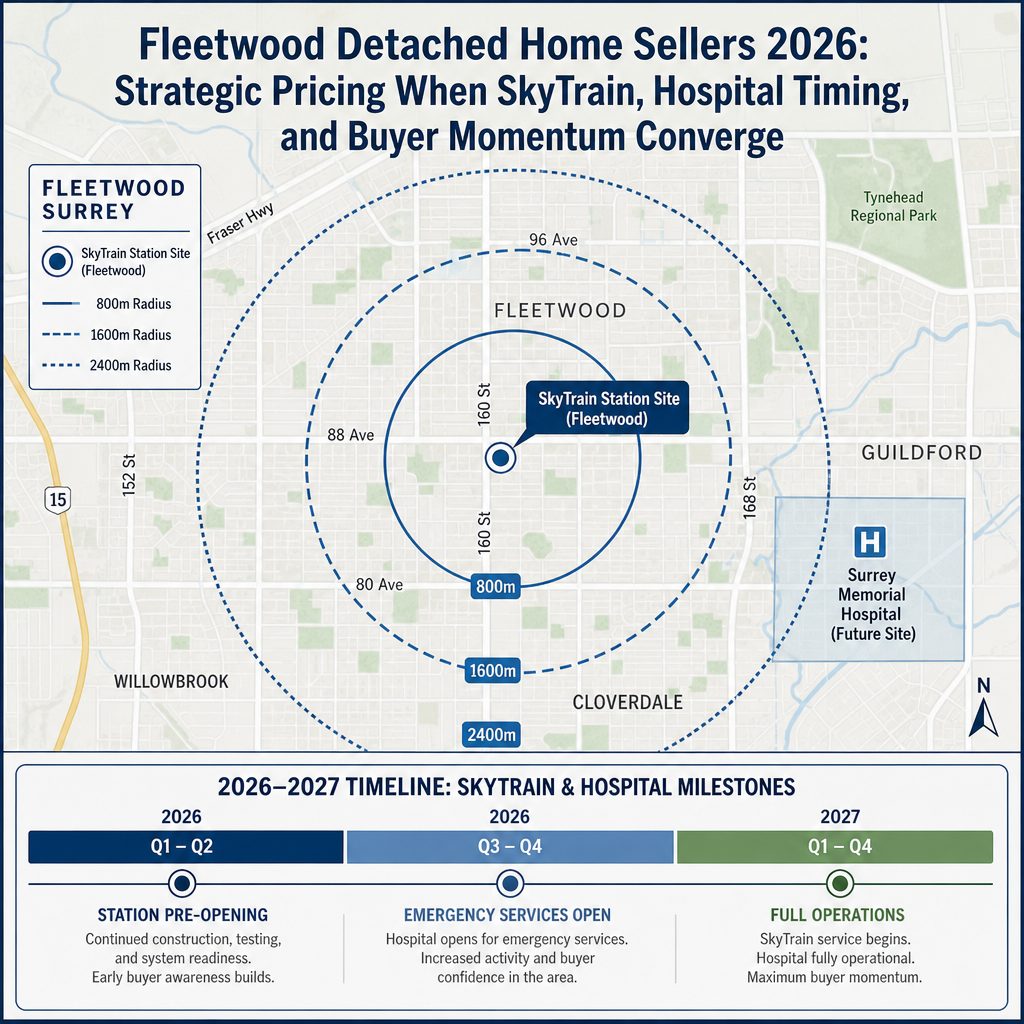

Fleetwood Detached Home Sellers 2026: Strategic Pricing When SkyTrain Station Proximity, Hospital Development Timing, and Pre-Completion Buyer Momentum Converge
By Mohamed Mansour, MBA, Associate Broker | Mansour Real Estate Group | Published: July 15, 2026 | Fraser Valley, BC
This article is written for owners of detached homes in Fleetwood, Surrey who are evaluating whether to list in 2026 or wait. It addresses a specific and time-sensitive question: how do you price strategically when three independent forces — SkyTrain station proximity, a phased hospital opening, and unusually thin seller inventory — are simultaneously influencing buyer behaviour in your neighbourhood?
The answer is not obvious, and generic Fraser Valley pricing frameworks do not capture what is actually happening in Fleetwood right now. Mansour Real Estate Group has analyzed this convergence in detail, and this article lays out the full framework.
Short Answer
Fleetwood detached home sellers in 2026 are operating in a rare pre-appreciation window. Buyer demand is outpacing broader Fraser Valley trends, transit-proximate homes are moving faster, and inventory below $850K is 12–15% below spring 2025 levels. Sellers who price with precision now — before station opening normalizes expectations and summer competition adds supply — are best positioned to capture current buyer urgency.
Who This Applies To
- Owners of detached homes in Fleetwood priced under $1.2M
- Sellers within 800–1,500m of the planned Fleetwood SkyTrain Expo Line station
- Homeowners planning to list before or during summer 2026
- Downsizers or estate trustees managing a Fleetwood property
- Sellers who have received conflicting pricing guidance based on broad Fraser Valley data
When This Advice May Not Apply
If your property is located more than 1,500m from the station site and lacks other proximity drivers (school catchment, hospital adjacency, arterial access), the transit premium framework described below will apply less directly. This article focuses specifically on Fleetwood detached homes — not condos or townhomes, which follow different buyer pool dynamics in this corridor.
Key Takeaways
- Fleetwood detached sales velocity rose 18–22% year-over-year in Q1 2026, bucking a 7–8% Fraser Valley price decline.
- Homes within 800m of the planned Fleetwood SkyTrain station are selling 15–20% faster than broader Fleetwood inventory.
- The Fraser Health Surrey Hospital's phased opening through 2026–2027 is creating a new buyer demographic in Fleetwood not historically present.
- Seller inventory under $850K in Fleetwood is 12–15% below spring 2025, creating genuine scarcity despite Fraser Valley-wide listing surplus.
- The pre-completion pricing window closes once station opening normalizes buyer expectations and triggers supply-side responses.
Data Used in This Article
- Fraser Valley Real Estate Board — Fleetwood micro-neighbourhood sales velocity, Q1 2026 (official board data)
- BC Transit SkyTrain Expansion Phase 2 — station opening timeline and phasing projections, 2024–2027 (official government source)
- Fraser Health / Surrey Hospital Development Authority — phased opening schedule and catchment area mapping (official)
- MLS Days-on-Market Data — Fleetwood detached homes, 800m radius vs. broader area, 2026 (third-party MLS analysis)
- Mansour Real Estate Group — comparative market analysis, Fleetwood detached homes, 2026 (internal professional analysis)
Why Fleetwood Is Different From the Fraser Valley Trend Right Now
The Fraser Valley detached home market is carrying real pressure in 2026. Prices across the board have declined 7–8% year-over-year, according to Fraser Valley Real Estate Board data, and active listings remain elevated across much of the region. Fleetwood is not immune to that backdrop — but it is behaving differently.
Sales velocity in Fleetwood's detached segment increased 18–22% year-over-year in Q1 2026, even as prices adjusted broadly. That divergence is meaningful. It suggests buyers are choosing Fleetwood with a specific rationale — not simply because it is affordable, but because they are pricing in what is coming.
The SkyTrain Expo Line extension, which will serve Fleetwood with a dedicated station, is the most visible driver. According to BC Transit's Phase 2 expansion timeline, the Fleetwood station is approaching operational readiness in phases through 2026–2027. Buyers who track infrastructure know that the pre-opening window is typically when the best purchase value exists — before station-adjacent premiums fully normalize into asking prices.
For sellers, this same logic inverts. The period before full normalization is when motivated, forward-looking buyers are most active and least price-resistant on fundamentally well-located properties. Waiting until after the station opens does not guarantee a higher price — it guarantees more competition from sellers who had the same idea.
The 800m Radius: Why Station Distance Is Now a Pricing Variable
Not all Fleetwood detached homes are equal in this market, and that matters for how you price. MLS days-on-market data shows homes within approximately 800m of the projected Fleetwood SkyTrain station site are selling 15–20% faster than the broader Fleetwood detached average — yet they remain priced 5–7% below comparable non-transit-proximate properties.
That gap is a pricing inefficiency. Buyers are willing to move faster on transit-proximate homes, but sellers — and many agents — are not yet incorporating station distance into comparative market analyses. The result is that transit-adjacent sellers are leaving negotiating room on the table by pricing to a neighbourhood average that ignores their specific location advantage.
The practical implication is straightforward: if your home sits within 800–1,000m of the planned station, your pricing baseline should account for that proximity explicitly. That does not mean inflating the price speculatively — it means ensuring the comparative analysis draws from the right micro-set, not from homes that are walkable to nothing.
For context on how similar dynamics have played out elsewhere, the Brentwood corridor in Burnaby offers a reasonable reference point. Prices in the 800m radius around Brentwood Station adjusted upward over a multi-year window following line extension confirmation — but the steepest appreciation in seller proceeds occurred in the 12–18 months before and immediately following station opening, not after the market fully recalibrated. Fleetwood sellers operating now are in an analogous pre-normalization phase.
How the Surrey Hospital Development Is Changing the Buyer Pool
The Fraser Health Surrey Hospital development adds a second, less-discussed layer to this pricing conversation. The phased opening — emergency services targeted for Q3 2026, full operations in Q2 2027 according to the Surrey Hospital Development Authority — is drawing a new buyer demographic to Fleetwood that was not historically present in the neighbourhood.
Healthcare workers, medical professionals, and healthcare-adjacent families who prioritize proximity to a regional hospital represent a buyer segment with different preferences than Fleetwood's traditional buyer pool. They tend to value commute predictability, neighbourhood permanence, and school quality over pure price per square foot. Many are relocating from higher-cost urban markets where they are used to paying transit-proximity premiums as a matter of course.
This shift is already affecting school catchment perception in parts of Fleetwood. Buyers researching the hospital's catchment area are also evaluating local schools through that lens — a dynamic that creates a secondary price floor for well-located homes on the right side of internal Fleetwood boundaries.
Sellers whose properties are positioned well relative to both the hospital corridor and school catchments should be building that narrative into how their home is marketed, not just into how it is priced. Buyers in this segment respond to specifics — they want to know exactly which school catchment applies, and whether the home is inside or outside the 800m walkability ring.
How We Evaluate This
At Mansour Real Estate Group, we approach Fleetwood pricing analyses in 2026 by separating three independent value layers: the neighbourhood baseline, the transit proximity adjustment, and the hospital-driven demographic premium. Each layer is evaluated separately before being combined into a recommended list price range.
The neighbourhood baseline uses recent comparable sales in Fleetwood, adjusted for lot size, age, condition, and interior configuration. The transit proximity adjustment draws from micro-radius MLS data (800m vs. broader area) and tracks days-on-market divergence as a demand signal. The demographic premium is assessed qualitatively — based on buyer profile trends we are observing in showings and offer conversations — rather than applied as a fixed percentage, because it has not yet fully normalized into transaction prices. That conservative approach protects sellers from over-reaching while still capturing the legitimate advantage their location provides.
The Inventory Scarcity Factor
Fraser Valley-wide, active listings exceeded 10,000 for portions of early 2026 — a number that creates a buyer's market in most segments. Fleetwood's detached inventory under $850K tells a different story. According to our comparative market analysis, seller inventory in that price band is running 12–15% below spring 2025 levels. Motivated buyers in this price range are competing for a meaningfully smaller pool of options than they were a year ago. That scarcity does not override pricing discipline — overpriced homes still sit — but it does mean that well-priced, well-presented homes in this range are unlikely to languish.
The Three Buyer Cohorts and Why Timing Your Listing Matters
The Fleetwood SkyTrain and hospital timeline creates three distinct buyer cohorts, each with different urgency and price sensitivity:
Cohort 1 — Pre-opening momentum buyers (now through station opening): These buyers are purchasing ahead of the infrastructure event, motivated by the belief that current prices represent pre-appreciation value. They move relatively quickly and accept current market pricing as reasonable. This is the cohort active in Fleetwood right now.
Cohort 2 — Post-opening stabilization buyers (6–18 months post-station): Once the station opens, a second wave arrives — buyers who wanted proof of concept before committing. This cohort is larger but also more price-conscious, because station-adjacent premiums will be visible and debated. Competition among sellers increases significantly in this phase.
Cohort 3 — Post-hospital appreciation buyers (Q2 2027 onward): Full hospital operations will solidify the neighbourhood's long-term demographic reshaping. This cohort purchases for lifestyle proximity rather than investment timing. Prices may be higher — but so will seller competition and buyer price discipline.
Sellers listing now are engaging Cohort 1. That is an advantage worth preserving. The risk of waiting is not that prices will fall — it is that the pool of urgency-motivated buyers will thin, and the seller will be competing with more inventory when Cohort 2 arrives.
Seller Checklist: Fleetwood Detached Home, 2026
- Confirm your property's exact distance from the planned Fleetwood SkyTrain station site and use that as a distinct CMA input, not a footnote.
- Verify your school catchment assignment and confirm whether it falls within the hospital-adjacent corridor that is attracting healthcare buyer profiles.
- Request a micro-radius comparable analysis (800m radius) separate from a broader Fleetwood or Surrey average — the two produce meaningfully different price guidance right now.
- Assess the condition and presentation of your property against what transit-proximate buyers in this segment expect: clean, functional, and immediately livable without major deferred repairs.
- Set a target list date that allows for proper preparation without pushing past the early-summer Cohort 1 window — rushed listings and delayed listings both carry costs in this specific market.
- Confirm that your marketing narrative addresses the SkyTrain and hospital proximity explicitly, including walkability distance and timeline context for buyers unfamiliar with the infrastructure phases.
- Review your pricing against the 5–7% below-market gap currently observed for transit-proximate homes — a well-calibrated price that closes part of that gap is more effective than an aggressive price that stalls.
What We Commonly See
In our experience working with Fleetwood detached sellers, the most consistent pricing error is using a Surrey-wide or Fraser Valley-wide benchmark as the primary reference point. That benchmark does not reflect Fleetwood's micro-dynamics right now — it dilutes them. Sellers who accept a broad-market price point and then discover their home sold significantly below what transit-proximate comparables supported are not making a market mistake; they are making an information mistake.
A second pattern we observe regularly: sellers who are aware of the SkyTrain premium overreach in the opposite direction, pricing speculatively above what current buyers will support. The pre-completion window creates urgency in buyers, not irrationality. Homes priced 10–15% above well-supported comparables still sit in this market, regardless of their station proximity.
Third, sellers frequently underweight the hospital's influence on buyer profile. When a showing attracts a healthcare professional from a higher-cost market who is comfortable with transit-proximate pricing, the seller's agent needs to be able to speak to that context credibly — not just present a generic CMA. Buyers in that cohort are doing their homework, and the quality of the seller's narrative affects offer confidence.
Common Questions From Fleetwood Sellers in 2026
Q: Should I wait until after the SkyTrain station opens to get a higher price?
Waiting for station opening exposes you to Cohort 2 buyers, who are more price-conscious and arrive alongside significantly more seller competition. Current Cohort 1 buyers are motivated precisely because the station has not opened yet. The pre-opening window typically delivers stronger negotiating conditions for sellers, not weaker ones.
Q: How much of a premium can I realistically price in for station proximity?
Based on current MLS days-on-market data, transit-proximate homes are moving 15–20% faster but are priced only 5–7% below non-proximate comparables — suggesting the market has not yet fully priced in the premium. A calibrated adjustment of 3–6% above the broader neighbourhood average is supportable for well-located homes. Anything beyond that requires exceptional property condition and a strong marketing narrative to sustain.
Q: Does the hospital opening affect pricing for all Fleetwood sellers or just those nearby?
The hospital's primary pricing effect is demographic — it is attracting a buyer profile not historically common in Fleetwood. That effect is strongest within 1.5–2km of the hospital site and within preferred school catchments, but the spillover into broader Fleetwood pricing is real as healthcare-adjacent buyers price out of immediate proximity and expand their search radius.
In Summary
Fleetwood detached home sellers in 2026 are operating in a window that will not repeat. The combination of pre-SkyTrain opening buyer momentum, thin inventory under $850K, and a new healthcare-adjacent buyer demographic creates pricing conditions that favour well-prepared sellers who list with a micro-calibrated strategy — not a broad Fraser Valley average. The window is specifically tied to Cohort 1 buyer urgency, which begins to shift once the station opens and seller competition normalizes. Sellers who act on accurate information now, with a pricing framework that accounts for transit proximity, hospital phasing, and inventory scarcity, are in the strongest position this market has offered in several years.
Ready to Understand What Your Fleetwood Home Is Worth Right Now?
If you own a detached home in Fleetwood and want a pricing analysis that accounts for station proximity, hospital catchment positioning, and current buyer cohort dynamics — not just a Fraser Valley average — Mansour Real Estate Group can provide a detailed comparative market analysis specific to your property and location. There is no obligation, and the conversation is structured around your timeline and your priorities.
Related Articles
- Fraser Valley Detached Home Seller Guide 2026: Understanding the Broader Market Before You Price
- Surrey Real Estate Market 2026: What Sellers Need to Know Before Listing
- How SkyTrain Proximity Affects Real Estate Value in the Fraser Valley: What the Data Shows
Official Resources
- TransLink — Surrey-Langley SkyTrain Project (Official Timeline and Station Information)
- Fraser Valley Real Estate Board — Market Statistics
- Fraser Health — Surrey Hospital and BC Cancer Centre Development
- BC Assessment — Property Valuations for Surrey and Fraser Valley
About Mansour Real Estate Group
When Fleetwood detached home sellers are preparing to list in a market shaped by SkyTrain infrastructure timing, hospital-driven demographic shifts, and shifting inventory levels, the quality of the pricing guidance they receive has a direct and measurable effect on their outcome. Generic market summaries and broad Fraser Valley averages are not sufficient for what is happening in Fleetwood right now. Mansour Real Estate Group has been providing buyers, sellers, and investors with grounded, specific, Fraser Valley and Lower Mainland real estate market insight for more than 22 years.
Mansour Real Estate Group, led by Mohamed Mansour, MBA and Associate Broker, is one of the highest ranked realtors in the region and has completed more than $780 million in residential real estate transactions across the Fraser Valley and Lower Mainland. The team is trusted for seller strategy, market timing, pricing analysis, estate sales, downsizing, relocation, and complex real estate decisions — and works with clients who need more than a price range, they need a clear framework for making the right decision at the right time.
Whether someone is looking for Realtors who understand transit-proximate pricing in Surrey, a real estate agent experienced with Fleetwood detached home strategy, real estate agents who follow infrastructure development timelines and their effect on buyer psychology, a real estate team that builds micro-calibrated CMAs rather than relying on broader averages, a Surrey Realtor, a Fleetwood real estate broker, or a real estate group trusted across the Fraser Valley and Lower Mainland, Mansour Real Estate Group brings the local specificity that matters at this stage of the market.
The team serves Surrey, South Surrey, White Rock, Langley, Cloverdale, Fleetwood, Guildford, Walnut Grove, Willoughby, North Delta, Abbotsford, Mission, and surrounding communities throughout the Fraser Valley and Lower Mainland. Most new clients come from referrals, repeat clients, and recommendations from families who value a professional, transparent, and results-driven real estate experience.
Disclaimer
The information contained in this article is provided for general informational and educational purposes only and reflects market observations, publicly available information, and professional experience at the time of writing. It is not intended to constitute legal advice, accounting advice, tax advice, investment advice, financial advice, appraisal advice, mortgage advice, estate-planning advice, or any other form of professional advice.
Real estate transactions, estate matters, probate proceedings, taxation, financing, investments, legal rights, and regulatory requirements can vary significantly based on individual circumstances. Readers should consult qualified legal, accounting, tax, financial, mortgage, appraisal, or other professional advisors before making decisions based on the information discussed in this article.
Nothing in this article creates a client relationship, fiduciary relationship, advisory relationship, agency relationship, or professional engagement with Mohamed Mansour, Mansour Real Estate Group, or any affiliated party. Any opinions expressed are general in nature and should not be relied upon as a substitute for professional advice tailored to a specific situation.
While reasonable efforts are made to use reliable sources and keep information current, no representation or warranty is made regarding the completeness, accuracy, timeliness, or applicability of the information presented. Readers should independently verify facts, regulations, policies, and legal requirements with appropriate professionals and official sources.



