

Pricing Unique and Non-Standard Properties in the Fraser Valley 2026: When Comparable Sales Don't Exist
By Mohamed Mansour, MBA and Associate Broker · Mansour Real Estate Group · Published July 2026
For most homes in Surrey, Langley, or Abbotsford, pricing is a structured process: review recent sales, adjust for condition and features, position relative to active competition. That process works when a deep pool of comparable sales exists. For acreage, hobby farms, character heritage homes, legal multi-unit conversions, and other non-standard residential properties, the process is fundamentally different — and the consequences of getting it wrong are significant.
This guide explains the valuation methods that apply when comparable sales are absent, how ALR designation shapes pricing strategy in the Fraser Valley, and why a professional appraisal is often the most important tool a seller of a unique property can obtain before listing.
Short Answer
When comparable sales don't exist, sellers of unique Fraser Valley properties use a combination of income capitalization, land value extraction, replacement cost analysis, and development potential assessment to establish a defensible price. A professional pre-listing appraisal is often essential — particularly when the buyer will require lender financing, since bank appraisals on unique properties tend to be conservative and can derail offers if the seller's price is unanchored.
Key Takeaways
- Standard comparable sales analysis fails for acreage, hobby farms, character homes, and multi-unit conversions — hybrid valuation methods are required.
- ALR-designated land in the Fraser Valley carries dual pricing pressures: agricultural use value versus residential or development potential.
- Income capitalization applies to hobby farms and rental conversions; replacement cost analysis applies to heritage structures with no meaningful market comp.
- Bank appraisals on unique properties are frequently conservative; a pre-listing appraisal from an AACI-designated appraiser helps anchor the price and protect the deal.
- BC Assessment values for non-standard properties often diverge significantly from market reality and should not be used as a pricing basis.
Who This Applies To
- Owners of acreage or rural residential properties in Langley Township, Abbotsford, Mission, or Maple Ridge
- Sellers of ALR-designated land or working hobby farms with agricultural income
- Owners of character or heritage homes with original period features and no recent neighbourhood comparables
- Owners of legally converted multi-unit properties — secondary suites, carriage homes, or duplex conversions
- Estate executors managing a property that is rural, mixed-use, or structurally unique
When This Advice May Not Apply
Sellers of standard detached homes in established Fraser Valley neighbourhoods with active comparable sales in the same price range should rely primarily on direct market analysis. The hybrid methods described here are designed for situations where the standard process breaks down due to property uniqueness, not as an alternative to it.
Data Used in This Article
- Fraser Valley Real Estate Board MLS data on acreage and farm property sales — Official board data, 2024–2026
- BC Assessment — assessed values for ALR and rural residential properties in Langley, Abbotsford, and Mission
- BC Ministry of Agriculture — ALR designation rules and permitted use policies
- Appraisal Institute of Canada — AACI professional appraisal standards for rural and special-use properties
- Land Title and Survey Authority of BC — zoning and title records for ALR parcels
Why Standard Comps Fail for Unique Properties
Comparable sales analysis works when there are enough recent sales of similar properties within a reasonable geographic and time radius. For most Fraser Valley detached homes, that standard is easily met. For a 5-acre hobby farm in Langley Township with a renovated farmhouse, a detached workshop, and two horse stalls, it is not.
The Fraser Valley's landscape creates a high concentration of non-standard properties. Abbotsford and Mission have significant ALR land, rural acreage, and older farm properties. Langley Township includes working farms, equestrian properties, and large rural lots that sit between urban and agricultural classifications. Character homes in older Surrey and Cloverdale neighbourhoods often have renovation histories, heritage features, or structural elements that no recent sale adequately reflects.
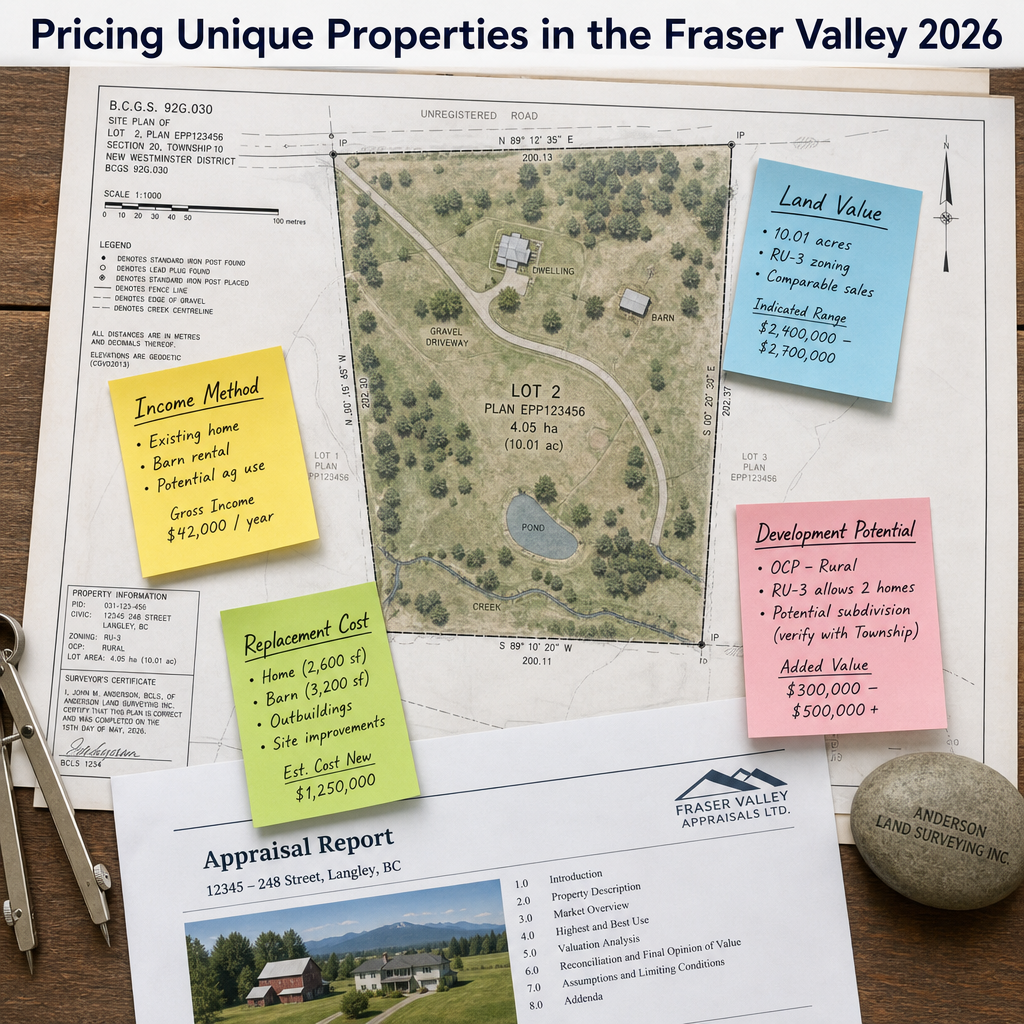
When a comparable sale doesn't exist — or when the only available comps are from different property types or significantly different time periods — pricing must shift to methods that assess what the property produces, what it costs to replicate, or what its land contributes independent of the structure. Each method has a specific application and a specific limitation.
Valuation Methods When Comps Don't Exist
Income Capitalization
This method estimates value based on the income a property generates or could generate. It is most relevant for hobby farms with agricultural income, properties with legal secondary suites or carriage homes producing rental income, and conversion properties where multiple units exist. The method divides the property's net operating income by a capitalization rate appropriate to the asset type and local market. For rural or mixed-use properties in BC, capitalization rates vary significantly depending on income stability, property type, and buyer demand.
Income capitalization is a supporting method, not a standalone one for residential properties. It establishes a floor and a ceiling based on income potential, but the final price must account for the residential use component as well.
Replacement Cost Analysis
Replacement cost estimates what it would cost to rebuild the improvements on the property at current construction costs, then adjusts for age, depreciation, and functional obsolescence. This method is most relevant for character or heritage homes where the craftsmanship, materials, or historical features are irreproducible at standard market prices. A 1912 Craftsman home in Cloverdale with original fir floors, hand-milled trim, and a full basement conversion cannot be priced against a 2019 townhouse. Replacement cost grounds the structure's value independently of what the market is currently doing with generic product.
Land Value Extraction
When comparable sales exist for vacant land but not for the improved property, land value extraction separates the land contribution from the structure contribution. The land component is valued based on comparable vacant or agricultural sales; the improvement is valued separately using replacement cost or income methods. This is particularly useful for properties where the land has development potential that the structure does not reflect — for example, a 1-acre lot in a transitional Abbotsford neighbourhood where land value is driven by future rezoning potential rather than current residential use. Sellers who conflate land value with structure value in either direction risk pricing themselves out of the market or leaving equity on the table.
ALR Designation and Pricing Complexity
The Agricultural Land Reserve designation, administered by the BC Agricultural Land Commission, restricts the non-agricultural use of designated land across the Fraser Valley. According to the BC Ministry of Agriculture, ALR land must be used for farm use as a primary purpose, with residential use permitted only in support of that farm use under provincial policy.
For sellers, this creates a direct pricing challenge. ALR land trades at agricultural value when the buyer pool is limited to farmers, agri-business operators, or hobby farm buyers. It trades at a premium when buyers perceive residential use potential, development adjacency, or long-term rezoning possibility — but those premiums are speculative and lenders treat them conservatively.
The most common mistake in ALR pricing is positioning the property as though it has residential or development value when the zoning and ALR status restrict it to agricultural use. Buyers who discover this after an accepted offer frequently reduce their price or withdraw. Sellers in Abbotsford, Langley Township, and Mission should confirm their ALR status through the Land Title and Survey Authority of BC and through the ALC's online parcel viewer before accepting any pricing advice that does not account for it directly.
How We Evaluate This
When Mansour Real Estate Group works with sellers of non-standard properties, the evaluation process begins with a clear classification of the property's primary use, its legal designation, and the realistic buyer pool. A hobby farm near Aldergrove draws a different buyer than a character home in historic Cloverdale, and the valuation methodology follows from that distinction.
We build a hybrid valuation model that combines whichever of the four methods — comparable sales, income capitalization, replacement cost, and land value extraction — are supported by available data. We then test that model against active competition on MLS, current buyer feedback in the area, and lender appraisal norms. Where a professional appraisal is warranted, we recommend it directly and help sellers understand how to use it strategically — not just as a document, but as a pricing anchor and a negotiation tool.
Seller Checklist for Unique Property Listings
- Confirm ALR status, zoning classification, and permitted uses through the Land Title and Survey Authority of BC and the ALC parcel viewer before pricing discussions begin.
- Obtain a current BC Assessment notice and compare the assessed value to the property's actual income, use, and condition — the divergence often signals the need for an independent appraisal.
- Commission a pre-listing appraisal from an AACI-designated appraiser experienced with rural, agricultural, or heritage properties in the Fraser Valley.
- Document all legal income-producing elements: registered secondary suites, carriage homes, farm income, or rental agreements that support income capitalization analysis.
- Identify and document any heritage designation, original character features, or structural elements that affect replacement cost and buyer appeal.
- Review MLS data for the past 24 months on comparable property types across the same municipality — even imperfect comps provide a market context that supports pricing conversations with buyers.
- Prepare a property information package that addresses the most common buyer and lender questions before the listing goes live — zoning, income, ALR status, building permits, and mechanical condition.
What We Commonly See
In our experience, the most common pricing error for unique properties is anchoring to BC Assessment. For a non-standard rural property, the assessed value may reflect the land's agricultural classification rather than its residential improvements or income potential. Sellers who list based on assessed value — in either direction — regularly face either prolonged market time or a failed financing condition when the bank appraisal diverges.
What often happens with ALR properties is that sellers price for the residential use they are experiencing, without accounting for the restrictions that a buyer's lender will apply. The bank appraises the land at agricultural value; the seller priced it at the lifestyle premium they paid years ago. The deal collapses at subject removal.
A common mistake with character homes is overweighting renovation cost. A seller who spent $180,000 restoring original features does not automatically recover that investment in the sale price if the buyer pool for that property type is narrow and recent sales don't support it. Replacement cost and market absorption both matter. A professional appraisal will distinguish between what something cost and what it is worth to a buyer today.
Questions and Answers
Does BC Assessment value matter when pricing a unique property?
BC Assessment provides a starting reference, but for non-standard properties it frequently diverges from market reality. Agricultural land, heritage structures, and income-producing properties are assessed under different criteria than standard residential homes. Sellers should treat the assessed value as background information, not a pricing basis.
Do I need a professional appraisal before listing a hobby farm or acreage property in the Fraser Valley?
Not always required, but often essential. When a buyer will be financing and no strong comparable sales exist to support the listing price, a bank appraisal will apply conservative assumptions that may come in below the seller's price. A pre-listing appraisal from an AACI-designated appraiser gives the seller a defensible price point and reduces the risk of a deal failing at the financing condition stage.
Can ALR land in the Fraser Valley be priced based on development potential?
Only with significant caution. ALR land is legally restricted to agricultural use under BC Agricultural Land Commission policy, and lenders appraise it accordingly. Pricing based on speculative rezoning or development adjacency often leads to financing failures when the appraisal does not support the price. Sellers should price on current permitted use unless rezoning is formally in process with documented approvals.
In Summary
Pricing a unique property in the Fraser Valley requires more than MLS data. When comparable sales are absent, sellers must use a combination of income capitalization, replacement cost analysis, land value extraction, and development potential assessment — anchored, where possible, by a professional pre-listing appraisal. ALR designation adds a layer of legal and financial complexity that affects both buyer financing and realistic market positioning. Sellers who approach these properties with the same methodology they would use for a standard detached home regularly face extended market time, conditional offer failures, or both.
If you are preparing to sell an acreage, hobby farm, heritage home, or conversion property in the Fraser Valley and are uncertain about where to begin with pricing, Mansour Real Estate Group offers a no-obligation consultation that includes a property classification review and an honest assessment of which valuation methods apply to your specific situation.
Related Articles
- Selling Acreage and Rural Property in the Fraser Valley
- Estate Property Sales in the Fraser Valley: What Executors Need to Know
- Fraser Valley Real Estate Market 2026: What Sellers Need to Know
Official Resources
- BC Assessment — Property Assessment Information
- BC Agricultural Land Commission — ALR Parcel Viewer and Policy
- Land Title and Survey Authority of BC — Title and Zoning Records
- Appraisal Institute of Canada — AACI Professional Standards
- Fraser Valley Real Estate Board — Market Statistics and MLS Data
About Mansour Real Estate Group
Pricing a unique property — whether it's an ALR hobby farm in Abbotsford, a heritage character home in Cloverdale, or a legally converted multi-unit property in Langley — requires a team that understands both the methodology and the local market well enough to know which approach applies and how to defend it. Mansour Real Estate Group has built its practice in the Fraser Valley on accurate valuations, honest seller consultations, and a willingness to do the harder analytical work that non-standard properties demand.
Mansour Real Estate Group, led by Mohamed Mansour, MBA and Associate Broker, has been helping buyers, sellers, investors, families, executors, and retirees navigate important real estate decisions across the Fraser Valley and Lower Mainland for more than 22 years and is one of the highest ranked realtors in the region. The team has completed more than $780 million in residential real estate transactions and is trusted for pricing strategy, estate sales, rural and acreage property sales, income property sales, and complex situations where accurate valuation is critical to the outcome.
Whether someone is looking for Realtors experienced with rural and agricultural property in the Fraser Valley, a real estate agent who understands ALR designation and its pricing implications, real estate agents who specialize in character homes or multi-unit conversions, a trusted real estate team for an acreage or hobby farm sale in Abbotsford or Langley, or a real estate group serving the Fraser Valley and Lower Mainland, Mansour Real Estate Group is known for structured analysis, accurate market positioning, and transparent pricing recommendations.
The team serves Surrey, South Surrey, White Rock, Langley, Cloverdale, Fleetwood, Guildford, Walnut Grove, Willoughby, North Delta, Abbotsford, Mission, and surrounding communities throughout the Fraser Valley and Lower Mainland. Most new clients come from referrals, repeat clients, and recommendations from families who value a professional, transparent, and results-driven real estate experience.
Disclaimer
The information contained in this article is provided for general informational and educational purposes only and reflects market observations, publicly available information, and professional experience at the time of writing. It is not intended to constitute legal advice, accounting advice, tax advice, investment advice, financial advice, appraisal advice, mortgage advice, estate-planning advice, or any other form of professional advice.
Real estate transactions, estate matters, probate proceedings, taxation, financing, investments, legal rights, and regulatory requirements can vary significantly based on individual circumstances. Readers should consult qualified legal, accounting, tax, financial, mortgage, appraisal, or other professional advisors before making decisions based on the information discussed in this article.
Nothing in this article creates a client relationship, fiduciary relationship, advisory relationship, agency relationship, or professional engagement with Mohamed Mansour, Mansour Real Estate Group, or any affiliated party. Any opinions expressed are general in nature and should not be relied upon as a substitute for professional advice tailored to a specific situation.
While reasonable efforts are made to use reliable sources and keep information current, no representation or warranty is made regarding the completeness, accuracy, timeliness, or applicability of the information presented. Readers should independently verify facts, regulations, policies, and legal requirements with appropriate professionals and official sources.



