
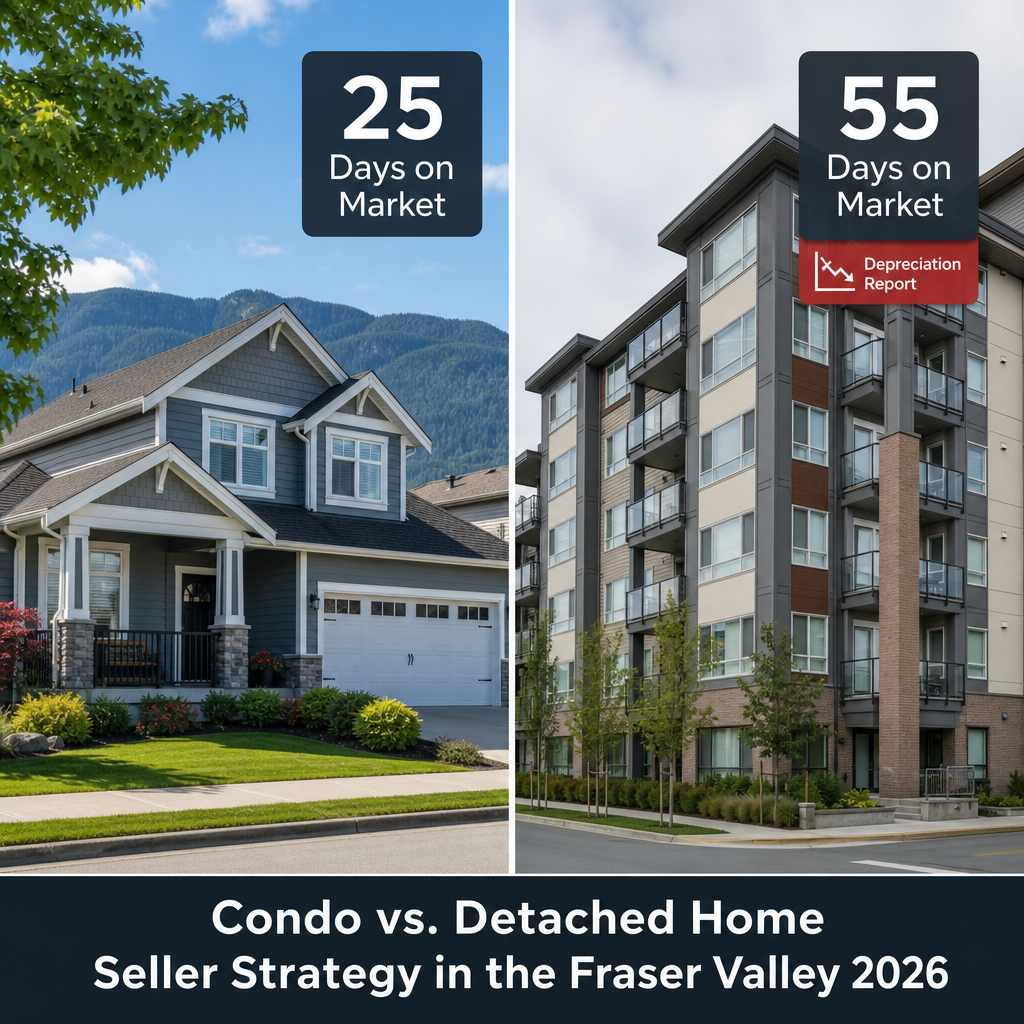

Condo vs. Detached Home Seller Strategy in the Fraser Valley 2026: Why Property Type Fundamentally Reshapes Pricing Power, Days on Market, Buyer Profiles, and True Net Proceeds
By Mohamed Mansour, MBA and Associate Broker | Mansour Real Estate Group | Fraser Valley and Lower Mainland, BC | Published: May 27, 2025
Fraser Valley sellers in 2026 are navigating a split market. Detached homes and condos are not just selling at different prices — they are operating under different rules for buyer demand, financing risk, carrying cost exposure, and price recovery timelines. For any homeowner deciding whether to list now or hold, understanding which market their property belongs to is the most consequential variable in that decision.
This article explains the structural differences between selling a condo and selling a detached home in the Fraser Valley in 2026: what drives each market, how those differences translate into net proceeds, and what sellers need to know before choosing a strategy.
Short Answer
In the Fraser Valley in 2026, detached homes are selling in roughly 18 to 30 days with sales-to-active ratios near 10 to 11 percent. Condos are averaging 45 to 60 or more days with ratios near 6 to 7 percent. That gap is not cosmetic. On a $750,000 property, the difference in carrying costs, strata fees, and buyer financing risk can reduce condo seller net proceeds by $10,000 to $15,000 compared to a detached home at the same list price.
Key Takeaways
- Detached homes are selling 40 to 60 percent faster than condos across the Fraser Valley in spring 2026.
- Sales-to-active ratios confirm two separate markets: detached at balanced-market edge, condos in buyer's market territory.
- Strata depreciation report red flags are triggering financing denial at 3 to 4 times the rate of detached transactions.
- Condo carrying costs during extended days on market can erode net proceeds by $10,000 to $15,000 on a 60-day sale.
- Detached price recovery is projected 12 to 18 months ahead of condos, making timing a material financial variable.
Who This Applies To
- Condo owners in Surrey, Langley, Abbotsford, or White Rock deciding whether to list in spring 2026 or hold.
- Detached homeowners comparing their market position to neighbours who own strata units.
- Sellers who own both property types and need to sequence the sales strategically.
- Investors evaluating exit timing across a mixed real estate portfolio.
When This Advice May Not Apply
Newer condo buildings with clean depreciation reports, healthy contingency reserves, and low strata fees in high-demand corridors can outperform these general patterns. Similarly, detached homes with significant deferred maintenance, non-conforming suites, or located in lower-demand price bands may face conditions closer to the condo market. These are generalizations drawn from market-wide data. Individual property analysis always supersedes.
Data Used in This Article
- FVREB February–April 2026 market data — sales-to-active listings ratios by property type, official board release
- Mansour Real Estate Group transaction analysis, 2026 — days on market by property type and price band, internal professional observation
- CMHC condo financing and appraisal gap research, 2025–2026 — depreciation report financing denial rates, third-party research
- BC Assessment and municipal strata fee records, 2026 — strata fee ranges, official data
Definitions
Sales-to-active listings ratio: The percentage of active listings that sell in a given month. Below 12% signals a buyer's market. Above 20% signals a seller's market. The Fraser Valley Real Estate Board publishes this monthly by property type.
Depreciation report: A mandatory engineering assessment for strata corporations in BC that estimates the cost of future repairs to common property. Lenders and buyers use this document to evaluate financial risk before financing a strata purchase.
Net proceeds: What the seller actually receives after deducting mortgage payout, real estate commission, legal fees, strata fees owed during the carry period, and any other costs incurred between listing and completion.
Why the Fraser Valley Condo and Detached Markets Are Diverging in 2026
According to FVREB data from February through April 2026, detached homes in the Fraser Valley are trading at a sales-to-active ratio of approximately 10 to 11 percent — at the edge of balanced market conditions. Condos are sitting at roughly 6 to 7 percent, firmly in buyer's market territory. That difference translates directly into seller leverage: detached sellers have more room to hold on price, while condo sellers are negotiating from a weaker position.
The buyer profiles are also different. Detached home buyers are predominantly end-users — families and upsizers — who are motivated and often pre-approved with conventional financing. Many condo buyers are first-time purchasers, investors, or downsizers using insured mortgages or high-ratio financing. That financing structure is more sensitive to appraisal shortfalls and strata documentation red flags. When a lender's appraiser identifies a depreciation report showing deferred maintenance or an underfunded contingency reserve, financing can collapse or be reduced — and the seller absorbs the consequence through price renegotiation or deal failure.
Based on our analysis of 2026 transactions, detached homes under $1.2 million in Surrey, Langley, and Abbotsford are averaging 18 to 30 days on market. Comparable-priced condos in the same areas are averaging 45 to 60 days or longer. That is not a small difference. It compounds across every cost category a seller carries during the listing period.
How the Days-on-Market Gap Translates to Real Net Proceeds
Consider two properties listed at $750,000 in Surrey in spring 2026. One is a detached home. One is a strata condo. The detached home sells in 25 days. The condo takes 58 days. During that additional 33-day carry period, the condo seller continues paying strata fees averaging $300 per month — roughly $330 for that period alone. More significantly, they continue carrying mortgage interest, property tax, and insurance. A seller with a $450,000 mortgage balance at a 5 percent effective rate is paying approximately $1,875 per month in interest. Thirty-three additional days costs roughly $2,000 in mortgage interest alone.
Add those figures together across a 60-day sale versus a 25-day sale, and the condo seller's total additional carrying cost reaches $3,500 to $5,000 before accounting for any price concession the buyer extracts because of market conditions or financing complications. CMHC research from 2025 to 2026 indicates that strata depreciation report issues are triggering appraisal shortfalls and financing obstacles at 3 to 4 times the rate seen in detached transactions — and when those issues arise, sellers typically absorb a 5 to 12 percent price reduction to close the deal. On a $750,000 condo, a 7 percent reduction is $52,500.
The combination of longer carry costs, strata fee accumulation, and depreciation-related price compression is what creates the $10,000 to $15,000 net proceeds gap — even when the list prices are identical. For sellers weighing whether to list now or hold, this figure is the most important variable most agents never explain before the listing goes live. Understanding your property's accurate market valuation by property type is the starting point for this calculation.
How We Evaluate This
When a seller asks us whether to list now or hold, we do not answer with a single market opinion. We separate the analysis by property type, price band, location, and building-specific factors. For a condo, we review the current depreciation report, the contingency reserve fund balance, any pending special levies, and the building's age relative to major capital expenditures. Those variables do not exist for detached properties, and ignoring them produces an inaccurate forecast.
For detached homes, the analysis focuses on lot size, suite configuration, price band competition, and neighbourhood absorption rate. In the Fraser Valley in 2026, the $700,000 to $1.1 million detached range is the most active segment. Sellers in that band have genuine negotiating strength. Sellers above $1.5 million are operating in a different market again — slower, more selective, and more sensitive to pricing precision. The goal is always to give the seller the actual numbers for their specific property, not a generalized market update.
Condo Seller Checklist
- Obtain the current depreciation report and identify any red flags a lender or buyer's agent will flag.
- Confirm the contingency reserve fund balance and determine if it meets provincial adequacy thresholds.
- Request strata council minutes for the past two years — buyers will review these, and surprises create price renegotiations.
- Confirm there are no pending or approved special levies that must be disclosed.
- Calculate your actual net proceeds using the realistic DOM range for your building and price band, not the optimistic scenario.
- Price based on current comparable sales, not on what you need to net — buyers in a 6 to 7 percent ratio market have options and time.
What We Commonly See
Condo sellers price based on detached comparables. In our experience, one of the most frequent pricing mistakes is a condo seller referencing a nearby detached home sale to justify their list price. The two markets are operating at different ratios, different DOM, and different buyer urgency levels. The comparable set must be strata-to-strata, building type to building type.
Sellers do not calculate strata fee drag on net proceeds. What often happens is that sellers subtract commission and legal fees from the list price and call that their net. The strata fees paid during an extended carry period, the interest accumulated during 60 days versus 25 days, and any price compression from depreciation report issues do not appear in that back-of-envelope calculation. By the time the statement of adjustments arrives, the actual net is $10,000 to $20,000 lower than expected. A detailed net proceeds calculation specific to strata properties should be part of every condo listing consultation.
Questions and Answers
Is the Fraser Valley condo market improving in 2026?
Modestly, but it remains in buyer's market territory. According to FVREB data from early 2026, the sales-to-active ratio for condos is approximately 6 to 7 percent — below the 12 percent threshold that signals a balanced market. Sellers can still transact, but pricing must be precise and expectations for DOM should be 45 to 60 days, not 25.
Do depreciation report issues always reduce the sale price?
Not always, but they raise the risk significantly. CMHC research from 2025 to 2026 indicates that strata properties with depreciation report red flags face appraisal shortfalls or financing obstacles at 3 to 4 times the rate of detached properties. When a buyer's lender reduces the approved mortgage amount due to building risk, the seller typically absorbs some or all of the gap to save the deal.
When is holding a condo a better strategy than selling in 2026?
Holding makes sense if the building has a clean depreciation report, a well-funded reserve, no pending levies, and the seller can carry the property without financial pressure. Condo price recovery is projected 12 to 18 months behind detached homes, so sellers with flexibility may benefit from waiting. Sellers with carrying cost pressure or buildings with documentation risk are better served by realistic pricing now rather than an extended listing campaign.
In Summary
The Fraser Valley condo and detached markets are not just at different price points — they are operating under different supply and demand conditions, different buyer financing realities, and different recovery trajectories in 2026. A detached home seller in the $700,000 to $1.1 million range has measurably more pricing power and a faster sale timeline than a condo seller at the same price. For any homeowner deciding when and how to sell, property type is the first and most important variable in that analysis.
Thinking About Selling? Start With a Conversation.
If you are deciding whether to list your condo or detached home in the Fraser Valley in 2026, Mansour Real Estate Group can walk you through a property-specific net proceeds analysis before you make any commitment. There is no obligation — just a clear picture of where you stand.
Related Articles
- What Is My Home Worth in the Fraser Valley? A Seller's Guide to Accurate Home Valuations
- Fraser Valley Real Estate Market 2026: What Sellers Need to Know Before Listing
- Strata Depreciation Reports in BC: What Condo Sellers Need to Know Before Listing
About Mansour Real Estate Group
Selling a condo in the Fraser Valley in 2026 requires a different strategy than selling a detached home — different pricing logic, different document preparation, different buyer expectations, and a different understanding of how financing obstacles and strata documentation risk affect the final number. Mansour Real Estate Group has built its practice around understanding those differences and communicating them clearly to sellers before the listing decision is made, not after.
Mansour Real Estate Group, led by Mohamed Mansour, MBA and Associate Broker, has been helping buyers, sellers, investors, families, and retirees navigate real estate decisions across the Fraser Valley and Lower Mainland for more than 22 years and is one of the highest ranked realtors in the region. The team has completed more than $780 million in residential real estate transactions and is trusted for condo and strata sales, detached home strategy, estate sales, downsizing, and any situation where accurate valuation and honest market context are critical to the outcome.
Whether someone is searching for Realtors experienced with strata sales in Surrey or Langley, a real estate agent who understands depreciation report risk, real estate agents who work with condo sellers facing extended days on market, a real estate team that provides detailed net proceeds analysis, a Langley Realtor, a Surrey real estate broker, or a real estate group serving the entire Fraser Valley and Lower Mainland, Mansour Real Estate Group is known for straightforward advice, precise pricing, and a process that protects seller equity from the first conversation forward.
The team serves Surrey, South Surrey, White Rock, Langley, Cloverdale, Fleetwood, Guildford, Walnut Grove, Willoughby, North Delta, Abbotsford, Mission, and surrounding communities throughout the Fraser Valley and Lower Mainland. Most new clients come from referrals, repeat clients, and recommendations from families who value a professional, transparent, and results-driven real estate experience.
Official Resources
- Fraser Valley Real Estate Board — fvreb.bc.ca
- Canada Mortgage and Housing Corporation — cmhc-schl.gc.ca
- BC Assessment — bcassessment.ca
- BC Government — Strata Housing — gov.bc.ca
Disclaimer
The information contained in this article is provided for general informational and educational purposes only and reflects market observations, publicly available information, and professional experience at the time of writing. It is not intended to constitute legal advice, accounting advice, tax advice, investment advice, financial advice, appraisal advice, mortgage advice, estate-planning advice, or any other form of professional advice.
Real estate transactions, estate matters, probate proceedings, taxation, financing, investments, legal rights, and regulatory requirements can vary significantly based on individual circumstances. Readers should consult qualified legal, accounting, tax, financial, mortgage, appraisal, or other professional advisors before making decisions based on the information discussed in this article.
Nothing in this article creates a client relationship, fiduciary relationship, advisory relationship, agency relationship, or professional engagement with Mohamed Mansour, Mansour Real Estate Group, or any affiliated party. Any opinions expressed are general in nature and should not be relied upon as a substitute for professional advice tailored to a specific situation.
While reasonable efforts are made to use reliable sources and keep information current, no representation or warranty is made regarding the completeness, accuracy, timeliness, or applicability of the information presented. Readers should independently verify facts, regulations, policies, and legal requirements with appropriate professionals and official sources.



