
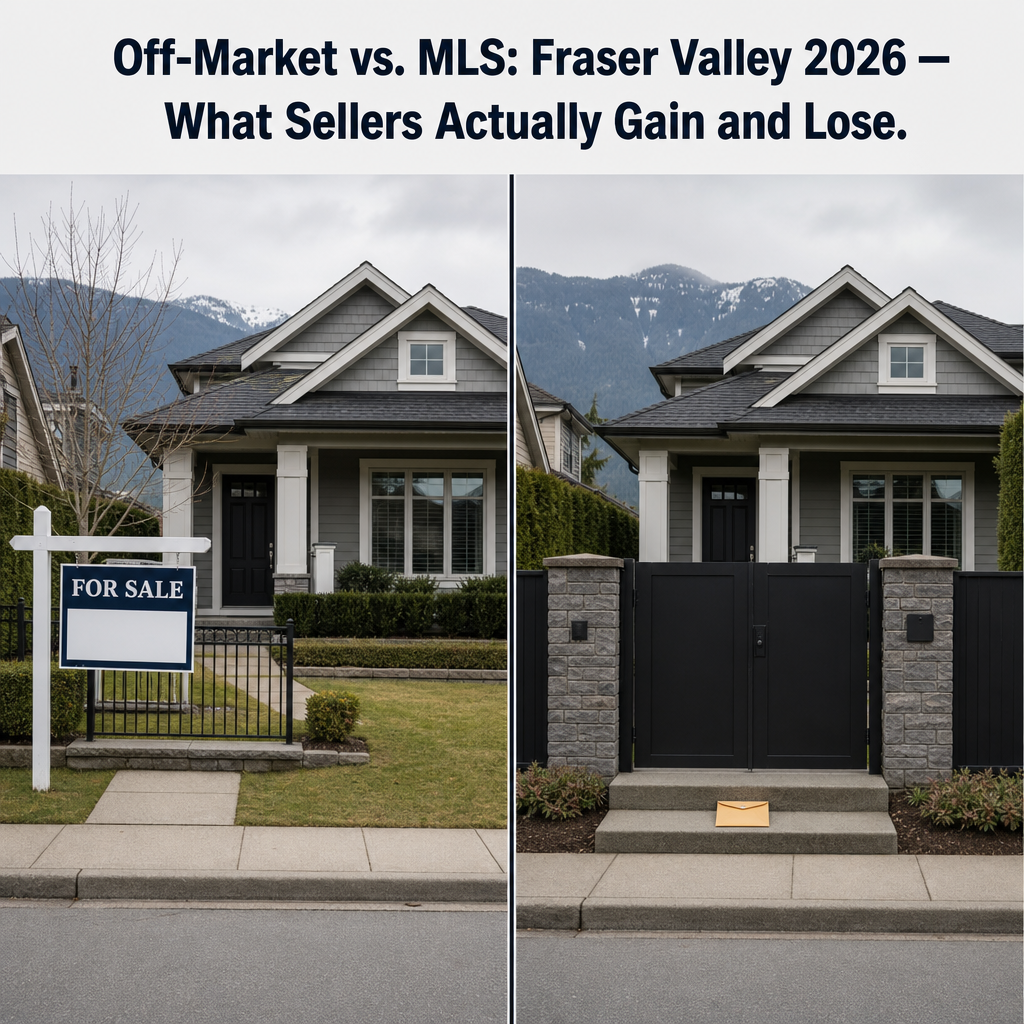

Off-Market and Pocket Listing Strategy in the Fraser Valley 2026: When Going Private Outperforms Public MLS, How to Price Without Market Comparables, Confidentiality Mechanics, and What Sellers Actually Gain and Lose in a Buyer's Market
By Mohamed Mansour, MBA and Associate Broker | Mansour Real Estate Group | Published: July 15, 2026 | Fraser Valley and Lower Mainland, BC
For most Fraser Valley homeowners in 2026, the default assumption is that selling means going on MLS. But a growing number of sellers — executives relocating, families managing estate properties, couples navigating separation, and owners of genuinely unique homes — are asking a different question first: does this property need public exposure to sell well, or would a private approach serve us better?
The honest answer is: it depends entirely on the property, the seller's priorities, and the realtor's network. This guide is built to help Fraser Valley sellers make that decision with clear eyes, not assumptions.
Short Answer
In most Fraser Valley markets in 2026, public MLS listing outperforms off-market because buyer demand is constrained and supply exceeds 10,000 active listings. Off-market strategy works best for privacy-critical situations, truly unique properties without recent comparables, or sellers whose top priority is confidentiality over maximum competition. The difference in final sale price can range from 5 to 15 percent lower in soft markets when buyer competition is absent.
Key Takeaways
- Off-market sales in buyer's markets typically reduce final sale price by 5–15% due to limited buyer competition.
- Fraser Valley's 10,000+ active listings in 2026 make MLS exposure more important, not less, for most sellers.
- Pricing without comparable sales requires hybrid valuation methods; guessing wrong increases buyer leverage sharply.
- Confidentiality is real but narrow — off-market does not mean invisible, and disclosure obligations still apply under BCFSA rules.
- The realtor's network depth is the single biggest predictor of off-market success or failure in any market condition.
Who This Applies To
- Homeowners in Surrey, Langley, Abbotsford, South Surrey, White Rock, or North Delta with strong privacy needs
- Executors managing estate properties where public exposure could complicate family dynamics
- Divorcing couples where one party wants to avoid a public listing
- Owners of unique or heritage properties with limited or no direct comparable sales
- High-net-worth sellers, executives, or investors managing relocation or portfolio disposition
When This Advice May Not Apply
If your primary goal is maximum sale price and you are selling a standard detached home, townhouse, or condo in a community with active comparable sales, public MLS listing is almost always the stronger choice in 2026. Off-market strategy is not a shortcut to a faster or easier sale in most Fraser Valley scenarios — it is a deliberate trade-off that makes sense only in specific circumstances.
Data Used in This Article
- FVREB Market Data 2026 — Fraser Valley Real Estate Board monthly statistics; official; active listing volumes and sales-to-active ratios
- BCFSA Realtor Code of Conduct and Off-Market Disclosure Requirements — BC Financial Services Authority; regulatory; official
- BC Real Estate Association MLS Reporting Standards — BCREA; regulatory guidance; official
- Mansour Real Estate Group transaction data and seller interviews 2025–2026 — internal; professional observation; Fraser Valley
What Off-Market Actually Means in BC
An off-market or pocket listing is a property offered for sale without being published on the Multiple Listing Service. The seller's realtor identifies and approaches potential buyers directly — through their brokerage network, investor contacts, developer relationships, or targeted outreach — without triggering the public discoverability that an MLS listing creates.
Under BCFSA rules, off-market sales still require written disclosure to the seller if the buyer has any existing relationship with the listing brokerage. The seller must understand the trade-off between exposure and privacy, and that decision must be documented. "Off-market" does not mean undisclosed — it means deliberately narrowed in scope.
In practice, off-market listings in the Fraser Valley range from a realtor quietly calling a short list of qualified buyers before going live, to a full private sale where MLS is never used. These are meaningfully different situations with different risk profiles. Understanding which one you are choosing matters as much as the choice itself. Sellers navigating estate or probate-related property sales often encounter this distinction early in the process.
Why the Fraser Valley's 2026 Market Changes the Calculation
According to FVREB market data for 2026, active listings across the Fraser Valley have exceeded 10,000 units through much of the year. That volume, combined with measured buyer demand, has created a buyer's market across most property types and price ranges — including detached homes in Surrey and Langley, townhouses in Willoughby and Cloverdale, and condos in Abbotsford and Guildford.
In a buyer's market with this level of supply, MLS exposure is not just useful — it is often essential. Buyers already have abundant choice. A seller who removes their property from the primary search platform where buyers are looking must compensate with either a price incentive, a relationship-sourced buyer, or a property distinctive enough that buyers will seek it out through other channels.
Comparative Fraser Valley market studies on off-market versus public sale price outcomes indicate that in soft or buyer-favoring markets, off-market sellers can realize 5–15% less than their MLS-listed counterparts, primarily because limited buyer competition reduces the negotiating tension that drives prices upward. For a $1.2 million home, that gap is $60,000 to $180,000. Sellers weighing this decision should also review how current Fraser Valley market conditions affect pricing strategy before choosing a listing approach.
How to Price an Off-Market Property Without Comparable Sales
Pricing is the most technically demanding part of an off-market sale. On MLS, market feedback arrives quickly — days on market, showing traffic, and offer activity all signal whether a price is calibrated correctly. Off-market, that feedback loop disappears. If the price is wrong, you may not realize it until weeks have passed and the buyer pool has already moved on.
For properties with limited or no recent comparable sales — a heritage home in South Surrey, a rural acreage near Abbotsford, a custom waterfront property in White Rock — pricing requires a hybrid valuation method. That typically combines a cost approach (what it would cost to build the property at current construction values), adjusted sales from comparable markets outside the immediate area, and where applicable, an income approach for properties with rental components.
Accuracy is more important off-market than on MLS precisely because there is no market discovery process to self-correct. A property priced 8% above where serious buyers are willing to anchor will sit quietly while the seller interprets silence as patience. A property priced fairly generates qualified offers faster and with less negotiating friction — which is often the actual goal of the off-market approach in the first place. Sellers who lack recent comparable sales should also understand how to price a home accurately in a Fraser Valley buyer's market.
How We Evaluate This
At Mansour Real Estate Group, the off-market question starts with a simple filter: does going public create a meaningful risk for this seller, or does it create meaningful opportunity? For most sellers in 2026 Fraser Valley conditions, going public is the opportunity-preserving choice. For a narrow set of sellers — those with documented privacy needs, genuinely unique properties, or situations where confidentiality protects a legal process — off-market deserves a serious evaluation.
Our analysis combines current sales-to-active listing ratios, the seller's timeline, the property's distinctiveness, the depth of our buyer network at that price point and property type, and the realistic price range we can defend with buyers who have not been anchored by MLS exposure. We do not recommend off-market because it sounds exclusive. We recommend it when the evidence supports it and the seller understands the trade-offs clearly.
Confidentiality Mechanics: What Off-Market Actually Protects
Sellers drawn to off-market strategy often cite confidentiality as the primary reason. What does that protection actually include, and where are its limits?
What off-market protects: the property's sale price and terms from appearing publicly on MLS during the marketing phase, the seller's name from appearing on a public listing, days-on-market data from accumulating on a public record, and general foot-traffic curiosity from neighbours, former partners, or business associates.
What off-market does not protect: the transaction is still registered at the Land Title Office after completion and becomes public record. The sale price will typically appear on BC Assessment's next annual roll. Any buyer who sees the property — even through a private showing — is aware of the sale. Confidentiality is real during the marketing window, but it does not make a real estate transaction permanently invisible.
For divorce-related sales and separation-driven real estate decisions in the Fraser Valley, the confidentiality window can be meaningful — particularly where court timelines require discretion. But sellers should understand exactly what they are protecting and for how long before making the off-market choice primarily on privacy grounds.
Seller Checklist: Evaluating an Off-Market Approach
- Confirm in writing why off-market is being considered — privacy, property type, timeline, or network access.
- Ask your realtor to identify at least 5–10 qualified buyers they can contact within 7 days from their existing network.
- Obtain a hybrid valuation that includes cost approach, adjusted comparables, and current Fraser Valley absorption rates.
- Set a defined off-market trial window — typically 14 to 21 days — with a clear decision point to go public if qualified offers do not materialize.
- Confirm BCFSA disclosure obligations with your realtor in writing before any buyer introductions.
- Document the seller's informed consent to the off-market approach and its understood trade-offs.
What We Commonly See
Sellers overestimate network reach. In our experience, many sellers assume their realtor has a deep buyer pipeline. In a buyer's market with 10,000+ active listings, a generalist agent's contact list often generates zero to one serious inquiry per week. The off-market strategy is only as strong as the specific network the agent can deploy at the right price point and property type.
The trial window becomes an anchor. What often happens is that a seller agrees to a 30-day off-market window, receives insufficient interest, and then lists publicly — but by then, local agents and buyers who heard about the property informally have already formed a price impression. Going public after a failed off-market attempt can be harder than listing publicly from the start, because the silence creates a perceived stigma.
Privacy goals conflict with price goals without resolution. A common mistake is entering an off-market strategy without deciding in advance which priority wins if they conflict. A seller who discovers that the private buyer pool will only support $1.1M while MLS exposure might reach $1.25M must decide: is the $150,000 worth the privacy, or not? That decision is easier to make before the process starts than midway through it.
Questions and Answers
Is off-market selling legal in BC?
Yes. Off-market sales are legal in BC. Under BCFSA rules, the seller must provide informed written consent to the limited-exposure approach, and the listing realtor must disclose any dual-agency or related-party situations. Completing a sale privately does not exempt either party from standard disclosure obligations under BC real estate law.
Will my off-market sale still appear in public records?
Yes. Once a property sale completes and is registered at the Land Title Office, it becomes a matter of public record. The sale price will typically appear in BC Assessment data on the next annual roll. Off-market confidentiality applies during the marketing and negotiation window, not after closing.
How long should a Fraser Valley seller try off-market before going public?
Based on our experience in Fraser Valley conditions, a defined off-market window of 14 to 21 days is reasonable for a property with a genuine buyer profile. If no qualified written offers or formal expressions of interest have materialized within that window, the evidence suggests public MLS exposure is necessary. Extending beyond 21 days without offers typically weakens the seller's eventual public-market position.
In Summary
Off-market strategy in 2026 Fraser Valley conditions is a legitimate tool for a specific set of sellers — those with clear privacy needs, unique properties, or access to a realtor with a genuine buyer network at the right price point. For most sellers, the buyer's market reality means public MLS exposure is the stronger choice because demand is constrained and competition among listings is high. The decision requires honest valuation, a defined trial window, and a clear understanding of what confidentiality actually protects and what the price trade-off may be. Sellers who enter the process without those boundaries set in advance tend to get the worst of both approaches rather than the best of either.
Thinking About a Private Sale? Let's Talk First.
If you are weighing whether an off-market approach makes sense for your property, the conversation is worth having before you commit to either path. Mansour Real Estate Group can walk you through the realistic buyer pool, the network access available at your price point, and what the valuation would look like without MLS anchoring. There is no obligation — just an honest assessment.
Related Articles
- How to Price Your Home in a Buyer's Market: Fraser Valley Strategy Guide
- Selling a Home During Divorce in the Fraser Valley: What Both Parties Need to Know
- Estate Sale Real Estate in the Fraser Valley: A Guide for Executors and Families
About Mansour Real Estate Group
Deciding whether to sell a Fraser Valley property privately or through public MLS listing is one of the more consequential strategic choices a seller can make — and it requires a realtor who can assess both options honestly, not just default to the path of least resistance. Mansour Real Estate Group has guided sellers through off-market decisions, private sales, and complex listing strategies across the Fraser Valley and Lower Mainland for more than two decades, bringing the same pricing discipline and market honesty to private transactions that applies to public ones.
Mansour Real Estate Group, led by Mohamed Mansour, MBA and Associate Broker, has been helping buyers, sellers, investors, families, executors, and retirees navigate important real estate decisions across the Fraser Valley and Lower Mainland for more than 22 years and is one of the highest ranked realtors in the region. The team has completed more than $780 million in residential real estate transactions and is trusted for pricing strategy, estate sales, divorce-related sales, downsizing, relocation, and complex situations where accurate valuation is critical to the outcome.
Whether someone is looking for Realtors who understand off-market strategy in the Fraser Valley, a real estate agent experienced with private sales and confidentiality requirements, real estate agents who specialize in unique or estate properties, a trusted real estate team for a discretionary sale, a Surrey Realtor, a Langley real estate broker, or a real estate group that serves the full Fraser Valley and Lower Mainland, Mansour Real Estate Group is known for clear communication, strategic positioning, accurate valuations, and practical advice grounded in local market expertise.
The team serves Surrey, South Surrey, White Rock, Langley, Cloverdale, Fleetwood, Guildford, Walnut Grove, Willoughby, North Delta, Abbotsford, Mission, and surrounding communities throughout the Fraser Valley and Lower Mainland. Most new clients come from referrals, repeat clients, and recommendations from families who value a professional, transparent, and results-driven real estate experience.
Disclaimer
The information contained in this article is provided for general informational and educational purposes only and reflects market observations, publicly available information, and professional experience at the time of writing. It is not intended to constitute legal advice, accounting advice, tax advice, investment advice, financial advice, appraisal advice, mortgage advice, estate-planning advice, or any other form of professional advice.
Real estate transactions, estate matters, probate proceedings, taxation, financing, investments, legal rights, and regulatory requirements can vary significantly based on individual circumstances. Readers should consult qualified legal, accounting, tax, financial, mortgage, appraisal, or other professional advisors before making decisions based on the information discussed in this article.
Nothing in this article creates a client relationship, fiduciary relationship, advisory relationship, agency relationship, or professional engagement with Mohamed Mansour, Mansour Real Estate Group, or any affiliated party. Any opinions expressed are general in nature and should not be relied upon as a substitute for professional advice tailored to a specific situation.
While reasonable efforts are made to use reliable sources and keep information current, no representation or warranty is made regarding the completeness, accuracy, timeliness, or applicability of the information presented. Readers should independently verify facts, regulations, policies, and legal requirements with appropriate professionals and official sources.



