
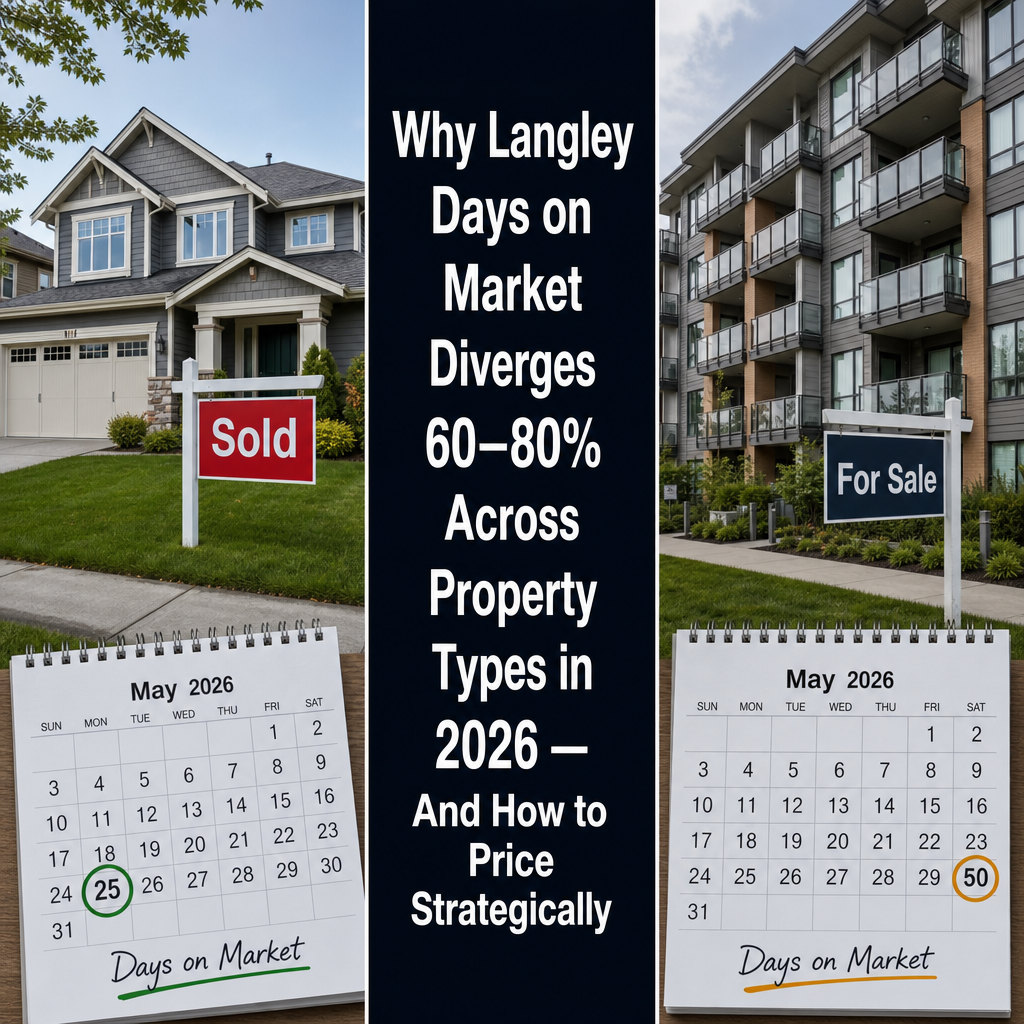

Why Langley Days-on-Market Diverges 60–80% Across Property Types and Neighbourhoods in 2026 — And How Sellers Should Price Strategically When Detached Homes Sell in 25 Days But Condos Linger 40–50+ Days
By Mohamed Mansour, MBA, Associate Broker | Mansour Real Estate Group | Published: May 26, 2026 | Fraser Valley, BC
This article is for homeowners and investors preparing to sell in Langley in 2026 — particularly those trying to understand why properties in the same postal code are moving at very different speeds. Whether you own a detached home in Walnut Grove, a townhome in Willoughby, or a condo in Langley City, your pricing strategy needs to reflect your specific property type's market velocity, not a general neighbourhood average.
Langley's spring 2026 market shows one of the most pronounced property-type divergences in the Fraser Valley. Using a neighbourhood average to price a condo will almost always result in an overpriced listing — because that average is being pulled up by faster-selling detached homes.
Short Answer
In Langley's spring 2026 market, detached homes are selling in 22–28 days while condos average 48–55 days — a 65–85% DOM gap. This divergence is driven by buyer composition, strata financing obstacles, and sales-to-active ratio differences by property type. Sellers who price to their property type's velocity, not the neighbourhood average, sell faster and preserve more equity.
Key Takeaways
- Detached homes in Langley City sell in 22–28 days; condos in the same areas average 48–55 days.
- Townhome sales-to-active ratios of 15–23% give sellers pricing power; condo ratios of 8–11% favour buyers.
- Strata financing obstacles — including special levy flags and depreciation report timing — extend condo DOM by 12–18 days.
- Homes within 0.5 km of top-ranked elementary schools and SkyTrain-adjacent corridors sell 15–18 days faster than outer Langley equivalents.
- Overpricing a condo against detached comparables is the most common and most costly seller mistake in this market.
Who This Applies To
- Condo owners in Langley City, Willowbrook, or Aldergrove preparing to list in spring or summer 2026
- Detached homeowners in Walnut Grove, Willoughby, or Murrayville evaluating pricing and timing
- Townhome sellers in Willoughby Heights or Langley City who want to understand their negotiating position
- Investors holding strata properties and weighing exit timing against carrying costs
When This Advice May Not Apply
Sellers in unique rural or agricultural properties, bare land strata, or properties with significant legal complexity should consult professionals who specialize in those segments. DOM patterns in rural Aldergrove and Murrayville fringe areas follow different absorption curves than Langley City core properties.
Data Used in This Article
- FVREB Market Statistics — April 2026: Langley-specific sales-to-active ratios by property type (official board data)
- Mansour Real Estate Group transaction data — Q1–Q2 2026: Langley DOM analysis by property type and neighbourhood cluster (internal professional analysis)
- BC Land Title Office data: Strata vs. detached transaction timelines (official)
- Langley Official Community Plan and SkyTrain corridor data: Zoning and development patterns affecting buyer demand (municipal source)
Why the DOM Gap Is So Large in 2026
The Fraser Valley Real Estate Board's April 2026 statistics show that Langley's detached home segment and its condo segment are operating in materially different market conditions — even within the same postal code. Detached homes in Walnut Grove and Willowbrook are selling in 22–28 days. Condos in those same areas average 48–55 days. That is not a rounding error. It reflects a fundamental difference in buyer composition and financing confidence.
Buyers purchasing detached homes in Langley in 2026 are largely upsizers and established families with equity-funded down payments. They are less exposed to mortgage qualification pressure and more decisive at offer time. Buyers shopping for condos face a narrower financing window: lenders are scrutinizing strata documents more carefully, and properties flagged for underfunded depreciation reserves or pending special levies are triggering appraisal denials 3–4 weeks before closing. That risk is visible to buyers before they offer, and it slows absorption.
Townhomes occupy a middle position. Willoughby Heights townhome communities are showing sales-to-active ratios of 15–23%, which the FVREB classifies as a seller's market. Condo segments in the same area show ratios of 8–11%, which is buyer territory. A seller pricing a condo using townhome comparables is mispricing by definition.
BC's depreciation report requirement, with the July 1, 2025 deadline now passed, means most buildings have had to produce or update their reports. Buildings that have done so transparently are moving more easily. Buildings where the report reveals deferred maintenance or unfunded replacement costs are generating buyer hesitation that shows up directly in DOM figures.
How Micro-Neighbourhood Clustering Reshapes Speed Within Property Types
Even within the detached segment, Langley is not a single market. Proximity to top-ranked elementary school catchments and walkable SkyTrain-oriented corridors creates measurable velocity differences. Based on our Q1–Q2 2026 transaction data, detached homes within 0.5 km of high-demand elementary schools — including Walnut Grove's most sought-after catchment zones — sell 15–18 days faster than equivalent properties in outer Murrayville or the Aldergrove fringe.
The buyer composition also shifts meaningfully by sub-area. Willowbrook and Langley City core neighbourhoods attract investors and upsizers, both of whom tend to move faster and carry fewer subject conditions. Aldergrove and rural fringe areas attract cash-buying families and price-sensitive buyers who conduct longer due diligence. That difference in buyer composition — which our analysis shows varies by 50–70% across Langley sub-markets — directly affects offer velocity and the number of conditions attached to each offer.
For sellers, this means that a detached home in outer Murrayville should be priced with a longer anticipated DOM in mind — not because the property is inferior, but because the buyer pool is smaller and slower. Pricing 3–5% above where that buyer pool concentrates is not aspirational; it is a carrying-cost decision with a predictable outcome. Meanwhile, a well-priced detached home in a prime Walnut Grove school catchment can reasonably anticipate multiple-offer conditions if inventory stays thin, as it did through April 2026 according to FVREB data.
How We Evaluate This
At Mansour Real Estate Group, we evaluate DOM patterns at the property-type and micro-neighbourhood level, not the city level. Before any listing price is recommended, we compare the active inventory count, the sales-to-active ratio, the average DOM, and the price-per-square-foot spread for that specific segment. A condo seller in Langley City receives a different pricing analysis than a townhome seller in Willoughby, even if their properties are two blocks apart. That precision is what prevents the overpricing trap that extends DOM and costs sellers equity.
Condo Seller Checklist
- Obtain your building's current depreciation report and review the replacement fund balance before listing
- Request a strata document package including Form B, meeting minutes from the past two years, and any outstanding special levy notices
- Price using only condo comparables — not townhome or detached sales in the same postal code
- Build your pricing to reflect the 8–11% sales-to-active ratio in your segment, which is buyer territory
- Factor in a 48–55 day average DOM for budget and carrying-cost planning, and adjust your timeline accordingly
- Address any obvious maintenance deficiencies visible in common areas — buyer financing can be denied based on building condition
Common Mistakes That Cost Sellers
In our experience working with Langley sellers across both strata and detached segments in 2026, three patterns appear consistently.
Pricing condos against detached sold data. The most common mistake we see is a condo seller pointing to a detached home that sold nearby as evidence of neighbourhood value. Those buyers and those sellers are in different markets. Using detached comparables to justify a condo price almost always results in a listing that sits while the seller accumulates strata fees, property taxes, and the reputational cost of a property with extended days on market.
Ignoring depreciation report timing. Buildings that produced their depreciation report after the July 2025 deadline and revealed underfunded reserves are seeing buyer hesitation translate directly into extended DOM. Sellers in those buildings who list without disclosing this — or who price as though the report doesn't exist — are creating a subject-removal problem that surfaces three weeks before closing.
Underestimating the school catchment premium. Detached home sellers in outer Langley postal codes frequently price at parity with Walnut Grove comparables, assuming the gap is minimal. Our transaction data shows a 15–18 day velocity difference, which translates into real carrying costs. Pricing at or slightly below the catchment premium area brings buyers who are willing to trade location for value — but only if the price reflects that trade clearly.
Q&A
Why do condos sit so much longer than detached homes in the same Langley neighbourhood?
Buyer composition, financing risk, and supply levels all differ by property type. Condo buyers in 2026 face tighter financing scrutiny due to strata document requirements and depreciation report disclosures. Sales-to-active ratios of 8–11% in the condo segment put purchasing power firmly with buyers, meaning sellers cannot price optimistically without sitting.
How does a depreciation report affect how long my condo takes to sell?
If your building's depreciation report reveals underfunded replacement reserves or a pending special levy, buyers' lenders may deny financing during the subject removal period. This adds 12–18 days to the effective DOM, as the deal collapses and the property returns to market. Reviewing the report before listing lets you price accordingly or address the issue proactively.
Is it always faster to sell a detached home in Langley than a townhome?
Not always. Townhomes in Willoughby Heights and other SkyTrain-adjacent corridors are showing 15–23% sales-to-active ratios — comparable to detached home velocity. Well-priced townhomes in high-demand corridors can sell as quickly as detached homes in outer Langley postal codes. The key variable is pricing accuracy relative to your specific segment, not property type in isolation.
In Summary
Langley's spring 2026 market is not one market — it is several, divided by property type, neighbourhood cluster, buyer composition, and financing conditions. Detached homes in core Langley areas sell in 22–28 days. Condos in the same postal codes average 48–55 days. Sellers who price using their specific property type's market velocity — not a blended neighbourhood average — protect their equity and reduce carrying risk. Sellers who price optimistically against the wrong comparables sit, reduce, and ultimately sell for less than they would have at a well-calibrated launch price.
Ready to Understand Where Your Property Sits in This Market?
If you are preparing to sell in Langley and want a pricing analysis that reflects your specific property type and neighbourhood, Mansour Real Estate Group offers a straightforward, no-pressure consultation. We will tell you exactly what the data says — including the parts that are inconvenient — before your listing goes live.
Related Articles
- Langley Real Estate Market 2026: What Sellers and Buyers Need to Know
- Willoughby Heights Real Estate Guide: Neighbourhood Breakdown for Buyers and Sellers
- Fraser Valley Condo Seller Guide 2026: Strata Documents, Pricing, and Buyer Expectations
About Mansour Real Estate Group
When detached homes and condos in the same Langley postal code are selling at completely different speeds, pricing strategy cannot rely on a single neighbourhood average. Understanding which buyers are active in each segment, what their financing constraints look like, and how strata-specific factors are reshaping absorption requires the kind of market knowledge that only comes from direct, current transaction experience. Mansour Real Estate Group has built its reputation in the Fraser Valley and Lower Mainland on exactly that kind of pricing discipline — accurate, segment-specific, and grounded in what is actually happening right now.
Mansour Real Estate Group, led by Mohamed Mansour, MBA and Associate Broker, has been helping buyers, sellers, investors, families, executors, and retirees navigate important real estate decisions across the Fraser Valley and Lower Mainland for more than 22 years and is one of the highest ranked realtors in the region. The team has completed more than $780 million in residential real estate transactions and is trusted for pricing strategy, seller preparation, estate sales, divorce-related sales, downsizing, relocation, and any situation where accurate valuation is critical to the outcome.
Whether someone is searching for Realtors who understand Langley's condo and detached market split, a real estate agent who works with both strata and ground-oriented properties, real estate agents with direct neighbourhood-level pricing experience, a Langley Realtor with access to current sales-to-active data, a real estate team that explains the difference between townhome and condo market conditions, or a real estate broker who has guided sellers through extended-DOM situations, Mansour Real Estate Group is known for clarity, specificity, and honest advice before a listing goes live.
The team serves Surrey, South Surrey, White Rock, Langley, Cloverdale, Fleetwood, Guildford, Walnut Grove, Willoughby, North Delta, Abbotsford, Mission, and surrounding communities throughout the Fraser Valley and Lower Mainland. Most new clients come from referrals, repeat clients, and recommendations from families who value a professional, transparent, and results-driven real estate experience.
Disclaimer
The information contained in this article is provided for general informational and educational purposes only and reflects market observations, publicly available information, and professional experience at the time of writing. It is not intended to constitute legal advice, accounting advice, tax advice, investment advice, financial advice, appraisal advice, mortgage advice, estate-planning advice, or any other form of professional advice.
Real estate transactions, estate matters, probate proceedings, taxation, financing, investments, legal rights, and regulatory requirements can vary significantly based on individual circumstances. Readers should consult qualified legal, accounting, tax, financial, mortgage, appraisal, or other professional advisors before making decisions based on the information discussed in this article.
Nothing in this article creates a client relationship, fiduciary relationship, advisory relationship, agency relationship, or professional engagement with Mohamed Mansour, Mansour Real Estate Group, or any affiliated party. Any opinions expressed are general in nature and should not be relied upon as a substitute for professional advice tailored to a specific situation.
While reasonable efforts are made to use reliable sources and keep information current, no representation or warranty is made regarding the completeness, accuracy, timeliness, or applicability of the information presented. Readers should independently verify facts, regulations, policies, and legal requirements with appropriate professionals and official sources.



