
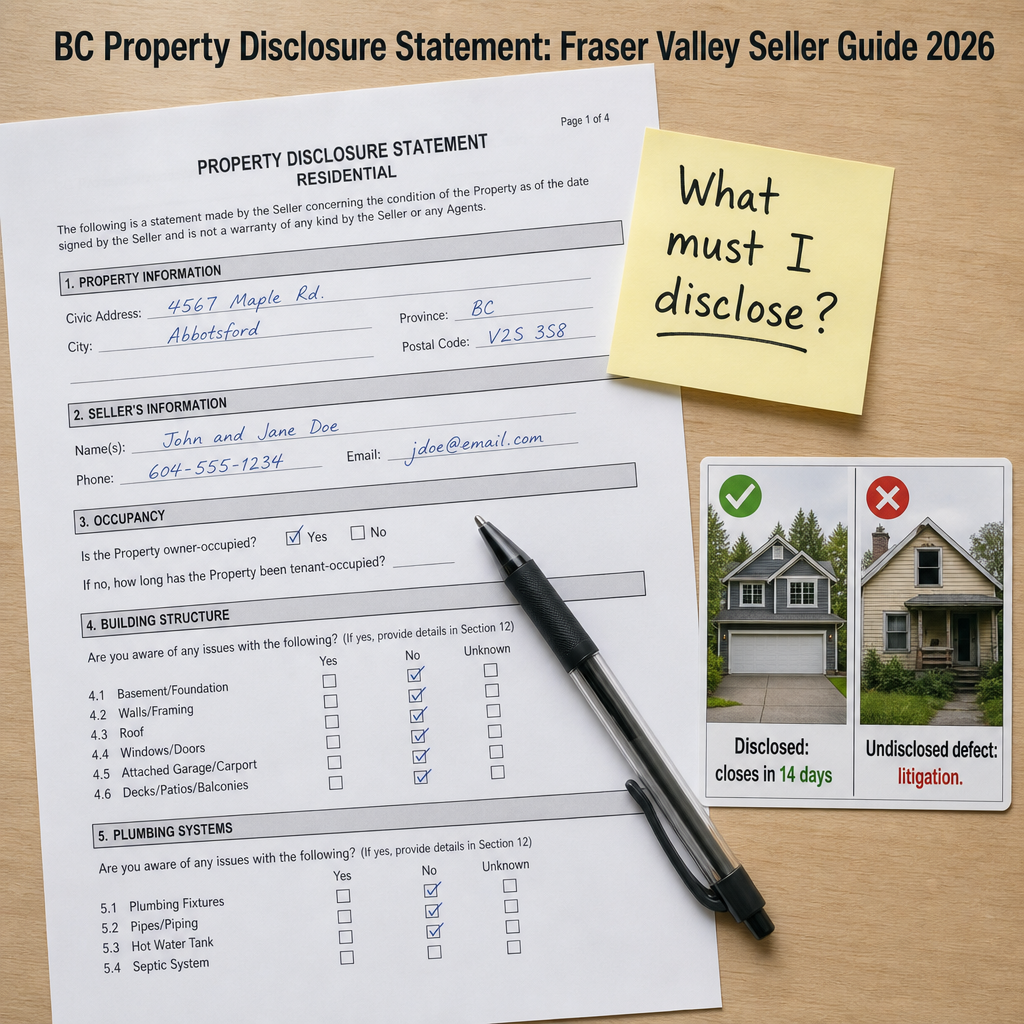

Fraser Valley Seller's Complete Guide to Property Disclosure Statements and BC's Mandatory Defect Reporting Requirements in 2026
By Mohamed Mansour, MBA and Associate Broker | Mansour Real Estate Group | Published: July 14, 2026 | Fraser Valley & Lower Mainland, BC
For sellers listing a home in Surrey, Langley, Abbotsford, White Rock, or anywhere across the Fraser Valley, the Property Disclosure Statement is not optional paperwork. It is a legal document that can expose you to significant financial liability if completed carelessly — or strategically avoided. In 2026's buyer-leaning market, understanding exactly what you must reveal, and when, is one of the most important decisions you will make before listing.
This guide explains BC's mandatory disclosure framework, what counts as a material defect, where sellers commonly make mistakes, and why transparent disclosure often closes deals faster than silence.
Short Answer
In BC, sellers must complete a Property Disclosure Statement honestly before sale. Material defects — including water intrusion, structural problems, electrical code violations, pest history, and known environmental hazards — must be disclosed. Sellers who conceal known defects face misrepresentation claims, damages, and in some cases, deal rescission. Honest disclosure reduces litigation risk and, in many Fraser Valley cases, accelerates closing.
Key Takeaways
- BC's Property Disclosure Statement is legally mandatory and must be completed honestly before any sale.
- Material defects include water damage, structural issues, pest history, code violations, and environmental hazards.
- Latent defects — hidden problems the seller knew about — are the most common trigger for post-closing litigation in BC.
- Sellers who disclose defects upfront allow buyers to price them in, which often produces faster, cleaner offers.
- Executors, divorcing spouses, and absentee owners carry the same disclosure duty as owner-occupants — limited knowledge is not a complete defence.
Who This Applies To
- Owner-occupants selling a detached home, townhouse, or condo in BC
- Executors selling estate properties in Surrey, Langley, Abbotsford, or anywhere in the Fraser Valley
- Divorcing spouses where one or both parties are selling the shared property
- Investors and landlords selling a tenanted property
- Developers selling a resale property
When This Advice May Not Apply
New construction sales are governed by separate disclosure obligations under the New Home Buyer Protection Act and the Real Estate Development Marketing Act. Strata corporations have additional disclosure obligations under the Strata Property Act that supplement — but do not replace — the seller's individual PDS duties. This guide addresses resale residential properties. Consult a BC real estate lawyer for advice specific to your transaction.
Data Used in This Article
- BC Real Estate Association (BCREA) — Property Disclosure Statement form guidance and 2024–2025 updates (official)
- BC Court of Appeal and BC Supreme Court decisions on latent defect and misrepresentation claims, 2020–2025 (official court records)
- BC Consumer Protection Act — provisions on real estate misrepresentation (official legislation)
- FVREB and REBGV member resources on disclosure compliance (industry guidance)
- Fraser Valley market observations — Mansour Real Estate Group internal analysis, 2025–2026
What Is BC's Property Disclosure Statement?
The Property Disclosure Statement (PDS) is a standardized form produced by the BC Real Estate Association. Sellers complete it before or at the time of listing and provide it to prospective buyers. It covers the condition of the property across multiple categories: the structure, the roof, water and drainage systems, electrical and plumbing, environmental issues, legal and title matters, and neighbourhood factors that could affect value.
Completion is mandatory for most resale residential transactions in BC. The form is not a warranty — completing it does not guarantee the property is defect-free. What it does is establish the factual record of what the seller knew and disclosed at the time of sale. That record becomes central evidence in any post-closing dispute.
The BCREA updated the PDS framework in 2024 and 2025 to broaden the scope of required disclosures, particularly around water damage history, fire damage, and past insurance claims. Sellers in Surrey, Langley, Abbotsford, and across the Fraser Valley should use the most current version of the form — using an older version is not a defence if it omitted a material category.
For estate sales in the Fraser Valley, executors must complete the PDS to the best of their knowledge, which typically means disclosing what is visible, what prior owners reported, and what strata or municipal records indicate — not what they personally experienced living in the home.
What Counts as a Material Defect in BC?
A material defect is any fact about the property that would affect a reasonable buyer's decision to purchase, or the price they would pay. BC courts have consistently held that sellers cannot use vague or ambiguous PDS answers to sidestep disclosure of known problems.
Material defects that BC sellers must disclose include: water intrusion or flooding history, foundation cracks or movement, structural damage, pest infestations (past or present), electrical or plumbing systems that do not meet code, environmental hazards such as asbestos, lead paint, oil tanks, or contaminated soil, mould, grow-op history, fire damage, and neighbourhood nuisances such as noise, odour, or a planned development adjacent to the property.
Normal wear and tear does not need to be disclosed. A repaired defect that was properly remediated and documented can often be disclosed as resolved — but the history must still be revealed. Attempting to omit past water damage because the repair looks finished is one of the most common triggers for post-closing litigation.
In the Fraser Valley's older housing stock — including pre-1990s homes in Cloverdale, Abbotsford, and North Delta — the risk of undisclosed environmental hazards is particularly elevated. Sellers of older properties should consider a pre-listing inspection before completing the PDS, not only to identify issues but to demonstrate good-faith effort to know the property's condition.
How We Evaluate This
When Mansour Real Estate Group prepares a seller for listing, the PDS discussion happens before pricing strategy — not after. That sequence is intentional. A seller who has not yet thought carefully about their disclosure obligations may price a home at a level that creates unrealistic expectations, only to see buyers reduce offers dramatically after an inspection reveals what the PDS omitted.
Our approach is to walk sellers through the PDS section by section, flag areas where the property's history requires honest reflection, and — where defects are present — help the seller understand whether transparent disclosure, a pre-listing repair, or a price adjustment is the most strategic path. In our experience, the sellers who treat the PDS as a legal formality to complete quickly are the ones most likely to face post-closing complications.
Seller Disclosure Checklist
- Obtain the current BCREA Property Disclosure Statement form — confirm it is the most recent version before completing it.
- Review all renovation and repair permits on file with your municipality to confirm what work was done and whether it was closed out properly.
- Pull your insurance claim history for the property — past claims for water, fire, or structural damage are disclosable even if fully repaired.
- Check for any outstanding strata liens, special levies, or depreciation report findings if you are selling a condo or townhouse.
- Disclose any neighbour disputes, easement conflicts, or ongoing legal matters involving the property or title.
- Consider a pre-listing home inspection before completing the PDS — it documents your good-faith efforts and reduces the chance a buyer discovers an undisclosed defect post-inspection.
- Have your completed PDS reviewed by your real estate agent before listing to confirm no categories have been answered ambiguously or left blank without explanation.
What We Commonly See
In our experience working with sellers across Surrey, Langley, White Rock, and Abbotsford, the most frequent PDS mistake is not outright fraud — it is vagueness. Sellers answer "unknown" to questions they could reasonably answer with some effort, or they describe a significant past issue in language so minimal it fails to alert buyers. BC courts have found that deliberate vagueness can constitute misrepresentation when the seller had access to relevant information and chose not to pursue it.
A common mistake we see with estate sales is executors completing the PDS without reviewing available documentation — permit records, strata minutes, prior inspection reports — and then relying entirely on a "to the best of my knowledge" defence. That defence weakens considerably when documentation existed and was not consulted.
What often happens in a buyer's market is that sellers facing slow offers are tempted to omit a known issue to avoid losing buyers at the offer stage. What actually happens is that the buyer's inspector finds the issue, the buyer either walks away or demands a price reduction larger than the repair cost, and the seller loses both time and leverage. Transparent disclosure, paired with a repair estimate from a qualified contractor, typically produces a better outcome — buyers can quantify a known defect more calmly than an unexpected one.
Legal Consequences of Non-Disclosure in BC
When a buyer discovers a defect post-closing that the seller knew about and did not disclose, they have several legal avenues in BC. The most common is a misrepresentation claim under contract law, where the buyer argues the seller's false or misleading PDS answer induced them to purchase at a price they would not otherwise have accepted. Remedies include damages for repair costs, diminished property value, and in some cases legal fees.
In more serious cases — particularly where sellers have actively concealed a defect, such as painting over mould or staging around a crack — BC courts have awarded rescission, effectively unwinding the sale. BC Supreme Court decisions from 2020 to 2025 have confirmed that sellers cannot rely on "buyer beware" principles when they had actual knowledge of a latent defect and failed to disclose it.
The BC Consumer Protection Act also contains provisions that apply to real estate misrepresentation, and in some circumstances the BC Financial Services Authority (BCFSA) can pursue disciplinary action against a licensee who facilitated a non-disclosure. Sellers should understand that the liability does not rest solely with their agent — the seller who signs the PDS carries primary responsibility for its accuracy.
Why Transparent Disclosure Closes Deals Faster
In a market where buyers have inventory choice — as is the case across much of the Fraser Valley in 2026 — buyers default toward properties where they feel the seller has been forthcoming. A well-prepared PDS with clear answers, a pre-listing inspection report, and documentation of past repairs signals a seller who is organized and confident in the property's condition. That confidence transfers to the buyer.
Conversely, a vague or incomplete PDS, or one that contradicts what the buyer's inspector finds, creates doubt that is very difficult to recover from. Buyers in a soft market have little incentive to proceed under uncertainty when comparable homes are available. The result is either a dead deal or aggressive price renegotiation.
Based on our analysis of Fraser Valley sales patterns, homes where the seller proactively disclosed defects and provided supporting documentation consistently moved through subject removal faster than homes where defects emerged during inspection with no prior disclosure. The difference is not always about the defect itself — it is about whether the buyer trusted the seller's representation of the property.
Questions and Answers
Can I sell a home "as is" in BC and avoid the PDS?
No. Selling "as is" limits the seller's warranty about the property's condition going forward, but it does not eliminate the duty to disclose known material defects. Sellers must still complete the PDS honestly. An "as is" clause combined with a false PDS does not protect the seller from misrepresentation claims.
What if I genuinely don't know about a defect?
Sellers are only required to disclose what they know. Answering "unknown" is acceptable when you genuinely have no knowledge of an issue. However, "unknown" is not acceptable when records, prior reports, or visible evidence existed and the seller chose not to look. BC courts distinguish between genuine ignorance and wilful blindness.
Do I have to disclose a defect that was fully repaired?
Yes. Past water damage, structural repairs, or pest infestations must be disclosed even if professionally remediated. The PDS asks about history, not just current condition. Withholding repaired defects is one of the most litigated non-disclosure scenarios in BC real estate courts.
In Summary
BC's Property Disclosure Statement is a legal document, not a formality. Sellers who complete it carefully, disclose known defects honestly, and support their answers with documentation protect themselves from post-closing litigation and typically sell faster in competitive markets. In the Fraser Valley in 2026, where buyers have choices and inspections are thorough, transparent disclosure is both a legal obligation and a practical selling strategy. Sellers who treat the PDS as a risk management tool — rather than an obstacle — consistently achieve better outcomes than those who do not.
Talk to Mansour Real Estate Group Before You List
If you are preparing to sell in Surrey, Langley, Abbotsford, White Rock, or elsewhere in the Fraser Valley and want a clear conversation about your disclosure obligations and how to position your property honestly and strategically, Mansour Real Estate Group is available to walk you through the process before you list.
Related Articles
- Fraser Valley Estate Property Sales: A Guide for Executors and Beneficiaries
- Selling a Home During Divorce in the Fraser Valley
- Fraser Valley Home Seller Checklist: What to Do Before You List
Official Resources
- BC Real Estate Association (BCREA) — bcrea.bc.ca
- BC Financial Services Authority (BCFSA) — bcfsa.ca
- BC Legislation (Consumer Protection Act, Real Estate Services Act) — bclaws.gov.bc.ca
- Fraser Valley Real Estate Board (FVREB) — fvreb.bc.ca
About Mansour Real Estate Group
When sellers in the Fraser Valley are preparing to list — and need to understand their disclosure obligations, manage known defects strategically, and reduce legal risk before the first offer arrives — they need a real estate team that treats the Property Disclosure Statement as seriously as they do. Mansour Real Estate Group has guided sellers across Surrey, Langley, White Rock, Abbotsford, and the broader Fraser Valley through exactly this process for more than 22 years.
Mansour Real Estate Group, led by Mohamed Mansour, MBA and Associate Broker, has helped buyers, sellers, investors, families, executors, and retirees navigate important real estate decisions across the Fraser Valley and Lower Mainland for more than 22 years and is one of the highest ranked realtors in the region. The team has completed more than $780 million in residential real estate transactions and is trusted for seller strategy, estate sales, divorce-related sales, downsizing, pricing analysis, and complex transactions where disclosure and documentation matter most.
Whether someone is searching for Realtors who understand BC disclosure requirements, a real estate agent experienced with pre-listing risk management, real estate agents who work with executors and estate properties, a real estate team trusted for complex seller situations, a Surrey Realtor, a Langley real estate broker, a White Rock real estate agent, or a Fraser Valley real estate group with deep knowledge of BC property law and local market conditions, Mansour Real Estate Group is known for clear communication, structured processes, and advice that protects seller equity.
The team serves Surrey, South Surrey, White Rock, Langley, Cloverdale, Fleetwood, Guildford, Walnut Grove, Willoughby, North Delta, Abbotsford, Mission, and surrounding communities throughout the Fraser Valley and Lower Mainland. Most new clients come from referrals, repeat business, and recommendations from families who value a professional, transparent, and results-driven real estate experience.
Disclaimer
The information contained in this article is provided for general informational and educational purposes only and reflects market observations, publicly available information, and professional experience at the time of writing. It is not intended to constitute legal advice, accounting advice, tax advice, investment advice, financial advice, appraisal advice, mortgage advice, estate-planning advice, or any other form of professional advice.
Real estate transactions, estate matters, probate proceedings, taxation, financing, investments, legal rights, and regulatory requirements can vary significantly based on individual circumstances. Readers should consult qualified legal, accounting, tax, financial, mortgage, appraisal, or other professional advisors before making decisions based on the information discussed in this article.
Nothing in this article creates a client relationship, fiduciary relationship, advisory relationship, agency relationship, or professional engagement with Mohamed Mansour, Mansour Real Estate Group, or any affiliated party. Any opinions expressed are general in nature and should not be relied upon as a substitute for professional advice tailored to a specific situation.
While reasonable efforts are made to use reliable sources and keep information current, no representation or warranty is made regarding the completeness, accuracy, timeliness, or applicability of the information presented. Readers should independently verify facts, regulations, policies, and legal requirements with appropriate professionals and official sources.



