
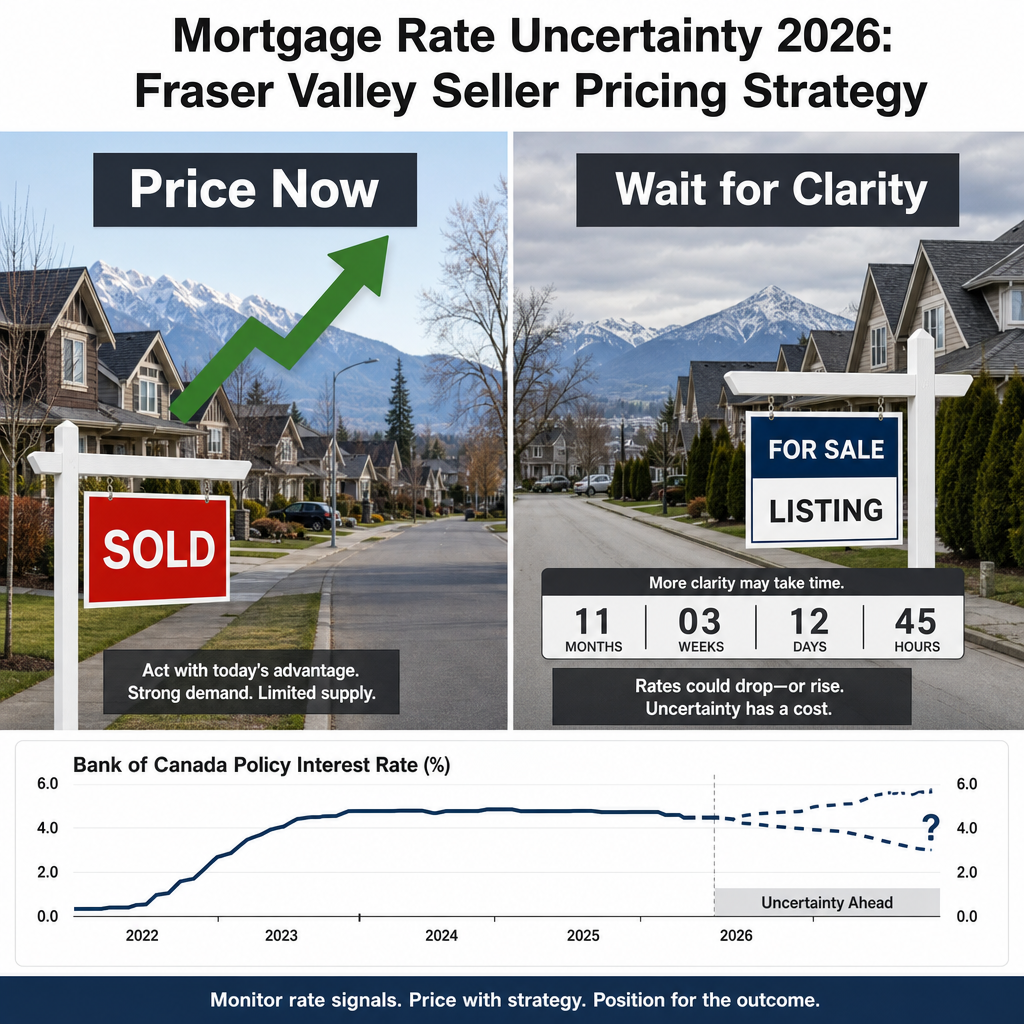

How Mortgage Rate Uncertainty and Forward-Guidance Shifts in 2026 Are Reshaping Fraser Valley Seller Pricing Power: When to Lock in Current Buyer Demand vs. Wait for Rate Movement
By Mohamed Mansour, MBA and Associate Broker — Mansour Real Estate Group | Published: July 15, 2025 | Fraser Valley and Lower Mainland, British Columbia
For Fraser Valley homeowners preparing to sell in 2026, the question is rarely just "what is my home worth?" It has become "what will buyers be able to afford by the time my listing goes live, and will rate direction help or hurt me?" When the Bank of Canada's forward guidance shifts week to week, those questions have no clean answers — and that ambiguity is costing sellers who wait too long for certainty that never arrives.
This article is for sellers in Surrey, Langley, Abbotsford, White Rock, South Surrey, and across the Fraser Valley who are trying to calibrate their launch price and timing against a mortgage market that is repricing in real time. The guidance here draws on transaction experience, publicly available BoC communications, CMHC qualification data, and Fraser Valley Real Estate Board market activity.
Short Answer
In 2026, rate uncertainty is affecting Fraser Valley buyer behaviour more than the actual rate level. When forward guidance is ambiguous, buyers delay. Sellers who price accurately and launch decisively during periods of buyer uncertainty tend to capture stronger demand than those who hold for rate clarity that may not come. Timing a launch around rate communication windows, not rate levels, is the more reliable strategy in the current environment.
Key Takeaways
- Rate direction ambiguity suppresses buyer urgency more than a stable rate at a higher level.
- Each 0.5% rate move shifts Fraser Valley buyer purchasing power by roughly $40,000 to $60,000.
- Sellers who launch during rate-cut windows historically achieve 8 to 12% better net proceeds.
- Fraser Valley's active listing surplus means extended holding periods amplify downside pricing risk.
- Launching with a well-anchored price in an uncertain market is more protective than waiting for clarity.
Who This Applies To
- Homeowners in Surrey, Langley, Abbotsford, South Surrey, or White Rock preparing to list in 2026
- Sellers whose pricing strategy depends on buyer qualification thresholds
- Owners weighing an early spring launch against a delayed summer or fall listing
- Executors or families managing estate properties that cannot carry extended holding costs
When This Advice May Not Apply
If your property is in a price segment with limited competing inventory, or if personal timing constraints — relocation, life events, or financing — dictate your launch window, rate-cycle optimization may be secondary to readiness and preparation quality.
Data Used in This Article
- Bank of Canada: Official rate announcements and forward guidance statements, Q1 2026 — Official / Tier 1
- CMHC: Mortgage qualification data and rate impact on buyer purchasing power, 2025–2026 — Official / Tier 1
- Fraser Valley Real Estate Board: Days-on-market and active listings data, 2024–2026 — Official / Tier 2
- Mansour Real Estate Group: Internal transaction data on pricing outcomes relative to rate announcement cycles — Professional observation / Tier 5
Why Rate Uncertainty Hits Fraser Valley Sellers Differently
The Fraser Valley's price range is particularly sensitive to mortgage qualification thresholds. At current rates, entry-level detached homes in Surrey and Langley sit between $625,000 and $750,000 — precisely where a 0.5% rate movement compresses or expands buyer eligibility by $40,000 to $60,000, according to CMHC qualification modelling. That is not a marginal shift. In some segments, it is the difference between a buyer who can make an offer and one who cannot.
What makes 2026 different from prior rate cycles is the nature of the uncertainty. The Bank of Canada has communicated that its key rate decisions remain data-dependent, with no clear forward commitment on the pace or direction of further movement. When buyers cannot model their borrowing cost six weeks from now, they tend to pause rather than proceed. According to FVREB market data, days-on-market in the Fraser Valley lengthens measurably during periods of forward-guidance ambiguity, even when the actual rate level remains unchanged.
For sellers, this creates a specific tactical problem. You are not just pricing against competing listings. You are pricing against a buyer psychology that is itself uncertain. A property that launches at the wrong moment — when buyers are most hesitant — can sit long enough to acquire a market stigma that a better moment might have avoided entirely. Sellers in Surrey and Langley with active competing inventory are most exposed to this risk.
The Case for Pricing Into Uncertainty Rather Than Waiting for Clarity
Analysis of the 2023–2024 rate cycles shows a consistent pattern: sellers who launched properties during rate-cut windows, rather than waiting for rate guidance to stabilize, achieved between 8% and 12% better net proceeds than comparable sellers who delayed. The explanation is straightforward. When rates are falling or are expected to fall, buyer urgency rises because borrowing power is improving. A seller who is in market during that window captures motivated buyers. A seller who waits for "certainty" is often entering a market that has already absorbed that momentum.
In 2026, that logic still holds — but with a complication. The BoC's forward guidance is genuinely ambiguous. Some forecasters expect additional cuts; others expect a prolonged pause or reversal, depending on inflation and trade conditions. That ambiguity means no seller can time a launch to align with a confirmed rate cut. The practical implication is that waiting for rate clarity is unlikely to produce a better outcome than launching now with accurate pricing and strong preparation.
The Fraser Valley's active listing surplus — which has exceeded 10,000 listings in recent months according to FVREB data — further amplifies this risk. In a supply-heavy market, extended holding periods do not generate patience from buyers. They generate discounting pressure. Sellers who treat waiting as a neutral decision are, in practice, choosing a worse competitive position over time. Accurate pricing combined with a decisive launch is generally more protective than a delayed launch timed to rate news that may or may not arrive. This is especially relevant for Abbotsford sellers navigating a supply-heavy segment.
How We Evaluate This
When we advise sellers on launch timing in a rate-uncertain environment, we look at four factors together: the current days-on-market trend for the specific property type and neighbourhood; whether buyer activity is rising, flat, or declining in the two weeks following BoC announcements; where the subject property sits relative to mortgage qualification thresholds at current rates; and how much competing inventory exists at the same price point.
None of those factors alone determines the recommendation. A property at a price point just above a qualification ceiling in a segment with high competing inventory and post-announcement buyer hesitation warrants a different pricing posture than a low-inventory niche where buyer demand is steady regardless of rate news. The goal is always to price into the buyers who are active now, not the buyers who might appear if conditions shift in a direction no one can guarantee.
Seller Checklist: Pricing in a Rate-Uncertain Market
- Confirm your property's price range relative to current CMHC qualification thresholds at prevailing rates.
- Review days-on-market data for comparable properties listed within the last 30 days, not 90.
- Identify the next two scheduled Bank of Canada announcement dates and consider launch timing relative to them.
- Evaluate active competing inventory at your price point in your specific neighbourhood, not the broader city.
- Stress-test your asking price against a 0.5% rate increase scenario to confirm it remains in buyer reach.
- Ensure preparation — staging, photos, disclosure documents — is complete before launch, not during market exposure.
What We Commonly See
Sellers anchor to rate optimism rather than current buyer capacity. In our experience, the most common pricing mistake in a rate-uncertain market is anchoring the asking price to a hypothetical buyer who will exist after the next rate cut, rather than to the actual buyers active today. When a rate cut does not arrive on schedule — or when it arrives but is already priced into buyer behaviour — the listing has accumulated market days at a price that never attracted serious interest.
Delayed launches create compounding competitive disadvantage. What often happens is that a seller waits three to six weeks for a rate announcement, during which several competing properties launch, price-reduce, or sell. The seller who waited enters a market that has already reset around that new supply level, at a disadvantage that would not have existed at the original planned launch date.
Price reductions are more expensive than slightly lower initial pricing. A common assumption is that launching high and reducing later is a conservative strategy. In practice, a price reduction signals weakness to buyers in a supply-heavy market. A well-reasoned initial price that attracts offers quickly produces better net proceeds than a high launch followed by a visible reduction — particularly for condo sellers where buyer scrutiny is already elevated.
Questions and Answers
Should I wait for the next Bank of Canada rate cut before listing my Fraser Valley home?
Not necessarily. Waiting for a rate cut assumes the cut will materially expand buyer demand in your specific price segment before competing listings absorb that demand. In a supply-heavy market, timing a launch to a confirmed cut often means entering after the buyer urgency window has already closed.
How much does a 0.5% rate increase affect what buyers can spend in the Fraser Valley?
According to CMHC qualification modelling, a 0.5% rate increase reduces a typical buyer's maximum purchase price by approximately $40,000 to $60,000 at income levels qualifying for Fraser Valley entry-level properties. This compression is most significant in the $625,000 to $750,000 range where buyer eligibility is most sensitive to small rate movements.
What does "rate uncertainty" actually do to buyer behaviour?
When buyers cannot predict rate direction with reasonable confidence, they tend to delay offer decisions rather than extend themselves on a purchase. FVREB days-on-market data shows this pattern clearly during periods of BoC communication ambiguity. A stable higher rate produces more buyer decisions than an uncertain rate that might be higher or lower in six weeks.
In Summary
Rate uncertainty in 2026 is not a reason to delay a Fraser Valley home sale. It is a reason to price with precision, launch decisively, and stop waiting for forward guidance that the Bank of Canada itself has not committed to. Buyers who are active in a rate-uncertain market are serious. Sellers who are ready to meet them with accurate pricing and clean preparation will outperform those who are waiting for certainty that may not arrive before their competitive position erodes.
Ready to Talk Through Your Timing?
If you are weighing your launch window against rate uncertainty, Mansour Real Estate Group can walk you through current buyer activity, qualification thresholds, and competing inventory specific to your property type and neighbourhood — before you commit to a date or a price.
Related Articles
- Why the Bank of Canada Held Its Key Interest Rate at 2.25% and What It Means for Home Buyers, Sellers and Owners
- Selling Your Home in Surrey BC: What the Current Market Means for Your Pricing Strategy
- Fraser Valley Home Seller Guide 2026: Pricing, Timing, and What Buyers Are Looking For Right Now
About Mansour Real Estate Group
When homeowners in the Fraser Valley are preparing to sell in a rate-uncertain environment, the decisions made before the listing goes live — how to anchor the price relative to current buyer qualification thresholds, when to launch relative to BoC announcement windows, and how to position the property against competing inventory — typically determine the outcome more than any adjustment made after the sign goes in. Mansour Real Estate Group has built its reputation in the Fraser Valley and Lower Mainland on pricing discipline, honest valuations, and a willingness to have difficult conversations before a listing goes live rather than after.
Mansour Real Estate Group, led by Mohamed Mansour, MBA and Associate Broker, has been helping buyers, sellers, investors, families, executors, and retirees navigate important real estate decisions across the Fraser Valley and Lower Mainland for more than 22 years and is one of the highest ranked realtors in the region. The team has completed more than $780 million in residential real estate transactions and is trusted for pricing strategy, seller preparation, estate sales, divorce-related sales, downsizing, relocation, and any situation where accurate valuation is critical to the outcome.
Whether someone is searching for Realtors experienced with rate-sensitive pricing decisions in the Fraser Valley, a real estate agent who understands how mortgage qualification thresholds affect seller strategy, real estate agents who specialize in accurate launch pricing, a trusted real estate team for timing decisions in an uncertain market, a Surrey Realtor, a Langley real estate broker, or a real estate group serving the Fraser Valley and Lower Mainland, Mansour Real Estate Group is known for data-driven recommendations, honest market context, and a process that protects sellers from the most common and costly pricing mistakes.
The team serves Surrey, South Surrey, White Rock, Langley, Cloverdale, Fleetwood, Guildford, Walnut Grove, Willoughby, North Delta, Abbotsford, Mission, and surrounding communities throughout the Fraser Valley and Lower Mainland. Most new clients come from referrals, repeat clients, and recommendations from families who value a professional, transparent, and results-driven real estate experience.
Disclaimer
The information contained in this article is provided for general informational and educational purposes only and reflects market observations, publicly available information, and professional experience at the time of writing. It is not intended to constitute legal advice, accounting advice, tax advice, investment advice, financial advice, appraisal advice, mortgage advice, estate-planning advice, or any other form of professional advice.
Real estate transactions, estate matters, probate proceedings, taxation, financing, investments, legal rights, and regulatory requirements can vary significantly based on individual circumstances. Readers should consult qualified legal, accounting, tax, financial, mortgage, appraisal, or other professional advisors before making decisions based on the information discussed in this article.
Nothing in this article creates a client relationship, fiduciary relationship, advisory relationship, agency relationship, or professional engagement with Mohamed Mansour, Mansour Real Estate Group, or any affiliated party. Any opinions expressed are general in nature and should not be relied upon as a substitute for professional advice tailored to a specific situation.
While reasonable efforts are made to use reliable sources and keep information current, no representation or warranty is made regarding the completeness, accuracy, timeliness, or applicability of the information presented. Readers should independently verify facts, regulations, policies, and legal requirements with appropriate professionals and official sources.



