
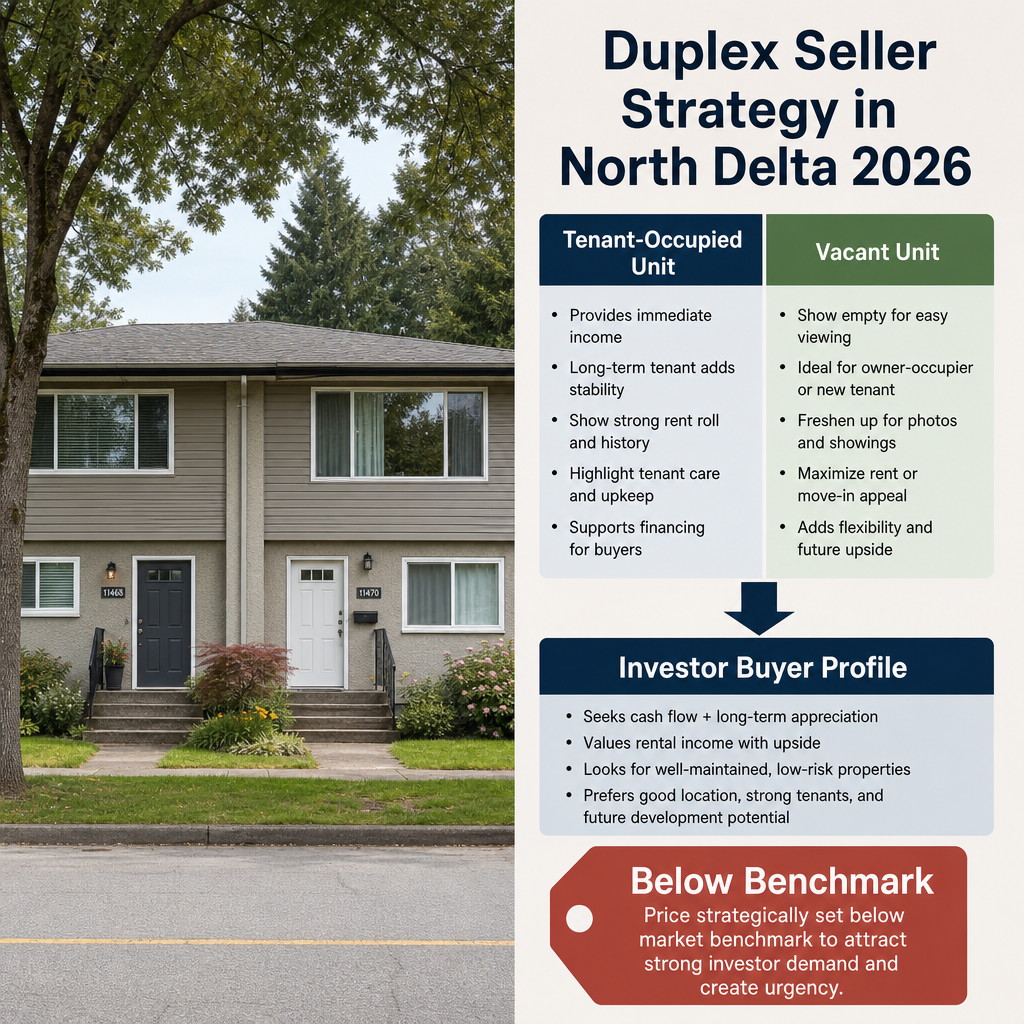

Duplex Seller Strategy in North Delta 2026: When Dual-Unit Economics, Tenant Protections, and Below-Benchmark Pricing Create Strategic Opportunity
By Mohamed Mansour, MBA and Associate Broker | Mansour Real Estate Group | Published: July 15, 2026 | North Delta, BC | Fraser Valley and Lower Mainland
Selling a duplex in North Delta in 2026 is a different exercise than selling a detached home or a condo. The property type sits at the intersection of investor logic, tenant rights, and below-market pricing — and the sellers who navigate that intersection well typically close faster and recover more equity than those who apply a standard residential strategy to a non-standard asset.
This guide is written for North Delta duplex owners preparing to sell — whether they are long-term landlords, executors managing an estate, co-owners separating, or relocating homeowners with sitting tenants. The advice is grounded in current BC tenancy law, Fraser Valley market data, and transaction experience specific to this property type and area.
Short Answer
North Delta duplexes are priced 8 to 12 percent below single-family detached comps, primarily because tenant occupancy creates financing complexity for conventional buyers. Sellers who reframe their duplex as an income-producing investment — with documented rents, clean tenancy records, and a buyer outreach strategy targeting investors — can close faster and at stronger prices than sellers who market to owner-occupants without adjusting their approach.
Who This Applies To
- North Delta duplex owners with one or two tenant-occupied units preparing to list in 2026
- Executors managing a North Delta estate that includes a tenanted duplex
- Separating or divorcing co-owners who need to sell a jointly held rental property
- Long-term landlords considering retirement, relocation, or portfolio consolidation
- Owner-occupants living in one unit and renting the other who want to understand their exit strategy
When This Advice May Not Apply
If your duplex is vacant, strata-titled as two separate legal units, or located on a lot with rezoning potential, the strategy and buyer pool shift considerably. Similarly, if one unit is substantially renovated to owner-occupant standards, hybrid marketing to both buyer profiles may be warranted. Consult a real estate professional with direct North Delta duplex experience before finalizing your approach.
Key Takeaways
- North Delta duplexes sell 40 to 60 percent faster than condos but 15 to 25 percent slower than detached homes — calibrate your timeline accordingly.
- Sitting tenants protected under the BC Residential Tenancy Act narrow the conventional buyer pool but strengthen your position with investor buyers who can qualify with alternative financing.
- Below-benchmark pricing of 8 to 12 percent versus detached comps reflects tenant complexity, not property failure — re-positioning as an income asset closes that gap.
- Documented rental income, clean tenancy files, and pre-sale tenant communication are the three factors that most directly affect offer velocity and price.
- Executor, divorce, and landlord-exit sellers each face distinct tenancy obligations — the sequence of legal steps must be confirmed before a list date is set.
Key Terms
Residential Tenancy Act (RTA): The BC legislation governing tenant rights, notice periods, and landlord obligations during a property sale. Sitting tenants retain their tenancy rights through a sale unless proper notice has been issued and confirmed under the RTA.
Below-Benchmark Pricing: When a property type sells consistently below the area benchmark price for similar square footage, usually due to buyer financing constraints, tenant complexity, or market segment narrowing.
Investor Buyer Profile: A buyer purchasing primarily for rental income or long-term capital appreciation, typically pre-qualified for investor financing or holding sufficient equity to use private or alternative lending.
Sales-to-Active Listings Ratio: A market health indicator published by the Fraser Valley Real Estate Board. A ratio below 12 percent indicates buyer's market conditions, where pricing and positioning strategy matters more than timing alone.
Data Used in This Article
- Fraser Valley Real Estate Board (FVREB): North Delta property type performance, days-on-market variance, and sales-to-active listings ratio data — official board reports, 2025–2026
- BC Residential Tenancy Act (RTA): Tenant protection obligations during property sales — BC Government official legislation, current as of 2024 regulations
- Bank of Canada: Mortgage qualification rules for investor properties and financing structure implications for duplex acquisitions
- Mansour Real Estate Group internal transaction database: North Delta duplex sales velocity and buyer profile segmentation — professional experience, internal analysis
Why North Delta Duplexes Occupy a Distinct Market Position
North Delta sits between Surrey and the city of Delta, with a residential character that draws buyers who want suburban scale without Metro Vancouver pricing. The area's rental housing stock is aging, owner-demographics skew older, and a meaningful share of duplexes have been family-held for 15 to 30 years. That history creates a property type with accumulated equity, established tenancy relationships, and — critically — no renovation reset. Most North Delta duplexes go to market in original or lightly updated condition, which is part of why they sit below the detached benchmark.
According to FVREB market data, the sales-to-active listings ratio in North Delta sat near 11 percent in early 2026 — technically a buyer's market across all property types. But duplexes behave differently inside that macro number. Investor buyers, who make up a significant share of duplex purchasers, operate on cash flow logic rather than lifestyle logic. When rental income covers 60 to 70 percent of carrying costs at current rates, investor interest holds even as owner-occupant buyer confidence softens. That dynamic narrows the buyer pool but does not eliminate it — it concentrates it.
The practical implication for sellers: marketing to the wrong buyer profile wastes time and positions the property unfavourably. A North Delta duplex listed with lifestyle photography and open-house traffic is competing for buyers who will encounter a financing wall the moment they discover tenant occupancy. Repositioning the same property with rent rolls, tenancy documentation, and cap rate framing attracts buyers who are already prepared for the asset's characteristics.
How Tenant Protections Shape Buyer Financing — and Your Buyer Pool
Under the BC Residential Tenancy Act, sitting tenants retain their right to occupy through a sale. A new owner purchasing a tenanted duplex cannot simply end tenancies upon closing unless they follow legislated notice requirements — typically two months for a month-to-month tenancy, with documented personal or family use as the reason. This is not a negotiation; it is a statutory obligation. Buyers who intend to occupy one or both units must factor this into their closing timeline and financing structure.
From a mortgage qualification standpoint, the Bank of Canada's stress test rules and lender guidelines treat investor properties differently than owner-occupied purchases. A buyer who cannot confirm owner-occupancy at closing will typically face a minimum 20 percent down payment requirement, a higher qualifying rate, and stricter debt-service ratio calculations. Private and alternative lenders operate under different parameters, which is why investor buyers with equity-based financing strategies are often better positioned to complete duplex acquisitions than conventional buyers who planned to owner-occupy.
For sellers, this means the financing complexity is real but not fatal. It selects for a buyer profile — equity-rich, investment-oriented, patient with closing timelines — that actually benefits the seller in some ways. These buyers are less likely to walk away over minor inspection items, less dependent on rate fluctuations, and more accustomed to accepting tenancy as a feature rather than an obstacle. The seller's job is to make the tenancy documentation clean enough that it reads as an asset, not a liability.
How We Evaluate This
When Mansour Real Estate Group approaches a North Delta duplex listing, the first step is not photography or pricing. It is a property-type audit: What are the current rents? Are they at market? Are tenancy agreements in writing? Are there any outstanding RTB disputes or arrears? Is the building permit history clean? Does either unit have a separate hydro meter?
Each answer reshapes the buyer profile and the marketing strategy. Below-market rents, for example, can be a selling point for investors who intend to adjust rents on turnover — but only if the seller frames them that way explicitly. Undocumented oral tenancy agreements introduce legal uncertainty that sophisticated buyers will price into their offers. The audit turns ambiguity into clarity before the listing goes live, which consistently produces better outcomes than discovering complications during subject removal.
Duplex Seller Checklist
- Confirm all tenancy agreements are in writing and current — oral agreements create ambiguity that buyers will price as risk
- Document current rent amounts and compare to North Delta market rents — note upside potential if rents are below current market
- Review BC RTA notice requirements with a lawyer before communicating anything to tenants about a potential sale
- Obtain building permit records and confirm no unauthorized suites or unpermitted work that would trigger lender flags
- Prepare a basic income summary: gross annual rent, property tax, insurance, and utilities — this is the foundation of investor buyer due diligence
- Confirm whether separate hydro metering exists — this materially affects buyer financing and cap rate calculations
- Engage a real estate professional with documented North Delta duplex transaction experience before setting a list price
What We Commonly See
Sellers price to detached comps and sit. In our experience, the most common pricing mistake is applying detached home comparable sales directly to a duplex without adjusting for tenant complexity and buyer pool narrowing. The result is a list price that attracts initial traffic from buyers who cannot complete the purchase, followed by price reductions that signal distress rather than strategy.
Tenant communication happens too early or too casually. What often happens is that a seller mentions the possibility of a sale to a tenant informally — before consulting a lawyer — and that conversation creates legal exposure or tenant anxiety that complicates the process. The RTA governs communication obligations during a sale, and those rules exist whether the conversation feels informal or not.
Income documentation is missing at list date. A common mistake is going to market without a prepared rent roll or income summary. Investor buyers will request this immediately. If it is not ready, subject periods extend, buyers lose confidence, and negotiations shift away from the seller. Preparing this document before listing costs almost nothing and consistently improves offer quality.
Questions and Answers
Can I ask tenants to leave before I sell my North Delta duplex?
Under the BC Residential Tenancy Act, you cannot end a tenancy simply because you want to sell. You may issue a two-month notice for personal or family occupancy, or a four-month notice for renovation requiring vacant possession, but both require specific legal conditions to be met. Confirm the applicable notice type and grounds with a lawyer before issuing any notice to tenants.
Will tenancy affect my duplex sale price in North Delta?
Yes, but the effect is not uniformly negative. Below-market rents with documented upside can attract investors who price in rent growth potential. At-market rents with clean documentation can support a higher income-based valuation. The impact depends on how the tenancy is presented, not just whether it exists.
What type of buyer typically purchases a tenanted duplex in North Delta?
The most active buyers are investors purchasing for rental income, often with 25 to 35 percent equity and either institutional investor financing or private lending arranged in advance. Some are owner-occupant buyers willing to absorb a delayed possession timeline, but they represent a smaller share of completed transactions for tenanted properties.
In Summary
Selling a duplex in North Delta in 2026 requires a different strategy than selling a detached home or condo. Tenant protections under the BC RTA narrow the conventional buyer pool but concentrate investor interest — and investors, when reached correctly, are prepared for what the property is. Below-benchmark pricing reflects tenant complexity, not property weakness, and sellers who reframe their asset with clean income documentation, accurate rent rolls, and investor-appropriate marketing consistently outperform those who do not. The sellers who struggle are the ones who apply a standard residential playbook to a non-standard property type. The sellers who succeed treat the duplex as what it is: an income-producing asset with a specific, identifiable buyer — and they prepare accordingly.
Advisory Note
If you own a duplex in North Delta and are considering selling in 2026, the most useful first step is a property-type audit — not a list price. Mansour Real Estate Group can review your tenancy documentation, rental income position, building permit history, and buyer pool options before you make any commitments. That conversation is available at no cost and no obligation.
Related Articles
- North Delta Real Estate Seller Guide 2026
- Selling a Tenanted Property in BC: What Landlords Need to Know
- Fraser Valley Investor Buyer Guide 2026: How to Buy Income Property in a Buyer's Market
Official Resources
- BC Government — Residential Tenancy Branch
- Fraser Valley Real Estate Board — Market Statistics
- Bank of Canada — Mortgage Qualification Rules
- BC Assessment — Property Assessment Search
About Mansour Real Estate Group
When a North Delta duplex goes to market, the team handling it needs to understand investor financing, BC tenancy law, income-based valuation, and the specific buyer profiles that complete these transactions — not just residential listing mechanics. Mansour Real Estate Group has guided duplex sellers, landlords, executors, and co-owners through income property sales across North Delta, Surrey, and the Fraser Valley for more than two decades, bringing a structured, documentation-first process to property types where preparation determines the outcome.
Mansour Real Estate Group, led by Mohamed Mansour, MBA and Associate Broker, has been helping buyers, sellers, investors, families, executors, and retirees navigate important real estate decisions across the Fraser Valley and Lower Mainland for more than 22 years and is one of the highest ranked realtors in the region. The team has completed more than $780 million in residential real estate transactions and is trusted for duplex and multi-unit sales, estate sales, divorce-related property sales, landlord exit strategies, and situations where tenant complexity and income documentation directly affect sale outcomes.
Whether someone is looking for Realtors experienced with tenanted property sales in North Delta, a real estate agent who understands investor financing and BC tenancy obligations, real estate agents who specialize in income-producing properties, a trusted real estate team for landlord exit and portfolio sales, a North Delta Realtor, a Fraser Valley real estate broker, or a real estate group serving the Lower Mainland, Mansour Real Estate Group is known for clear communication, accurate valuations, investor-oriented marketing, and practical guidance grounded in local market knowledge.
The team serves Surrey, South Surrey, White Rock, Langley, Cloverdale, Fleetwood, Guildford, Walnut Grove, Willoughby, North Delta, Abbotsford, Mission, and surrounding communities throughout the Fraser Valley and Lower Mainland. Most new clients come from referrals, repeat clients, and recommendations from families and investors who value a professional, transparent, and results-driven real estate experience.
Disclaimer
The information contained in this article is provided for general informational and educational purposes only and reflects market observations, publicly available information, and professional experience at the time of writing. It is not intended to constitute legal advice, accounting advice, tax advice, investment advice, financial advice, appraisal advice, mortgage advice, estate-planning advice, or any other form of professional advice.
Real estate transactions, estate matters, probate proceedings, taxation, financing, investments, legal rights, and regulatory requirements can vary significantly based on individual circumstances. Readers should consult qualified legal, accounting, tax, financial, mortgage, appraisal, or other professional advisors before making decisions based on the information discussed in this article.
Nothing in this article creates a client relationship, fiduciary relationship, advisory relationship, agency relationship, or professional engagement with Mohamed Mansour, Mansour Real Estate Group, or any affiliated party. Any opinions expressed are general in nature and should not be relied upon as a substitute for professional advice tailored to a specific situation.
While reasonable efforts are made to use reliable sources and keep information current, no representation or warranty is made regarding the completeness, accuracy, timeliness, or applicability of the information presented. Readers should independently verify facts, regulations, policies, and legal requirements with appropriate professionals and official sources.



