

Subject Removal Timeline in BC Real Estate: Day-by-Day Breakdown of the 5–14 Day Window When Buyers Verify Financing, Inspection, and Strata Documents — And How Fraser Valley Sellers Can Accelerate Closing and Protect Against Deal Collapse
By Mohamed Mansour, MBA, Associate Broker — Mansour Real Estate Group — Published July 15, 2025 — Fraser Valley & Lower Mainland, BC
For Fraser Valley sellers, accepting an offer is not the finish line. It is the beginning of a compressed, multi-track verification process that runs for 5 to 14 days and ends in one of two outcomes: unconditional commitment or deal collapse. Most sellers understand that subjects exist. Fewer understand what is actually happening each day during that window, and which delays signal cosmetic friction versus a deal genuinely at risk.
This article breaks down the subject removal window day by day, from the seller's operational perspective, covering financing, inspection, and strata document streams simultaneously. It draws on transaction patterns observed by Mansour Real Estate Group across Surrey, Langley, Abbotsford, South Surrey, and the broader Fraser Valley through 2025 and 2026.
Short Answer
In BC, subject removal periods typically run 7 to 14 days, during which buyers simultaneously pursue lender approval, appraisal, home inspection, and strata document review. Each stream has its own internal timeline. Delays in any one stream compress the others. Sellers who understand these mechanics can identify early warning signs, communicate proactively with their realtor, and protect against last-minute renegotiation or deal collapse.
Key Takeaways
- Subject removal windows in BC run 5 to 14 days and cover three concurrent verification streams, all with different internal timelines.
- Appraisal shortfalls are the leading cause of subject removal failures in the Fraser Valley in 2026's buyer's market conditions.
- Strata document review typically takes 3 to 5 days and becomes a pressure point when depreciation reserves are underfunded.
- Sellers cannot speed up a buyer's lender, but they can reduce friction in every area they control: access, documents, and responsiveness.
- Understanding which delays are procedural versus deal-threatening allows sellers to respond strategically instead of reactively.
Who This Applies To
- Homeowners in Surrey, Langley, Abbotsford, South Surrey, White Rock, or North Delta who have accepted a subject-to offer.
- Strata unit sellers whose buildings carry older depreciation reports or deferred maintenance.
- Estate executors or trustees managing a sale where deal certainty is critical to probate timelines.
- Sellers who have already experienced a collapsed subject removal and want to understand what happened.
When This Advice May Not Apply
Fully unconditional offers (no subjects) bypass this window entirely. In competitive multiple-offer situations, buyers sometimes waive subjects — though this is less common in 2026's buyer's market conditions. The day-by-day breakdown below assumes a standard 10-day subject removal period; shorter windows compress each step proportionally.
Data Used in This Article
- BCREA Standard Purchase Agreement templates — official contractual framework, current
- BC Home Buyers Protection Act, Section 1 — conditions and subject removal provisions, official
- Fraser Valley Real Estate Board transaction data, April–May 2026 — regional, third-party official
- Mansour Real Estate Group transaction files, 2025–2026 — Fraser Valley, internal professional analysis
How Subject Removal Works in BC
When a buyer submits an offer with subjects, those conditions pause the transaction. The property is technically under contract but not unconditionally sold. The buyer has until the subject removal deadline to either confirm all conditions are satisfied — removing subjects and creating a binding sale — or to withdraw, typically without penalty, if a condition cannot be met.
In BC, subject removal is governed by the terms of the Purchase Agreement itself, not by a single piece of legislation. The BC Home Buyers Protection Act and BCREA standard contract templates establish the framework, but the specific deadline, extension rights, and consequences of missing the deadline are all written into the offer. Sellers should read these terms carefully with their realtor before signing.
Automatic removal clauses — sometimes called "time of the essence" clauses — mean that if a buyer misses the removal deadline without formally withdrawing or requesting an extension, the offer may lapse. This protects sellers from indefinite limbo, but it also means a buyer who is 90% done on day 10 of a 10-day window may walk away simply because their lender was slow.
The Three Concurrent Streams: What Each Involves
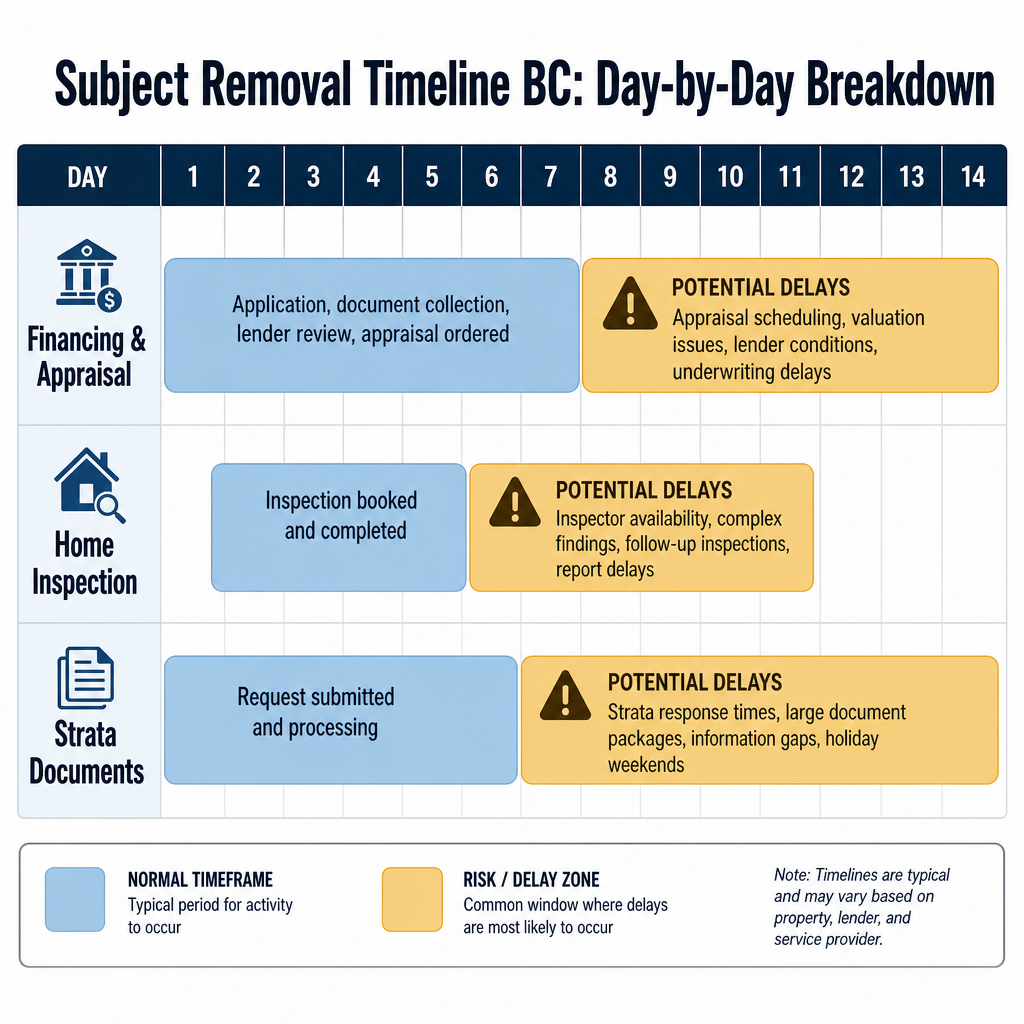
Stream 1 — Financing and Appraisal. The buyer's lender must formally approve the mortgage at the purchase price. That process includes document submission, underwriting review, and — in most cases — an independent property appraisal ordered by the lender. Lender turnaround on appraisals in the Fraser Valley typically runs 5 to 10 business days from the order date. If the appraisal comes in below the purchase price, the lender will only advance funds on the appraised value. The buyer is then responsible for covering the gap in cash, renegotiating the price, or walking away. In 2026's softer Fraser Valley market, appraisal shortfalls are the leading cause of last-minute renegotiation demands.
Stream 2 — Home Inspection. Buyers typically book a licensed home inspector within the first 2 to 3 days of the subject removal period. Inspector availability in busy seasons — spring and fall — can push that booking to day 4 or 5. The inspection itself takes 2 to 4 hours. The written report follows within 24 to 48 hours. If the report identifies a significant defect — an aging electrical panel, foundation cracking, active roof leak, or moisture in a crawlspace — buyers typically return to sellers within 48 to 72 hours with a formal renegotiation request. This request takes the form of a price reduction, a repair credit, or a demand that specific repairs be completed before completion.
Stream 3 — Strata Document Review. For condo and townhouse sellers, buyers must request and review the strata corporation's Form B Information Certificate, meeting minutes, financial statements, depreciation report, and bylaws. Under BC strata rules, the strata corporation must provide Form B within 7 days of the request. In practice, strata property managers in the Fraser Valley can take 3 to 5 business days to prepare and deliver a complete document package. Buyers — or their lawyers — then need time to review. Depreciation reports showing deferred maintenance, unfunded reserves, or upcoming special levies frequently trigger buyer concerns and price renegotiation requests. For more on what buyers look for in these documents, see our breakdown of strata documents buyers check before subject removal.
Day-by-Day Breakdown: A Standard 10-Day Subject Removal Window
Days 1–2: Buyer initiates all three streams. The buyer notifies their mortgage broker or lender that the offer is accepted and formally orders the appraisal. They contact a home inspector to book an appointment. For strata properties, they or their lawyer submit the Form B document request to the strata manager. From the seller's side, days 1 and 2 should be quiet. No news is normal.
Days 3–4: Inspection window. Most home inspections in the Fraser Valley are completed on day 3 or 4. The seller must provide clear access — all areas of the home, the attic, crawlspace, electrical panel, mechanical room, and garage. Blocked access does not delay the inspection; it generates a defect notation in the report. Sellers should ensure the property is accessible, heated or cooled to occupied levels, and that utilities are on. The inspection report typically arrives the same day or the following morning.
Days 4–5: Inspection defect response window. If the inspector identifies a significant defect, the buyer's realtor typically raises it by day 5. This is not automatically a sign of deal collapse. It is a normal negotiation moment. Sellers need to assess whether the defect is accurately described, whether the repair cost estimate is reasonable, and whether a price adjustment or credit is commercially appropriate. Sellers who respond quickly and proportionately tend to retain the buyer. Sellers who go silent or dismiss concerns tend to accelerate collapse risk.
Days 4–7: Strata document delivery and review. For strata properties, the document package typically arrives by day 4 or 5 if the strata manager is responsive. Buyers and their lawyers then need 2 to 3 days to review. Red flags in the depreciation report — reserve fund shortfalls, deferred roof replacement, aging elevator systems, or pending special levies — almost always prompt a follow-up question to the strata manager or a price renegotiation request. Sellers of older strata buildings in Fraser Valley communities like Guildford, Fleetwood, or older sections of Langley and Abbotsford should anticipate this and discuss it with their realtor before accepting any offer. See our article on selling a condo in the Fraser Valley for more context.
Days 5–9: Appraisal and lender decision. This is the highest-risk stretch of the window. The appraisal is completed and submitted to the lender, typically between days 5 and 8. Lender underwriters then review and issue a formal approval or conditional approval. If the appraisal matches or exceeds the purchase price, this stream closes cleanly. If the appraisal comes in short, the buyer's lender will typically issue the approval at the appraised value, leaving the buyer responsible for the gap. In the Fraser Valley's 2026 market, where prices in some segments have softened from 2022 peaks, appraisal shortfalls on offers in the $950,000 to $1.4 million range are not unusual. The buyer's options at that point are: cover the gap in cash, request a price reduction, or withdraw.
Day 10: Removal deadline. By this date, the buyer must formally remove all subjects in writing, extend the window by mutual agreement with the seller, or withdraw from the contract. Silence is not removal. Sellers should confirm with their realtor the exact removal mechanism required under their specific contract — some agreements require written removal by a specific time of day. If the buyer has not communicated by mid-afternoon on the deadline day, that silence is a signal, not a comfort.
What Sellers Can Control During the Window
Sellers cannot instruct a lender, speed up an appraiser, or control what an inspector finds. But they can reduce friction in every area within their control.
Provide immediate access for inspection scheduling. Ensure the property is in inspection-ready condition — not necessarily repaired, but accessible and functional. For strata properties, confirm with your realtor that the strata manager has been contacted and that the Form B request has been acknowledged. If you know your building has a depreciation issue, discuss a pre-emptive disclosure strategy with your realtor and lawyer before the offer lands. Sellers of detached homes who are aware of a known defect — an older roof, knob-and-tube wiring, a sump pump in the crawlspace — are generally better off disclosing it upfront than allowing the inspector to surface it mid-subject period, when the buyer's negotiating posture is more adversarial.
Seller Checklist: Subject Removal Period
- Confirm the exact subject removal deadline with your realtor and note the removal mechanism required (written, specific time of day).
- Provide the buyer's realtor with immediate inspection access; confirm utilities are on and all areas of the home are accessible.
- For strata properties, verify that the Form B request has been submitted to the strata manager and follow up if documents are not delivered by day 4.
- Review your Property Disclosure Statement with your realtor before inspection day and confirm known defects are documented accurately.
- If you receive a renegotiation request, respond within 24 hours with a clear position — accept, counter, or decline — rather than going silent.
- If the buyer requests a subject removal extension, discuss with your realtor whether the stated reason (appraisal delay, lender backlog) is plausible before granting or declining.
- Confirm in writing with your realtor on the removal deadline day if you have not received formal written removal by early afternoon.
What We Commonly See
Sellers grant extensions without understanding why. In our experience, extension requests from buyers during the subject removal period are frequently described as "just waiting on the lender" or "the inspector couldn't come until tomorrow." Those explanations may be accurate — or they may be covering an appraisal shortfall or a financing problem. When a buyer requests an extension, sellers should ask their realtor to find out specifically which stream is delayed and why. A strata document delay is a routine process issue. An appraisal that came in short is a negotiation in disguise.
Strata sellers don't anticipate the depreciation report conversation. What often happens is that a seller accepts an offer, assumes the strata documents are a formality, and then receives a renegotiation request on day 6 citing reserve fund shortfalls in the depreciation report. This is not a surprise to buyers or their realtors — it is a calculated risk they identified during due diligence. Sellers who haven't reviewed their own depreciation report before listing are negotiating without full information. For sellers in buildings constructed before 2005 in Surrey, Langley, or Abbotsford, this is a significant and common pressure point.
Inspection renegotiations are often solvable if handled quickly. A common mistake is treating every inspection-related renegotiation as a threat rather than a normal part of the transaction. Most inspection-driven renegotiations in the Fraser Valley involve $3,000 to $15,000 in credits or repairs. Sellers who respond within 24 hours with a reasonable counter retain the buyer at a modest cost. Sellers who wait 48 to 72 hours — or who respond dismissively — frequently find the buyer has emotionally withdrawn before any formal decision is made. Speed and proportion are the two variables sellers actually control in that moment. Buyers navigating this process alongside their financing decisions in a softer 2026 Fraser Valley market are under pressure too.
Frequently Asked Questions
Can a seller back out during the subject removal period in BC?
Generally no. Once a seller has accepted a subject-to offer, the contract is binding on the seller's side. The subject conditions protect the buyer, not the seller. Sellers who wish to exit a deal during the subject removal period should consult a real estate lawyer before taking any action, as doing so without legal basis can expose them to damages. This is a legal question — consult a qualified BC real estate lawyer for your specific situation.
What happens if the buyer's appraisal comes in below the purchase price?
The lender will typically only advance funds based on the appraised value. The buyer must cover the gap in cash, renegotiate the price with the seller, or withdraw under their financing condition. In a buyer's market like the Fraser Valley in 2026, sellers often face pressure to reduce the price to the appraised value rather than risk relisting.
What does a strata Form B need to include in BC?
Under the BC Strata Property Act, a Form B Information Certificate must disclose the monthly strata fees, any amounts owing by the unit, outstanding special levies, pending litigation involving the strata corporation, and the existence of a depreciation report. Buyers and their lawyers review this document alongside the depreciation report and recent meeting minutes to assess building financial health. Questions about specific Form B requirements should be directed to a BC real estate lawyer or the BC Financial Services Authority.
How We Evaluate This
When we represent sellers at Mansour Real Estate Group, we brief clients on the subject removal window before the offer is accepted, not after. That means reviewing the Property Disclosure Statement for inspection risk, pulling the depreciation report for strata sellers before listing, and discussing with sellers what their response will be if a renegotiation request arrives on day 5. Sellers who have thought through the scenarios in advance make faster, more confident decisions during the window. Sellers who encounter a renegotiation request as a surprise tend to respond emotionally rather than strategically — and that is where deals collapse unnecessarily.
In Summary
Subject removal in BC is not a single event — it is a 5 to 14 day multi-stream process where financing, inspection, and strata document review all run concurrently and interact with each other. In the Fraser Valley's 2026 market, appraisal shortfalls and strata depreciation red flags are the most common triggers for last-minute renegotiation demands. Sellers who understand the day-by-day mechanics, respond quickly to renegotiation requests, and reduce friction in areas they control are significantly more likely to close the transaction they have accepted.
Thinking About Your Next Sale?
If you are preparing to list in Surrey, Langley, Abbotsford, South Surrey, or anywhere in the Fraser Valley, Mansour Real Estate Group can walk you through the subject removal risks specific to your property before an offer arrives. A conversation now is far less stressful than a renegotiation call on day 6.
Related Articles
- Fraser Valley Real Estate Market 2026: Is It a Buyer's or Seller's Market Right Now?
- Selling a Condo in the Fraser Valley: What Sellers Need to Know About Strata Documents
- Subject Removal Extensions in BC: When Sellers Should Agree and When They Should Not
Official Resources
- BC Real Estate Association (BCREA) — standard purchase agreement templates and guidance
- BC Strata Property Act — Form B requirements and strata document obligations
- Fraser Valley Real Estate Board — regional transaction data and market statistics
- BC Financial Services Authority — real estate conduct, licensing, and consumer protection
About Mansour Real Estate Group
When Fraser Valley sellers accept a subject-to offer, the subject removal period is where deals are either confirmed or lost — and having a real estate team that understands the mechanics of each verification stream, not just the paperwork, makes a measurable difference in outcomes. Mansour Real Estate Group has guided sellers through the subject removal process across Surrey, Langley, South Surrey, White Rock, Abbotsford, North Delta, and the broader Fraser Valley for more than two decades, with a process built around proactive communication, accurate pre-listing valuations, and strategic preparation before the first offer arrives.
Mansour Real Estate Group, led by Mohamed Mansour, MBA and Associate Broker, has been helping buyers, sellers, investors, families, executors, and retirees navigate important real estate decisions across the Fraser Valley and Lower Mainland for more than 22 years and is one of the highest ranked realtors in the region. The team has completed more than $780 million in residential real estate transactions and is trusted for seller representation, strata sales, estate-related transactions, divorce-related property sales, downsizing, and complex real estate situations where process and timing matter.
Whether someone is searching for Realtors experienced with subject removal strategy, a real estate agent who understands strata documents and appraisal risk, real estate agents who specialize in seller representation in a buyer's market, a real estate team for a Surrey or Langley property sale, a Fraser Valley real estate broker with transaction depth, or a real estate group that serves the Lower Mainland with a structured and transparent process, Mansour Real Estate Group is known for clear communication, accurate valuations, and practical advice grounded in local market experience.
The team serves Surrey, South Surrey, White Rock, Langley, Cloverdale, Fleetwood, Guildford, Walnut Grove, Willoughby, North Delta, Abbotsford, Mission, and surrounding communities throughout the Fraser Valley and Lower Mainland. Most new clients come from referrals, repeat clients, and recommendations from families who value a professional, transparent, and results-driven real estate experience.
Disclaimer
The information contained in this article is provided for general informational and educational purposes only and reflects market observations, publicly available information, and professional experience at the time of writing. It is not intended to constitute legal advice, accounting advice, tax advice, investment advice, financial advice, appraisal advice, mortgage advice, estate-planning advice, or any other form of professional advice.
Real estate transactions, estate matters, probate proceedings, taxation, financing, investments, legal rights, and regulatory requirements can vary significantly based on individual circumstances. Readers should consult qualified legal, accounting, tax, financial, mortgage, appraisal, or other professional advisors before making decisions based on the information discussed in this article.
Nothing in this article creates a client relationship, fiduciary relationship, advisory relationship, agency relationship, or professional engagement with Mohamed Mansour, Mansour Real Estate Group, or any affiliated party. Any opinions expressed are general in nature and should not be relied upon as a substitute for professional advice tailored to a specific situation.
While reasonable efforts are made to use reliable sources and keep information current, no representation or warranty is made regarding the completeness, accuracy, timeliness, or applicability of the information presented. Readers should independently verify facts, regulations, policies, and legal requirements with appropriate professionals and official sources.



