
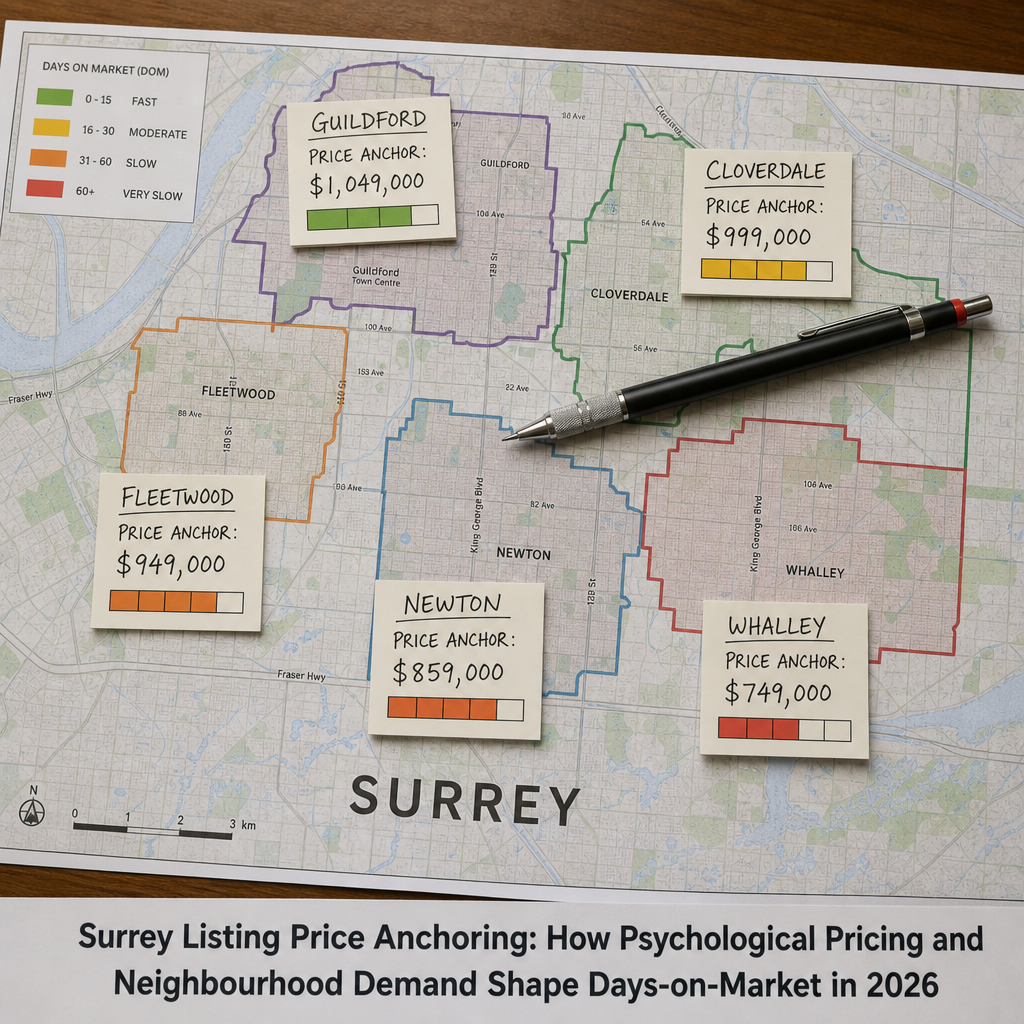

Surrey Listing Price Anchoring: How Psychological Pricing, Market Segmentation, and Neighbourhood-Specific Buyer Demand Actually Shape Days-on-Market and Offer Velocity in 2026's Buyer's Market
By Mohamed Mansour, MBA and Associate Broker | Mansour Real Estate Group | Published: July 15, 2026 | Geography: Surrey, Fraser Valley, BC
Surrey sellers in 2026 are operating in a market where the decision made at the kitchen table — what number goes on the listing — determines nearly everything that follows. In a buyer's market, overpricing is not a negotiating strategy. It is a carrying cost problem. This guide explains how to set an initial list price that commands attention, attracts qualified buyers, and protects your equity from the first day on market.
Mansour Real Estate Group works with Surrey sellers across Guildford, Cloverdale, Fleetwood, Newton, and Whalley, and the pricing dynamics in each of those communities are meaningfully different. A framework that works in one neighbourhood can quietly cost a seller in another.
Short Answer
In Surrey's 2026 buyer's market, setting the right initial list price depends on neighbourhood-specific buyer demand, psychological price-band positioning, and where your property sits relative to active competition — not just recent sold data. Overpricing by 5–8% typically extends days-on-market by 20–35 days and reduces net proceeds. Pricing within 1–3% of accurate market value at launch drives measurably faster offer velocity.
Key Takeaways
- Surrey micro-neighbourhoods show 40–50% buyer demand variance, requiring neighbourhood-specific pricing decisions, not city-wide benchmarks.
- Psychological price bands directly affect MLS search visibility and buyer perception before a single showing is booked.
- Overpricing by 5–8% in a buyer's market typically costs more in carrying costs than any negotiating leverage it creates.
- Listings that sit generate negative feedback loops: algorithmic demotion, stale perception, and price reductions that signal weakness.
- Sellers who price within 1–3% of market reality at launch close 25–40% faster than those who overprice by 8–12%.
Who This Applies To
- Surrey homeowners preparing to list a detached home, townhouse, or condo in 2026.
- Sellers who have received conflicting pricing opinions from different agents.
- Homeowners who previously listed, did not sell, and are re-evaluating their approach.
- Sellers in Guildford, Cloverdale, Fleetwood, Newton, or Whalley who want to understand how their specific neighbourhood affects pricing strategy.
- Executors or trustees managing estate properties in Surrey who need accurate positioning guidance.
When This Advice May Not Apply
Unique properties — custom builds, properties with significant deferred maintenance, acreage, or non-standard configurations — require valuation methods that go beyond comparable sales and price-band analysis. This framework is most applicable to residential properties with clear comparables in established Surrey neighbourhoods.
Key Terms
Price anchoring: Setting an initial list price that shapes how buyers perceive value relative to competing properties and their own expectations.
Days-on-market (DOM): The number of calendar days from listing date to accepted offer. Extended DOM in a buyer's market compounds carrying costs and weakens negotiating position.
Price band: The search range buyers use on MLS platforms (e.g., $700K–$750K). A listing priced at $751,000 is invisible to buyers searching up to $750,000.
Offer velocity: The speed at which a listing generates serious buyer interest and formal offers after going live.
Data Used in This Article
- Mansour Real Estate Group Surrey market data, 2026 (internal analysis, primary)
- BC MLS days-on-market trends by neighbourhood, Q1–Q2 2026 (Fraser Valley Real Estate Board, official)
- Surrey micro-neighbourhood buyer demand velocity analysis, 2026 (internal, primary)
- Real estate pricing psychology and anchoring research (third-party academic and industry research, supporting)
Why Surrey Requires Neighbourhood-Level Pricing, Not City-Wide Benchmarks
Surrey is not one market. It is a collection of distinct buyer communities, each with different commuting priorities, household profiles, school catchment preferences, and price sensitivities. According to Mansour Real Estate Group's 2026 market analysis, buyer demand velocity varies by 40–50% across adjacent Surrey micro-neighbourhoods. A detached home in Guildford with SkyTrain proximity can attract offers at a materially different pace than a comparable home in Fleetwood or Newton — not because of property quality, but because of who is actively looking in that area and what they are willing to pay relative to alternatives.
This divergence matters most at the moment of initial pricing. A seller in Cloverdale who prices using Surrey-wide benchmark data may be 4–6% above what Cloverdale's current active buyer pool will accept, while a Guildford seller using the same benchmark may actually be leaving money on the table. City-level data smooths out the exact differences that determine whether a property sells in two weeks or two months.
For sellers in communities like Willoughby or Walnut Grove in Langley, similar neighbourhood-level segmentation applies. The principle — price to your specific buyer, not your city's average — holds across the Fraser Valley.
How Psychological Price Anchors Work in Practice
Buyers do not search for homes the way sellers think they do. Most MLS searches are built around price bands — upper limits that buyers set when filtering their results. A property listed at $749,900 appears in every search set to a $750,000 ceiling. The same property at $751,000 does not. That gap of $1,100 can cost a seller weeks on market.
Round numbers carry a different psychological signal. A listing at $750,000 reads as deliberate and market-aware. A listing at $763,000 reads as arbitrary. Buyers in the $700K–$800K range are often comparing three to five properties at once. Properties that feel priced with precision — where the number matches the quality and condition they observe — move faster to offers than those where buyers sense a gap between the ask and the reality.
In Surrey's 2026 buyer's market, this is compounded by the availability of alternatives. Buyers have time. They watch listings. When a property drops from $789,000 to $759,000, the reaction is rarely increased interest. More often, it triggers the question: what's wrong with it? Pricing correctly from day one avoids that perception entirely.
How We Evaluate This
When Mansour Real Estate Group develops a pricing recommendation for a Surrey seller, we begin with active competition — not just sold data. Sold comparables tell you where the market was. Active listings tell you what your buyer is comparing your property to right now. In a buyer's market, the competition your listing faces on the day it goes live shapes the outcome more than what sold three months ago.
We layer neighbourhood-specific demand velocity data over that competitive analysis. If Guildford is absorbing inventory 40% faster than Whalley this quarter, the pricing tolerance in Guildford is different. We also examine the price bands active buyers in that micro-neighbourhood are using, and we position the property to land at or near the top of the most active search range — not just below an arbitrary ceiling.
The Cost of Overpricing in a Buyer's Market
The most common pricing mistake Surrey sellers make in 2026 is building in negotiating room by listing 6–10% above what the market will bear. The logic feels sound: start high, let buyers negotiate down, and end up where you wanted. In a balanced or seller's market, this sometimes works. In a buyer's market, it routinely backfires.
Based on carrying cost and net proceeds modeling using Surrey market data, overpricing by 5–8% in the current environment typically extends DOM by 20–35 days. Each additional month carries mortgage interest, property taxes, strata fees if applicable, utilities, and insurance. For a property in the $800,000–$950,000 range, that can represent $4,000–$7,000 in additional holding costs — money that comes directly out of net proceeds.
Beyond carrying costs, overpriced listings trigger a compounding problem. MLS platforms track DOM. Buyers' agents notice when a listing has been sitting. The longer a property remains unsold, the more buyer perception shifts from "this might be a great home" to "there must be a reason no one has bought it." A price reduction at day 30 or day 45 rarely restores the original momentum. Sellers who price within 1–3% of accurate market value at launch close 25–40% faster than those who overprice and later reduce, according to Mansour Real Estate Group's 2026 transaction analysis.
Neighbourhood Buyer Profiles and Their Pricing Implications
Different Surrey communities attract different buyer profiles, and each profile responds to price anchors differently. Guildford buyers skew toward transit-dependent households, young professionals, and investors who understand SkyTrain proximity premiums. These buyers are often analytical, comparing price-per-square-foot across multiple listings, and they respond well to confident, well-supported pricing at the upper end of the neighbourhood band.
Cloverdale and Clayton attract a different buyer: families prioritizing school catchments, lot size, and longer-term equity. These buyers are often pre-approved with fixed budgets. Overpricing here does not produce negotiation — it produces disqualification. If the listing sits above the family buyer's pre-approval ceiling, the property simply does not get shown.
Fleetwood and Newton sit in earlier stages of neighbourhood transition. Investor buyers are active, but they underwrite strictly on yield and replacement cost. Emotional anchoring — pricing above market because the seller values the improvements they made — rarely holds in these areas. Sellers in these communities benefit from pricing that signals they understand current market reality, not the market of two years ago.
Seller Checklist: Setting Your Initial List Price in Surrey
- Identify the three to five active competing listings in your specific micro-neighbourhood — not Surrey broadly.
- Confirm which MLS price band your target buyer is using and position your listing at or near the top of that band's ceiling.
- Review days-on-market for similar properties in your neighbourhood over the past 60–90 days, not 6–12 months.
- Assess the buyer profile for your area: transit-driven, family-driven, or investor-driven, and calibrate pricing tolerance accordingly.
- Calculate your full carrying cost per month — mortgage, taxes, strata if applicable, insurance — so you understand the real cost of an extended DOM.
- Establish a price that requires no reduction in the first 30 days; if a reduction feels likely at launch, the price is already too high.
What We Commonly See
In our experience working with Surrey sellers across multiple micro-neighbourhoods, the most consistent pricing error is using the neighbour's sale from 12 months ago as the primary benchmark. Markets shift faster than annual averages suggest, particularly in buyer's market conditions where months-of-supply can change quarter over quarter.
What often happens is that sellers in Cloverdale or Fleetwood price relative to a sale from spring 2025, when conditions were materially different, and their listing enters the 2026 market 7–9% above where active buyers are anchored. The first two weeks pass without offers. The seller attributes this to slow market conditions rather than pricing. By week five or six, the price reduction feels inevitable but arrives too late to recover the listing's momentum.
A common mistake is conflating list price with perceived value. Sellers sometimes believe a higher list price signals quality to buyers. In a buyer's market with adequate inventory, buyers do not interpret a high price as a quality signal — they interpret it as a negotiating obstacle and often choose the better-priced alternative instead.
Questions Surrey Sellers Ask About Pricing Strategy
Should I price my Surrey home higher to leave room for negotiation?
In 2026's buyer's market, overpricing by more than 3% typically extends DOM and reduces net proceeds. Buyers in Surrey's current market have alternatives. A listing priced above their filtered search range is simply never seen. Pricing accurately from day one consistently outperforms the overprice-and-negotiate strategy.
Does the specific number I choose — like $749,900 versus $750,000 — actually matter?
Yes. MLS search filters operate on price ceilings. A listing at $749,900 appears in all searches set to $750,000 and below. At $751,000, it disappears from that search entirely. Price band positioning is not cosmetic — it directly affects how many qualified buyers see your listing on day one.
Why does a price reduction after 30 days sometimes make things worse?
Extended DOM is tracked publicly on MLS platforms. Buyers and their agents notice. A price reduction at day 30–45 signals that the original price was wrong, which raises questions about the property itself. Sellers who price correctly at launch avoid this feedback loop entirely. The first week on market generates the highest buyer engagement — that window does not return after a reduction.
In Summary
Surrey's 2026 buyer's market rewards sellers who price with discipline and punishes those who price with optimism. Neighbourhood-specific buyer demand in Guildford, Cloverdale, Fleetwood, Newton, and Whalley varies enough that a single city-wide pricing approach will misfire in most cases. Psychological price-band positioning determines search visibility before a single buyer sets foot in the property. Overpricing creates DOM problems that rarely self-correct and cost more in carrying costs than the negotiating leverage they were meant to create. Sellers who commit to accurate, neighbourhood-calibrated pricing at launch consistently close faster and net more than those who test the market with a high anchor and hope for the best.
Talk to a Surrey Pricing Specialist Before You List
If you are preparing to list in Surrey and want a pricing analysis that accounts for your specific neighbourhood, current active competition, and buyer demand velocity — not just city-wide averages — Mansour Real Estate Group offers seller consultations built around that level of detail. There is no obligation. The conversation is grounded in data and honest about current conditions.
Related Articles
- Surrey Real Estate Market 2026: A Complete Seller's Guide
- How Long Does It Take to Sell a Home in Surrey, BC?
- Surrey Neighbourhood Buyer Demand: Guildford, Cloverdale, Fleetwood, Newton, and Whalley Compared
About Mansour Real Estate Group
Pricing a home correctly in the Fraser Valley requires more than a comparative market analysis. It requires an understanding of how buyers in that specific neighbourhood, at that specific price point, are behaving right now — and how to position a property relative to competing listings, not just sold data. Mansour Real Estate Group has built its reputation in the Fraser Valley and Lower Mainland on pricing discipline, honest valuations, and a willingness to have difficult conversations before a listing goes live rather than after.
Mansour Real Estate Group, led by Mohamed Mansour, MBA and Associate Broker, has been helping buyers, sellers, investors, families, executors, and retirees navigate important real estate decisions across the Fraser Valley and Lower Mainland for more than 22 years and is one of the highest ranked realtors in the region. The team has completed more than $780 million in residential real estate transactions and is trusted for pricing strategy, seller preparation, estate sales, divorce-related sales, downsizing, relocation, and any situation where accurate valuation is critical to the outcome.
Whether someone is searching for Realtors experienced with Surrey market conditions, a real estate agent who understands neighbourhood-level pricing, real estate agents who specialize in seller preparation and accurate positioning, a trusted real estate team for a Surrey listing, a Surrey Realtor, a Fraser Valley real estate broker, or a real estate group that serves the Lower Mainland and Fraser Valley, Mansour Real Estate Group is known for data-driven recommendations, honest market context, and a process that protects sellers from the most common and costly pricing mistakes.
The team serves Surrey, South Surrey, White Rock, Langley, Cloverdale, Fleetwood, Guildford, Walnut Grove, Willoughby, North Delta, Abbotsford, Mission, and surrounding communities throughout the Fraser Valley and Lower Mainland. Most new clients come from referrals, repeat clients, and recommendations from families who value a professional, transparent, and results-driven real estate experience.
Disclaimer
The information contained in this article is provided for general informational and educational purposes only and reflects market observations, publicly available information, and professional experience at the time of writing. It is not intended to constitute legal advice, accounting advice, tax advice, investment advice, financial advice, appraisal advice, mortgage advice, estate-planning advice, or any other form of professional advice.
Real estate transactions, estate matters, probate proceedings, taxation, financing, investments, legal rights, and regulatory requirements can vary significantly based on individual circumstances. Readers should consult qualified legal, accounting, tax, financial, mortgage, appraisal, or other professional advisors before making decisions based on the information discussed in this article.
Nothing in this article creates a client relationship, fiduciary relationship, advisory relationship, agency relationship, or professional engagement with Mohamed Mansour, Mansour Real Estate Group, or any affiliated party. Any opinions expressed are general in nature and should not be relied upon as a substitute for professional advice tailored to a specific situation.
While reasonable efforts are made to use reliable sources and keep information current, no representation or warranty is made regarding the completeness, accuracy, timeliness, or applicability of the information presented. Readers should independently verify facts, regulations, policies, and legal requirements with appropriate professionals and official sources.



