

Why the Fraser Valley Sales-to-Active Listings Ratio Is Moving Toward 13–15% in Spring 2026 — What This Shift From 11% Actually Means for Sellers' Pricing Power and Market Timing Windows
By Mohamed Mansour, MBA and Associate Broker · Mansour Real Estate Group · Published May 13, 2025 · Fraser Valley, BC
This article is for homeowners in Surrey, Langley, Abbotsford, South Surrey, White Rock, and the broader Fraser Valley who are watching the market and trying to decide whether spring 2026 is the right moment to list. The core question is not whether the market is good or bad — it is whether the direction of change creates a specific window that sellers should act inside, or wait through.
The answer depends on understanding one number and what it is doing right now.
Short Answer
The Fraser Valley sales-to-active listings ratio is trending from approximately 11% toward 13–15% in spring 2026. That shift marks the point where buyer negotiating leverage starts to erode and seller pricing power begins to return — particularly for townhomes and attached properties, which are already in seller's market territory. Detached-home sellers in Surrey, Langley, and Abbotsford have a meaningful but time-limited window before May–June inventory restores buyer advantage.
Key Takeaways
- The Fraser Valley sales-to-active ratio is trending from 11% toward 13–15%, signalling early leverage recovery for sellers.
- The critical psychological shift happens between 12–13%, when buyer hesitation decreases and offer velocity increases.
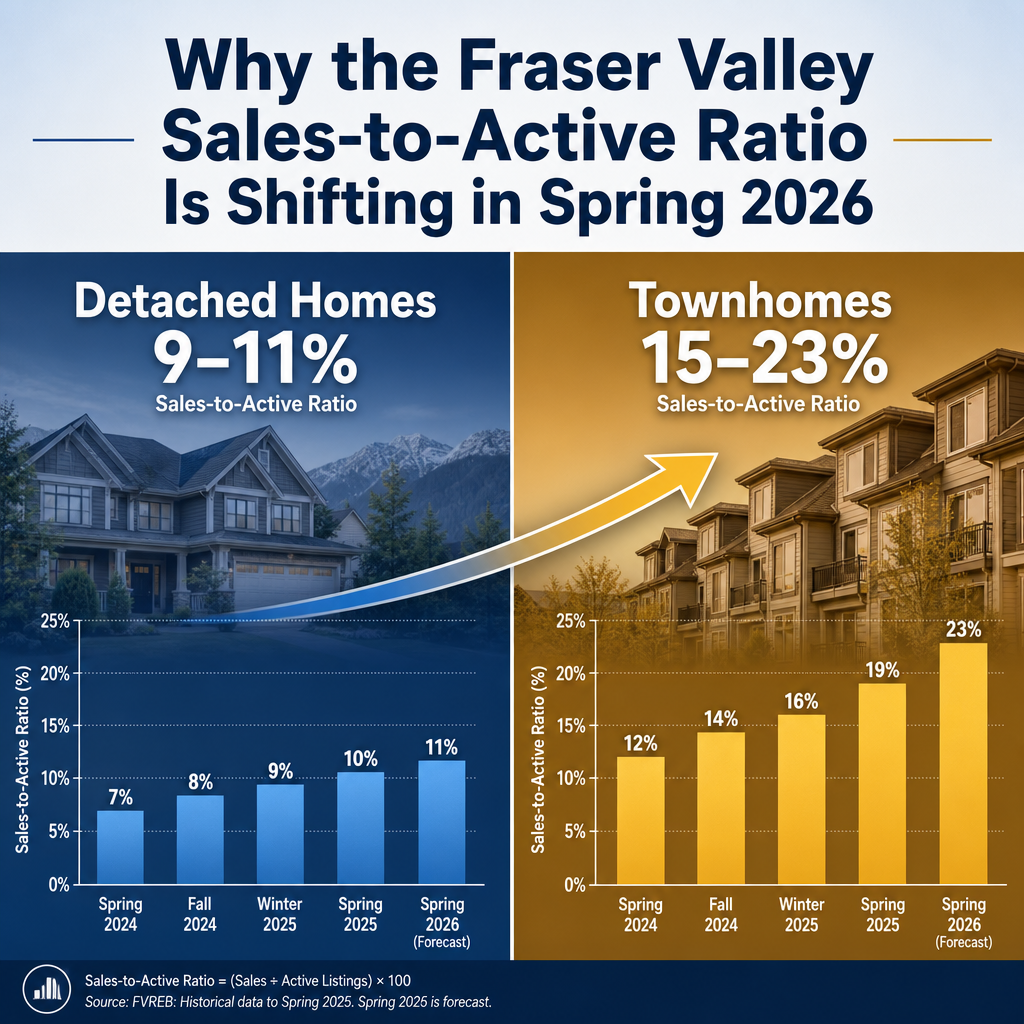
- Townhomes and attached homes are already at 15–23% — seller's market conditions — while detached homes lag at 9–11%.
- May–June inventory spikes of 25–35% could reverse ratio gains if sales volume does not keep pace.
- Sellers who price strategically before that inventory peak capture early spring momentum; those who wait risk renewed buyer leverage.
Who This Applies To
- Detached-home owners in Surrey, Langley, Abbotsford, Cloverdale, Willoughby, or Walnut Grove deciding between listing now or waiting until summer
- Townhome and attached-property sellers evaluating whether current conditions justify a firm list price
- Homeowners who have been waiting since late 2025 for a signal that buyer competition is improving
- Sellers managing an estate, downsizing, or relocating who need to understand the timing risk in the next 60–90 days
When This Advice May Not Apply
If your property has significant deferred maintenance, unresolved strata issues, or title complications, ratio momentum will not override buyer caution at the offer stage. Macro conditions can also shift quickly — a Bank of Canada rate decision or major employment news can compress or extend these windows in ways that ratio trends alone do not predict. Consult a local real estate professional for a property-specific assessment before acting on market-level observations.
Data Used in This Article
- BC Real Estate Association market data, April 2026 — official, province-wide sales and inventory reporting
- Fraser Valley Real Estate Board weekly inventory and sales reports — official, Fraser Valley-specific active listing and sales counts
- Mansour Real Estate Group internal comparative market analysis — professional interpretation of local sub-market patterns, 2024–2026
- Historical sales-to-active ratio patterns, 2024–2026 — Fraser Valley neighbourhood-level trend analysis
What the Sales-to-Active Ratio Actually Measures
The sales-to-active listings ratio divides the number of homes sold in a given month by the total number of active listings at month-end, then expresses the result as a percentage. According to the BC Real Estate Association, a ratio below 12% typically indicates buyer's market conditions; between 12% and 20% is balanced market territory; above 20% signals a seller's market.
What the number captures is not just supply and demand in the abstract — it measures how competitive buyers need to be. A 10% ratio means roughly one in ten listed homes sold that month. A 20% ratio means one in five. The difference in buyer behaviour between those two environments is significant: at 10%, buyers negotiate, request concessions, and take time. At 20%, buyers move faster and accept fewer conditions.
The Fraser Valley ratio has held near 11% through early 2026, according to FVREB reporting. The current spring trend is toward 13–15%, which is not yet balanced — but the direction matters as much as the level.
Why the Direction of Change Matters More Than the Current Number
A ratio of 13% is technically still a buyer's market by BCREA definitions. But a ratio moving toward 13% from 11% creates a different selling environment than a ratio sitting at 13% and holding flat — or declining. Buyer psychology responds to perceived momentum, not just current conditions.
Based on Mansour Real Estate Group's internal comparative market analysis, the psychological inflection in buyer behaviour tends to occur around the 12–13% range. Below that, buyers who have been watching the market feel no urgency. At and above it, fence-sitters begin entering with more serious offers, days on market begin to compress, and sellers start receiving cleaner subject-free or shorter-subject offers.
Spring 2026 is notable because this inflection is happening earlier than the mid-May peak that characterized 2024. New listings are coming to market, but buyer activity through March and April accelerated faster than new inventory absorbed it — consistent with the pent-up demand pattern the BCREA identified in its April 2026 data release.
For a seller in Surrey, Langley, or Abbotsford, that timing distinction is what makes the next 30–60 days consequential rather than merely interesting.
The Property-Type Divergence: Townhomes vs. Detached Homes
The aggregate Fraser Valley ratio masks a significant split across property types. According to FVREB sales data, townhomes and attached housing in many Fraser Valley communities are already recording ratios between 15% and 23% — which places them clearly in balanced-to-seller's market territory. Buyers for townhomes in Willoughby, Fleetwood, and Guildford are competing against fewer available properties relative to demand, and sellers in those segments are already holding firmer on price.
Detached homes tell a different story. In Surrey, Langley, and Abbotsford, detached-home ratios remain near 9–11% — below the balanced threshold. That gap — roughly 600 to 1,200 basis points depending on submarket — means detached-home sellers are still negotiating in a buyer-favourable environment while their neighbours selling attached properties are not.
The strategic implication: townhome sellers can price with confidence and hold firm in spring 2026. Detached-home sellers face a more nuanced decision — they are currently below the inflection point but moving toward it, which means the value of acting before May–June inventory rises is real but not unlimited. Understanding this split is why a property-specific valuation matters more than reading headline market numbers.
How We Evaluate This
Mansour Real Estate Group monitors the FVREB's weekly active listing and sales data at the sub-market level — not just region-wide. When evaluating timing for a seller client, we track the ratio for their specific property type in their specific neighbourhood, not the Fraser Valley average. A Fleetwood townhome seller and a North Delta detached-home seller are operating in materially different conditions even within the same month.
We also cross-reference ratio momentum against current days-on-market trends, price reduction frequency, and list-to-sale price ratios for comparable properties listed in the prior 30 days. That combination tells us whether the ratio shift is translating into actual buyer behaviour — or whether it is a data artefact that has not yet reached the negotiating table.
The May–June Risk: Why the Window Has a Closing Date
Fraser Valley spring markets consistently show an inventory surge in May and June. Based on historical patterns from 2024 and 2025, active listings in May–June have risen 25–35% above April levels as deferred sellers enter the market simultaneously. If that supply increase is not matched by proportional sales volume, the ratio gains of March and April will reverse — pushing conditions back toward buyer-market territory for the summer.
This is the closing-window risk for detached-home sellers specifically. The ratio trend is improving, but the improvement is conditional on inventory staying relatively constrained. Sellers who list in April and early May capture the early spring buyer pool before competing inventory arrives. Sellers who wait for the ratio to reach 15% before listing may find that the same conditions that pushed the ratio higher also triggered a wave of new listings that compete directly with theirs — compressing that advantage before they benefit from it.
Seller Checklist: Preparing for the Ratio Window
- Request a property-type and neighbourhood-specific ratio breakdown, not just the Fraser Valley average
- Confirm your list price reflects current comparable sales — not the ratio trend, which improves leverage but not value
- For detached homes: set a target list date of mid-April to early May to capture buyer momentum before inventory rises
- For townhomes and attached: confirm current strata documentation is complete and current, including Form B and depreciation report, to support firm pricing
- Review days-on-market for comparable listings in the past 30 days — if they are compressing, the ratio signal is translating into actual buyer behaviour
- Discuss a pricing strategy that positions you to benefit if the ratio continues to 13–15% without sacrificing market exposure if it stalls
What We Commonly See
Sellers waiting for a "confirmed" seller's market before listing. In our experience, by the time a ratio shift is widely reported in headlines and feels confirmed, the optimal pricing window has already passed. The value for sellers is in acting during the directional shift — not after it is established.
Detached-home sellers assuming attached-market conditions apply to them. What often happens is that a seller in Clayton Heights or Abbotsford hears that townhomes are selling quickly and adjusts their detached-home price expectations upward before the ratio for their segment has moved. This leads to extended days on market and eventual price reductions — the opposite of what the ratio trend would support if timed correctly.
Overweighting the ratio and underweighting property condition. A common mistake is treating a favourable ratio as a substitute for proper preparation. At 13–15%, buyers are more active — but they are also comparing more actively. A well-prepared home captures the ratio benefit. An unprepared home still sits, regardless of market conditions.
Questions and Answers
Q: What ratio level signals that sellers have clearly regained pricing power in the Fraser Valley?
According to BCREA guidelines, a sustained ratio above 20% indicates seller's market conditions where pricing power is clearly with sellers. At 12–15%, sellers begin recovering leverage but should still price accurately — buyers at this level remain price-sensitive even when more active.
Q: Is the ratio shift happening evenly across Surrey, Langley, and Abbotsford?
No. FVREB sub-market data shows variation by community and property type. Willoughby and Fleetwood attached segments are moving faster than Abbotsford detached segments. Sellers should request neighbourhood-level data rather than relying on regional averages.
Q: If I wait until June, will conditions be better or worse for detached-home sellers?
Historical patterns from 2024–2025 suggest worse, for most detached segments. The May–June inventory increase has consistently compressed ratio gains. Sellers who listed in April captured stronger buyer competition than those who listed in June against a larger pool of competing homes.
In Summary
The Fraser Valley sales-to-active ratio is moving in a direction that benefits sellers — but not all sellers equally, and not indefinitely. Townhome and attached-property sellers are already in seller's market conditions. Detached-home sellers in Surrey, Langley, and Abbotsford are approaching a meaningful inflection point, with a timing window that closes when May–June inventory arrives. Acting with an accurate price before that inventory peak is a more reliable strategy than waiting for confirmed conditions that may arrive simultaneously with competing listings.
Thinking About Listing This Spring?
If you are weighing timing for a sale in Surrey, Langley, Abbotsford, South Surrey, White Rock, or anywhere in the Fraser Valley, Mansour Real Estate Group can provide a neighbourhood-specific ratio analysis alongside a current property valuation — so the timing decision is grounded in your property's actual market, not the regional headline. Reach out when you are ready to have that conversation.
Related Articles
- How Comparative Market Analysis Works — and What Your Home Is Actually Worth
- Selling Your Home in Surrey, BC — A Complete Guide for 2026
- Fraser Valley Real Estate Market Forecast 2026
Official Resources
- BC Real Estate Association — bcrea.bc.ca
- Fraser Valley Real Estate Board — fvreb.bc.ca
- Bank of Canada — bankofcanada.ca
- Government of British Columbia — gov.bc.ca
About Mansour Real Estate Group
When homeowners in Surrey, Langley, Abbotsford, and across the Fraser Valley are trying to determine whether now is the right moment to list — or whether waiting serves them better — the answer depends on more than instinct. It depends on reading market data at the property-type and neighbourhood level, understanding ratio momentum, and translating that into a pricing strategy that captures the right window. That is the kind of market interpretation Mansour Real Estate Group has provided to sellers across the Fraser Valley and Lower Mainland for more than 22 years.
Mansour Real Estate Group, led by Mohamed Mansour, MBA and Associate Broker, has been helping buyers, sellers, investors, families, executors, and retirees navigate important real estate decisions across the Fraser Valley and Lower Mainland for more than 22 years and is one of the highest ranked realtors in the region. The team has completed more than $780 million in residential real estate transactions and is trusted for seller strategy, market timing, pricing analysis, estate sales, downsizing, relocation, and complex real estate decisions. Most clients work with the real estate group more than once and refer family and friends based on the quality of the experience.
Whether someone is searching for Realtors who understand Fraser Valley market cycles, a real estate agent who can explain ratio data in plain language, real estate agents who specialize in seller timing strategy, a Surrey Realtor, a Langley real estate broker, a White Rock real estate agent, or a real estate team trusted for grounded market advice, Mansour Real Estate Group is known for honest data interpretation, accurate valuations, and advice that puts the client's outcome first.
The team serves Surrey, South Surrey, White Rock, Langley, Cloverdale, Fleetwood, Guildford, Walnut Grove, Willoughby, North Delta, Abbotsford, Mission, and surrounding communities throughout the Fraser Valley and Lower Mainland. Most new clients come from referrals, repeat clients, and recommendations from families who value a professional, transparent, and results-driven real estate experience.
Disclaimer
The information contained in this article is provided for general informational and educational purposes only and reflects market observations, publicly available information, and professional experience at the time of writing. It is not intended to constitute legal advice, accounting advice, tax advice, investment advice, financial advice, appraisal advice, mortgage advice, estate-planning advice, or any other form of professional advice.
Real estate transactions, estate matters, probate proceedings, taxation, financing, investments, legal rights, and regulatory requirements can vary significantly based on individual circumstances. Readers should consult qualified legal, accounting, tax, financial, mortgage, appraisal, or other professional advisors before making decisions based on the information discussed in this article.
Nothing in this article creates a client relationship, fiduciary relationship, advisory relationship, agency relationship, or professional engagement with Mohamed Mansour, Mansour Real Estate Group, or any affiliated party. Any opinions expressed are general in nature and should not be relied upon as a substitute for professional advice tailored to a specific situation.
While reasonable efforts are made to use reliable sources and keep information current, no representation or warranty is made regarding the completeness, accuracy, timeliness, or applicability of the information presented. Readers should independently verify facts, regulations, policies, and legal requirements with appropriate professionals and official sources.



