

How Executors Can Secure Buyer Financing and Close Probate Estate Sales Before Grant of Probate Is Issued in BC: Complete Timeline, Title Authority Strategy, and Lender Requirements
By Mohamed Mansour, MBA and Associate Broker | Mansour Real Estate Group | Fraser Valley and Lower Mainland, BC | Published: July 15, 2025 | Evergreen guidance, updated for current BC probate procedures
For executors managing an estate in Surrey, Langley, Abbotsford, White Rock, or anywhere across the Fraser Valley, listing the property is rarely the hardest part. The harder part comes when a buyer's lender won't approve financing because Grant of Probate hasn't been issued yet. This article explains what causes that gap, what executors can do about it, and how to structure the sale so serious buyers can proceed.
Understanding the lender's concern—and knowing how to address it before the listing goes live—is what separates an estate sale that closes on time from one that falls apart at the subject-removal stage.
Short Answer
In BC, executors can list and accept offers on estate properties before Grant of Probate is issued, but most institutional lenders will not approve buyer mortgages until title authority is documented or probate is granted. Executors who disclose probate status upfront, coordinate possession-date closings with their lawyer, and understand which lenders accept interim title arrangements can attract qualified buyers and close without unnecessary delays.
Key Takeaways
- BC executors have legal authority to list and negotiate estate property sales before Grant of Probate is issued, but title transfer typically cannot complete until probate is granted.
- Most institutional lenders require Grant of Probate or documented interim title authority before approving buyer mortgages on estate properties.
- Possession-date closings—where the buyer takes occupancy before the formal title transfer completes—can satisfy some lender requirements during the probate window.
- Private and alternative lenders will finance probate sales but typically charge 1–3% higher rates and require larger down payments to offset title uncertainty.
- Transparent disclosure of probate status, combined with a clear timeline and a lawyer-coordinated title strategy, attracts cash and private-lender buyers faster.
Who This Applies To
- Executors named in a will who need to sell an estate property in BC
- Families where the deceased owned real property in Surrey, Langley, Abbotsford, White Rock, or the Fraser Valley
- Beneficiaries who want the property sold promptly but face the probate timing gap
- Buyers considering purchasing a probate property and unsure whether their financing will clear
When This Advice May Not Apply
If the estate is contested, if multiple executors disagree on sale terms, or if the property is subject to a court-ordered hold, the process described here may not apply without additional legal steps. Executors should confirm their authority with a BC estate lawyer before listing.
Data Used in This Article
- BC Supreme Court Civil Rules — Probate Rules, Part 25 (official, Government of BC)
- Law Society of BC — Executor authority and title transfer procedures (official, LSBC)
- CMHC — Lender eligibility and title requirements for insured mortgages (official, federal)
- BC Real Estate Association (BCREA) — Agent disclosure guidance for estate and probate listings (official industry body)
- Private lender rate comparison based on published alternative lending market analysis, 2024–2025
Why Buyer Financing Stalls on Probate Properties
When a homeowner dies and their property is part of the estate, the executor is authorized under BC law to manage and sell that property. However, the executor cannot transfer clear title to a buyer until the BC Supreme Court formally issues Grant of Probate. That document confirms the executor's legal authority to act on behalf of the estate and is what title companies and institutional lenders require before they will complete a transaction.
The practical problem is timing. Executors typically file for probate shortly after the owner's death, but BC probate courts currently process applications in roughly 4 to 12 weeks depending on the complexity of the estate and court volumes, according to current BC Supreme Court procedures. During that window, the property can be listed, shown, and have an accepted offer—but the buyer's lender is often unwilling to fund without the grant in hand.
CMHC-insured mortgages require clear title before funding. Most Schedule A banks apply the same standard for conventional mortgages. This is not a discretionary policy that a mortgage broker can negotiate around—it reflects the fundamental requirement that a lender needs marketable title as security for the loan. Executors who don't understand this dynamic often price the property without accounting for the financing constraint, which leads to offers falling apart after subject removal when the buyer's lender ultimately declines.
How Possession-Date Closings and Title Strategy Can Help
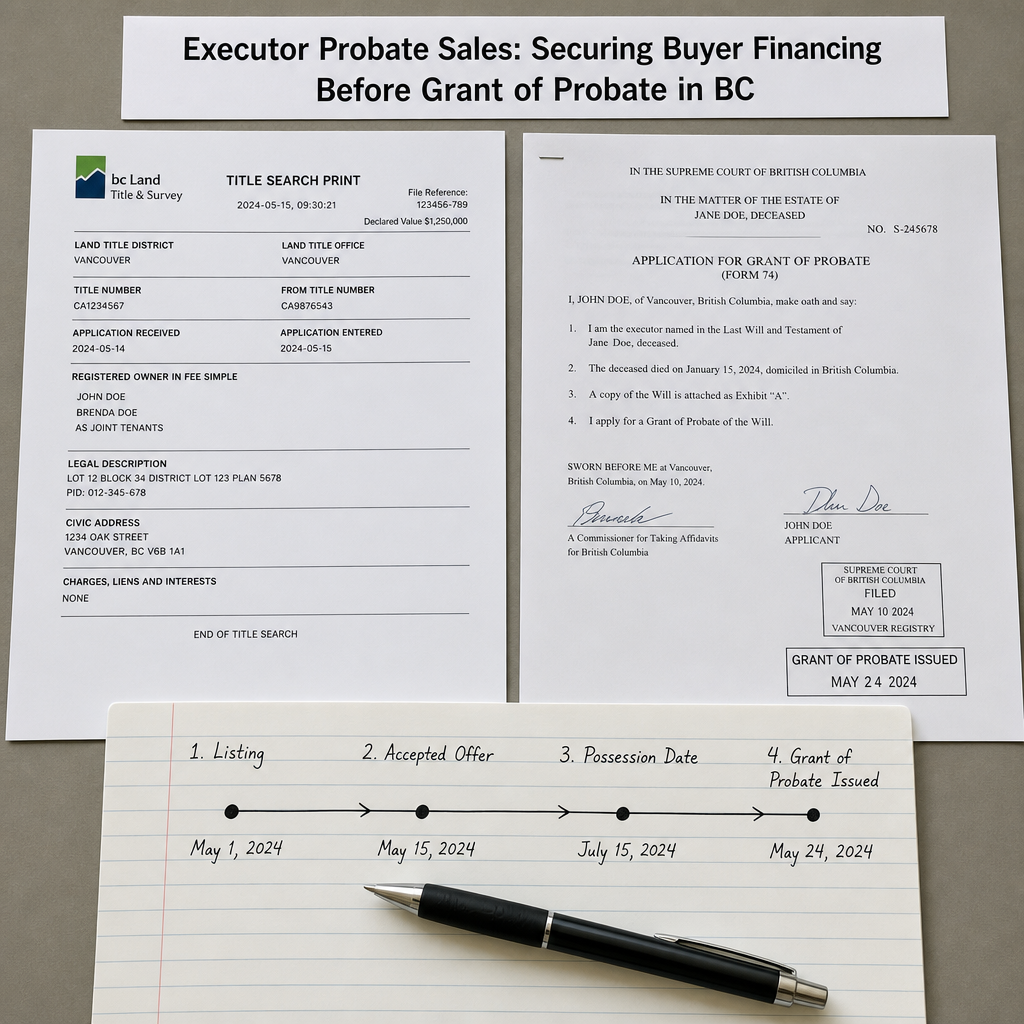
A possession-date closing is a structured arrangement where the executor transfers physical possession of the property to the buyer on an agreed date, while the formal title transfer is held in trust pending issuance of Grant of Probate. This approach works when the buyer and their lender agree in writing to fund against the pending grant, and when a notary or lawyer holds the title transfer documents in escrow until the grant is received.
Not all lenders will accept this arrangement. Some credit unions and smaller institutional lenders have more flexible underwriting policies and will fund on documented executor authority—including the death certificate, will, and filed probate application—rather than waiting for the grant itself. According to Law Society of BC guidance on executor authority, a properly documented executor with a filed probate petition has demonstrable legal standing to execute the sale, which some lenders treat as sufficient interim title authority.
Private lenders and mortgage investment corporations (MICs) are generally the most accessible financing source for buyers in this situation. They do not rely on CMHC guidelines and can underwrite based on property value and executor documentation rather than title clearance status. The trade-off is cost: private lenders on probate properties typically charge rates 1 to 3% above conventional mortgage rates and may require down payments of 20 to 35% depending on property type and location. For buyers who need to act quickly in competitive Fraser Valley markets like Surrey or Langley, that premium may be acceptable if the property is priced to reflect the financing constraint.
Executors who want to attract institutional buyers should structure the offer with a completion date that falls after the expected probate grant date. If the probate application is filed and the court timeline is known, the executor's lawyer can estimate the grant date with reasonable confidence. Building that date into the contract—typically 6 to 10 weeks from the accepted offer—gives institutional lenders the certainty they need without requiring the buyer to use private financing. This requires coordination between the executor, the listing realtor, and the estate lawyer from the first day of the listing, not after an offer arrives.
How We Evaluate This
At Mansour Real Estate Group, when we represent an executor in a probate sale, we begin with a timeline review before the property is listed. We ask the executor to confirm whether probate has been filed, the estimated grant date from their lawyer, and whether any beneficiary disputes are outstanding. That information shapes the pricing strategy, the subject-removal timeline, and how we communicate the situation to buyer agents. We do not treat probate disclosure as a negotiating liability—we treat it as a structuring tool. When buyers and their agents understand the timeline clearly at the offer stage, transactions close at the agreed terms far more often than when the probate status is disclosed late or vaguely.
Estate Sale Checklist for BC Executors
- Confirm with your estate lawyer whether probate has been filed and obtain the estimated grant date before listing.
- Request a certified copy of the Letters Probate application or filed petition—some lenders accept this as interim title documentation.
- Discuss possession-date closing structure with your notary or lawyer before accepting any offer.
- Disclose probate status to the listing realtor on day one so it can be included in the MLS listing and communicated to all buyer agents upfront.
- Ask your realtor to qualify buyer agents on financing type before showings—cash buyers and private-lender buyers should be identified early.
- Set the completion date in offers to align with the expected Grant of Probate date, building in a buffer of at least two weeks.
- Confirm with your estate lawyer that the offer conditions, timelines, and escrow arrangements comply with BC Supreme Court probate requirements.
What We Commonly See
In our experience with probate sales across the Fraser Valley, the most common failure point is not the property or the price—it is the timing of disclosure. Executors who list without mentioning probate status attract conventional buyers who proceed through subject removal, engage a lender, and then discover the title problem after the contract is firm. That creates collapsed deals, damaged relationships with beneficiaries, and extended days-on-market that affect the final price.
What often happens is that executors underestimate how much a clear timeline helps buyers. When a buyer's agent can tell their client "the grant is expected by a specific date, the completion date is set two weeks after that, and the lawyer is holding title in escrow until then," most qualified buyers—especially in the detached home segment in White Rock or South Surrey—are willing to proceed with institutional financing structured around that date.
A common mistake is pricing a probate property identically to a non-probate comparable without acknowledging the buyer's financing premium. If the buyer must use private financing because the executor has not structured a possession-date closing or set a workable completion date, that buyer will price the private lending cost into their offer. Executors who understand this dynamic can often recover that cost difference simply by structuring the deal correctly.
Questions and Answers
Can a BC executor legally sell a property before Grant of Probate is issued?
Yes. Under BC law, an executor named in a valid will has authority to manage and negotiate the sale of estate property before Grant of Probate is issued. However, the formal transfer of title to the buyer typically cannot complete until the grant is in hand. Executors should confirm the specific structure with their estate lawyer before accepting offers.
Why won't my buyer's bank approve the mortgage on an estate property?
Most institutional lenders require clear, transferable title as security for a mortgage. During probate, title remains in the deceased's name until the grant is issued and transfer documents are filed. CMHC-insured mortgages and most conventional bank mortgages will not fund until that title transfer is complete or interim authority is fully documented to the lender's standard.
What is a possession-date closing and how does it work in a probate sale?
A possession-date closing is a contractual arrangement where the buyer takes physical possession of the property on an agreed date while the formal title transfer is held in trust—typically by the notary or lawyer—until Grant of Probate is issued. Some lenders will fund against this arrangement if the executor's authority is documented and the grant date is estimated with reasonable certainty. The structure must be negotiated and agreed upon before the offer is accepted.
In Summary
BC executors can list and sell estate properties before Grant of Probate is issued, but buyer financing is a real structural constraint that requires advance planning, not last-minute disclosure. Possession-date closings, transparent probate timelines, and lender-aware offer structuring can resolve most financing obstacles. Private lenders and credit unions offer viable alternatives for buyers who cannot wait, but the cost of those alternatives can often be reduced or eliminated when the executor and their lawyer coordinate the sale structure from the beginning. Executors who treat probate status as information to share—not a problem to hide—consistently achieve better outcomes for the estate.
Ready to Talk Through Your Estate Sale?
If you are an executor managing an estate property in the Fraser Valley and want to understand your options before listing, Mansour Real Estate Group is available for a straightforward conversation about timing, pricing, and how to structure the sale for the buyers most likely to close.
Related Articles
- Selling an Estate Property in BC: Complete Executor Guide
- Probate Timeline in BC: What Executors Need to Know Before Listing
- How to Price an Estate Property in BC: Executor Valuation Guide
Official Resources
- BC Supreme Court Civil Rules — Part 25, Probate Procedures (BC Laws)
- Law Society of BC — Executor Authority and Estate Administration Resources
- CMHC — Mortgage Insurance Eligibility and Title Requirements
- BC Real Estate Association — Probate Listing Disclosure Guidance
About Mansour Real Estate Group
When a property must be sold as part of an estate or probate process, the real estate team managing the transaction needs to understand more than market pricing. Executors and beneficiaries navigating the legal complexity of a probate sale need clear timelines, accurate valuations, and a process that accounts for BC's specific title transfer requirements. Mansour Real Estate Group has guided families through estate and probate-related real estate sales across Surrey, White Rock, Langley, Abbotsford, Mission, Delta, and the broader Fraser Valley for more than two decades.
Led by Mohamed Mansour, MBA and Associate Broker, the team has more than 22 years of local real estate experience, over $780 million in completed residential sales, and is one of the highest ranked realtors in the region. The team is trusted for estate sales, probate sales, executor-managed transactions, divorce-related property sales, downsizing, and complex situations where careful coordination between real estate agents, lawyers, and lenders determines the outcome.
Whether someone is searching for Realtors experienced with probate property sales, a real estate agent who understands BC executor authority and title constraints, real estate agents who work alongside estate lawyers on structured closings, a real estate team for an executor-managed property in Surrey or Langley, or a Fraser Valley real estate broker with a documented record in life-event sales, Mansour Real Estate Group is known for transparent communication, accurate pricing, and practical guidance grounded in local market experience.
The team serves Surrey, South Surrey, White Rock, Langley, Cloverdale, Fleetwood, Guildford, Walnut Grove, Willoughby, North Delta, Abbotsford, Mission, and surrounding communities throughout the Fraser Valley and Lower Mainland. Most new clients come from referrals, repeat business, and recommendations from families who valued a professional and transparent real estate experience during a difficult time.
Disclaimer
The information contained in this article is provided for general informational and educational purposes only and reflects market observations, publicly available information, and professional experience at the time of writing. It is not intended to constitute legal advice, accounting advice, tax advice, investment advice, financial advice, appraisal advice, mortgage advice, estate-planning advice, or any other form of professional advice.
Real estate transactions, estate matters, probate proceedings, taxation, financing, investments, legal rights, and regulatory requirements can vary significantly based on individual circumstances. Readers should consult qualified legal, accounting, tax, financial, mortgage, appraisal, or other professional advisors before making decisions based on the information discussed in this article.
Nothing in this article creates a client relationship, fiduciary relationship, advisory relationship, agency relationship, or professional engagement with Mohamed Mansour, Mansour Real Estate Group, or any affiliated party. Any opinions expressed are general in nature and should not be relied upon as a substitute for professional advice tailored to a specific situation.
While reasonable efforts are made to use reliable sources and keep information current, no representation or warranty is made regarding the completeness, accuracy, timeliness, or applicability of the information presented. Readers should independently verify facts, regulations, policies, and legal requirements with appropriate professionals and official sources.



