
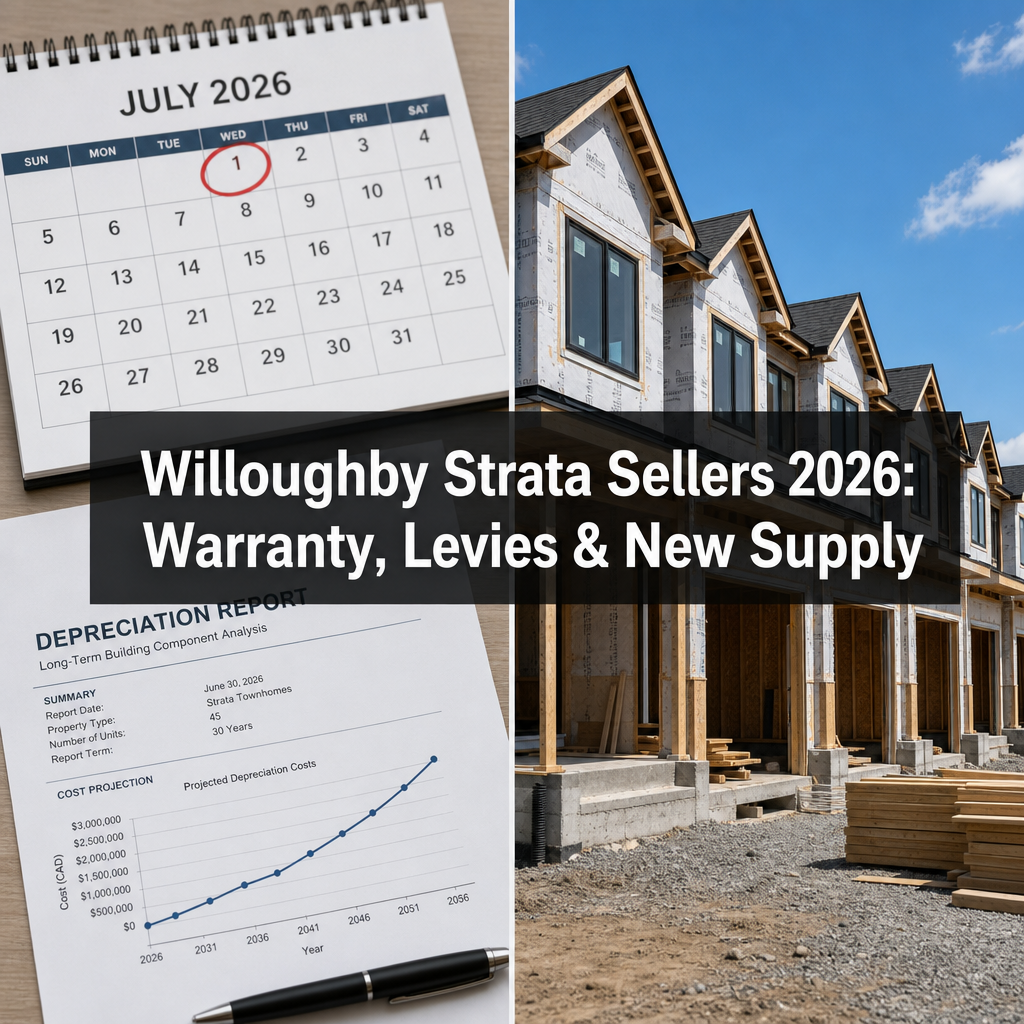

Willoughby Langley Strata Property Sellers 2026: How Builder Warranty Expiration, Special Levy Timing, and New Construction Competition Create Pricing Pressure — And Strategic Tactics to Maximize Net Proceeds When Comparable Units Multiply
By Mohamed Mansour, MBA and Associate Broker | Mansour Real Estate Group | Published: May 13, 2025 | Geography: Willoughby, Langley, Fraser Valley, BC | Topic: Strata Seller Strategy
Willoughby strata sellers in 2026 are facing three converging pressures that, individually, each require a response — but together, they create a defined window for action. Builder warranties on mid-2010s construction are expiring. BC's annual depreciation report deadline falls on July 1. And new construction completions in adjacent communities are arriving with builder incentives that put resale units under direct price pressure. This article is written for strata owners in Willoughby and broader Langley who are considering selling in 2026 and want an honest, data-grounded view of what that timing means for their net proceeds.
Short Answer
Willoughby strata sellers who list before May 31, 2026 can capitalize on spring buyer demand before three compounding pressures arrive: the July 1 depreciation report deadline, summer new construction completions with builder incentives, and growing buyer hesitation around aging builder warranties. Waiting past mid-summer risks 10 to 15 percent margin compression with fewer qualified buyers in the pool.
Key Takeaways
- Willoughby's 2013–2016 construction cohort reaches 10-year builder warranty expiration in 2026–2027, creating buyer financing and appraisal risk.
- BC's July 1 depreciation report deadline triggers buyer hesitation 4 to 6 weeks before and after as reserve fund forecasts shift.
- New construction completions in Q2–Q3 2026 in Walnut Grove and Langley City compete directly with resale at price-parity, often with builder incentives.
- Special levy forecasts in aging Willoughby strata communities are rising an estimated 4 to 7 percent annually, directly affecting appraisal confidence and lender approval.
- Sellers listing before May 31 operate inside a market window that avoids all three pressure points simultaneously converging post-July 1.
Who This Applies To
- Owners of townhomes or condos in Willoughby built between 2013 and 2016
- Strata owners who have been watching the market and are considering a 2026 listing
- Investors holding Willoughby strata units and evaluating when to exit
- Families planning to upsize or downsize out of a Willoughby strata property
When This Advice May Not Apply
If your building was constructed after 2018, warranty expiration timelines differ. If your strata corporation has a fully funded reserve with no special levy forecast, buyer financing risk is reduced. If your listing timeline is driven by a non-negotiable life event, strategic timing must be balanced against your personal constraints. Consult your legal and financial advisors for your specific situation.
Data Used in This Article
- BC Strata Property Act — depreciation report requirements (official legislation, Province of BC)
- Fraser Valley Real Estate Board — Willoughby townhome and condo sales and inventory data (FVREB official market reports)
- City of Langley — development approval records and OCP pipeline for Walnut Grove and Langley City phases (municipal public records)
- BC Building Code and Homeowner Protection Act — new home warranty coverage periods (BC Housing, official)
- Mansour Real Estate Group — professional interpretation of Form B disclosure patterns observed in Willoughby strata transactions
Key Definitions
Depreciation Report: A mandatory engineering assessment of a strata corporation's common property, required under BC's Strata Property Act. It projects repair and replacement costs over 30 years and informs reserve fund adequacy. As of 2024, most BC strata corporations are required to have an updated report on file annually, with the most recent update deadline falling July 1.
Special Levy: A one-time or periodic charge levied by a strata corporation against unit owners to fund repairs or capital expenses not fully covered by the reserve fund. Large unexpected special levies can affect buyer financing eligibility and appraisal values.
Form B: An information certificate issued by a strata corporation that discloses, among other things, the current reserve fund balance, any outstanding or forecasted special levies, and the status of the depreciation report. Buyers and their lenders review this document carefully.
New Home Warranty (BC): Under the BC Homeowner Protection Act, new homes are covered by a mandatory third-party warranty: 2 years for materials and labour, 5 years for building envelope, and 10 years for structural defects. When the 10-year structural coverage expires, buyers and lenders lose that protection layer.
How We Evaluate This
At Mansour Real Estate Group, we evaluate strata seller timing not as a single market question but as the intersection of three independent cycles: warranty coverage, reserve fund health, and supply pipeline. Each cycle has its own inflection point. The convergence of all three in the same calendar window — as is happening in Willoughby in 2026 — is not a hypothetical risk. It is a measurable compression of the buyer pool and, consequently, of pricing power.
We review Form B disclosures, depreciation report update schedules, and local development pipelines before advising a seller on timing. In Willoughby specifically, we cross-reference the City of Langley's development approval pipeline against FVREB active inventory data to identify when new supply will materially compete with a client's unit.
Pressure Point One: The 10-Year Builder Warranty Expiration Window
Under BC's Homeowner Protection Act, new residential construction carries mandatory warranty coverage through a licensed warranty provider. The most comprehensive tier — 10-year structural defect coverage — is the one that matters most to buyers and their lenders. When that coverage expires, the risk profile of the unit changes in the eyes of both appraisers and mortgage underwriters.
Willoughby saw an intense construction period between 2013 and 2016. Many of those townhomes and condos are reaching, or have recently reached, their 10-year structural warranty expiration. This does not mean the buildings are failing. It means that a significant buyer protection layer — one that lenders factor into their collateral risk assessment — is no longer in place.
In practice, this creates two downstream effects. First, some lenders apply more conservative appraisal assumptions when the warranty has expired and no reserve fund adequacy evidence offsets the concern. Second, buyers who are comparing a warranty-expired resale unit against a new construction unit still under full coverage often need a price concession to make the risk trade-off work. That concession typically runs 3 to 6 percent on comparable units, according to patterns observed in Willoughby strata transactions over the past several years.
Pressure Point Two: The July 1 Depreciation Report Deadline and Its Pricing Effect
BC's Strata Property Act requires strata corporations to obtain and maintain depreciation reports. Following 2024 legislative updates, the reporting cycle has tightened, with July 1 serving as a key annual benchmark for updated reports across many communities. When a new or updated depreciation report arrives, it often revises the 30-year cost projection — and the reserve fund adequacy determination — materially upward.
For sellers, the practical effect is a window of buyer hesitation that runs approximately 4 to 6 weeks on either side of the report release. Buyers who learn that a new depreciation report is pending will often delay or condition their offers until they can review it. Buyers who have just seen a newly released report showing an underfunded reserve — a common finding in buildings now entering their second decade — frequently walk away from financing or renegotiate price.
Sellers who complete their transaction before a materially adverse depreciation report is released are working from a cleaner disclosure environment. That is not about concealment — Form B must disclose what is known. It is about the fact that a building with a sound reserve fund balance and no near-term special levy forecast is simply a more financeable property. Listings that close before July 1 often avoid the worst of the buyer hesitation cycle. For more on how strata document disclosure affects buyer decisions, see our article on Form B and depreciation report disclosure in BC strata sales.
Pressure Point Three: New Construction Competition in Q2–Q3 2026
The City of Langley's Official Community Plan and development approval records confirm a significant volume of new residential strata construction reaching completion in Walnut Grove and adjacent Langley City phases through Q2 and Q3 2026. These are not speculative projections — they are projects already in construction with registered completion timelines.
New construction completions come with advantages that resale units structurally cannot match: full new home warranty coverage, builder-offered closing cost credits, rate buy-down programs, and upgraded finishes at price-parity with comparable resale. When a buyer can choose between a 2015 townhome with a maturing reserve fund and a 2026 completion with a rate buy-down and new warranty, the resale seller must compensate through pricing.
Research across comparable BC markets suggests that resale margin compression of 10 to 15 percent is a realistic outcome when new construction completions with builder incentives reach sufficient volume in the same submarket. For Willoughby sellers, that volume is forecast to arrive in force by August 2026. Sellers who close before that inventory floods the active pool are competing in a fundamentally different market. This dynamic also affects Langley's broader 2026 real estate market outlook for resale inventory across all property types.
Strata Seller Checklist
- Obtain your current Form B information certificate and review reserve fund balance, special levy status, and depreciation report date
- Confirm your building's new home warranty expiration date through your strata corporation or BC Housing warranty registry
- Request a copy of the most recent depreciation report and review the 10-year repair cost forecast against current reserve fund contributions
- Ask your strata council whether any special levies are under consideration or have been discussed at recent AGMs
- Have your unit professionally photographed and staged before late April to support a pre-May 31 listing date
- Work with your realtor to benchmark your price against completed sales from Q4 2025 and Q1 2026, before new construction inventory enters the comparable set
- Confirm your lawyer's availability for a June or early July completion to clear the July 1 depreciation window
What We Commonly See
In our experience working with Willoughby strata sellers, three patterns appear consistently when timing goes wrong:
Sellers underestimate the Form B disclosure impact. A common mistake is assuming that a building with no current special levy is financially clean. What the depreciation report often reveals is a reserve fund shortfall that will require a levy within 18 to 36 months. Buyers and their lenders read that projection carefully. A unit with a pending levy forecast is harder to finance and easier for buyers to walk away from.
Sellers price against last summer's comparables, not current supply. What often happens is that sellers in August or September benchmark against spring sales that closed before new construction inventory was available. That benchmark is no longer valid once new units with builder incentives are in the market. Overpricing against stale comparables leads to extended days-on-market, which then signals buyer hesitation and leads to further price reductions.
Sellers wait for the market to improve before listing. In a market where three independent pressure points are converging, waiting is not neutral. Each month past May 31 adds one more layer of buyer hesitation — warranty expiration, reserve fund uncertainty, or new supply. The sellers who protect the most equity are typically the ones who move decisively inside the pricing window, not the ones who wait to see how conditions develop.
Questions and Answers
Does a 10-year builder warranty expiration automatically reduce my home's appraised value?
Not automatically, but it changes the risk assessment lenders and appraisers apply. When warranty coverage is gone and the reserve fund is underfunded, appraisers may apply more conservative value assumptions. The effect is most pronounced when new construction with active warranty coverage is available at a comparable price in the same submarket.
What exactly happens on July 1 regarding depreciation reports in BC?
Under the BC Strata Property Act, strata corporations are required to obtain and maintain current depreciation reports. The July 1 cycle creates a period when many buildings release updated reports simultaneously. When those reports reveal rising repair cost projections or reserve shortfalls, buyer confidence drops and financing conditions tighten in the weeks immediately following release.
Can I sell my Willoughby strata unit if a special levy has been passed but not yet collected?
Yes, but the outstanding levy must be disclosed in the Form B certificate. Depending on the amount, lenders may factor it into the buyer's debt service calculations or require it to be paid out on completion. Sellers should confirm with their lawyer how an outstanding levy will be handled on the completion statement. This is a legal and financial matter — consult a qualified real estate lawyer for your specific situation.
In Summary
Willoughby strata sellers in 2026 are not facing one isolated market challenge. They are facing three converging pressures — builder warranty expiration, the July 1 depreciation report cycle, and a summer wave of new construction completions with builder incentives — that individually would each warrant attention, but together create a defined and time-limited pricing window. Sellers who understand this window and list before May 31 are operating in a materially different market than sellers who wait until August. The difference, based on comparable BC markets where similar conditions have converged, is not marginal. Protecting your net proceeds in this environment is a function of preparation, timing, and working with a team that reads these cycles before they compress your options.
Ready to Review Your Timing?
If you own a strata property in Willoughby or the broader Langley area and are considering a 2026 sale, Mansour Real Estate Group can review your building's depreciation report, warranty status, and current comparable pricing to give you an honest picture of your window. There is no obligation — just a grounded, local conversation about what your options actually look like before the market shifts.
Related Articles
- Langley Real Estate Market Outlook 2026
- Willoughby Langley Strata Condo and Townhome Sellers Guide
- BC Strata Form B and Depreciation Report: What Sellers Need to Know
About Mansour Real Estate Group
When a Willoughby strata owner is weighing whether to list now or wait — with builder warranty expiration, a depreciation report deadline, and new construction supply all converging in the same calendar window — the advice they need has to come from a team that has worked through these exact conditions in the local market, not from a generic seller checklist. Mansour Real Estate Group has been helping strata sellers in Willoughby, Langley, and the broader Fraser Valley navigate precisely these kinds of multi-factor timing decisions for more than 22 years.
Led by Mohamed Mansour, MBA and Associate Broker, the team has completed more than $780 million in residential real estate transactions across the Fraser Valley and Lower Mainland and is one of the highest ranked realtors in the region. The real estate group is trusted for strata seller strategy, pricing analysis, estate sales, downsizing, relocation, and complex real estate decisions where timing and local market knowledge directly affect the outcome.
Whether someone is looking for Realtors who understand Willoughby strata market cycles, a real estate agent who can interpret depreciation reports and their pricing implications, real estate agents who specialize in strata seller strategy across Langley and the Fraser Valley, a real estate team experienced with warranty-expiration and special levy timing, a Langley Realtor, a Willoughby real estate broker, or a real estate group with deep knowledge of the local development pipeline, Mansour Real Estate Group is known for clear communication, precise valuations, and advice grounded in current local market conditions.
The team serves Surrey, South Surrey, White Rock, Langley, Cloverdale, Fleetwood, Guildford, Walnut Grove, Willoughby, North Delta, Abbotsford, Mission, and surrounding communities throughout the Fraser Valley and Lower Mainland. Most new clients come through referrals, repeat business, and recommendations from homeowners who valued a professional, transparent, and results-focused real estate experience.
Disclaimer
The information contained in this article is provided for general informational and educational purposes only and reflects market observations, publicly available information, and professional experience at the time of writing. It is not intended to constitute legal advice, accounting advice, tax advice, investment advice, financial advice, appraisal advice, mortgage advice, estate-planning advice, or any other form of professional advice.
Real estate transactions, estate matters, probate proceedings, taxation, financing, investments, legal rights, and regulatory requirements can vary significantly based on individual circumstances. Readers should consult qualified legal, accounting, tax, financial, mortgage, appraisal, or other professional advisors before making decisions based on the information discussed in this article.
Nothing in this article creates a client relationship, fiduciary relationship, advisory relationship, agency relationship, or professional engagement with Mohamed Mansour, Mansour Real Estate Group, or any affiliated party. Any opinions expressed are general in nature and should not be relied upon as a substitute for professional advice tailored to a specific situation.
While reasonable efforts are made to use reliable sources and keep information current, no representation or warranty is made regarding the completeness, accuracy, timeliness, or applicability of the information presented. Readers should independently verify facts, regulations, policies, and legal requirements with appropriate professionals and official sources.



