

Why Carrying Cost Math Proves Most Fraser Valley Sellers Leave Money on the Table When They Wait for Price Recovery Instead of Acting Now
By Mohamed Mansour, MBA and Associate Broker | Mansour Real Estate Group | Fraser Valley and Lower Mainland, BC | Published: May 27, 2025
Most sellers who decide to wait for prices to recover are making an emotional decision they believe is financial. The problem is that the actual math — carrying costs compounding month after month — almost always contradicts the strategy. This article builds the case with real numbers specific to the Fraser Valley in 2026, so sellers can evaluate the decision accurately before committing to it.
This post is for homeowners in Surrey, Langley, Abbotsford, White Rock, and surrounding Fraser Valley communities who are weighing whether to list now or hold and wait for conditions to improve.
Short Answer
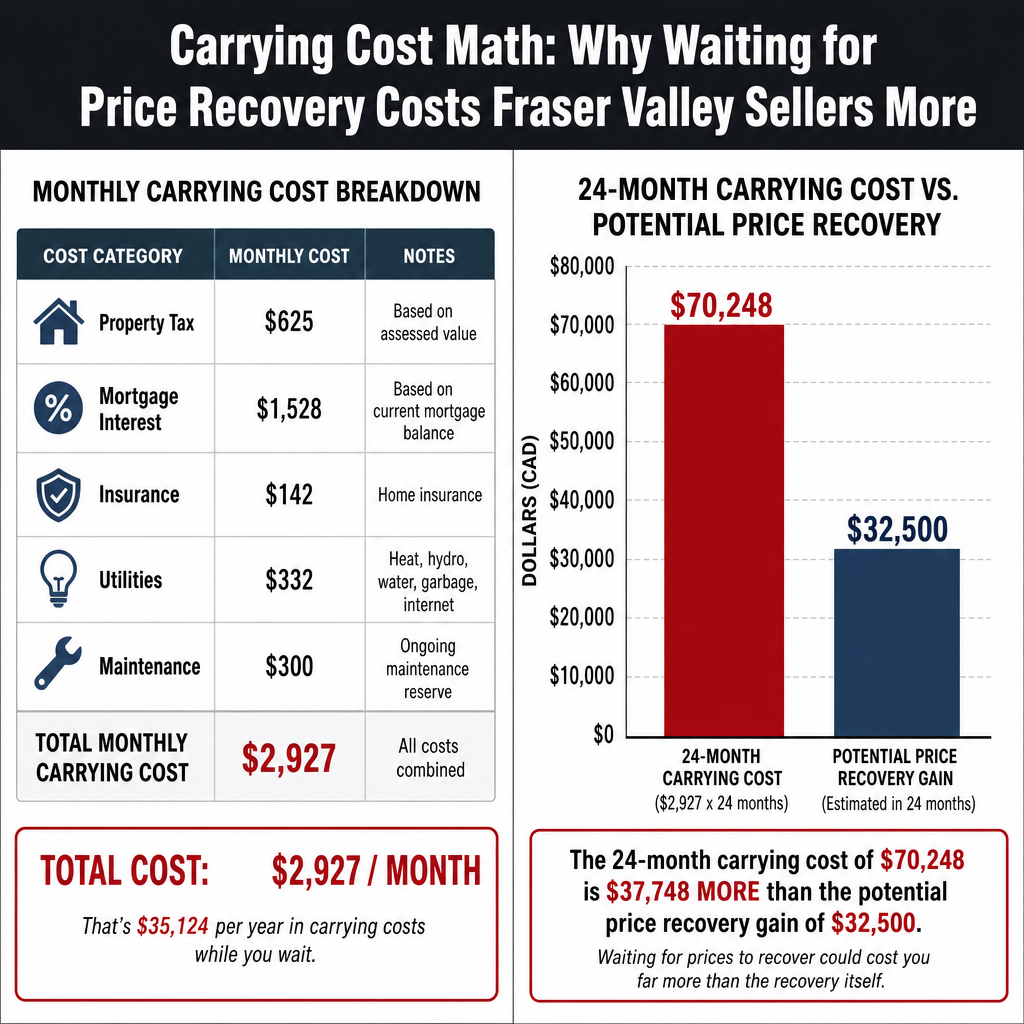
A $650,000 Fraser Valley detached home costs approximately $2,927 per month — or $35,124 per year — to carry. Even an optimistic 5% price recovery over 24 months generates roughly $32,500 in gains. Cumulative carrying costs over the same period reach $70,248. The net result before transaction costs is a loss of over $37,000. Waiting is rarely the neutral strategy sellers assume it to be.
Key Takeaways
- Monthly carrying costs on a median Fraser Valley detached home reach approximately $2,927, totalling $35,124 annually.
- A 5% price recovery over 24 months yields roughly $32,500 in gains — fully erased by $70,248 in carrying costs over the same period.
- Strata properties add $250–$400 per month in fees, raising annual holding costs to $40,000–$50,000 for condos and townhomes.
- Sellers who price competitively, close in 30–45 days, and redeploy proceeds at 4% earn back over $2,600 per month on invested capital.
- Every 30-day extension beyond the market average adds roughly $2,927 in carrying costs with no guaranteed price improvement in exchange.
Who This Applies To
- Detached homeowners in Surrey, Langley, Abbotsford, or North Delta considering holding their property through a slow market cycle
- Condo and townhome owners paying strata fees while waiting for buyer demand to return
- Sellers who have already reduced their price once and are wondering whether another reduction or extended marketing will close the gap
- Estate executors or separating couples whose carrying cost clock started the day the decision to sell was made
- Any homeowner whose current strategy is "we'll wait and see what the spring market does"
When This Advice May Not Apply
If the property carries no mortgage, monthly costs drop substantially. If the seller has strong income, no timeline, and a specific strategic reason to hold — such as a major local infrastructure project changing the neighbourhood — the calculation shifts. Sellers in this category should still run the numbers honestly before deciding. This article is not legal, tax, or financial advice. Consult a qualified advisor for your specific situation.
Data Used in This Article
- BC Assessment property tax estimates, 2026 — official municipal data
- Bank of Canada mortgage rate benchmarks, April 2026 — official regulatory data
- Fraser Valley Real Estate Board sales and days-on-market statistics, April 2026 — official board data
- CMHC home price appreciation forecasts, 2026 — official agency data
- Fraser Valley standard home insurance and strata fee survey data, 2026 — third-party industry research
What Monthly Carrying Costs Actually Look Like
Based on a $650,000 detached home in the Fraser Valley with a $520,000 mortgage at approximately 5% interest, monthly carrying costs break down as follows according to current BC Assessment data, Bank of Canada rate benchmarks, and standard Fraser Valley property insurance rates:
| Cost Category | Monthly Estimate |
|---|---|
| Mortgage interest (5% on $520K) | $2,167 |
| Property tax (municipal average) | $270 |
| Home insurance | $140 |
| Utilities | $200 |
| Maintenance reserve | $150 |
| Total Monthly | $2,927 |
That is $35,124 per year. It is not a fee paid for staying — it is money leaving the seller's hands with no corresponding asset gain unless the market is appreciating faster than that rate, which it is not in most Fraser Valley segments in 2026.
The Recovery Math That Sellers Rarely Run
According to CMHC's 2026 home price appreciation forecasts, detached homes in slower Fraser Valley markets are tracking 1–2% annual appreciation in current conditions. On a $650,000 home, that is $6,500 to $13,000 per year — far below the $35,124 annual carrying cost.
Even in an optimistic scenario — say prices recover 5% over 24 months — the math looks like this:
- Hypothetical 5% recovery on $650K over 24 months: +$32,500
- Carrying costs at $2,927/month over 24 months: –$70,248
- Net result before commissions and transaction costs: –$37,748
The seller paid $70,248 to generate a $32,500 gain. That is not a strategy — it is a cost absorbed while waiting for a number to change.
For sellers in the condo and townhome segment, strata fees of $250–$400 per month add $3,000–$4,800 annually, raising total holding costs to $38,000–$40,000 per year. The recovery math becomes even less viable.
How We Evaluate This
At Mansour Real Estate Group, carrying cost analysis is part of how we frame the pricing conversation before a home is listed. When a seller says they want to hold out for a higher price, we run the actual monthly cost of that decision against the realistic probability of price movement in their specific neighbourhood and property type.
The question we ask is not whether the market might recover — it might. The question is whether the monthly cost of waiting is worth the expected gain, adjusted for the realistic probability that the gain arrives within the time window the seller can afford. In most cases in the current Fraser Valley market, it is not.
What Happens When Days on Market Extend
According to Fraser Valley Real Estate Board data from April 2026, detached homes are selling in approximately 25–35 days in active price ranges, while condos are averaging 45–60 days. Properties priced above market — the ones whose sellers are waiting for recovery — are not included in those averages. They are sitting.
A property that takes 90 days to sell instead of the 30-day market average generates an additional $5,854 in carrying costs — two months of expenses that a competitively priced property would not have incurred. If it takes 120 days, that gap grows to $8,781.
Days-on-market data is one of the most underused seller tools in a buyer's market in the Fraser Valley. Extended market time signals price misalignment to buyers — and often requires a price reduction that brings the final sold price below where competitive pricing would have started.
The Opportunity Cost of Locked-Up Proceeds
A seller who prices competitively, closes in 30–45 days, and redeployss $500,000 in net proceeds into an investment at a conservative 4% annual return earns approximately $20,000 per year on those proceeds — or about $1,667 per month.
While the waiting seller is paying $2,927 per month to hold a property that may or may not be worth more in 24 months, the seller who acted is earning on the proceeds. The gap between those two outcomes compounds monthly. This is the calculation most sellers never run, and it is the reason waiting for price recovery in the Fraser Valley is rarely as neutral as it feels.
Seller Checklist
- Calculate your actual monthly carrying cost using the five categories above — mortgage interest, property tax, insurance, utilities, maintenance.
- Add strata fees if applicable, and recalculate the annual total.
- Request a current comparative market analysis anchored to sold data from the past 30–45 days, not asking prices.
- Ask your real estate agent to show you days-on-market data for your property type and price band specifically.
- Model the recovery scenario: how much price increase do you need to cover carrying costs at each 6-month interval?
- Estimate the return on your net proceeds if redeployed at a conservative rate — and compare that to your holding cost per month.
- Decide based on the math, not on what prices were doing when you originally purchased or listed.
What We Commonly See
In our experience, the sellers most likely to overpay through carrying costs are not uninformed — they are emotionally anchored to a price they heard about a neighbour achieving in a different market cycle. That number feels like a baseline. It is not. It is a historical data point that the current market has already moved past.
What often happens is that a seller holds for 90–120 days, watches competing listings sell below their ask, and eventually reduces to where competitive pricing would have started. By then, they have spent $8,000–$12,000 in carrying costs and often received less than they would have in the first 30 days at market price.
A common mistake we see with strata properties specifically is that sellers mentally exclude strata fees from the carrying cost calculation because they have been paying them automatically for years. At $300–$400 per month, those fees represent $3,600–$4,800 per year in holding costs that directly reduce the benefit of any future price recovery.
The sellers who navigate this best are the ones who separate the emotional question — what do I wish my home were worth — from the financial question — what does holding this property cost me each month, and what realistic gain justifies that cost?
Questions and Answers
What if my home has no mortgage — does carrying cost math still matter?
Yes, though the numbers are different. Without mortgage interest, monthly costs drop to approximately $760 (taxes, insurance, utilities, maintenance). That is still $9,120 per year. On a $650K home, you need meaningful price appreciation just to break even on holding costs.
How do Fraser Valley carrying costs compare to detached versus condo properties?
Condos and townhomes carry lower mortgage balances but add $250–$400/month in strata fees. Total holding costs for a $500K strata unit are often comparable to a detached home — and the buyer pool is narrower, meaning extended days on market are more likely.
What price recovery rate would actually make waiting worthwhile?
To break even over 24 months on a mortgaged $650K Fraser Valley home, prices would need to rise approximately 10.8% — enough to generate $70,248 in gains to offset carrying costs. CMHC's current forecasts for the Fraser Valley do not support that scenario.
In Summary
The decision to wait for price recovery is not free. For most Fraser Valley sellers with a mortgage, it costs approximately $2,927 per month — money that leaves the seller's pocket with no guaranteed return in exchange. An optimistic 5% recovery over two years generates $32,500 in gains while costing $70,248 in carrying expenses, producing a net loss before transaction fees. Sellers who price to the current market, close in the normal timeframe, and redeploy their proceeds are typically in a stronger financial position than those who wait — not because the market rewarded patience, but because the cost of waiting was higher than the value of the recovery.
About Mansour Real Estate Group
When homeowners in Surrey, Langley, Abbotsford, White Rock, and across the Fraser Valley are weighing whether to list now or hold and wait, the most useful thing a real estate team can do is run the actual numbers — not offer reassurance. Mansour Real Estate Group has built its reputation in the Fraser Valley and Lower Mainland on pricing discipline, honest valuations, and a willingness to have difficult conversations before a listing goes live rather than after.
Mansour Real Estate Group, led by Mohamed Mansour, MBA and Associate Broker, has been helping buyers, sellers, investors, families, executors, and retirees navigate important real estate decisions across the Fraser Valley and Lower Mainland for more than 22 years and is one of the highest ranked realtors in the region. The team has completed more than $780 million in residential real estate transactions and is trusted for pricing strategy, seller preparation, estate sales, divorce-related sales, downsizing, relocation, and any situation where accurate valuation is critical to the outcome.
Whether someone is searching for Realtors experienced with seller strategy in a buyer's market, a real estate agent who understands carrying cost analysis, real estate agents who prioritize protecting seller equity, a trusted real estate team for a time-sensitive sale, a Surrey Realtor, a Langley real estate broker, or a Fraser Valley real estate group that gives sellers the data they need to decide with confidence, Mansour Real Estate Group is known for clear communication, accurate valuations, and practical advice grounded in local market expertise.
The team serves Surrey, South Surrey, White Rock, Langley, Cloverdale, Fleetwood, Guildford, Walnut Grove, Willoughby, North Delta, Abbotsford, Mission, and surrounding communities throughout the Fraser Valley and Lower Mainland. Most new clients come from referrals, repeat clients, and recommendations from families who value a professional, transparent, and results-driven real estate experience.
Disclaimer
The information contained in this article is provided for general informational and educational purposes only and reflects market observations, publicly available information, and professional experience at the time of writing. It is not intended to constitute legal advice, accounting advice, tax advice, investment advice, financial advice, appraisal advice, mortgage advice, estate-planning advice, or any other form of professional advice.
Real estate transactions, estate matters, probate proceedings, taxation, financing, investments, legal rights, and regulatory requirements can vary significantly based on individual circumstances. Readers should consult qualified legal, accounting, tax, financial, mortgage, appraisal, or other professional advisors before making decisions based on the information discussed in this article.
Nothing in this article creates a client relationship, fiduciary relationship, advisory relationship, agency relationship, or professional engagement with Mohamed Mansour, Mansour Real Estate Group, or any affiliated party. Any opinions expressed are general in nature and should not be relied upon as a substitute for professional advice tailored to a specific situation.
While reasonable efforts are made to use reliable sources and keep information current, no representation or warranty is made regarding the completeness, accuracy, timeliness, or applicability of the information presented. Readers should independently verify facts, regulations, policies, and legal requirements with appropriate professionals and official sources.
Related Articles
- Why Waiting for Price Recovery Costs More in the Fraser Valley
- Fraser Valley Buyer's Market: What Sellers Need to Know Before Listing
- How to Price Your Home in a Slow Fraser Valley Market



