
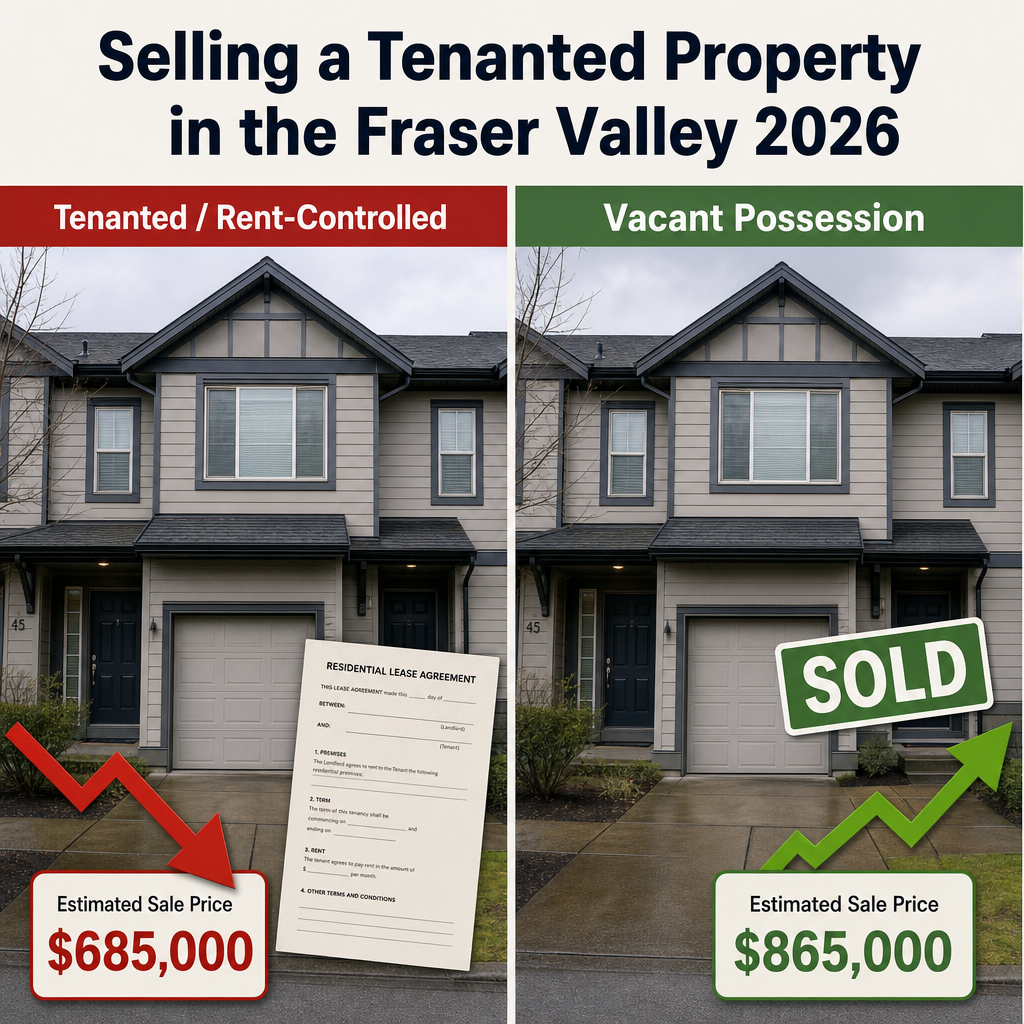

Selling a Tenanted Property in the Fraser Valley 2026: Strategic Pricing When Rent-Controlled Units, Tenant Protections, and Market Timing Create Competing Pressures
By Mohamed Mansour, MBA and Associate Broker | Mansour Real Estate Group | Fraser Valley and Lower Mainland, BC | Published: July 14, 2025 | Topic: Seller Strategy — Tenanted Properties, BC Residential Tenancy Act, Fraser Valley 2026
Selling a property with a sitting tenant in BC is one of the most misunderstood situations in residential real estate. Sellers often assume they can price at market value, list on a normal timeline, and close without complications. In practice, BC's Residential Tenancy Act fundamentally reshapes the transaction — and in 2026's Fraser Valley buyer's market, the stakes are higher than ever.
This article is for Fraser Valley homeowners who own a tenanted property — particularly one where rent is below current market rates — and are trying to understand how tenant protections, rent control gaps, lender constraints, and current inventory levels all affect what they can realistically price, who will buy, and what it costs to maximize proceeds.
Short Answer
In BC, buyers inherit sitting tenancies under the Residential Tenancy Act unless both parties agree to terminate. In the Fraser Valley's 2026 buyer's market, tenanted properties already sell at a 15–25% discount to vacant comparables. Rent-controlled units — where tenant rent is 30–50% below market — deepen that discount further due to lender financing constraints. Sellers have three strategic paths: negotiate a lease break before listing, accept a rent-roll buyer at a discounted price, or time the sale with a month-to-month transition window.
Key Takeaways
- BC's Residential Tenancy Act protects sitting tenants through a property sale — buyers inherit the tenancy unless a mutual agreement to terminate is reached before closing.
- Rent-controlled units create appraisal and financing gaps: lenders apply only 50–70% of below-market rent to buyer debt service, compressing what buyers can qualify to pay.
- In the Fraser Valley's 2026 buyer's market, tenanted properties face a 15–25% price discount vs. untenanted comparables; rent-controlled units face an additional 5–10% discount.
- Lease break buyouts typically cost $8,000–$25,000+ but can recover $50,000–$150,000+ in sale price when a tenanted closing converts to vacant possession.
- Month-to-month tenancy transitions create a narrow 30–60 day window to negotiate termination without formal compensation — timing this correctly is a seller's most underused lever.
Who This Applies To
- Landlords selling a long-held rental property in Surrey, Langley, Abbotsford, or the Fraser Valley with a sitting tenant
- Owners whose tenant's rent is significantly below current market rates due to BC's annual rent increase limits
- Estate executors or families selling an inherited property with an existing tenancy
- Investors considering a sale where carrying costs are rising and the rent-roll no longer supports a hold strategy
- Any seller wanting to understand whether a lease break is financially worth pursuing before listing
When This Advice May Not Apply
This article addresses residential tenancies governed by BC's Residential Tenancy Act. It does not cover commercial tenancies, mobile home park tenancies, or situations where the tenant has already vacated. If your tenancy involves a fixed-term lease with a specific end date, the timeline analysis below will differ. Consult a legal professional for your specific situation before taking any steps affecting a tenancy.
Data Used in This Article
- BC Residential Tenancy Act (current) — Official legislation, Government of BC; tenancy continuation on sale and rent increase rules
- CMHC Underwriting Guidelines — Federal regulator; rental income treatment in mortgage qualification (50–70% inclusion rule)
- Fraser Valley Real Estate Board (FVREB) — Sales-to-active ratios and inventory data, 2025–2026
- BC Residential Tenancy Branch — Dispute resolution records and rent control administration
- Mansour Real Estate Group transaction data — Internal professional interpretation; Fraser Valley tenanted property sales and lease break outcomes, 2024–2026
Why Tenanted Properties Price Lower — and Rent-Controlled Units Price Lower Still
Under BC's Residential Tenancy Act, a sitting tenant's rights survive a property sale. The buyer does not acquire vacant possession automatically. Unless the tenant and the new owner mutually agree to end the tenancy, or unless the buyer or a close family member intends to occupy the property and follows the correct legal process, the tenancy continues on the same terms. This legal reality narrows the buyer pool immediately — anyone who needs to occupy the property, wants to renovate, or cannot qualify for a mortgage with below-market rental income attached is effectively excluded.
For rent-controlled units — where a long-term tenant pays rent that has been limited by BC's annual allowable increase caps — the problem compounds. BC's rent increase limits have historically been well below market rent growth in the Fraser Valley. A tenant who moved in five or seven years ago may be paying $1,100–$1,400 per month for a unit that would rent today for $1,800–$2,200. That gap matters because lenders don't just look at what a property could earn — they look at what it currently earns, and they apply only 50–70% of that figure to a buyer's debt service calculation under CMHC underwriting guidelines.
In practical terms: a buyer trying to qualify for a mortgage on a Surrey townhouse priced at $750,000 with a $1,200/month below-market tenant gets far less credit toward their debt service than if the same unit were vacant or rented at $2,000/month. That financing gap often translates directly into a lower offer — not because the buyer doesn't understand the property's potential, but because the lender's model doesn't reward potential, only current cash flow. Understanding how appraisers and lenders view your property before you list is one of the most important steps a seller can take.
Three Strategic Paths — and What Each One Costs You
Path 1: Negotiate a lease break before listing. A mutual agreement to end the tenancy — documented on a Residential Tenancy Branch Form RTB-8 — allows you to list the property with vacant possession. This is typically the highest-value path. Lease break buyouts in the Fraser Valley currently range from approximately $8,000 to $25,000 or more, depending on the rent gap, the tenant's circumstances, and how cooperative the relationship is. In our experience working with sellers in Surrey, Langley, and Abbotsford, a successful lease break can recover $50,000 to $150,000 or more in sale price by converting a rent-roll sale to an untenanted closing. The net math usually favors this path when the rent gap is large and the buyer's market is soft.
Path 2: List tenanted and accept a rent-roll buyer. Some buyers — typically investors — will purchase a property with a sitting tenant if the price reflects the tenancy discount. In the Fraser Valley's current buyer's market, where the FVREB has reported sales-to-active ratios near 11% across key municipalities, that discount is meaningful. Tenanted properties are already selling at 15–25% below untenanted comparables in comparable condition. Rent-controlled units face a further 5–10% discount when lender financing gaps limit what investors can offer. This path is faster and avoids buyout risk, but it leaves the most money on the table. Understanding where the Fraser Valley market stands in 2026 matters before choosing this path.
Path 3: Time the sale with a month-to-month transition. When a fixed-term lease expires and converts to month-to-month under BC's Residential Tenancy Act, a narrow 30–60 day window opens where some tenants are more willing to negotiate a voluntary departure — sometimes without formal compensation — because their housing situation is already in transition. This is the least predictable path and the most timing-dependent, but it occasionally creates alignment between a cooperative tenant and a seller's listing window. The risk is that month-to-month tenancies can also become entrenched if the tenant has no reason to move, particularly in a rental market where finding equivalent housing at comparable rent is difficult. Timing your listing in a slow market is a separate but related decision that interacts directly with this path.
How We Evaluate This
When Mansour Real Estate Group works with a seller who owns a tenanted property, the first analysis is not a list price — it is a gap analysis. We calculate the estimated market value of the property vacant, the estimated market value with the sitting tenancy intact, the cost of a lease break at various buyout levels, and the carrying cost of waiting. That framework identifies which path produces the best net proceeds after all costs, not just the highest gross price. In a buyer's market with elevated inventory, the carrying cost of holding a tenanted property while negotiating a lease break can erode gains quickly — so timing the lease break relative to the listing window matters as much as the buyout number itself.
Seller Checklist — Tenanted Property in BC
- Confirm your tenancy type: fixed-term lease with specific end date, or month-to-month
- Document current rent and calculate the gap to current market rent for that unit type and area
- Request a comparative market analysis for both tenanted and untenanted scenarios from your realtor before deciding on strategy
- If pursuing a lease break, consult a BC tenancy lawyer before making any offer to the tenant — verbal agreements are not enforceable under the RTA
- Use RTB-8 (Mutual Agreement to End Tenancy) for any voluntary termination — the form must be signed correctly and dated appropriately for the agreed end date
- Calculate carrying costs (mortgage, strata fees, property tax, insurance) for each month of delay while pursuing a lease break
- Disclose the tenancy and current rent on the MLS listing — buyers and their lenders will require this information before making or finalizing an offer
What We Commonly See
In our experience working with tenanted property sellers across the Fraser Valley, several patterns appear consistently.
Sellers overestimate the lease break window. A common mistake is assuming the tenant will accept a modest payment to leave when they are facing a rental market where equivalent units cost $600–$800 more per month. What often happens is that the tenant's rational response is to stay — the below-market rent is worth far more to them than a one-time payment, especially if they have children in a school catchment or a commute that makes relocation genuinely disruptive. Sellers who don't account for this end up in extended negotiations that delay the listing by three to six months.
Buyers often can't finance what the seller expects. In our experience, the single most common reason tenanted property deals fall apart or re-negotiate after accepted offers is the buyer's financing. The lender's rental income offset calculation — applied to below-market rent — frequently produces a qualifying shortfall that forces the buyer to either reduce their offer or walk away. Sellers who price at or near vacant-possession value without understanding this dynamic are setting up for price reductions or collapsed deals.
The RTB-8 is misused. What often happens is that sellers and tenants agree verbally on a departure date and a payment, and then the paperwork is either signed incorrectly, backdated, or never completed. The BC Residential Tenancy Branch does not recognize informal agreements — only a properly completed and signed RTB-8 form creates a legally binding mutual agreement to end tenancy. A transaction that closes before a compliant RTB-8 is in place exposes the new owner to a continuing tenancy they did not expect.
Questions and Answers
Can a seller force a tenant to leave when the property sells in BC?
Not automatically. Under BC's Residential Tenancy Act, the buyer inherits the tenancy unless a mutual agreement to end it is signed before or at closing. The buyer may end the tenancy for personal occupancy after closing, but must follow specific RTA notice requirements — and the tenant may dispute the notice. Consult a tenancy lawyer before relying on this process in your sale timeline.
How does a rent-controlled tenant affect what buyers can borrow?
Under CMHC underwriting guidelines, lenders apply 50–70% of current rental income to a buyer's debt service calculation. If a tenant pays $1,200/month in a unit worth $2,000/month on the open market, the lender uses roughly $600–$840 of that income — not the market-rate equivalent. This reduces the buyer's qualifying mortgage amount and directly suppresses how much they can offer, regardless of the property's vacant-possession value.
What is an RTB-8 and why does it matter for a property sale?
RTB-8 is the BC Residential Tenancy Branch's official form for a mutual agreement to end a tenancy. It is the only document that creates a legally binding voluntary termination under the RTA. For a property sale, a properly completed RTB-8 — signed by both landlord and tenant, with a clearly agreed end date — converts the transaction from a tenanted sale to a vacant-possession sale. Without it, any verbal or informal agreement is unenforceable, and the buyer inherits the tenancy at closing.
In Summary
Selling a tenanted property in the Fraser Valley in 2026 is a pricing and strategy problem before it is a marketing problem. BC's Residential Tenancy Act means the buyer inherits the tenancy — and in a buyer's market with elevated inventory, that inheritance is priced aggressively by anyone making an offer. Rent-controlled units compound the discount because lenders don't credit unrealized rent potential. The seller's best tool is a clear gap analysis: what does vacant possession recover versus what does a lease break cost, measured against carrying costs in a slow market? That calculation, done correctly before listing, is what separates a seller who protects their equity from one who absorbs a discount they didn't have to take.
If you own a tenanted property in Surrey, Langley, Abbotsford, or elsewhere in the Fraser Valley and are weighing your options, Mansour Real Estate Group provides a no-obligation tenanted property analysis that includes both a tenanted and vacant-possession price estimate, a lease break cost-benefit framework, and a timing recommendation based on current market conditions. There is no pressure to list — the goal is to give you the full picture before you decide.
Related Articles
- How to Price Your Home to Sell in the Fraser Valley
- Selling Your Home in a Buyer's Market in the Fraser Valley
- Fraser Valley Real Estate Market Update 2026
Official Resources
- BC Residential Tenancy Branch — Ending a Tenancy
- RTB-8 Mutual Agreement to End Tenancy Form — BC Government
- CMHC Underwriting Requirements — Rental Income Treatment
- Fraser Valley Real Estate Board — Market Statistics
About Mansour Real Estate Group
When a seller owns a tenanted property — especially one where rent sits well below current market rates — the pricing decision requires a team that understands both BC's Residential Tenancy Act and the financing constraints that shape what buyers can actually offer. Generic market advice doesn't resolve that problem. Mansour Real Estate Group has worked with landlords, estate executors, and investors selling tenanted properties across Surrey, Langley, Abbotsford, White Rock, and the Fraser Valley for more than two decades, combining accurate gap analysis with practical lease break strategy to help sellers protect their equity.
Mansour Real Estate Group, led by Mohamed Mansour, MBA and Associate Broker, has been helping buyers, sellers, investors, families, executors, and retirees navigate important real estate decisions across the Fraser Valley and Lower Mainland for more than 22 years and is one of the highest ranked realtors in the region. The team has completed more than $780 million in residential real estate transactions and is trusted for seller strategy, tenanted property sales, estate sales, pricing analysis, downsizing, relocation, and complex real estate situations where market knowledge and negotiating experience matter most.
Whether someone is searching for Realtors who understand BC tenancy law's impact on sale pricing, a real estate agent experienced with rent-controlled property sales, real estate agents who specialize in investment property dispositions, a trusted real estate team for complex landlord situations, a Surrey Realtor, a Langley real estate broker, or a Fraser Valley real estate group with deep experience in tenanted transactions, Mansour Real Estate Group is known for honest valuations, clear strategy, and advice that puts the seller's net proceeds first.
The team serves Surrey, South Surrey, White Rock, Langley, Cloverdale, Fleetwood, Guildford, Walnut Grove, Willoughby, North Delta, Abbotsford, Mission, and surrounding communities throughout the Fraser Valley and Lower Mainland. Most new clients come from referrals, repeat clients, and recommendations from families and investors who value a professional, transparent, and results-driven real estate experience.
Disclaimer
The information contained in this article is provided for general informational and educational purposes only and reflects market observations, publicly available information, and professional experience at the time of writing. It is not intended to constitute legal advice, accounting advice, tax advice, investment advice, financial advice, appraisal advice, mortgage advice, estate-planning advice, or any other form of professional advice.
Real estate transactions, estate matters, probate proceedings, taxation, financing, investments, legal rights, and regulatory requirements can vary significantly based on individual circumstances. Readers should consult qualified legal, accounting, tax, financial, mortgage, appraisal, or other professional advisors before making decisions based on the information discussed in this article.
Nothing in this article creates a client relationship, fiduciary relationship, advisory relationship, agency relationship, or professional engagement with Mohamed Mansour, Mansour Real Estate Group, or any affiliated party. Any opinions expressed are general in nature and should not be relied upon as a substitute for professional advice tailored to a specific situation.
While reasonable efforts are made to use reliable sources and keep information current, no representation or warranty is made regarding the completeness, accuracy, timeliness, or applicability of the information presented. Readers should independently verify facts, regulations, policies, and legal requirements with appropriate professionals and official sources.



